
Authors of old Asiatic books claimed that ultimate truth was certainly discoverable
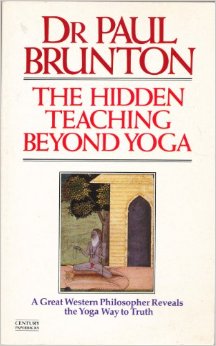
"I knew however that the forest thinkers of Asiaitic countries had leisurely pondered this problem long before the first city Greeks had begun to ponder it in Europe. Moreover there was this vital difference that whereas the Western thinkers usually claimed that nobody had discovered ultimate truth and that human limitations were so narrow that nobody was likely to discover it, the authors of old Asiatic books claimed that ultimate truth was certainly discoverable and that a few sages had definitely known it.'- Paul Brunton
"This need of wider intellectual enlightenment concerning both the nature of the world and its correct relation to the mystical view of man, in short, Truth in all its fullness, caused me to look around and consider where else it might be satisfied. I knew several of the answers of the West, knew too that they were often excellent as far as they went, but they did not go far enough... I knew something of the Western philosophies, admirably reasoned and laboriously worked out as they were, but their tremendous conflict of opinion largely cancelled out each other's value and left the student bewildered. I knew however that the forest thinkers of Asiaitic countries had leisurely pondered this problem long before the first city Greeks had begun to ponder it in Europe. Moreover there was this vital difference that whereas the Western thinkers usually claimed that nobody had discovered ultimate truth and that human limitations were so narrow that nobody was likely to discover it, the authors of old Asiatic books claimed that ultimate truth was certainly discoverable and that a few sages had definitely known it...
I felt therefore that if hope lay anywhere it lay in Asia, the continent where the world's most renowned religious, mystic and philosophical teachers from Jesus to Confucius had been born. It needed but slightly more consideration to narrow the search to India because I knew from wide study and personal travel that all the Asiatic lands, like Tibet, China, and Japan had directly or indirectly derived their philosophic knowledge, yoga systems and religious speculations from this single fountain-head.'
Paul Brunton, Ph.D., The Hidden Teaching Beyond Yoga,
E. P. Dutton & Co., Inc. (1966) p. 39-40.
Paul Brunton
From Wikipedia, the free encyclopedia
Paul Brunton (October 21, 1898 - July 27, 1981) was a British philosopher, mystic, traveler, and guru. He left a journalistic career to live among yogis, mystics, and holy men, and studied Eastern and Western esoteric teachings. Dedicating his life to an inward and spiritual quest, Brunton felt charged to communicate his experiences about what he had learned in the East to others. His works had a major influence on the spread of Eastern yoga and mysticism to the West. Taking pains to express his thoughts in layperson's terms, Brunton was able to present what he had learned from the Orient and from ancient tradition as a living wisdom. His writings express his view that meditation and the inward quest are not exclusively for monks and hermits, but will also support those living normal, active lives in the Western world.)
Biography
Paul Brunton was born in London in 1898 and after having served in the First World War, started to devote himself to mysticism. He came into contact with Theosophists. In the early 1930s, Brunton embarked on a voyage to India, which would bring him into contact with such luminaries as Meher Baba, Sri Shankaracharya of Kancheepuram and Sri Ramana Maharshi. Brunton has been credited with introducing Ramana Maharshi to the West through his books “A Search in Secret India" and "The Secret Path.'
One day -sitting with Ramana Maharishi- Brunton had an experience which Steve Taylor names"an experience of genuine enlightenment which changed him forever.' Brunton describes it in the following way:
"I find myself outside the rim of world consciousness. The planet which has so far harboured me disappears. I am in the midst of an ocean of blazing light. The latter, I feel rather than think, is the primeval stuff out of which worlds are created, the first state of matter. It stretches away into untellable infinite space, incredibly alive.'[1]
After two decades of successful writing, Brunton retired from publishing books and devoted himself to writing essays and notes. Upon his death in 1981 in Vevey, Switzerland, it was revealed that in the period since the last published book in 1952, he had rendered about 20,000 pages of philosophical writing.
A longtime friend of Paul Brunton, philosopher Anthony Damiani, coordinated the publishing effort together with a team of people including Paul Cash and Timothy Smith. The Swedish-American publisher Robert Larson started publishing the 16-volume set in 1984.
"Bring again and again into remembrance the fact that you are a pilgrim, that this world is but a camp, and that the situations in which you find yourself, or create for yourself, should be regarded not from the worldly point of view only, but still more from that of this quest of the Overself.' Paul Brunton
wwww.en.wikipedia.org/wiki/Paul_Brunton
Web (May 12, 2013)
[1] Jackson, Kevin: A Short History of Pyramidology
The Complete Idiot's
Guide To Hinduism
Inner ReligionGuide To Hinduism
One of the great ironies of religious history is that, although the religions that came out of the Near East—Judaism, Islam, Christianity—adamantly reject most of Hinduism's fundamental teachings, their mystical traditions—the Kaballah, Sufism, and Christian Gnosticism—reflect Hindu insights in almost every detail. Numerous students of comparative religion, from Muslim scholar Al Buruni in 1000 C.E. to the world famous writer Aldous Huxley nearer our own time, have expressed their amazement at the parallels between the major mystical traditions of the world and Hinduism...
Hinduism is by far the most complex religion in the world, shading under its enormous umbrella an incredibly diverse array of contrasting beliefs, practices, and denominations. Hinduism is by far the oldest major religion. It has had more than enough time to develop a diversity of opinions and approaches to spirituality unmatched in any other tradition.'
Linda Johnsen, The Complete Idiot's Guide to Hinduism,
Alpha; 1st edition (October 11, 2001) p. 77
Related Articles
Gnosis is mutual knowing and being known of and by God
The Gnostic Gospels: Self-knowledge is knowledge of God
The mystic makes contact with the god inside
Hinduism is about exploring the very depths of your own soul yourself
Authors of old Asiatic books claimed ultimate truth was discoverable
But if you do not know yourselves, then you dwell in poverty
The failure to attain direct experience of the truth
The real study, in religion, is first-hand experience of God.
For Lao Tze it is the Tao, in Jewish mysticism it is the Shekinah
Spiritual but not Religious
Disclaimer: Our material may be copied, printed and distributed by referring to this site. This site also contains copyrighted material the use of which has not always been specifically authorized by the copyright owner. We are making such material available to our readers under the education and research provisions of "fair use" in an effort to advance freedom of inquiry for a better understanding of religious, spiritual and inter-faith issues. The material on this site is distributed without profit. If you wish to use copyrighted material for purposes other than “fair use” you must request permission from the copyright owner.

