
"Feminine images cluster around the Spirit, as the Syriac word for spirit, ruha, is itself feminine.”
"An early stream of Aramaic-Syriac Christian tradition portrayed the
Spirit as feminine... In the Gospel of the Hebrews, the Holy Spirit is
seen as Christ's mother and also the power that transports him to the
mountain of his transfiguration. In this gospel, Christ says, 'Even
so did my mother, the Holy Spirit, take me by one of my hairs and
carry me away unto the great Mountain, Tabor.'
The most lush development of female images for the Spirit is found in
the second-century Syriac hymns the Odes of Solomon. The language of
these hymns is poetic, non philosophical, and explains a plurality of
images for the believer's transformed life through communion with the
divine. Feminine images cluster around the Spirit, as the Syriac word
for spirit, ruha, is itself feminine.”
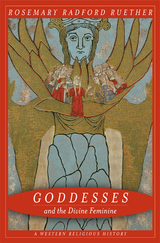
Goddesses and the Divine Feminine: A Western Religious History
By Rosemary Radford Ruether, University of California Press; 2006,
page 132
The Qur'n uses two terms Ruh-Allah and Ar-Ruh-Al-Qudus for the Spirit of God. Such is the case in the following references: "We gave unto Jesus, son of Mary, clear proofs [of Allah's sovereignty], and we supported him with the Holy Spirit [ar-Ruh-al Qudus]," (Surah 2, Al-Baqarah, The Cow: 87).
"When Allah saith: O Jesus, son of Mary! Remember My favour unto thee and unto thy mother; how I strengthened thee with the Holy Spirit [al- Ruh al-Qudus], so that the Scripture and Wisdom and the Torah and the Gospel ... and thou didst heal him who was born blind and the leper by My permission; and how thou didst raise the dead, by My permission" (Surah 5 Al-Ma'idah, The Table Spread: 110).
"Go, O my sons, and ascertain concerning Joseph and his brother, and despair not the Spirit of Allah [Ruh-Allah]" (Surah 12, Joseph: 87).
"Say (O Muhammad): The Holy Spirit hath revealed it (the Quran) from thy Lord with Truth, that it may confirm the faith of those who believe and as a guidance and Good Tidings (gospels) for those who have Surrendered (to Allah).” 16:102
"And thus have We inspired in thee (Muhammad) a Spirit of Our Command. Thou knowest not what the Scripture was nor what the Faith. But We have made it a light whereby We guide whom We will of Our bondmen. And lo! Thou verily dost guide unto a right path, the path of Allah, unto whom belongs whatsoever is in the heavens and whatsoever is in the earth. Do not all things reach Allah at last?” 42:52-53
"And lo! It (the Quran) is a revelation of the Lord of the Worlds which the True Spirit hath brought down upon thy heart, that thou mayest be one of the warners in plain Arabic speech.” 26:192-195
Note: The above quotations from the Qur'n make reference to God, to His Word, and to His Spirit. Ruh is Allah's own attribute given to human beings. The Quran doesn't say the ruh of man but Ruh of Allah. In Aramaic, Ruha d-Qudsha means "The spirit of holiness" (corresponding to Hebrew: Ruah ha-Qodes, and Arabic: ar-Ruh-al Qudus). For Jews, Muslims and Syriac-speaking Christians it signifies the Holy Spirit mentioned in both the Quran and the Bible.
For four hundred years the word Holy Spirit was ruha, a feminine word derived from the Hebrew ruach
"Christian Misogyny
Rooted in the Hebrew Scriptures and flourishing in a patriarchal culture, Christianity developed its own negative attitudes towards women and the old religion of the Goddess. At times subtle, at other times brutal, the movement was away from partnership and towards hierarchy, from feminine images of the Divine to strictly masculine ones. Despite Jesus' radical inclusion of women as friends and disciples and his refusal to treat them as second-rate, sinfully sexual, or stupid, his followers quickly established as orthodox an all-male priesthood, a masculine Trinity, and a theologically expressed aversion to women.
Thus Tertullian, a Christian theologian in the third century, described Eve as the gateway to the devil because, according to the Genesis myth, she first broke God's law and brought about the loss of original purity. He held her personally responsible for the death of Christ, and his general distrust and distaste of women was based on this rationale.
Origin, a theologian contemporary with Tertullian, wrote of the feminine and the corporeal as essentially one, and unworthy of God. He believed that God saw only the masculine and spiritual aspects of creation, since the Creator could surely not be expected to stoop so low as to regard the feminine and fleshy. St. Jerome, writing a century later, expressed this same equation of woman with sexuality and sin by reasoning that since Paul had written that it is well for a man not to touch a woman (1 Cor 7:1), then it must always be bad to touch a woman. Women were dangerously physical, inferior to men at best and destructive to the eternal souls at worst.
Virginity and celibacy therefore became elevated as spiritually more pure than marriage or sexual activity of any kind, and sexual sin was judged severely. Expressions of Christianity such as Gnosticism that gave women and men an equal place in the community, in liturgy, and in leadership, and that refereed to the Godhead as 'Mother' as well as 'Father' were suppressed as heretical, and their sacred writings were destroyed.
Where the Wisdom tradition was brought to bear on Christology, with Christ seen as the incarnation of God' eternal and universal wisdom, the feminine word Sophia was replaced by the masculine Logos. And in Syria, where for four hundred years the word Holy Spirit was ruha, a feminine word derived from the Hebrew ruach, and where the Holy Spirit was described as Mother, complementing the parental imagery of Father and Son in the Trinity, the association of feminine language with heresy led authors to assign masculine gender to the word— grammatical nonsense but evidence of the theological desire to defeminize the Divine.”
She changes everything: seeking the divine on a feminist path
Lucy Reid, pages 32-33
Continuum International Publishing Group Ltd. (2 Feb 2006)
"Rooted in the Hebrew Scriptures and flourishing in a patriarchal culture, Christianity developed its own negative attitudes towards women and the old religion of the Goddess. At times subtle, at other times brutal, the movement was away from partnership and towards hierarchy, from feminine images of the Divine to strictly masculine ones. Despite Jesus' radical inclusion of women as friends and disciples and his refusal to treat them as second-rate, sinfully sexual, or stupid, his followers quickly established as orthodox an all-male priesthood, a masculine Trinity, and a theologically expressed aversion to women...
And in Syria, where for four hundred years the word Holy Spirit was ruha, a feminine word derived from the Hebrew ruach, and where the Holy Spirit was described as Mother, complementing the parental imagery of Father and Son in the Trinity, the association of feminine language with heresy led authors to assign masculine gender to the word—grammatical nonsense but evidence of the theological desire to defeminize the Divine."
Lucy Reid, She Changes Everything
Continuum, 2005, pages 32-33
"Fortunately, contemporary feminist scholarship provides a way to resolve Jung's difficulties and simultaneously deepen his basic insights. The feminine Wisdom or Shekinah the Old Testament says was with God from the beginning, feminist scholars point out, functions like the Holy Spirit or Paraclete of the New Testament, shares its symbolism of the dove, and is specifically referred to as God's 'holy spirit from above' in Wisdom 9:17-18.
Neglecting the similarity of Wisdom to the Paraclete did not of course begin with Jung. It began with those early Christians who sought to give intellectual respectability to Hebraic-Christian myth by reformulating it in terms of Hellenistic philosophy. The actual denigration of Wisdom, however, commenced before Christianity with Philo-Judaeus and other Alexandrian thinkers who, bowing to the era's intellectual fashions, concluded that feminine attributes lessened God. God's dignity, these philosophers insisted, required him to be all male no less than all good and powerful.
Anxious to protect the masculinity of their God, the church fathers declined to meld the Judaic wisdom figure with its natural successor, the Paraclete, which would have made one member of the Godhead feminine."
James P. Driscoll, The unfolding God of Jung and Milton
University Press of Kentucky, 1992, p. 88
Shri Mataji: "Among Muslims there are Sufis who are realized souls"
“And even in Koran, Mohamed Sahab says that all the Heavens lie at the lotus feet of The Mother.
Among them, among Muslims there are Sufis who are realized souls and also accepted in the society. The other day I met somebody in Paris, a very high person in the Islamic world and he accepted Sahaja Yoga. He said it is described in Koran that there has to be Qiyamah, the Resurrection - we believe in Resurrection.
Also it is for Christians or Hindus, everybody, they have to be resurrected to a higher state.
It is just for money and power are some people who are trying to mislead others, keeping them away from Resurrection. I must say they are committing the greatest sin against the Holy Ghost.”
The Paraclete Shri Mataji
July 1, 1993
Ayatollah Dr. Mehdi Rouhani
Royal Albert Hall, UK — July 3, 1997
"If we consider the most ancient evidence left by homo sapiens, we can see that man has always been aware of the existence of a Supreme Being, who is Lord of all things and of all living creatures.
Using every conceivable means, human beings of every era have always tried to show their feelings of deep respect (and reverence) towards God and to perform what is due to their Creator.
This is why Islam has always stressed the possibility of direct communication with God. Even those who have fallen into idolatry have never denied the existence of the Creator, but have simply put their idols and images in His place. And this is still happening today. This being the case, how can we recognise a true prophet and what is his or her mission?
The mission of the prophets is to reveal the will of God, that is, to provide a logical and tangible explanation of religion as it is experienced in our daily lives.
Genuine monotheism - the belief in a Supreme Being - means (or implies) the unshakeable oneness of the whole creation between man and God. Monotheism proves then, the pointlessness of idols and of images that come between man and God. The mission of the prophets is thus to set human beings on the right track, and in order to do this, the prophets have used two parallel and complementary paths:
- the way of learning, based on theology and philosophy
- and the way of Self-Knowledge or Self-Realisation
This is why we find in our Holy Book, the Koran, both scholastic discourse and phrases which hint at the 'way in' to knowledge of the Highest Self. The concrete means of putting this message into practise is what is offered to us in this age by Shri Mataji Nirmala Devi.
To back up this Truth, if you will allow me. I will quote these words of the Prophet Muhammad, who tells us: 'God is closer to man than his own veins.' And the Prophet says: 'With the knowledge of the Spirit, man will begin to know himself, so as to finally achieve knowledge of God.' 'With the purification of his inner being, man becomes conscious that he is the Spirit.'
It is thus the experience of spontaneous Self Realisation - which is revealed by Shri Mataji Nirmala Devi - and Sahaja Yoga - which is the practise which she teaches - both spontaneous Self Realisation and Sahaja Yoga are in perfect harmony with the teachings of Islam. It is because of this revelation by Shri Mataji that I have wanted to speak to you tonight.”
Ayatollah Dr. Mehdi Rouhani
Royal Albert Hall, UK — July 3, 1997
Islamic Conference Focuses On Sahaja Yoga
The Hindustan Times, February 9, 1998
"LUCKNOW (Feb 9) — Interpretation of the Quran in the light of Sahaja Yoga was the topic of the first international conference of the Islamic Study Group in the city here on Sunday. Various Muslim scholars from around the globe dwelt on the divine powers of Nirmala Devi, who has rediscovered the magic of 'sahaj yoga.' The members discussed the benefits of this form and how Muslims could benefit from it.
Speaking on occasion, Mr. Husain Top, a renowned sufi saint from Turkey, said the seven heavens mentioned by the prophet were in fact seven 'chakras' of consciousness.
'The Almighty is pleased after one attains a higher state of consciousness through self-purification and meditation,' he said.
'God sees through man and he hears through man,' the sufi saint said. Mr. Top said in the final stage of consciousness man is enveloped by the will of God and in this state he attains union with the Almighty and finds peace.
Mr. Jamal from Algeria revealed that 'Qayamet' or Doomsday as is generally understood, is not destruction but resurrection attaining enlightenment. He explained that the real meaning of the greater 'jehad' or holy war was the 'conquest of the self.'
Mr. Javed Khan, president of the Indian Taekwondo Association and the All-India Kickboxing Federation, said the 'meraj' or ascent can be attained through self-realization, which happens spontaneously in Sahaja Yoga. The Quran and the Hadith speak specifically about 'meraj,' he said.
Dr. Amjad Ali from Australia spoke on the same topic and explained the matter in detail. He related every aspect of his theory to the electromagnetic field of the energy present within every individual, which he termed as 'chakras.' Explaining the position of the 'kundalini,' which he said was the breath of god in the human body, Mr. Amjad Ali said the 'kundalini' ascends from the base of the spine to the top of the head, which when aroused leads to self-realization.
Dr. Zafar Rashid from the United Kingdom talked about incarnations. He said the holy ghost was in fact the primordial feminine power called 'Adi Shakti.' "It is through this 'shakti' that we can attain salvation," he said.
Mr. Majeed Golpour from Iran said resurrection is also the time for advent of the 12th. Imam or the 'Ma'dhi' (which Javed said was in fact 'Adi Shakti'.) Mr. Golpour said from the various signals he received from time to time, it has become clear that 'adi shakti' or the 'imam ma'ahdi' had come to Earth in the form of Nirmala Devi.”
The Hindustan Times, February 9, 1998
In Sufism, woman is the ultimate secret, for woman is the soul.
"Sufism cherishes the esoteric secret of woman, even though Sufism is the esoteric aspect of a seemingly patriarchal religion. Muslims pray five times a day facing the city of Makkah. Inside every Mosque is a niche, or recess, called the Mihrab - a vertical rectangle curved at the top that points toward the direction of Makkah. The Sufis know the Mihrab to be a visual symbol of an abstract concept: the transcendent vagina of the female aspect of divinity. In Sufism, woman is the ultimate secret, for woman is the soul. Toshihiko Izutsu writes, 'The wife of Adam was feminine, but the first soul from which Adam was born was also feminine.'[16]
The Divine Feminine in Islam manifests metaphysically and in the inner expression of the religion.
The Divine Feminine has always been present in Islam. This may be surprising to many people who see Islam as a patriarchal religion. Maybe the reason for this misconception is the very nature of the feminine in Islam. The Divine Feminine in Islam manifests metaphysically and in the inner expression of the religion. The Divine Feminine is not so much a secret within Islam as She is the compassionate Heart of Islam that enables us to know Divinity. Her centrality demonstrates her necessary and life-giving role in Islam.
Sufism, or mystical Islam 'has always honored the Divine Feminine'
Sufism, or as some would define it 'mystical Islam' has always honored the Divine Feminine. Of course, Allah has both masculine and feminine qualities, but to the Sufi, Allah has always been the Beloved and the Sufi has always been the Lover. The Qur'n, referring to the final Day, perhaps divulges a portion of this teaching: "And there is manifest to them of God what they had not expected to see.”[17]
Sufis have always described this theophanic experience as the vision of a woman
Islam is aniconic. In other words, images, effigies, or idols of Allah are not allowed, although verbal depiction abounds. There was a question long debated in Islam: can we see Allah? The Prophet said in a hadith, 'In Paradise the faithful will see Allah with the clarity with which you see the moon on the fourteenth night (the full moon).' Theologians debated what this could mean, but the Sufis have held that you can see Allah even in this world, through the 'eye of the heart.' The famous Sufi martyr al-Hallaj said in a poem, 'ra'ytu rabbi bi-'ayni qalbi' (I saw my Lord with the eye of my heart). Relevant to the focus of this paper is that Sufis have always described this theophanic experience as the vision of a woman, the female figure as the object of ru'yah (vision of Allah).
Muyiddin ibn al-'Arabi. He said, 'To know woman is to know oneself,' and"Whoso knoweth his self, knoweth his Lord.”
There was a great Sufi Saint who was born in 1165 C.E. Besides Shi' Muslims, numberless Sunni Ulemas called him 'The Greatest Sheikh' (al- Shaykh al-Akbar).[18] His name was Muyiddin ibn al-'Arabi. He said, 'To know woman is to know oneself,' and 'Whoso knoweth his self, knoweth his Lord.' Ibn al-'rabi wrote a collection of poems entitled The Tarjuman al-ashwaq. These are love poems that he composed after meeting the learned and beautiful Persian woman Nizam in Makkah. The poems are filled with images pointing to the Divine Feminine. His book Fusus al-hikam[19], in the last chapter, relates that man's supreme witnessing of Allah is in the form of the woman during the act of sexual union. He writes, 'The contemplation of Allah in woman is the highest form of contemplation possible: As the Divine Reality is inaccessible in respect of the Essence, and there is contemplation only in a substance, the contemplation of God in women is the most intense and the most perfect; and the union which is the most intense (in the sensible order, which serves as support for this contemplation) is the conjugal act.' Allah as the Beloved in Sufi literature, the ma'shuq, is always depicted with female iconography....
The Divine Feminine appears as the Khatun-i Qiyamat (Lady of Resurrection)
Among the Ghulat[25] there is much respect paid to the Divine Feminine. In the Ghulat group the Ahl-i-Haqq ("The People of Truth"), the Divine Feminine appears as the Khatun-i Qiyamat (Lady of Resurrection) who also is manifested as the mysterious angel Razbar (also Ramzbar or Remzebar). The writer, Frédéric Macler, claims that the name Razbar is of Arabic origin and means 'secret of the creator'. [26] The term qiyama literally means, 'rising' of the dead, and allegorically, it implies an idea denoting the rising to the next spiritual stage, and qiyamat-i qubra (great resurrection) means an attainment of the highest degree when a man becomes free from the ties of external laws, whom he shackles and transfigures into spiritual substance, which rejoins its divine sources.[27]"The King of the World was sitting on the water with His four associate angels (chahar malak-i muqarrab) when they suddenly saw the Pure Substance of Hadrat-i Razbar, the Khatun-i Qiyamat (Lady of the Resurrection). She brought out from the sea a round loaf of bread (kulucha), and offered it to the King of the World. By His order they formed a devotional assembly (jam), distributed the bread, offered prayers and exclaimed 'Hu!' Then the earth and the skies became fixed, the skies being that kulucha.”[28]
Lady of the Resurrection on the Resurrection Day be the helper of human beings.
Another rendition of the emergence of the Lady of the Resurrection is as follows: 'After this the Holder of the World and Creator of Man looked upon 'Azra'il with the eye of benefaction, and 'Azra'il became split into two parts, one exactly like the other, and from between these parts a drop of light emerged in the form of a loaf of kulucha bread. The Creator then said, I appoint that person (surat) who became separated from 'Azra'il to be the Lady of the Resurrection (Khatun-i Qiyamat), who will on the Resurrection Day be the helper of human beings.'[29]"
Laurence Galian, The Centrality of the Divine Feminine in Sufism
Notes
[16] Izutsu, Toshihiko. The Key Philosophical Concepts in Sufism and Taoism—Ibn Arabi and Lao-Tzu. Ghuang-Tzu:Tokyo 1966.
[17] Qur'n. Sura 39:47.
[18] al-Misri, Ahmad ibn Naqib. Reliance of the Traveller: A Classic Manual of Islamic Sacred Law (Umdat al-salik). Trans. Shaykh Nuh Ha Mim Keller. Amana Publications, 1994.
[19] al-'Arabi, Ibn. Wisdom of the Prophets (Fusus Al Hikam). Taj Publishers, 1994.
[25] The Ghulat being customarily judged Islamic (and usually Shi') extremists who go to extremes in exalting a person or persons to the extent of raising him or them above the ranks of ordinary human beings.
[26] Adjarian, H. "Gyoran et Thoumaris.” Translated into French by Frédéric Macler. Revue de L'Histoire des Religion 93, no. 3 (May — June 1926): 294-307.
[27] "Qiyamat-i Qubra in Alamut"
F.I.E.L.D. First Ismaili Electronic Library and Database
http://ismaili.net/histoire/history06/history620.html
[28] Tadhkira'i A'la, (Ahl-i Haqq Creation Story) as found in "The Truth-worshipers of Kurdistan: Ahl-i Haqq Texts" edited in the original Persian and analyzed by W. Ivanow, Leiden, Holland: E. J. Brill, 1953.
[29] Tadhkira'i A'la, (Ahl-I Haqq Creation Story) as found in "The Truth-worshipers of Kurdistan: Ahl-i Haqq Texts" edited in the original Persian and analyzed by W. Ivanow, Leiden, Holland: E. J. Brill, 1953.
THE CENTRALITY OF THE DIVINE FEMININE IN SUFISM
THE CENTRALITY OF THE DIVINE FEMININE IN SUFISM
[Published in the Proceedings of the "2nd Annual Hawaii
International Conference on Arts & Humanities", Honolulu, Hawaii.]
© 2004 by Laurence Galian
This paper examines the concept of the Divine Feminine from the Sufi
tradition (and its roots) with questions regarding the Sufi
definition of the Divine Feminine, the various techniques used to
experience it, the nature of the experiences, and the ultimate
intentions of the Islamic mystics known for engaging in such
practices. Through an investigation involving examinations of Sufi
teachings that the female body is the locus of continuous theophany
of the Divine in human beings, explorations of the cult of Prophet
Muhammad's daughter Fatima, comparisons of Tantric philosophical
tendencies shared by both the ancient Dravidian world and Islam,
analyses of songs chanted by a Sufi Order from Cairo, visionary
experiences of mystics from various traditions, and Islamic
techniques of sacred sex as revealed in Hadith and Sufi erotic
poetry, it has been gathered that Allah is, as defined by numerous
Sufis, the feminine form of the ultimate reality.
THE CENTRALITY OF THE DIVINE FEMININE IN SUFISM
LAURENCE GALIAN
Copyright 2003 Laurence Galian. All Rights Reserved.
The Eternal Feminine
Draws us heavenward.
—Goethe
The world famous Islamic Sufi poet Mevlana Jalaluddin Rumi (1207 -
1273) writes: "Woman is the radiance of God; she is not your
beloved. She is the Creator—you could say that she is not
created.”[1] This paper calls attention to an unexpected and little
explored fact of immense significance in Islam: at the center of
Islam abides the Divine Feminine.
Before the Prophet of Islam, Muhammad, brought the religion of Islam
to Arabia, the Arabs were a polytheistic people. Hindu merchants
frequently passed through Makkah, a major trading hub. Ancient
Indian Vedic texts refer to Makkah as a place where Alla The Mother
Goddess was worshiped. In Sanskrit, Alla means 'mother.' This name
was connected to the Hindu Goddess Ila. She was the consort of the
Hindu God Siva in his form known as Il, and this form of Siva was
known and worshiped in pre-Islamic Makkah. A great deal of cultural
and spiritual interchange took place between the merchants of Makkah
and India.
According to some scholars however, the ancient Arabs believed that
Allah (the greatest God) had entrusted the discharge of the various
functions of the universe to different (lesser) gods and goddesses.
People would therefore turn to these gods and goddesses to invoke
their blessings in all sorts of undertakings.[2] The ancient Arabs
prayed to these lesser gods and goddesses to intercede before Allah
and to pass their desires on to Allah. As part of their religious
practices, they visited Makkah. In Makkah was a large cube-like
building known as the Ka'ba. This temple contained three hundred
sixty idols. Those who were visiting the great city of Makkah as
pilgrims would circumambulate the Ka'ba as part of their religious
rites.[3] The pre-Islamic Arabs had a custom of performing a
sevenfold circumambulation of the Ka'ba completely naked. Men
performed this in the daytime and women at night.
The door of the Ka'ba is in the northeastern wall. On the outside,
in the corner east of the door and 1.5 meters above the ground, the
famous 'Black Stone' (Hajar Al-Aswad) is found. This Black Stone is
now in pieces, three large parts, and smaller fragments, which are
tied together with a silver band. The eminently feminine yoni [4]
form of the Black Stone's setting is remarkable. There are several
theories on the origin of the Black Stone: a meteor, lava, or
basalt. Its color is reddish black, with some red and yellow
particles. Its original diameter is estimated to have been 30 cm.
The identity of the Black Stone with the Great Goddess and with the
moon is recognized by the Hulama - the rationalist school of Islam.
[5]
Inside the Ka'ba there were fresco paintings including those of
Abraham and the 'Virgin Mary' with the baby Jesus.[6] When Muhammad
retook Makkah he began a program of removing the pagan influences
from the Ka'ba, the most holy of Muslim sites. He removed many
frescoes and images that he considered inauspicious but he
specifically left on the walls a fresco of the 'Virgin Mary' and her
child. The Qur'an obligates every believer to make a pilgrimage to
Makkah at least once in his or her lifetime, if finances permit.[7]
Since the time of Muhammad, during the Tawaf (circumambulation of
the Ka'ba)[8] pilgrims kiss or touch the black stone as they make
circuit around the Ka'ba.
Ben-Jochannan who has studied the polytheistic religions of the
Arabian peninsula points out that before Muhammad, Makkah was a holy
site to the worshipers of El'Ka'ba (a goddess). Her worshipers
knelt at her symbol, a jet black stone.[9] This jet-black stone was
probably a meteorite, and the Hajar Al-Aswad was once known as
the 'Old Woman'.[10] Popular tradition relates how Abraham, when he
founded the Ka'ba, bought the land from an old woman to which it
belonged. She however consented to part with it only on the
condition that she and her descendents should have the key of the
place in their keeping.[11] Today the stone is served by men called
Beni Shaybah (the Sons of the Old Woman).
The crescent moon goddess (and virgin warrior Goddess of the morning
star), Al-Uzza, was known to the pre-Islamic Arabs as 'The Mighty'.
Some scholars believe that in very ancient times, it was she who was
considered enshrined in the black stone of Makkah, where she was
served by priestesses. Her sacred grove of acacia trees once stood
just south of Makkah, at Nakla. The Acacia tree was sacred to the
Arabs who made the idol of Al-Uzza from its wood.[12]
Stones, similar to the black stone of the Ka'ba, were worshipped by
Arabs in most parts and by the Semitic races generally. The Kabyles
of Kabylia in Northern Algeria say their first Great Mother goddess
was turned to stone. Other names of the goddess are Kububa, Kuba,
Kube and the Latin Cybele.[13] Other scholars say that this
meteorite was brought to Makkah by the Sabeans or the Ethiopians and
state that the goddess who dwelt in the sacred black stone was given
the title Shayba (see Beni Shaybah - the Sons of the Old Woman,
above) who represented the Moon in its threefold existence - waxing,
(maiden), full (pregnant mother) and waning (old wise woman).[14]
Although the word Ka'ba itself means 'cube', it is very close to the
word ku'b meaning 'woman's breast'.[15]
Sufism cherishes the esoteric secret of woman, even though Sufism is
the esoteric aspect of a seemingly patriarchal religion. Muslims
pray five times a day facing the city of Makkah. Inside every Mosque
is a niche, or recess, called the Mihrab - a vertical rectangle
curved at the top that points toward the direction of Makkah. The
Sufis know the Mihrab to be a visual symbol of an abstract concept:
the transcendent vagina of the female aspect of divinity. In Sufism,
woman is the ultimate secret, for woman is the soul. Toshihiko
Izutsu writes, 'The wife of Adam was feminine, but the first soul
from which Adam was born was also feminine.'[16]
The Divine Feminine has always been present in Islam. This may be
surprising to many people who see Islam as a patriarchal religion.
Maybe the reason for this misconception is the very nature of the
feminine in Islam. The Divine Feminine in Islam manifests
metaphysically and in the inner expression of the religion. The
Divine Feminine is not so much a secret within Islam as She is the
compassionate Heart of Islam that enables us to know Divinity. Her
centrality demonstrates her necessary and life-giving role in Islam.
Sufism, or as some would define it 'mystical Islam' has always
honored the Divine Feminine. Of course, Allah has both masculine and
feminine qualities, but to the Sufi, Allah has always been the
Beloved and the Sufi has always been the Lover. The Qur'an,
referring to the final Day, perhaps divulges a portion of this
teaching: 'And there is manifest to them of God what they had not
expected to see.'[17]
Islam is aniconic. In other words, images, effigies, or idols of
Allah are not allowed, although verbal depiction abounds. There was
a question long debated in Islam: can we see Allah? The Prophet said
in a hadith, 'In Paradise the faithful will see Allah with the
clarity with which you see the moon on the fourteenth night (the
full moon).' Theologians debated what this could mean, but the Sufis
have held that you can see Allah even in this world, through
the 'eye of the heart.' The famous Sufi martyr al-Hallaj said in a
poem, 'ra'aytu rabbi bi-'ayni qalbi' (I saw my Lord with the eye of
my heart). Relevant to the focus of this paper is that Sufis have
always described this theophanic experience as the vision of a
woman, the female figure as the object of ru'yah (vision of Allah).
There was a great Sufi Saint who was born in 1165 C.E. Besides Shi'a
Muslims, numberless Sunni Ulemas called him 'The Greatest Sheikh'
(al-Shaykh al-Akbar).[18] His name was Muyiddin ibn al-'Arabi. He
said, 'To know woman is to know oneself,' and 'Whoso knoweth his
self, knoweth his Lord.' Ibn al-'Arabi wrote a collection of poems
entitled The Tarjuman al-ashwaq. These are love poems that he
composed after meeting the learned and beautiful Persian woman Nizam
in Makkah. The poems are filled with images pointing to the Divine
Feminine. His book Fusus al-hikam[19], in the last chapter, relates
that man's supreme witnessing of Allah is in the form of the woman
during the act of sexual union. He writes, 'The contemplation of
Allah in woman is the highest form of contemplation possible: As the
Divine Reality is inaccessible in respect of the Essence, and there
is contemplation only in a substance, the contemplation of God in
women is the most intense and the most perfect; and the union which
is the most intense (in the sensible order, which serves as support
for this contemplation) is the conjugal act.' Allah as the Beloved
in Sufi literature, the ma'shuq, is always depicted with female
iconography.
A popular new book, The Da Vinci Code[20], a thriller by Dan Brown,
tells the story of a Harvard professor summoned to the Louvre Museum
after a murder there to examine cryptic symbols relating to da
Vinci's work. During the course of his investigation, he uncovers an
ancient secret: the claim that Mary Magdalene represents the Divine
Feminine, and that she and Jesus had a sexual relationship. While
the book is a work of fiction, it does represent the force of the
Divine Feminine to unveil Herself in the midst of religious
traditions that have become altered through cultural accretions into
anti-sexual, anti-pleasure and anti-feminine belief structures.
There is also the worthy of note nonfiction work The Woman With the
Alabaster Jar: Mary Magdalen and the Holy Grail[21] which presents
the idea that Mary Magdalen was actually married to Jesus Christ and
the Holy Grail is not a cup or chalice at all but Mary's womb as she
carried the 'bloodline' of Jesus to Egypt and then to Europe. The
author, Margaret Starbird[22], advances her theory by analyzing art
of the dark ages and the 'understood' meaning behind it. Starbird
does an excellent job of researching European history, heraldry, the
rituals of Freemasonry, medieval art, symbolism, psychology,
mythology, religion, and the Hebrew and Christian Scriptures to
discover that the meaning of the Holy Grail could be the lost bride
of Jesus and the female child she carried within her.
Starbird's theological beliefs were profoundly shaken when she read
Holy Blood, Holy Grail[23], a book that dared to suggest that Jesus
Christ was married to Mary Magdalen and that their descendants
carried on his holy bloodline in Western Europe. Shocked by such
heresy, this Roman Catholic scholar set out to refute it, but
instead found new and compelling evidence for the existence of the
bride of Jesus. The roles of Muhammad's daughter Fatima and Mary are
similar. The true line of the Prophet 'Isa; (Jesus) and his real teaching
passing through Mary and into Europe mirrors the true line of the Imams (who
propagated the real teachings of the Prophet Muhammad) who issued from the womb
of Fatima. Fatima is regarded by some Sufis and theologians as the first
spiritual head (qutb) of the Sufi fellowship.[24]
Among the Ghulat[25] there is much respect paid to the Divine
Feminine. In the Ghulat group the Ahl-i-Haqq ("The People of
Truth"), the Divine Feminine appears as the Khatun-i Qiyamat (Lady of
Resurrection) who also is manifested as the mysterious angel Razbar (also
Ramzbar or Remzebar). The writer, Frédéric Macler, claims that the name Razbar
is of Arabic origin and means 'secret of the creator'.[26] The term qiyama
literally means, 'rising' of the dead, and allegorically, it implies an idea
denoting the rising to the next spiritual stage, and qiyamat-i qubra (great
resurrection) means an attainment of the highest degree when a man becomes free
from the ties of external laws, whom he shackles and transfigures into spiritual
substance, which rejoins its divine sources.[27] "The King of the World was
sitting on the water with His four associate angels (chahar malak-i muqarrab)
when they suddenly saw the Pure Substance of Hadrat-i Razbar, the Khatun-i
Qiyamat (Lady of the Resurrection). She brought out from the sea a round loaf of bread
(kulucha), and offered it to the King of the World. By His order
they formed a devotional assembly (jam), distributed the bread,
offered prayers and exclaimed 'Hu!' Then the earth and the skies
became fixed, the skies being that kulucha.”[28]
Another rendition of the emergence of the Lady of the Resurrection
is as follows: "After this the Holder of the World and Creator of
Man looked upon 'Azra'il with the eye of benefaction, and 'Azra'il
became split into two parts, one exactly like the other, and from
between these parts a drop of light emerged in the form of a loaf of
kulucha bread. The Creator then said, I appoint that person (surat)
who became separated from 'Azra'il to be the Lady of the
Resurrection (Khatun-i Qiyamat), who will on the Resurrection Day be
the helper of human beings.”[29]
The followers of Yarsanism, also known as the Yarisan, Aliullahi,
Ali-llahi (i.e., "those who deify 'Ali"), Alihaq, Ahl-i Haqq ("The
People of Truth") or Ahl-i Haq ("The People of the Spirit" (Hak or
Haqj), are concentrated in southern Kurdistan in both Iran and Iraq.
In each epoch there is a female avatar of the Universal Spirit, a
reflection of the higher status of women in the Kurdish culture and
tradition.[30]
What do those who study mystical Islam claim is the hidden meaning
regarding the existence of the sexes in creation? These researchers
perceive that the biological and psychological differences between
the sexes are only hints of a more momentous significance hidden
within the divinity Itself. Of course, Sufism does not argue against
the Oneness of Allah. The quintessence of Allah transcends duality,
yet the Ultimate Reality manifests qualities in creation that are
dualistic.
In Kabbalah (a Jewish mystical tradition)[31], just below the first
Sphere (sefirah) of divine emanation known as Keter
(meaning 'crown', 'summit' or 'pinnacle'), lie the two roots of
masculine and feminine, known as Hokhmah and Binah. Although they
are not masculine and feminine, Hokhmah and Binah are the archetypes
of the masculine and feminine. Binah is the Kabbalistic feminine
symbol for 'Understanding', a prelude to wisdom. 'Binah, the Great
Mother, sometimes also called Marah, the Great Sea, is, of course,
The Mother of All Living. She is the archetypal womb through which
life comes into manifestation.'[32] "The 'female' principle within
God is personified and called by the name: Shekhinah
(literally 'dwelling'), a term familiar from classical Rabbinical
literature. In the Kabbalah, however, the Shekhinah is not only
included as a distinctive principle within the inner divine life,
but this distinctive principle is explicitly, and quite graphically,
described as female.”[33]
The Divine Masculine and the Divine Feminine express two very
distinct aspects of Allah. First, that Allah is Supreme is the
principle of masculinity, and that Allah is Infinite is the
principle of femininity.[34]
In the Qur'an, Allah reveals Itself by giving Itself ninety-nine
names. These names are divided up by Islamic Ulama into the names of
Majesty (jalal) and the names of Beauty (jamal). The names of
Majesty call to mind images of the stern and strict 'father', while
the names of Beauty call to mind images of a gentle and
loving 'mother'. Allah did not exhaust Itself in creating the world;
hence Allah still exists along with creation. Allah, in creating the
world, is indicative of masculine qualities, such as achievement,
strength, dynamism, severity, and rulership. Yet, Allah is also
infinite compared to the finite world. This inconceivably extended
aspect of Allah is the aspect of Allah that the Sufi often refers to
in ecstatic poetry in the feminine gender. That is why Ibn al-'Arabi
says Allah can be referred to as both Huwa (He) and Hiya (She). One
of the drawbacks of the English language is that we do not give
gender to nouns. Arabic, like the Romance languages, expresses words
with gender. Many of the essential words regarding Allah are in the
feminine gender in Arabic.[35]
In this paper, the author will analyze three of these words: the
first is al-Hakim, the Wise; Wisdom is hikmah. In Arabic to say, for
example, 'Wisdom is precious,' you could repeat the feminine
pronoun: al-hikmah hiya thaminah, literally 'Wisdom, she is
precious.' It is stated by some Sufi Sheikhs (Masters) that Sufism
originally was named Sophia, which connects Sufism with the
Christian Gnostic tradition, in which Wisdom is personified as a
woman, the divine Sophia. The physical mother of Jesus was an
external image of manifestation of the Virgin Sophia, the
word 'Sophia' stemming from Sophos (wisdom). The Gnostics, whose
language was Greek, identified the Holy Spirit with Sophia, Wisdom;
and Wisdom was considered female. The Virgin was closely associated
by the early church with Wisdom, of the cathedral church at
Constantinople, while the ascension of the Virgin Mary refers to the
passing of Wisdom into Immortality. The litany of the Blessed Virgin
contains the prayer, 'Seat of Wisdom, pray for us.'
Julian of Norwich (1343-1420?), English religious writer, an
anchoress, or hermit, called Jesus Christ, the second Person of the
Roman Catholic 'Holy Trinity', our Mother in Wisdom, and our Mother
of Mercy or Compassion.[36] The latter title with the words 'mercy'
and 'compassion' returns us to a subtle interpretation of the phrase
Bismillah ir-Rahman ir-Rahim, often translated as 'In the name of
Allah the most Beneficent the most Merciful', but with the added
gnosis that God can appear to a human being as the Divine Feminine
and that the Divine Feminine is not confined to Christian or Islamic
mystical intuitive apprehension of spiritual truths. St. Peter
Chrysologos presented the Virgin as the seven-pillared temple which
Wisdom had built for herself.[37] The aforementioned philosopher
and Sufi, ibn al-Arabi, saw a young girl in Makkah surround by light
and realized that, for him, she was an incarnation of the divine
Sophia.[38]
Mary was born of an angelic annunciation; Fatima (the daughter of
the Prophet Muhammad) was considered to come from the level of
angels. She is considered by many Muslims as divine in origin and
several variations of a major hadith describe how she was conceived
on the night of Mi'raj (ascension). On this night Gabriel took
Muhammad to Jerusalem and then to Heaven. While up in Heaven, he was
offered some heavenly fruit, the seed of which was responsible for
her conception, after the Prophet's return on the same night and
making love to his beloved wife Khadija.
Fatima tul Zehra (Fatima the Radiant, Fatima the Brightest Star,
Fatima-Star of Venus, Fatima-The Evening Star), the daughter of the
Prophet, is the secret in Sufism. She is the Hujjat of 'Ali. In
other words, she establishes the esoteric sense of his knowledge and
guides those who attain to it. Through her perfume, we breathe
paradise. Though she was his daughter, the Prophet Muhammad called
her Um Abi'ha (mother of her father). What mystery was the Prophet
hinting at by this statement? While Fatima Zehra was Muhammad's
daughter, the Rasulallah (Prophet of God — Muhammad) understood that
his gnosis was bestowed upon him from the Divine Feminine.
Fatima Fatir as representative of Allah's Jamal, saves humankind
from Allah's Jalal. Esoterically, if it were not for Fatima (Mercy),
Allah would never have sent Muhammad (Peace be upon him) and the
Qur'an to humanity. The night is the exemplification of our
sovereign Fatima, especially the 'Night of Destiny' (laylat al-
Qadr). Lady Fatima was chosen from all women to be The Mother source
of Muhammad's lineage, the core of the generation of Muhammad.
Through her, the progeny of the Prophet multiplies — through a woman.
[39] The process of giving birth to the spirit is the feminine
principle. That to which has been given birth is the
masculine. 'This is why, in spiritual transformation and rebirth,
only the masculine principle can be born, for the feminine principle
is the process itself. Once birth is given to the spirit, this
principle remains as Fatima, the Creative Feminine, the Daughter of
the Prophet, in a state of potentiality within the spirit
reborn.'[40] Shi'as revere the person of Fatima, for she is the
mother of the line of inspired Imams who embodied the divine truth
for their generation. As such, Fatima is directly associated with
Sophia, the divine wisdom, which gives birth to all knowledge of
God. She has thus become another symbolic equivalent of the Great
Mother. Lady Fatima (as) has various names near Allah (Exalted Be
His Name), they are:
Fatima (Aleiha Assalam)
Siddiqah (the honest)
Al-Mubarakah (the blessed one)
Al-Tahirah (the pure)
Az-Zakiyah (the chaste)
Ar-Radhiatul Mardhiah (she who is gratified and who shall be
satisfied)
Al-Mardiyyah (the one pleasing to Allah )
Al-Muhaddathah (a person other than a Prophet, which the angels
speak to)
Az-Zahraa (the splendid)
Fatima was given the title of 'az-Zahraa' which means 'the
Resplendent One.' That was because of her beaming face, which seemed
to radiate light. However, others, who must keep their beliefs
prudently concealed, know the Prophet Muhammad's daughter as 'Fatima
Fatir'. In Her own sacred words She utters the truth, 'There is no
God beside me, neither in divinity nor humanity, neither in the
Heavens nor on earth, outside of me, who am Fatima - Creator.'
It is said by some Sufis that there is another great secret
regarding Fatima. These Sufis say that she was a Prophet from the
time of her father's death until the time of her death. After the
Prophet's death, Fatima lived seventy-five days. During this time
the Archangel Gabriel came to her and consoled her by telling her
what her father was doing in the spiritual worlds, what his status
was, and what would come about in the Islamic community after her
death. Imam 'Ali wrote down what Fatima dictated to him. Her words
were collected into what is known as the Mushaf. Mushaf refers to a
collection of sahifa, which is singular for 'page.' The literal
meaning of Mushaf is 'The manuscript bound between two boards.' In
the early days of Islam, people used to write on leather and other
materials. They either rolled the writings, what we know as
a 'scroll' in English, or kept the separable sheets and bound them
together, in what could be called a Mushaf, a book in today's terms.
Of course, the above narration requires more research and
exegesis. '... Fatima's book, I don't claim that it is Qur'an,
rather it contains what makes people need us and makes us in need of
no one,' stated Imam Sadiq.[41] According to the traditions of the
Ahlul Bayt, Fatima's Mushaf is not a Qur'an, but most definitely a
revelation by Allah, to the Mistress of Women and Daughter of the
Master of Prophets, just as He chose to make revelations to Moses'
mother.
Sufis are taught to be aware of coincidences. They say that
coincidences are merely 'Allah's orders', or 'no coincidence, only
Providence'. Hagia Sophia (Greek, "Holy Wisdom") was the cathedral
of Constantinople (today's Istanbul, Turkey).
The second word the author will consider, in this paper, is
accounted the second most important name of Allah, and that is al-
Rahman, the All-Merciful. The first ayat (verse) of Al-Fatiha (the
most important chapter in the Qur'an) firmly establishes that the
two names Al-Rahman and Al-Rahim refer to Allah, the Supreme Power,
and to Allah exclusively. The two names' etymology stems from the
same root: RAHM, which can mean 'womb' or 'place of origin'. There
is a hadith qudsi that specifically addresses that: Allah says, 'I
am al-Rahman. I created the womb and I derived its name from My
name. I will be connected to whoever stays connected to it, and I
will be cut off from whoever stays cut off from it.'
Sister W.H.[42] believes that most translators, in translating these
words, do not take into consideration the context in which Allah
refers to Itself as Rahman or Rahim. Surah Maryam (19) is the Sura
in which the name Al-Rahman is mentioned most frequently (sixteen
times). In ayat 18 of this Sura, Maryam asks for protection from Al-
Rahman against one whom she perceives as a man entering her private
chambers, but who in fact is the Archangel Jibreel (Gabriel). Sister
W.H. holds that Maryam is asking for protection from the Most
Powerful, the Almighty, not mercy from 'the Beneficent' as Rahman is
often translated. Sister W.H. continues by stating that Maryam
declares this asking for protection from Al-Rahman to the 'intruder'
in order also to frighten the 'intruder,' for which situation the
appellation 'the Merciful' or 'The Most Gracious' would hardly
instill fear, and hence also be unsuitable. In every instance of the
usage of the name Al-Rahman in the Qur'an, in the opinion of sister
W.H., the only appropriate interpretation is expressed in the name
The Almighty. Yet, as Cecilia Twinch perceives in her article The
Beauty of Oneness witnessed in the emptiness of the heart[43], in
this state of not knowing what the reality of the situation was, she
turned to God with all her being, saying, 'I take refuge in the
Merciful (Rahman) from you.' 'Consequently,' Ibn 'Arabi says, 'she
was overwhelmed with a perfect state of the Divine Presence.'"[44]
Nevertheless, Sister W.H. recounts another example of the Almighty
power of Al-Rahman, we have the description in Sura Taha, verse 5,
that culminates when 'Al-Rahman' is established on the throne.”Thus
the Holy Qur'an says, Inna Rabba-kumulla-hullazi khalaqas-samawati
wal-'rza fi sitati 'yamin sumas-tawa 'lal 'rsh: 'Your Guardian-
Lord is Allah, Who created the heavens and the earth in six days,
and is firmly established on the Throne.'[45] This is the perfect
image of power and authority, the assumption of full authority over
everything.
Whatever sister W.H.'s interpretation, the concept of mercy is still
relevant in this context. Note translations of the Towrah (Torah) of
Moosa (Moses) use the word 'Mercy-seat'; could this not be a
translation of the name Al-Rahman as 'Mercy' and Al-aarsh (throne)
as 'seat'? Bear in mind that these two names, Al-Rahman, Al-Rahim
are part of the most ancient, profound and universal revelation of
the Divine in the opinion of the Jewish people and the Muslims. Yet,
is this concept of the 'Mercy-seat' limited to the Jewish people and
the Muslims? No. The Egyptian Goddess Isis is one of the goddesses
that has stood the test of time. Isis is the Greek form of more
ancient names (Aset or Eset), and the name Isis is represented in
hieroglyphics with a picture of a 'throne'. The throne represented
the Feminine power of the Goddess, and the King when he ascends the
throne, is actually drawing power from the throne upon which he
sits. Halmasuit is the Hittite throne goddess that represents divine
legitimization of earthy rulership.
An Doctuir, An t-Athair Sean O Duinn, Department of Irish Mythology
University of Limerick, gave a most interesting presentation on the
personification of the Land as the Goddess as well as the place of
the sacred well in Irish Mythology and early Irish Christianity. He
explained that to the pre-Christian Irish, water was the source of
all life. Eire, after whom the country was named, was the superior
Goddess of water and fertility, the island of Ireland being the body
of the goddess. The Irish language has no word for the coronation of
a king. This is because Irish kings were not crowned; they were
married to the goddess in a ceremony called An Bainais - the
wedding. In the Bainais, the king received the land as his wife and
the fruits of the land and all the wealth of an agricultural society
came under his paternity as issued from the marriage.[46]
Surah 109 in the Qur'an, al-Kawthar, gives an especially revealing
look into the Prophet's feminine soul. It was revealed because his
enemies had been taunting him that he had no sons, only daughters,
while they had been given sons to perpetuate their patriarchal ways.
Allah revealed this message of consolation to the Prophet: "We have
given thee al-Kawthar ... surely the one who hates thee will be cut
off (from progeny). 'What is al-Kawthar? Al-Kawthar is a sacred pool
of life-giving water in Paradise-a profoundly feminine symbol. The
name of Kawthar is derived from the same root as kathir 'abundance',
a quality of the supernal Infinite, the Divine Feminine. Allah
established that Allah's feminine nature has primacy over Allah's
masculine nature when Allah says in the hadith qudsi[47] 'My mercy
precedes My wrath' (rahmati sabaqat ghadabi). The Prophet also
said, 'Your body has its rights over you.'
Eric Ackroyd, author of A Dictionary of Dream Symbols: With an
Introduction to Dream Psychology[48] writes about water, 'It is a
feminine symbol, representing either your own femininity (whether
you are a male or female), or your mother.' In addition, the Ka'ba
stood by a sacred spring, the Zemzem, whose sacred waters are drunk
by all good Muslims.[49] The Hajira or 'sudden departure' although
applied to the events following 622 C.E. bears the same name as
Hajira (Hagar), who discovered the spring of Zemzem flowing by
Ishmael's foot when searching for water for him after the 'sudden
departure' of Ibrahim.
Therefore, we see the Divine Feminine, as the Source of Life, being
expressed first by the means that humans may understand the Divine
Feminine, in other words, Wisdom, being a feminine word, second, by
the two most holy names of Allah: al-Rahman and al-Rahim which
express in a universal way (spanning cultures as varied as Egyptian,
Hittitie and Celtic) that the Source of Life is the Divine Feminine.
However, the Divine Feminine does not always manifest in ways that
most people think of as traditional, in other words: nurturing,
embracing, caring, and so forth. She has a martial aspect too, and
so it is not surprising that Al-Rahman wields power and can
appropriately be called The Almighty. Pakistani-American artist
Shahzia Sikander has explored the spiritual meaning of the Feminine
in South Asia through her female images that blend veiled Muslim
women and goddesses like Kali or Durga[50] in the same figure. By
depicting the Divine Feminine in her art, she says, 'I am interested
in the multidimensions of the female identity. The goddess could be
a figure of power. It refers to empowerment definitely. And yet
there is a certain sort of dark side to it too....'[51]
Now the author will consider the third name, and perhaps the most
outstanding of all: al-Dhat. This word, in Arabic, is also feminine.
Allah is Beyond the Beyond, higher than any action, manner or
condition, and any thought that any being may have.[52] This
transcendence of all qualities denotes the Divine Feminine. The
renowned Sufi master Najm al-Din Kubra wrote of the Dhat as
the 'Mother of the divine attributes.' On this makam or 'level of
existence', femininity corresponds to interiority and masculinity to
manifestation. The ancient Celtic Druids would perform a strange
rite after two people married. The Druid would go into the house in
which the marriage was consummated and reappear dressed in the
bride's gown. He would do this to demonstrate the balance between
the masculine and feminine aspects within himself.[53] The Druids
were ancient Celtic priests, shamans and philosophers as described
in Neo-Shamanists and Pagans Today P3: From N. Pennick to
Celtic/Northern Literature.[54]
Druid-Shaman-Priest: Metaphors of Celtic Paganism by Leslie Jones
further delves into the connection between the Druid and the Shaman.
[55] 'A Shaman is a man or woman who is able, at will, to enter into
a non-ordinary state of consciousness in order to make contact with
the spirit world on behalf of members of his or her
community.'[56] 'The distinctive feature of family shamanism was
participation by nearly all members of the family in ritual
activities. At the same time, peoples of northeastern Siberia had
shamans who played the main role in rituals. They included
transvestite male and female shamans. During religious ceremonies
(kamlaniye), such male shamans dressed in women's clothes and female
shamans dressed in men's clothes. Transvestite men and women shamans
were regarded as the most powerful.'[57] Ibn al-'Arabi divulged, 'I
sometimes employ the feminine pronoun in addressing Allah, keeping
in view the Essence.' The perfection of the human state, al-insan al-
kamil, means the perfection of both the masculine and feminine
qualities together, and is symbolized by the marriage of Imam 'Ali
(the nephew and brother-in-law of Muhammad) and Fatima (the daughter
of Muhammad).
Love stories abound in all cultures: Romeo and Juliet, Orpheus and
Eurydice, Tristan and Isolde, and in the Middle East, we find the
stories of Yusuf and Zuleika, and Majnun and Layla. The story of
Majnun and Layla was (and still is) widely known throughout the
Islamic world. However, in the hands of Persian Sufi poets, the
story became transformed into a symbol of the love of a human being
for Allah. In Sufism, questing for Allah is similar to the European
Grail quest in which the Knight quests for a Chalice (the cup being
a symbol of the female sexual organ). Layla, in Arabic, comes from
the word layl meaning 'night'. The association of the Divine
Feminine with Darkness and the Night is ubiquitous.
The Sumela Monastery, in Trabzon on the shore of the Black Sea, is
an important site for the Divine Feminine in Christianity, and
provides a connection with the concept of the Islamic
Layla. 'Sumela' is derived from the Greek words meaning 'dark
stone.' Water drips down from a dark rock near the monastery.'Dark
stone' has been a very ancient symbol of the Divine Feminine going
back to pagan times, as has been posited in this paper with regard
to the black stone of the Ka'ba.[58]
"These days, one of the most powerful archetypes being revived in
feminist religion is Lilith, archetype of the 'dark' inner feminine.
For ages this goddess had been cast aside and denigrated by
patriarchal religion as a demoness, but now she is being looked at
with renewed interest. To anyone following Lilith's career, it would
be interesting to learn how she already had been rehabilitated
centuries ago in Islamic Sufi guise. She is known to Muslims as
Layla — of Layla and Majnun fame. Both names come from the same
ancient Semitic root meaning 'night'. The old Akkadian form of her
name was Lilitu, from the root L-Y-L, with the feminine ending in -
t; it took the form Lilith in Hebrew. The Arabic name Layla is from
the same root with a feminine ending often used in Arabic girls'
names.”[59]
The blackness of night is an essential quality of the Divine
Feminine. The 'black cloak' of Muhammad is very famous. The Sufis
sing about kali kamaliya vala (the one wrapped in the black blanket)
in their qawwalis (spiritual songs). Muhammad's prayer rug was also
black, as was the first flag of Islam.
Majnun went crazy because of his love for Layla. He went out of his
mind. The goal of the Sufi is called fana or 'annihilation', in
which the Sufi literally goes out of his or her socially conditioned
mind. Majnun means someone not in an ordinary state of mind. To
quote the Diwan of Shaykh Ahmad al-'Alawi: 'I drew near to Layla's
dwelling, when I heard her call. O would that sweet voice never fall
silent! She favored me, drew me toward her, and took me into her
precinct; then with words most intimate addressed me. She sat by me,
then came closer, and raised the garment that veiled her from my
gaze; she took me out of myself, amazed me with her beauty ... She
changed me and transfigured me, marked me with her special seal,
pressed me to her, granted me a unique station and named me with her
name.'
In the nighttime, all that is visible during the day vanishes into
the darkness. Boundaries fade away at night. Forms are no longer
visible. This apparent lack of manifestation that takes place during
the night is directly connected to the unmanifested aspect of the
Divine Nature, Allah as Unmanifest. 'Aba'ad', is a very well known
song from the Persian Gulf region. The full-length song is twenty
and a half minutes in length. Many dancers and musicians in the
United States know this song as 'Layla, Layla' because about
fourteen minutes into the song the lyrics sing 'Layla' many times
over and over again. The Saudi Arabian vocalist who made this song
popular was Mohammed Abdou. 'Layla, Layla, Layla, Allah, Allah,
Layla', go the lyrics, intertwining the name Layla with the name
Allah.
At the top of (or beyond) the Kabbalistic Tree of Life is found
three mysterious 'veils of negative existence (unmanifestation).'
These veils contain and conceal the unmanifest aspects of the entire
Tree of Life. The veils are traditionally not illustrated on the
Tree of Life. When they are, they are drawn as three semi-circles
above Keter. The most remote veil is Ain, which represents absolute
negative existence. Complete darkness is a symbol of this state. The
seed grows in the darkness of the earth and the fetus develops in
the darkness of the womb. Each Sheikh has a woman that develops him
into a Sheikh. Therefore, in this seemingly patriarchal mystery
tradition (Sufism), we see that woman is the Hidden Initiatrix, the
Shadow Guide, the Blackness that births the Light. 'Da tariki,
tariqat'-'In the darkness, the Path,' is a Sufic maxim. The void
has been described as a dark cave, a shadowy mihrab, the Concealed
or Secret Radiance, the Black Stone of the Ka'ba, Ghayb ul-Ghaib (
Mystery of Mysteries ), Amma ( Darkness), and returning to the Womb
of Fatima ('Alaiha Assalam) The Mother.
The Prophet Muhammad pronounced an utterance of supreme compassion
and love for the feminine when he was returning from a battle with
his Companions. They came upon a group of women and children. One
woman had lost her child and was going around looking for him, her
breasts flowing with milk. When she found her child, she joyfully
put him to her breast and nursed him. The Prophet asked his
Companions, 'Do you think that this woman could throw her son in the
fire?' They answered 'No.' He then said, 'Allah is more merciful to
His servants than this woman to her son.'[60] Jalal al-Din Rumi, in
an amazing passage of the Masnavi on the Return to Allah, made
reference to the story of the infant Moses and addressed Allah
directly as 'Mother':
"On Resurrection Day, the sun and moon are released from service:
and the eye beholds the Source of their radiance,
then it discerns the permanent possession from the loan,
and this passing caravan from the abiding home.
If for a while a wet nurse is needed,
Mother, return us to your breast.
I don't want a nurse; my Mother is more fair.
I am like Moses whose nurse and Mother were the same.”[61]
Nick Herbert, a renowned physicist, states, 'Science has succeeded
(perhaps too well) in taming Nature; now it's time to learn how to
woo Her, seeing Her not as a collection of dead parts but
approaching Nature as the very Body of the Beloved.'[62]
In Islam, there is not the same condemnation of the body as is found
in many of the major Christian sects. Spirit if often depicted in
Christianity as 'male' and the body as 'female'. The body is not an
obstacle in Islam, but rather it is a means to attain enlightenment.
Sexual pleasure is not shunned in Islam, but rather incorporated
into daily life. To begin with, the body itself is given great
significance in Islam when one takes into account the bodily
postures that are a necessary and essential part of the compulsory
five times a day, prayer. During salat (Islamic prayers) the body is
metamorphosed into a manifestation of the sacred. These bodily
postures are very similar to the bodily postures one observes in
Hindu Hatha Yoga, which is a branch of Tantric Yoga. Islam's
unitary, holistic view of the body and spirit is evident in the
alchemical saying of the Shi'ite Imams, 'arwahuna ajsaduna wa-
ajsaduna arwahuna' (our spirits are our bodies and our bodies are
our spirits).
One of the primary goals of the Sufi is to reawaken the body to an
awareness of it being an expression of the divine. The body is not
basically sinful (as in the Roman Catholic Church's conception of
Original Sin) in Islam, rather the body is the seat of the highest
reality created by Allah in the whole universe. To understand the
Divine Feminine in Sufism, it is helpful to understand a few basics
of Tantra Yoga.
Therefore, the author asks the reader's indulgence as he briefly
explores Tantra Yoga. The author believes the reader will be richly
rewarded for his or her patience. The basic tenet of Tantrism is
that matter, and therefore the body, is also a manifestation of
Sakti power, that is, the power emanating from the feminine aspect
of Divine Reality. In the domain of the spiritual life, the same
term Sakti signifies the celestial energy that allows one to enter
into contact with the Divinity. Hence, the body must not be opposed
or despised. Tantra has been one of the most neglected branches of
Indian spiritual studies despite the considerable number of texts
devoted to this practice, which dates back to the 5th-9th century
C.E. Tantra itself means, 'to weave, to expand, and to spread', and
according to Tantric masters, the fabric of life can provide true
and ever-lasting fulfillment only when all the threads are woven
according to the pattern designated by nature.[63] Sex, being a part
of nature, then is considered part of the fabric of life. The
physical, spiritual and mental cannot be separated. To the Tantrics,
the body is a form of consciousness, but this consciousness is
veiled.
There is a form of Tantra, entitled 'Kundalini Tantra'. This is the
Yoga of sexual intercourse. In the classical literature of hatha
yoga Kundalini literally means coiling, like a snake. Kundalini can
be understood as an immanent and latent liberating power, or as
potentiality of liberation. This power lies in wait (is coiled) at
the base of the spine of the average person. It is useful to think
of Kundalini energy as the very foundation of our consciousness so
that when Kundalini moves through our bodies our consciousness
necessarily changes with it. Kundalini Tantra is engaged in
precisely for the reason of freeing up this energy that is waiting
at the base of the spine, and allowing it to flow freely up the
spine. In yogic anatomy the sushumna is the central channel and
conduit for the Kundalini energy that runs along our spine and up to
the crown of our head, the summit of liberation (brahmarandhra).
Along this channel are placed seven additional channel networks
called chakras. These chakras are associated with major aspects of
our anatomy - for example our throat, heart, solar plexus, and in
turn these aspects of our anatomy are related to aspects of our
human nature.
What ties Tantra to Sufism is contained in the symbolism of Prophet
Muhammad's nighttime ascent to Heaven. The Prophet ascended on al-
Buraq, a riding beast with the head of a woman, through the seven
heavens to the Throne of God. Hadith relates that the Prophet's bed
was still warm when he returned from the Mi'raj. On this night, the
Prophet Muhammad (Peace be upon him) reached within "two bows'
length" of Allah. Fakhruddin 'Iraqi explains: 'Imagine lover and
Beloved as a single circle divided by a line into two bow-shaped
arcs. This line but seems to exist, yet does not, and if it will be
erased at the moment of the Meeting, the circle will appear again as
one - as in fact it really is. This then is the secret of Two Bows'
Length.'[64] The secret Sufic explanation of the fact that the
Prophet's bed was still warm, is that Muhammad (Peace be upon him)
was making this journey while having sexual intercourse with his
wife Khadijah.
Additionally, it is possible that Muhammad's nighttime ascent to
Heaven, al-Mi'raj, was mediated by an hallucinogenic plant. Baqir
Majlisi reports," It is related from the Prophet that over each leaf
and seed of the isfand plant an angel is appointed so that through
its bark and roots and branches grief and sorcery are set
aside.”[65] There is an Iranian folk-song about isfand.
"Our Prophet selected it,
'Ali planted it, Fatima collected it
For Husayn and Hasan.
All who are born on Saturday,
On Sunday, or on Monday,
On Tuesday, or on Wednesday,
On Thursday, or on Friday;
Underground, on the ground;
Black-eyed, blue-eyed, crow-eyed, ewe-eyed;
All who have looked, all who have not;
Neighbor on left, neighbor on right;
Before the face, behind the back;
May the eye of the envious and of envy crack!"[66]
The Book of Plants by Abu Hanifa al-Dinawari (circa about 895 C.E.)
states that harmel is discernible in two forms. One has leaves like
the Egyptian willow and white fragrant flowers like those of
jasmine. Sesame oil and Moringa seed oil become fragrant with this
blossom. Its seed is a long capsule like that of Cassia. The other
is called in Persian, isfand, and its capsule is round. Harmel
contains the psychoactive compounds (harmine, harmaline, and
tetrahydroharmine).[67]
In most ancient hunter-gatherer societies, women balanced the males
supply of game with their collected harvest from the surrounding
wilderness. Women therefore became the first to learn the secrets of
plants, and plant propagation. This knowledge led to the development
of agriculture, and the evolution from the animal totems of the
hunter-gatherers to images of the Great Mother, who with proper
worship produced her abundant harvest in the same way that women
produced children. In various Mystery Cults, traditional ingestion
of hallucinogenic plants allowed members the option of seeking a
personal relationship with deity.
Interpretation of the Qur'an in the light of Sahaja Yoga was the
topic of the first international conference of the Islamic Study
Group in the city of Lucknow. Various Muslim scholars from around
the globe dwelt on the divine powers of Nirmala Devi, who it is
claimed rediscovered the magic of Sahaja Yoga. The members discussed
the benefits of this form and how Muslims could benefit from it.
Speaking on this occasion, Mr. Husain Top, a renowned Sufi saint
from Turkey, said the seven heavens mentioned by the prophet were in
fact seven 'chakras' of consciousness. 'God sees through man and he
hears through man,' the Sufi saint said. Mr. Top explained how in
the final stage of consciousness man is enveloped by the will of God
and in this state he attains union with the Almighty and finds peace.
[68] The human beloved becomes a witness (shahed), a Theophany of
the Real.[69] Ibn Tamiya had remarked a practice that reflected the
last of these views, noting that a mystic might kiss his or her
beloved and say to him or her, 'Thou art God.'[70] Abdelwalah
Bouhdiba describes the mystical approach to sexuality in
Sufism, 'The body of a woman, therefore, is a microcosm of the
masterly work of God. To lose oneself in it is to find oneself in
God. To run over it is to continue the great book of Allah.'[71]
An eighteenth-century Gujarati text of the Satpanth Nizari Isma'ilis
tells of a renowned Isma'ili and Sufi master imparting Tantric
spiritual instruction to a Nath Siddha Jogi master. It includes both
Islamic and Tantric terms, and demonstrates the intersection of
these two traditions. A portion of this document has been published
with a study by Dominique Sila Khan as 'Conversation between Guru
Hasan Kabiruddin and Jogi Kanipha: Tantra Revisited by the Isma'ili
Preachers.'[72]
Sometimes when the Divine Feminine is realized in all Her Splendor,
She so transforms her devotees that their forms of worship are
transformed also. Hence Islamic and Sufi groups arise that are
considered heretical to mainstream Islamic and Sufi belief
structures through attention and study of the feminine aspects of
divinity. The concept that Allah is the feminine form of the
Ultimate Reality is the inner secret of the most esoteric mysteries
of Islam. Ibn 'al-'Arabi pronounced: 'True divinity is female, and
Makkah is the womb of the Earth.' Because he said the godhead was
feminine, they accused Ibn al-'Arabi of blasphemy. Allah commanded
reverence for womankind in the Qur'an.[73]'Pay ye heed to Allah on
whose bounty ye depend, and pay ye heed to womankind!'[74] Prophet
Muhammad said that woman is the greatest treasure in the world. One
of Sufism's first saints, Rabi'ah, is held with equal reverence as
any male saint. In Chapter 9 of the Qur'an, At-Taubah, it is
written: 'Then Allah did send down His Sakinah (calmness,
tranquility and reassurance, etc.) on the Messenger (Muhammad), and
on the believers, and sent down forces (angels) ...' Then in Sura
48 we find: 'It is He who sent down the Sakinah into the hearts of
the believers, that they might add faith to their faith.'
The Sakinah in Islam is a manifestation of the Divine Feminine, very
similar to the Shekinah in the Hebrew tradition. Prophecies of the
return of the Shekinah, which had left the Temple and city of
Jerusalem in the days of Ezekiel, are repeated in Zechariah. The
word is also used to describe the mystical Shekinah presence in the
tabernacle. Shekinah in Hebrew is a feminine noun; it is interesting
that Isaiah refers to the Shekinah using feminine pronouns.[75]
In Arabic, Barakah means blessing or Divine Grace. It is a feminine
Arabic name. Barakah also carries the meaning of 'soul power',
the 'blessing', 'irradiation of sanctity', or the 'protective
energy', all of which constitute so many images of the celestial
Femininity.
Some contemporary feminists have condemned Muslim men for forcing
Muslim women to wear the veil. First, it must be made clear that the
veil is a patriarchal cultural accretion that is not a rule of
Islam. However, the veiling of women, suggests mystery and
sacralization. The Prophet said of himself: 'The Law (shari'ah) is
what I say; the Path (Tariqah) is what I do; and Knowledge (Haqiqah)
is what I am.' The Law carries with it connotations of masculine
action, while Knowledge carries with it a sense of feminine
intuition. One can truly experience the Divine Feminine only through
this Knowledge. Prophet Muhammad also said 'Three things from your
world have been made beloved to me: women, and perfume, and prayer
the comfort of my eyes.' The great Shaykh Tosun Bayrak al-Jerrahi al-
Halveti in his article 'True Love'[76] writes, "The Prophet of
Allah, when he tells of the things he was made to love, puts woman
above man. He uses the word thalath, feminine three, not thalathah,
masculine three, and yet in the same sentence there is the word tib —
perfume, which is masculine. In Arabic grammar when it is said, for
example, 'Fatima and Zayd came,' the verb is in the masculine form.
Thus the Prophet has purposefully and ungrammatically given
precedence to the female over the male. In addition to the first
loved one being feminine, third loved one, salat, is also
(grammatically) feminine. The pattern is repeated thus: Dhat
(Essence) is feminine; Adam is masculine; Eve is feminine. It is the
concept of trinity: man (masculine) is between two feminines. They
are linked: Essence to man; man to woman; woman to Essence.”
Unfortunately, much of the sexual revelations of the Saints of
Sufism have been repressed. We are only now becoming aware of the
great extent of these teachings. The Muslim Mullah and scholar, Imam
Suyuti, wrote at least nine known works on erotic techniques. Suyuti
is considered one of latter day Islam's greatest exoteric scholars.
Most of his peers also wrote one or two works on the subject, some
were quite prolific.[77] Ibn al-'Arabi also wrote a book of erotic
poetry titled Tarjuman al-ashwaq (The Interpreter of Desires) which
has meaning on both the erotic level and the spiritual level at
once. Ruzbihan Baqli, a great Sufi saint, wrote, 'He poured me the
wines of proximity; it was as though I was in that place like a
bride in the presence of God. What took place after that cannot
enter into expression. He graced me in a form that I cannot tell to
any of God's creatures, and he was unveiled and there manifested
from him the lights of his beautiful attributes.'[78] Sufis have had
to be very careful in their mystical descriptions of their
encounters with the Divine Feminine, as Sufis have been tortured and
martyred for their sayings and writings which offend the traditional
patriarchal view of Islam.
Pagla Kanai, a Bengali Muslim poet in the nineteenth century,
identified Fatima as 'Mother Tara' or 'Mother Tarini' and prayed to
her in this passage that blends Islam and Saktism:
"O mother, Pagla Kanai, who is of no consequence
cries for you with every breath;
please cast a little shadow of your feet on me;
O Mother, take me to your feet.
O Mother Tara, the redeemer of the world,
O Mother Tarini, you shall appear as the savior of Muslims
when Israfil will blow his horn,
when everything will be reduced to water,
and when your father's community will sink into water without a
boat.”[79]
Pagla Kanai also compared Fatima to the goddess Kali and considered
her more virtuous:
"Mother Kali is virtuous indeed—
she stood on her husband's chest!
Did my gracious mother (Fatima) ever trample Ali?”[80]
The Prophet Muhammad never advocated celibacy. According to a
hadith, 'marriage is half the religion'; and in some Sufi orders, a
student of Sufism cannot be considered for initiation until he or
she is married. To know the Absolute, one must experience the
primordial totality of the soul. Therefore, sexual union provides
the Sufi with a glimpse of this Totality or Unity. The Prophet of
Islam taught that when husband and wife look in each other's eyes
with love, their sins are forgiven. When they hold hands, good deeds
are recorded for them. When they make love, they are surrounded by
praying angels. One statement of the Prophet is that: 'In the sexual
act of each of you there is a sadaqa.'[81] The Prophet also
stated, 'Three things are counted inadequacies in a man. Firstly,
meeting someone he would like to get to know, and taking leave of
him before learning his name and his family. Secondly, rebuffing the
generosity that another shows to him. And thirdly, going to his wife
and having intercourse with her before talking to her and gaining
her intimacy, (and) satisfying his need from her before she has
satisfied her need from him.'
In other words, the Prophet stated that a proper Muslim man
understands that the woman takes priority before the man in reaching
orgasm. This statement of Muhammad is a clear indication that Islam
(as was taught and practiced during Muhammad's life) regarded women
in the marriage bed as equal, if not superior, to men.
The Sufi and Exoteric legalist scholar, Imam Abu Hamid al-Ghazali
(d. 505/1111), stated that, 'Sex should begin with gentle words and
kissing.' The scholar of both outward exoteric studies, and inward
studies, Imam al-Zabidi adds, in his commentary on al-Ghazali: 'This
should include not only the cheeks and lips; and then he should
caress the breasts and nipples, and every part of her body.'
Regarding foreplay, Muhammad stated, 'Not one of you should fall
upon his wife like an animal; but let there first be a messenger
between you.' 'And what is that messenger?' they asked; and he
replied, 'Kisses and words.' In his Magnum Opus Encyclopedia of the
Islamic Religious Sciences, the Ihya Ulum al-Din, Imam Abu Hamid al-
Ghazali stated, 'When he has come to his orgasm (inzal), he should
wait for his wife until she comes to her orgasm likewise; for her
climax may well come slowly. If he arouses her desire, and then sits
back from her, this will hurt her, and any disparity in their
orgasms will certainly produce a sense of estrangement. A
simultaneous orgasm will be the most delightful for her, especially
since her husband will be distracted by his own orgasm from her, and
she will not therefore be afflicted by shyness.'[82] This book, the
Ihya Ulum al-Din has been for over a thousand or so years the most
popular work on the Islamic religious sciences, indeed it is a
bestseller now in the Muslim world, and its sub-books have popular
English translations even to-day.
Female-oriented religions are directly connected with birth and the
body, nurturing, fecundity, nonviolence, wholeness, spirals, circles
and the Underworld. Perhaps this is the profound insight that the
Prophet Muhammad had when he said, 'Paradise is found at the feet of
The Mother.' The secret Sufi understanding of this hadith is that
the Arabic word for foot is the same word for the female pubic bone,
suggesting that illumination can be found through sexual intercourse
between two married Sufis in the station of Haqq. The great Sufi
Sheikh, Ibn 'Arabi, 'practiced ... the exaltation of sexual
intercourse as a supreme method of realization,' [83] and transmitted
his direct knowledge from Allah to fourteen women, eight of whom
received this transmission in dreams.[84]
Christianity, through contact with Sufism, has awakened to the
Divine Feminine, in the form of chivalry or courtly love,
characterized by the cult of the 'Lady' and by a no less particular
devotion for the Virgin. The poetry of spiritualized Eros was passed
along through the courtly love songs of the troubadours and the
deliberately veiled symbolism of the alchemists. Patriarchal
Christianity in the early Middle Ages condemned women as inferior
and the cause of sin, and enforced the most repressive rules ever.
It was only when the benign influence of Islam and Sufism began to
make itself felt in Europe that Christendom began to ease up on its
misogyny. The High Middle Ages of Europe arose from contact with
Islamic civilization. Queen Eleanor of Aquitaine (1122-1204) was a
key figure in this (and according to Idries Shah she was descended
from Prophet Muhammad). At her Court of Love at Poitiers, she was a
great patroness of the arts and encouraged the troubadours who sang
of courtly love, that is, spiritualized Eros, which came from
Sufism. She promoted the idea that real men loved and honored women,
rather than fighting feudal wars or becoming monks.
After this, Western civilization began to soften toward women, and
the veneration of Mary came to the forefront. However, 'sacred sex'
had to remain underground in Christianity and could only be detected
in the veiled, symbolic language of the poets and the alchemists.
The French troubadour Peire Vidal (d. 1205?) said in one of his
poems: 'I think I see God when I look on my lady nude.' He was put
on trial and nearly burned at the stake. Sufis have often had to
practice the art of taqiya (or concealment). That is, they practice
the customs and religious practices of the people amongst whom they
are living, in order not to be martyred by the prevailing
traditionalists. The same became true for those who were privy to
the arts of sacred sex during the Middle Ages. Many alchemical texts
are actually manuals of coital practices to achieve Divine Awareness
through sexual ecstasy. Books like the Perfumed Garden[85] were
considered marginal in the Islamic world, the better-known corpus of
sexual and erotic literature on its spiritual and worldly
significance is, in general, un-translated.
An ongoing debate regarding the derivation of the name Allah is
being waged among oriental scholars. To conclude this article, the
author presents a sampling of the various claims asserted about the
origin of the name 'Allah' and the relation of these assertions to
the Divine Feminine.
1.) Among the Qur'anic references to its 7th Century pagan milieu
may be found mention of three goddesses, called daughters of Allah:
AI-Lat, AI-'Uzza and Manat; these are also known from earlier
inscriptions in northern Arabia. Al-Lat (the Goddess) may have had a
role subordinate to that of El (Ilah), as 'daughter' rather than
consort.[86]
2.) The gods mentioned in the Qur'an are all female deities: Al-Lat,
al-Uzza and Manat, which represented the Sun, the planet Venus, and
Fortune, respectively; at Makkah they were regarded as the daughters
of Allah. As Allah meant 'the god', so Al-Lat means 'the goddess'.
[87]
3.) 'Ali-ilah; the god; the supreme; the all-powerful; all-knowing;
and totally unknowable; the predeterminer of everyone's life
destiny; chief of the gods; the special deity of the Quraysh; having
three daughters: Al Uzzah (Venus), Manah (Destiny) and Alat; having
the idol temple at Makkah under his name (House of Allah); the mate
of Alat, the goddess of fate.[88]
4.) The Quraysh tribe into which Muhammad was born was particularly
devoted to Allah, the moon god, and especially to Allah's three
daughters who were viewed as intercessors between the people and
Allah ... The worship of the three goddesses, Al-Lat, Al-Uzza, and
Manat, played a significant role in the worship at the Ka'ba in
Makkah. The first two daughters of Allah had names that were
feminine forms of Allah.[89]
5.) Allah, the moon god was married to the sun goddess. Together
they produce the three goddess (the daughters of Allah), Al-Lat, Al-
Uzza and Manat. All of these 'gods' were viewed as being the top of
the pantheon of Arab deities.[90]
6.) The shrine of the sacred stone in Makkah, formerly dedicated to
the pre-Islamic Triple Goddess Manat, Al-Lat (Allah), and Al-Uzza,
the 'Old Woman' was worshipped by Muhammad's tribesmen the
Koreshites. The stone was also called Kubaba, Kuba, or Kube, and has
been linked with the name of Cybele (Kybela), the Great Mother of
the Gods. The stone bore the emblem of the yoni, like the Black
Stone worshipped by votaries of Artemis... . priests of the Ka'ba
are still known as Sons of the Old Woman.[91]
7.) Lane's Arabic-English Lexicon (which is based on classical
Arabic dictionaries), says under the word Allah, while citing many
linguistic authorities: "Allah ... is a proper name applied to the
Being Who exists necessarily, by Himself, comprising all the
attributes of perfection, a proper name denoting the true god ...
the al being inseparable from it, not derived...” Thus according the
Lane's Arabic-English Lexicon, Allah is thus a proper name, not
derived from anything, and the Al is inseparable from it. The word
al-ilah (the god) is a different word.[92]
8.) In Lane's Arabic-English Lexicon the words ilah (god) and Allah
occur under the root A-L-H, but the word Al-lat is given under an
entirely different root L-T. Therefore, "Al-lat" is not the feminine
form of the word Allah (for in that case it would occur under the
same root as for "Allah"), but is derived from a completely
different root with a totally different meaning.[93]
9.) Allat, according to recent study of the complicated
inspirational evidence, is believed to have been introduced into
Arabia from Syria, and to have been the moon goddess of North
Arabia. If this is the correct interpretation of her character, she
corresponded to the moon deity of South Arabia, Almaqah, 'Vadd,
'Amm, or Sin as he was called, the difference being only the
oppositeness of gender. Mount Sinai (the name being an Arabic
feminine form of Sin) would then have been one of the centers of the
worship of this northern moon goddess. Similarly, al-'Uzza is
supposed to have come from Sinai, and to have been the goddess of
the planet Venus. As the moon and the evening star are associated in
the heavens, so too were Allat and al-'Uzza together in religious
belief, and so too are the crescent and star conjoined on the flags
of Arab countries today.[94]
10.) The ancient Greek historian Herodotos in the first volume of
his historic work "Histories Apodexis", line 131-132, refers to the
religion of the Persians. He writes, "They sacrifice to the sun and
the moon and the earth and the fire and the water and the winds.
Only to those they sacrifice of old. In addition they learnt to
sacrifice to Urania[95], too. They learnt it from the Assyrians and
the Arabs. The Assyrians call Aphrodite Mylitta[96], the Arabs
Alilat...”[97]
11.) It seems unlikely that the name Allah comes from al-ilaah "The
God", but rather from the Aramaic/Syriac alaha, meaning "God"
or "The God.” The final "a" in the name Alaha was originally the
definite article "The" is regularly dropped when Syriac words
and names are borrowed into Arabic. Middle-eastern Christianity used
Alah and Alaha frequently, and it would have often been heard.
However, in the Aramaic/Syriac language there are two different “A"
vowels, one rather like the "a" in English "hat"And the other more
like the vowel in "ought.” In the case of Alah, the first vowel was
like "hat" and the second like "ought.” Arabic does not have a vowel
like the one in "ought", but it seems to have borrowed this vowel
along with the word Alah. Those scholars who know Qur'anic Arabic,
know that the second vowel in alla is unique; it occurs only in that
one word in Arabic. Scholars believe that Jesus spoke mostly
Aramaic, although sometimes he spoke Hebrew and he might have spoken
Greek on some occasions. If Jesus spoke Aramaic, then he referred to
God using basically the same word that is used in Arabic.[98]
12.) The word "Allah", as a lot of other words, especially words of
the religious sphere, was imported from the Syriac (Aramaic)
language: "Alaha"- with three long a-vowels -, is the Aramaic word
for the (Christian) unique God. The last (long) "a" characterizes
the status absolutus in the Aramaic language and was duly omitted by
the Arabs like case endings in the Arabic vernacular, whereas the
understanding of the first syllable of "Alaha" as an article was a
common misunderstanding like for instance in Al-Iskandar from Greek
Alexandros etc. The doubling of the "L" is irrelevant, since the
doubling sign is a very late invention of Arabic orthography,
centuries after Muhammad.[99]
It is noteworthy that during the Zikrullahs of the Chadhiliyya Sufi
Order, the dervishes chant the name of Allah in 4/4 (four quarter)
time with three distinct vocalizations on beats one, two and three,
with a rest on the fourth beat. On beat number one, they chant the
first "a" of Allah. On beat number two, they chant "llah" of Allah.
And on beat number three, they distinctly chant another “A"
(pronouncing it exactly as the "a" chanted on the first beat). They
repeat this throughout their Zikruallah, sometimes only vocalizing
three staccato quarter notes in 4/4 (four quarter) time. This
trinity of sounds mimics the trinity of man (masculine) between two
feminines observed by Shaykh Tosun Bayrak al-Jerrahi al-Halveti in
his article "True Love" as discussed earlier in this paper. Since
the Chadhiliyya Sufi Order is centered in Cairo, it is not beyond
the realm of conjecture that they obtained the Aramaic word for God
from the Coptic Christians in the area.[100]
The Divine Feminine, while hidden and mysteriously woven throughout
Sufism, nevertheless will not be denied, but will reveal Herself to
those worthy of the knowledge. Is the Divine Feminine an aspect of
Allah , the form by which Allah unveils Allah to human beings, the
Ultimate Reality of Allah, the Dark Unmanifest cosmic womb from
which Ya Nur (The Light) bursts forth?
Her nature is as fluid as the dominion of water, which is a symbol
of the Divine Feminine. "It has a voice and can be silent, murmur
gently when tranquil or range and roar when it is tempestuous. Water
has many powers. It has the ability to refresh men and animals and
to restore new life to dried out vegetation. It can heal and purify
and also has the capacity to destroy. Water symbolizes the original
fountain of life, which precedes all form and all creation. Many
myths and legends are based on a concept of there being a primeval
ocean or watery abyss that was the source of all life. In the Hebrew
view of creation it is said that 'the Spirit of God moved on the
face of the Waters' and that 'the waters of the Torah' are the life-
giving waters of the sacred law. In the Qur'an it is said, 'From the
water we made every living thing'.”[101]
In the Dao-de jing of Lao-zi, the author writes, "The gateway of the
mysterious female is called the root of Heaven and Earth. Though
constantly flowing, it seems always to be present.”[102]
The waters flowing, from this gateway of the Divine Feminine, stream
throughout Sufi thought and practice.
THE CENTRALITY OF THE DIVINE FEMININE IN SUFISM
http://home.earthlink.net/~drmljg/id8.html
* I would like to express my gratitude to an individual who prefers to be known only by his initials "P.K.” for his fearless, dedicated and extensive exploration of the subject of the Divine Feminine.
[1] Rumi, Jalaluddin. The Mathnawi Jalaluddin Rumi. Trans. Reynold A. Nicholson. Gibb Memorial Trust, 2002 I:2437.
[2] Ali, Maulana Muhammad. Muhammad the Prophet. Lahore: 1924, p. 22
[3]. Syed, G. M.”Religion and Reality.”
G. M. Syed Institute of Social Sciences Sindh
http://sindhlink.net/saeen/religion/saeen-book2-chap4.htm
(1986).
[4] A Tantric term for vagina.
[5] Briffault, R. The Mothers: A Study of the Origins of Sentiments and Institutions (3 Volumes). London: George Allen & Unwin LTD, 1952.
[6]"Fatimah, Mary and the Divine Feminine in Islam"
Knowledge of Reality Magazine.
http://www.sol.com.au/kor/22_02.htm
(1996-2003).
[7] Qur'an. Sura 22:26-37.
[8]"The Black Stone: Dark Matter"
http://www.crystalinks.com/blackstone.html
[9] Ben-Jochannan, Yosef A.A. African Origins of Major"Western Religions. Black Classic Press, 1991.
Jackson, John G. Man, God and Civilization. Replica Books; Reprint edition, 2000.
[10] Taylor, Robert.”The Black Stone: The Nightside Tarot"
http://homepage.sunrise.ch/homepage/prkoenig/taylor1.htm
[11] Briffault, R. The Mothers: A Study of the Origins of Sentiments and Institutions (3 Volumes). London: George Allen & Unwin LTD, 1952.
[12]"The Acacia Tree and the Rites of Initiation"
http://www.acacialand.com/prima.html
[13] Taylor, Robert.”The Black Stone: The Nightside Tarot"
http://homepage.sunrise.ch/homepage/prkoenig/taylor1.htm
[14]"Ancient Abyssinia: Ancient Abyssinia: Saba"
http://www.geocities.com/CollegePark/Classroom/9912/ancientabyssinia. html
[15] According to the Scofield Bible, the word Almighty is a translation of the Hebrew El Shaddai, one of the names applied to God in the Old Testament. El means the "Strong One," and shad means"The breast, invariably used in Scripture for a woman's breast. Shaddai therefore means primarily 'the breasted.' The Divine therefore is 'Shaddai' because She is the nourisher, the strength- giver, and so, in a secondary sense, the satisfier, who pours Herself into believing lives.
[16] Izutsu, Toshihiko. The Key Philosophical Concepts in Sufism and Taoism — Ibn Arabi and Lao-Tzu. Ghuang-Tzu:Tokyo 1966.
[17] Qur'an. Sura 39:47.
[18] al-Misri, Ahmad ibn Naqib. Reliance of the Traveller: A Classic Manual of Islamic Sacred Law (Umdat al-salik). Trans. Shaykh Nuh Ha Mim Keller. Amana Publications, 1994.
[19] al-'Arabi, Ibn. Wisdom of the Prophets (Fusus Al Hikam). Taj Publishers, 1994.
[20] Brown, Dan. The Da Vinci Code. Doubleday, 2003.
[21] Starbird, Margaret. The Woman With the Alabaster Jar: Mary Magdalen and the Holy Grail. Bear & Co., 1993.
[22] . Margaret Starbird holds a master's degree in comparative literature from the University of Maryland and has studied at the Christian Albrechts University in Kiel, Germany, and at Vanderbilt Divinity School in Nashville.
[23] For those who feel that many of the assumptions drawn by the authors of Holy Blood, Holy Grail have been since disproved and believe the authors' sources are questionable, The Messianic Legacy also by Baigent explains more fully the information used to deduce the premises put forward in Holy Blood, Holy Grail. It is based on other published works by scholars and authorities on the interpretations of the Dead Sea Scrolls.
[24] Goldziher, Ignaz . Muhammedanische Studien 2. Halle, 1989, p. 300; as cited in:
Women of Sufism: A Hidden Treasure: Writings and Stories of Mystic Poets, Scholars & Saints. Selected and Introduced by Camille Adams Helminski. Boston: Shambhala, 2003.
[25] The Ghulat being customarily judged Islamic (and usually Shi'a) extremists who go to extremes in exalting a person or persons to the extent of raising him or them above the ranks of ordinary human beings.
[26] Adjarian, H. "Gyoran et Thoumaris.” Translated into French by Frédéric Macler. Revue de L'Histoire des Religion 93, no. 3 (May — June 1926): 294-307.
[27]"Qiyamat-i Qubra in Alamut"
F.I.E.L.D. First Ismaili Electronic Library and Database
http://ismaili.net/histoire/history06/history620.html
[28] Tadhkira'i A'la, (Ahl-i Haqq Creation Story) as found in "The Truth-worshipers of Kurdistan: Ahl-i Haqq Texts" edited in the original Persian and analyzed by W. Ivanow, Leiden, Holland: E. J. Brill, 1953.
[29] Tadhkira'i A'la, (Ahl-I Haqq Creation Story) as found in "The Truth-worshipers of Kurdistan: Ahl-i Haqq Texts" edited in the original Persian and analyzed by W. Ivanow, Leiden, Holland: E. J. Brill, 1953.
[30]"Yarsanism"
Religions in Kurdistan
Sources: The Kurds: A Concise Handbook, by Dr. M. R. Izady, Department of Near Eastern Languages and Civilizations, Harvard University, USA, 1992.
http://www.kurdish.com/kurdistan/religion/yarsan.htm
(1997-99).
[31] The Hebrew word, Kabbalah from the verb root k-b-l, "to receive," means literally, "oral received tradition.”
[32] Fortune, Dion. The Mystical Qabalah. Maine: Samuel Weiser, Inc., 1986.
[33] Schäfer, Peter. Mirror of His Beauty: Feminine Images of God from the Bible to the Early Kabbala. Princeton University Press, 2003.
[34]"Islam and the Divine Feminine"
peNkaLai katalikkirên
http://www.penkatali.org/feminine.html
[35] Armstrong, Karen. A History of God. Ballantine Books, 1993.
[36] Baker, Denise Nowakowski, Julian of Norwich's Showings: From Vision to Book, Princeton: Princeton University Press, 1994, 116.
[37]"Jesus of Nazareth"
GNOSTIC SOPHIA
Book of Jesus Volume I
Chapter 13
http://www.holyorderofmans.org/Jesus-of-Nazareth/13- gnostic_sophia.htm
[38]"Knowledge of Reality Magazine"
Issue # 22
http://www.sol.com.au/kor/kor_22.htm
[39] Bakhtiar, Laleh. Introduction. Shariati, Dr. Ali. Fatima is Fatima. Tehran: The Shariati Foundation.
[40] Bakhtiar, Laleh. Sufi: Expressions of the Mystic Quest. New York: Avon Books, 1976, p. 23.
[41] Related by Hussein Ibn Alala.
[42] W.H, Sister. "Al-Rahman"
Introduction to Islam
http://www.quran-islam.org/227.html
[43] Twinch, Cecilia. "The Beauty of Oneness witnessed in the emptiness of the heart"
Delivered at the MIAS Symposium on Retreat Berkeley, October 1997
The Muhyiddin Ibn 'Arabi Society
http://www.ibnarabisociety.org/twinch.html
[44] Wisdom of the Prophets, (extracts from Ibn Arabi's Fusus al- hikam translated into the French by Titus Burckhardt and into the English by Angela Culme-Seymour, Beshara Publications 1974, p. 69.
[45] Qur'an. Sura 7:54.
[46] Duinn, An Doctuir, An t-Athair Sean O.”Lectures at the Holy Well"
Castlemagner Historical Society
http://www.iol.ie/~edmo/lectures.html
[47] The hadith qudsi are hadiths in which the Prophet says that Allah says so and so. The meaning of the these hadith was revealed to the Prophet but he put them in his own words, unlike the Qur'an which is the word of Almighty Allah and the Prophet conveyed it exactly as it was revealed to him.
[48] Ackroyd, Eric. A Dictionary Of Dream Symbols: With An Introduction To Dream Psychology. Blandford Press, 1993.
[49] Briffault, R. The Mothers: A Study of the Origins of Sentiments and Institutions (3 Volumes). London: George Allen & Unwin LTD, 1952.
[50] Kali makes her "official" debut in the Devi-Mahatmya, where she is said to have emanated from the brow of Goddess Durga (slayer of demons) during one of the battles between the divine and anti-divine forces. Etymologically Durga's name means "Beyond Reach.” She is thus an echo of the woman warrior's fierce virginal autonomy. In this context Kali is considered the"forceful"form of the great goddess Durga.
"Mother Goddess as Kali - The Feminine Force in Indian Art" Article of the Month - August 2000
Exotic India — The One Stop Shop for Indian Arts http://www.exoticindiaart.com/kali.htm.
[51]"Art in the twenty-first century"
art:21
Shahzia Sikander
Biography
http://www.pbs.org/art21/artists/sikander/
[52] Muzaffereddin, Al-Hajj Shaikh, and Shems Friedlander. Ninety- Nine Names of Allah: The Beautiful Names. New York: Perennial Library, Harper Colophon Books, 1978.
[53] Naddair, Kaledon. Keltic Folk & Faerie Tales: Their Hidden Meaning Explored. Century.
[54]"Neo-Shamanists and Pagans Today P3: From N. Pennick to Celtic/Northern Literature"
Sociology of the Esoteric and Science News, June 28, 2003
http://mailbox.univie.ac.at/~muehleb9/neosh3.html
[55] Jones, Leslie Ellen. Druid-Shaman-Priest: Metaphors of Celtic Paganism. Hisarlik Press, 1998.
[56] Margaret Locke; Interview. Capra, Fritjof. Uncommon Wisdom: Conversations With Remarkable People. Simon & Schuster, 1988.
[57]"Hunters: Spiritual Life"
Message from the Museum Directors, Illinois State Museum
http://www.museum.state.il.us/exhibits/changing/journey/hunters- spiritual.html
[58] Dr. Adrienne Momi and Dr. Rashid Ergener"Anatolia Land of Mother Goddess"
http://www.mythic-travel.com/about.htm
[59]"The Return of Lilith Reintegration, the Dark Feminine, and Sufi Islam" http://www.penkatali.org/lilith.html
[60] From the hadith collection of Imam al-Bukhari.
[61] Rumi, Jalaluddin. The Mathnawi Jalaluddin Rumi. Trans. Reynold A. Nicholson.
Gibb Memorial Trust, 2002, V:701.
[62]"Interview with a Quantum Tantrik"
http://www.quantumtantra.com/interview.html
[63] Ji, Shri Aghori. "What is Tantra? Part 1: The Basic of Tantrism"
Hinduism, What You Need To Know About
http://hinduism.about.com/library/weekly/aa082501a.htm
[64]'Iraqi, Fakhruddin. Divine Flashes. Trans. and Intro. William Chittick and Peter
Lamborn Wilson, New York, Paulist Press, 1982, p. 98.
[65] Rudgley, Richard. Essential Substances: A Cultural History of Intoxicants in Society. Ed. John Urda. Kodansha International; Reprint edition (August 1995).
[66] This song was brought to my attention by Mr. Frederick R. Dannaway.
[67]"HARMEL AND YAGE (Notes taken from a thesis on soma, moly, yage and other psychotropic drugs)"
Source: Flattery, David. Haoma and Harmaline: The Botanical Identity of the Sacred Hallucinogen "Somo" and Its Legacy in Religion, Language, and Middle Eastern Folklore. University of California Press, May 1989.
http://www.iras.ucalgary.ca/~volk/sylvia/Haoma.htm
[68] Article The Hindustan Times 9 Feb. 1998.
[69] Wilson, Peter Lamborn. Sacred Drift: Essays on the Margins of Islam. San Francisco: City Light Books, 1993, 60-61.
[70] Taymiya, Ibn. Al-Radd 'ala Ibn 'Arabi wa-l-Sufiya. p. 56; cited by Ritter (Meer, pp. 476-77)
[71] Bouhdiba, Abdelwahab. Sexuality in Islam London. Routledge & Kegan Paul plc, 1985, p. 135.
[72] Khan, Dominique Sila. "Conversation between Guru Hasan Kabiruddin and Jogi Kanipha: Tantra Revisited by the Isma'ili Preachers.” Tantra in Practice. Ed. David Gordon White. U.K. Delhi, Motilal Banarsidass: 2001.
[73] Qur'an. Sura 4:1.
[74] Qur'an, Sura: Nisa, The Message of the Qur'an: Presented in Perspective by Hashim Amir-Ali, Charles E. Tuttle Company, Rutland, Vermont & Tokyo, Japan, 1974.
[75] Isaiah 51:9 and 10, and its context the pronouns are feminine. In verse 10 the KJV uses Thou and It to refer to the Shekinah. Both pronouns are feminine in Hebrew. The Qumran text makes the feminine form certain, literally feminine "You She" translated in KJV "Thou It.”
[76] Bayrak al-Jerrahi al-Halveti, Shaykh Tosun. "True Love"
http://www.crescentlife.com/spirituality/true_love.htm
[77] S, Mr. .”Islam and Sacred Sexuality"
http://www.gaia-web.org/gaia-wicca/philosophy/sexuality/islam.html
[78] Baqli, Shaikh Ruzbihan. The Unveiling of Secrets: Diary of a Sufi Master (original title: Kashf al
-asrar) Trans. Ernst, C. W., Chapel Hill, N.C., 1997, p. 54.
[79] Tara is a Tantric Sakti goddess (mahavidya), one of the best- loved manifestations of Sakti for Tantric practitioners, and as such she has appealed to the hearts of Bengali Muslims as much as the Prophet's beloved daughter Fatima.
[80] Roy, Asim. The Islamic Syncretic Tradition in Bengal. Princeton University Press, 1984, p. 94-95.
[81] Sadaqa, in Arabic, is a form of Worship defined primarily as a charitable gift; the implication here is that the sexual act is a gift. Second, Sadaqa is an act of worship, a rite.
[82] al-Ghazzali, Imam. Ihya Ulum Id-Deen. Trans. Maulana Fazlul- Karim. Islamic Book Services India.
[83] Wilson, Peter Lamborn. Sacred Drift: Essays on the Margins of Islam. San Francisco: City Light Books, 1993.
[84] Addas, Claude. Ibn 'Arabi, Ou La quête du Soufre Rouge. Paris: Gallimard, 1989.
[85] Nafzawi, Umar Ibn Muhammad. The Perfumed Garden of the Cheikh Nefzaoui: A Manual of Arabian Erotology. Trans. Richard Francis Burton. New American Library, 1999.
[86]"Arabian Religions.” Encyclopedia Britannica: 15th edition, 1979, p.1057.
[87] Guilaume, Alfred. Islam. Pelican, 1956, p. 6-7.
[88] Afshari, M. J. Is Allah The Same God As The God Of The Bible?
[89] Morey, Robert A. Islamic Invasion. Christian Scholars Press, 2001.
[90] Mercatante, Anthony S. The Facts on File Encyclopedia of World Mythology and Legend. Facts on File, Inc., 1989.
[91] Rootswoman. "Re: Before Allah ...was The Mother"
New Reasoning Forum - New Rastafari Speaks Board
[92] Lane, Edward William. Arabic English Lexicon. Intl Book Centre; Reprint edition, 1984.
[93] Lane, Edward William. Arabic English Lexicon. Intl Book Centre; Reprint edition, 1984.
[94] Finegan, Jack. The Archeology Of World Religions. Princeton University Press, 1952, p. 482-485, 492.
[95] Urania = The Celestial One, i.e. Aphrodite.
[96] Assyrian: Bilit
[97] Heger, Christoph.
Newsgroups: soc.religion.islam
Subject: Re: How About That Moon God?
Date: Wed Mar 25 18:59:38 EST 1998
[98] The Origin of the name "Allah"
http://answering-islam.org/Quran/Sources/alaha.html
[99] Heger, Christoph.
Newsgroups: soc.religion.islam
Subject: Re: How About That Moon God?
Date: Wed Mar 25 18:59:38 EST 1998
[100] La Chadhiliyya: Sufi Chants from Cairo Institut Du Monde Arabe
Audio CD (November 16, 1999)
ASIN: B000034D5I
[101] "The Symbolic Meaning of Water"
The Active Birth Centre
http://www.activebirthpools.com/symbolic.html
[102] "Passages on Feminine Power"
From the Dao-de jing of Lao-zi
Trans. Randall Nadeau, Trinity University
www.trinity.edu/rnadeau/Asian%20Religions/Lecture
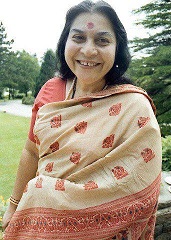
The Paraclete Shri Mataji “But to communicate with the people, to communicate with the Spirit—to understand the Kundalini, the vibrations, and their different decodings and all that—the Holy Spirit had to come; with Her mouth, and with Her voice, and with Her intelligence that is intelligible to you; with the knowledge, and everything.
Otherwise it is not possible to communicate and that's why if somebody has to come you have to just recognize. Recognition is the best way of understanding the powers that are given to you...
So somebody has to be there to give you the complete picture. You get Realization, you get vibrations (Ruach, Pneuma, Prana), but then what? What about the complete? And for that the Holy Ghost has to take a form. All right?”
The Paraclete Shri Mataji
Sydney, Australia—April 7, 1981
.jpg)
The Paraclete Shri Mataji "Israel's eschatological hope for the final indwelling of God is the foundation of the Christian hope for the `new heaven and the new earth'. Ezekiel 37.27 returns once more in the promise of Rev. 21.3: I will dwell with them, and I will be their God, and they shall be my peoples. That is `the tabernacle - the dwelling - of God with human beings', God's sanctuary among them `for ever': the new Jerusalem...
And yet there is one particular Christian contribution to Shekinah theology. This is the idea of the mutual Shekinah of God and human beings `in Christ'. `In Christ' is God himself, God who has `reconciled the world with himself' (II Cor. 5.19). Those who are `in Christ' are `a new creation' (II Cor. 5.17). `In Christ' we find a double dwelling: the indwelling of God and the indwelling of believers. This double indwelling becomes the foundation for the eschatological and universal hope of Christians for the new creation of all things...
The difference between Shekinah theology and christology is that although - especially among the rabbis - God's Shekinah, as Israel's co-sufferer and its companion on the way, can take on human features, it has not yet specifically `become flesh' and as messianic person `dwelt among us'.” (Moltmann 1996 Kindle 4351)
.jpg)
The Paraclete Shri Mataji "The early Christian faith in the resurrection was not based solely on Christ's appearances. It was just as strongly motivated, at the very least, by the experience of God's Spirit. Paul therefore calls this Spirit `the Spirit' or `power' of the resurrection. Luke makes the end of the appearances with Christ's ascension be followed by the outpouring of the pentecostal Spirit. Believing in the risen Christ means being possessed by the Spirit of the resurrection. In the Spirit, the presence of the living Christ was experienced. Believing in Christ's resurrection therefore does not mean affirming a fact. It means being possessed by the life-giving Spirit and participating in the powers of the age to come (Heb. 6.5).” (Moltmann 1990 Kindle 3261)
"Thus, the establishment of global peace can only come through people who have achieved this state in modern times which is very special and I call it a Blossom Time. In the Bible, it is described as the Last Judgment, also in the Koran it is called as Qiyamah (the Resurrection time).”
The Paraclete Shri Mataji
.jpg)
The Paraclete Shri Mataji "'There is no reference in the New Testament to any work of the Spirit apart from Christ. The Spirit is, in an exclusive sense, the Spirit of Christ.' In johannine thought, the activity of the Spirit is bound to the particularity of Jesus and the believing response to him. The Spirit's ministry is distinctively from Jesus and for the community that believes in Jesus... 'She will testify on my behalf. You also are to testify (15:26-27).'" (Stevick 2011, 294)
.jpg)
The Paraclete Shri Mataji "Is this eschatological symbol an appropriate way of describing the experiences with Jesus? Is it an arbitrary way of expressing them, or does it offer itself with an inward and inevitable cogency? It apparently grew up out of the apocalyptic structure of the 'seeing' of Christ. But does it also fit the experience of his death on the cross? The answer is 'yes', inasmuch as raising presupposes death, and the eschatological raising of the dead does not mean a revivification; nor does it mean a return to this life, which leads to death. The resurrection is not a revival, as in the case of Jairus's daughter, or Lazarus, whom Jesus brought back to this life but who later died once more. 'The raising of the dead' at the end of days means a qualitatively new life which no longer knows death and is not a continuation of this mortal life.” (Moltmann 1990 Kindle 3315)
.jpg)
The Paraclete Shri Mataji "When the Spirit of truth comes,
she will guide you into all truth. 16:38a
The Paraclete is referred to as the Spirit of truth (as in 14:17; 15:26 and 1 John 1:6 and 5:7). Again she comes. She will guide (hodego), a verb related to 'the way,' hodos, 14:6) the church into all the truth... The Spirit, in a movement that is through truth and into truth, will lead Jesus' followers into the Truth that Jesus is... The expression all the truth (te aletheia pase) refers not to speculative inquiry or a developed body of doctrine, but concretely to the truth which is Jesus, the word in which the church is constituted.” (Stevick 2011, 257)
"People do not know what time has come. It is the last chance. You won't get any more chance. In Bible it has been described as the Last Judgment. Your Last Judgment is in Sahaja Yoga and how it will be done can be judged by yourself.”
The Paraclete Shri Mataji
"This is the Last Judgment. Let us see what happens. Whatever people come is alright for me. Even if they do not come, it's still alright. Remember, God will not bow before you.”
The Messsiah-Paraclete Shri Mataji
"For us, in between Christ and this destroying incarnation of Mahavishnu called as Kalki, there is a time given to human beings to rectify themselves, for them to enter in the Kingdom of God, which in the Bible is called as the Last Judgment. That you will be judged, all of you will be judged on this earth.”
The Paraclete Shri Mataji
"I have to warn all the Sahaja Yogis who are here because Sahaja Yoga is the Last Judgment; not only that you will be judged, that you are entering into the Kingdom of God, but you become the citizens of God is correct.”
The Paraclete Shri Mataji
.jpg)
The Paraclete Shri Mataji "Paul brought out the connection here very clearly: `If the Spirit of him who has raised Jesus from the dead dwells in you, he who has raised Christ Jesus from the dead will give life to your mortal bodies also through his Spirit which dwells in you' (Rom. 8.11). He links the perfect tense of the raising of Christ with the present tense of the indwelling of the Spirit, and the present tense of the Spirit with the future tense of the resurrection of the dead. The perfect tense of the raising of Christ therefore designates, not a past event but an event in the past which in the Spirit determines the present, because it opens up the future of life. Without this history which it throws open in the Spirit and in hope, the resurrection is incomprehensible. The present liberating experience of the Spirit is grounded in the perfect of Christ's resurrection.” (Moltmann 1990 Kindle 3589)
"This is the greatest of the greatest things which can happen to anyone that you know. Also you know, this is the greatest happening, which was prophesied long time back as the Last Judgment. You know that this is the way, you are going to be judged. So we have to work very hard. We have to work. It is effortlessly given to you, alright. But to maintain it, keep it up to go high, we have to religiously work it out.”
The Paraclete Shri Mataji
"And that your Last Judgment is also now. Only through Kundalini awakening God is going to judge you. How is he going to judge you otherwise? You think of somebody now, a person comes in now. Here is somebody sitting to judge you. How? By how many hair-dressers you have been to? Or how many suits you have stitched for Christmas? Or what presents you have bought or how many cards you have sent? and to how many people you have sent some other things which may not be very palatable. That's not the way.”
The Paraclete Shri Mataji
.jpg)
The Paraclete Shri Mataji "The eschatological symbol of the raising of the dead is an interpretative category well suited to comprehend the contradictory experiences of the men and women disciples with Jesus: crucified in weakness - living in glory. No more can be said about the verification in Jesus himself. What happened to him between his death on Golgotha and his appearances no one saw, and no one claims to have seen. Only Christian painters have given free rein to their imaginations in the darkness of this mystery, yet without making the darkness any less. When Christ was raised, there were no eye witnesses of the event. Only `the empty tomb' gave ambiguous tidings of what had happened there. That Jesus' tomb was empty seems to be an extremely well attested fact, because both Jews and Christians knew of it. The message of the resurrection brought by the disciples on their return to Jerusalem could hardly have lasted a single hour in the city if it had been possible to show that Jesus' body was lying in the grave.” (Moltmann 1990 Kindle 3306)
"The Last Judgment has started. We are facing the Last Judgment today. We are not aware of it. And all the satanic forces have come out like the wolves in sheep's clothes. And they are trying to attract you and you do not judge them. You only sit down and judge the Reality. It has started, it is a fact. It has started.”
The Paraclete Shri Mataji
.jpg)
The Paraclete Shri Mataji "Pannenberg writes that, 'The eschatological salvation at which Christian hope is directed fulfills the deepest longing of humans and all creation even if there is not always a full awareness of the object of this longing. Yet like the reality of God it transcends all our concepts.' For Pannenberg the Spirit is the agent who leads creation into this eschaton... Pannenberg asserts that the Spirit was an eschatological reality for primitive Christianity. Israelite prophecy had promised that the Spirit would be poured out at the end of history, and they experienced this eschatological reality as already present in the gift of the Spirit.” (Varkey 2011 Kindle 6365)
"Christ has said very clearly in the second chapter of Matthew 2nd verse 'You'll be calling me Christ! Christ! I won't recognize you.' That's very true. It is not a question of who recognises Him, but He should recognize you because the advent of Christ is going to be absolutely terrible. He is not going to talk to you, convince you or comfort you or give you any council as I am trying my level best, but He will just come for the Last Sorting out because I declare that the Last Judgment has started. The Last Judgment takes place only through Kundalini awakening. There is no other way out. God is going to do it through living process.”
The Paraclete Shri Mataji
.jpg)
The Paraclete Shri Mataji "Seeing history in the perspective of resurrection means participating through the Spirit in the process of resurrection. Belief in resurrection is not summed up by assent to a dogma and the registering of a historical fact. It means participating in this creative act of God. A faith of this kind is the beginning of freedom. If God reveals himself in the raising of the Christ crucified in helplessness, then God is not the quintessence of power, such as the Roman Caesars represented. Nor is he the quintessence of law, such as the Greek cosmos reflects. God is then the power that quickens into life, that makes the poor rich, that lifts up the humble and raises the dead. Faith in the resurrection is itself a living force which raises people up and frees them from the deadly illusions of power and possession, because their eyes are now turned towards the future of life. The proclamation of the resurrection of Christ is a meaningful statement against the horizon, or in the context, of the history which the resurrection itself begins - the history of the freeing of human beings and the whole sighing creation from the forces of annihilation and death. Understood as an event that discloses the future and opens history, the resurrection of Christ is the foundation and promise of life in the midst of the history of death.” (Moltmann 1990 Kindle 3581)
"Sahaja Yoga is for the emancipation of the whole world, at every level. Once we have people of a certain number in Sahaja Yoga, it will start triggering understanding of real righteousness, religiousness and our love for God, and enlightened faith in God. This is how the Resurrection time is going to be worked out. This is the Last Judgment time, and everyone can judge him or herself through the light of the Spirit.”
The Paraclete Shri Mataji
The fulfillment of eschatological instruction promised by Jesus
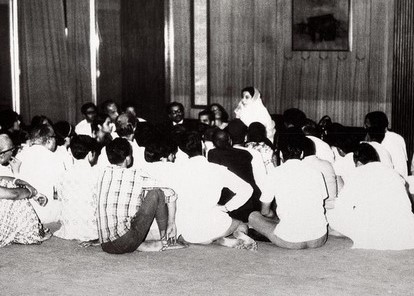
Total number of recorded talks 3058: Public Programs 1178, Pujas 651, and other (private conversations) 1249
“The Paraclete will come (15:26; 16:7, 8, 13) as Jesus has come into the world (5:43; 16:28; 18:37)... The Paraclete will take the things of Christ (the things that are mine, ek tou emou) and declare them (16:14-15). Bishop Fison describes the humility of the Spirit, 'The true Holy Spirit of God does not advertise Herself: She effaces Herself and advertises Jesus.' ...
It is by the outgoing activity of the Spirit that the divine life communicates itself in and to the creation. The Spirit is God-in-relations. The Paraclete is the divine self-expression which will be and abide with you, and be in you (14:16-17). The Spirit's work is described in terms of utterance: teach you, didasko (14:26), remind you, hypomimnesko (14:26), testify, martyro (15:26), prove wrong, elencho (16:8), guide into truth, hodego (16:13), speak, laleo (16:13, twice), declare, anangello (16:13, 14, 15). The johannine terms describe verbal actions which intend a response in others who will receive (lambano), see (theoreo), or know (ginosko) the Spirit. Such speech-terms link the Spirit with the divine Word. The Spirit's initiatives imply God's personal engagement with humanity. The Spirit comes to be with others; the teaching Spirit implies a community of learners; forgetful persons need a prompter to remind them; one testifies expecting heed to be paid; one speaks and declares in order to be heard. The articulate Spirit is the correlative of the listening, Spirit-informed community.
The final Paraclete passage closes with a threefold repetition of the verb she will declare (anangello), 16:13-15. The Spirit will declare the things that are to come (v.13), and she will declare what is Christ's (vv. 14, 15). The things of Christ are a message that must be heralded...
The intention of the Spirit of truth is the restoration of an alienated, deceived humanity... The teaching role of the Paraclete tends to be remembered as a major emphasis of the Farewell Discourses, yet only 14:26 says She will teach you all things. (Teaching is, however, implied when 16:13-15 says that the Spirit will guide you into all truth, and will speak and declare.) Franz Mussner remarks that the word used in 14:26, didaskein, "means literally 'teach, instruct,' but in John it nearly always means to reveal.” (Stevick 2011, 292-7)
The Holy Spirit as feminine: Early Christian testimonies and their interpretation,
Johannes van Oort, Radboud University, Nijmegen, The Netherlands
Department of Church History and Church Polity, Faculty of Theology, University of Pretoria, South Africa






Stephen E. Witmer, Divine instruction in Early Christianity
“Jesus therefore predicts that God will later send a human being to Earth to take up the role defined by John .i.e. to be a prophet who hears God's words and repeats his message to man.”
M. Bucaille, The Bible, the Qur'n, and Science
“And when Jesus foreannounced another Comforter, He must have intended a Person as distinct and helpful as He had been.”
F. B. Meyer, Love to the Utmost
“The Paraclete has a twofold function: to communicate Christ to believers and, to put the world on trial.”
Robert Kysar, John The Meverick Gospel
“But She—the Spirit, the Paraclete...—will teach you everything.”
Danny Mahar, Aramaic Made EZ)
“Grammatical nonsense but evidence of the theological desire to defeminize the Divine.”
Lucy Reid, She Changes Everything
“The functions of the Paraclete spelled out in verses 13-15... are all acts of open and bold speaking in the highest degree.”
David Fleer, Preaching John's Gospel
“The reaction of the world to the Paraclete will be much the same as the world's reaction was to Jesus.”
Berard L. Marthaler, The Creed: The Apostolic Faith in Contemporary Theology
Bultmann calls the “coming of the Redeemer an 'eschatological event,' 'the turning-point of the ages.”
G. Ladd, A Theology of the New Testament
“The Paraclete equated with the Holy Spirit, is the only mediator of the word of the exalted Christ.”
Benny Thettayil, In Spirit and Truth
“The divine Paraclete, and no lessor agency, must show the world how wrong it was about him who was in the right.”
Daniel B. Stevick , Jesus and His Own: A Commentary on John 13-17
Stephen Smalley asserts that “The Spirit-Paraclete ... in John's Gospel is understood as personal, indeed, as a person.”
Marianne Thompson, The God of the Gospel of John
“The Messiah will come and the great age of salvation will dawn (for the pious).”
Eric Eve, The Jewish context of Jesus' Miracles
“The remembrance is to relive and re-enact the Christ event, to bring about new eschatological decision in time and space.”
Daniel Rathnakara Sadananda, The Johannine Exegesis of God
“The Spirit acts in such an international situation as the revealer of 'judgment' on the powers that rule the world.”
Michael Welker, God the Spirit
The Paraclete's “Appearance means that sin, righteousness, and judgment will be revealed.”
Georg Strecker, Theology of the New Testament
“While the Spirit-Paraclete is the true broker, the brokers they rely on are impostors.”
T. G. Brown, Spirit in the writings of John
“The pneumatological activity ... of the Paraclete ... may most helpfully be considered in terms of the salvific working of the hidden Spirit.”
Michael Welker, The work of the Spirit
“The pneuma is the peculiar power by which the word becomes the words of eternal life.”
Robert Kysar, Voyages with John
“The gift of peace, therefore, is intimately associated with the gift of the Spirit-Paraclete.”
Francis J. Moloney, The Gospel of John
“This utopian hope, even when modestly expressed, links Jesus and the prophets to a much wider history of human longing.”
Harvey Cox, The Future of Faith
“Because of the presence of the Paraclete in the life of the believer, the blessings of the end-times—the eschaton—are already present.”
Robert Kysar, John
“They are going, by the Holy Spirit's power, to be part of the greatest miracle of all, bringing men to salvation.”
R. Picirilli, The Randall House Bible Commentary
“The Kingdom of God stands as a comprehensive term for all that the messianic salvation included... is something to be sought here and now (Mt. 6:33) and to be received as children receive a gift (Mk. 10:15 = Lk. 18:16-17).”
G. Ladd, A Theology of the New Testament
 Lessons for Living Found in Views of the Last Judgment
Beliefs
By PETER STEINFELS JAN. 20, 2007
“The image of the God who judges in wrath has caused a great deal of spiritual damage," Professor Moltmann will be telling his listeners.
But he is not satisfied with the alternative that makes eternal destiny simply a matter of the individual's own choice of whether to reject God. In that case, Professor Moltmann says, the Last Judgment becomes no more than "the ultimate endorsement of our free will." God really has nothing much to do with it beyond implementing the human outcome; in short, "we are the lords, and God is our servant," he says.
The alternative, in Professor Moltmann's view, is to put Jesus Christ at the center of this final drama. "It is high time to Christianize our traditional images and perceptions of God's Final Judgment," he says.
Any Last Judgment with Christ at the center must answer the cries of human victims for justice, without simply meting out vengeance on the perpetrators of injustice, Professor Moltmann suggests. A Christian eschatological vision would involve not the retributive justice of human courts but "God's creative justice," which can heal and restore the victims and transform the perpetrators.
The goal of a final judgment, in this interpretation, is not reward and punishment but victory over all that is godless, which he calls "a great Day of Reconciliation." Professor Moltmann argues for the universal preservation and salvation not only of humans, as individuals and as members of groups, but also of all living creatures. It has been "a fatal mistake of Christian tradition in doctrine and spirituality," he argues, to emphasize the "end of the old age" rather than "the new world of God," the beginning of the "life of the world to come."
This resurrected life will be bodily and worldly, and its expectation, he says, should teach people to "give ourselves wholeheartedly to this life here and surrender in love" to its “beauties and pains.”
New York Times, Lessons for Living Found in Views of the Last Judgment
January 20, 2007
“But today is the day I declare that I am the one who has to save the humanity. I declare I am the one who is Adishakti, who is the Mother of all the Mothers, who is the Primordial Mother, the Shakti, the desire of God, who has incarnated on this Earth to give its meaning to itself; to this creation, to human beings and I am sure through My Love and patience and My powers I am going to achieve it.
I was the one who was born again and again. But now in my complete form and complete powers I have come on this Earth not only for salvation of human beings, not only for their emancipation, but for granting them the Kingdom of Heaven, the joy, the bliss that your Father wants to bestow upon you.”
The Paraclete Shri Mataji
London, UK—December 2, 1979
“I am the one about which Christ has talked... I am the Holy Spirit who has incarnated on this Earth for your realization.”
The Paraclete Shri Mataji
New York, USA—September 30, 1981
“But to communicate with the people, to communicate with the Spirit—to understand the Kundalini, the vibrations, and their different decodings and all that—the Holy Spirit had to come; with Her mouth, and with Her voice, and with Her intelligence that is intelligible to you; with the knowledge, and everything.
Otherwise it is not possible to communicate and that's why if somebody has to come you have to just recognize. Recognition is the best way of understanding the powers that are given to you...
So somebody has to be there to give you the complete picture. You get Realization, you get vibrations (Ruach, Pneuma, Prana), but then what? What about the complete? And for that the Holy Ghost has to take a form. All right?”
The Paraclete Shri Mataji
Sydney, Australia—April 7, 1981
Guest: “Hello Mother.”
Shri Mataji: “Yes.”
Guest: “I wanted to know, is the Cool Breeze (Pneuma) that you have spoken about, you feel on the hands the Cool Wind of the Holy Spirit, as spoken about in the Bible?”
Shri Mataji: “Yes. Yes, yes, same thing, same thing. You have done the good job now, I must say.”
Interviewer: “Is it the Holy Spirit?”
Shri Mataji: “Yes, of course, is the Holy Spirit.”
Guest: “Aha... I am feeling it now on my hand through the [not clear]”
Shri Mataji: “It’s good.”
Interviewer: “Did you want to say anything more than that?”
Guest: “No, I just... That’s all I wanted to know because I...”
Shri Mataji: “Because you are thoughtless now. Enjoy yourself.”
Guest: “Thank you.”
The Paraclete Shri Mataji
Talkback Radio 2UE, Sydney, Australia—March 31, 1981
Second Guest: “I just want to ask Mother about a quotation from the Bible.”
Interviewer: “Yes, what’s that?”
Guest: “It says, ‘But the comfort of the Holy Spirit that the Father will send in My name would teach you all things.’ I would like to ask Her about that.”
Interviewer: “Could you just repeat the quotation again?”
Guest: “But the Comforter, the Holy Spirit, whom the Father will send in My name, will teach you all things.”
Interviewer: “And that’s from where?”
Guest: “John chapter 14, verse 26.”
Shri Mataji: “I think you should take your realization and then you will know the answer to it. Because, logically if it points out to one person, then you have to reach the conclusion, isn’t it? That’s a logical way of looking at things. But I am not going to say anything or claim anything. It is better you people find out yourself.”
Interviewer: “Does that answer your question?”
Guest: “Is the, is the Comforter on the Earth at the present time? Has the Comforter incarnated? Mataji should be able to tell us this because She said that through these vibrations on Her hands, She ...”
Shri Mataji: “Yes, She is very much here and She’s talking to you now. Can you believe that?”
Guest: “Well, I feel something cool [Pneuma/Prana/Chi] on my hand. Is that some indication of the ...?”
Shri Mataji: “Yes, very much so. So that’s the proof of the thing. You’ve already started feeling it in your hands.”
Guest: “Can I?”
Shri Mataji: “Ask the question, ‘Mother, are you the Comforter?’”
Guest: “Mother, are you the Comforter?”
Shri Mataji: “Ask it thrice.”
Guest: “Mother, are you the Comforter?”
Shri Mataji: “Again.”
Guest: “Mother, are you the Comforter?”
Shri Mataji: “Now, what do you get?”
Guest: “Oh, I feel this kind of cool tingling [Pneuma/Prana/Chi] passing all through my body.”
Shri Mataji: “That’s the answer now.”
The Paraclete Shri Mataji
Talkback Radio 2UE, Sydney, Australia—March 31, 1981
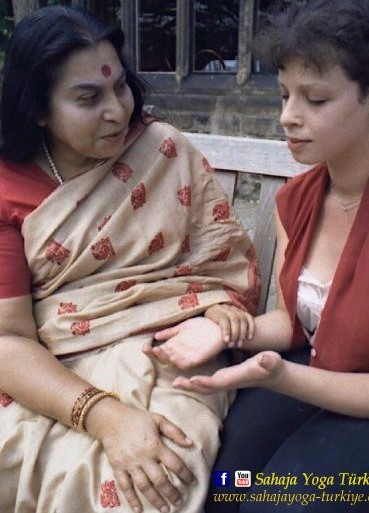
“The Paraclete and the disciples (vv. 25-26): The theme of departure (cf. vv. 1-6; vv. 18-24) returns. There are two "times" in the experience of the disciples: the now as Jesus speaks to them (v. 25) and the future time when the Paraclete, the Holy Spirit, sent by the Father in the name of Jesus, will be with them (v. 26). The Paraclete will replace Jesus' physical presence, teaching them all things and recalling for them everything he has said (v. 26). As Jesus is the Sent One of the Father (cf. 4:34; 5:23; 24, 30, 37; 6:38-40; 7:16; 8:16, 18, 26; 12:44-49), so is the Paraclete sent by the Father. The mission and purpose of the former Paraclete, Jesus (cf. 14:13-14), who speaks and teaches "his own" will continue into the mission and purpose of the "other Paraclete" (cf. v. 16) who teaches and brings back the memory of all that Jesus has said. The time of Jesus is intimately linked with the time after Jesus, and the accepted meaning of a departure has been undermined. The inability of the disciples to understand the words and deeds of Jesus will be overcome as they "remember" what he had said (cf. 2:22) and what had been written of him and done to him (cf. 12:16). The "remembering" will be the fruit of the presence of the Paraclete with the disciples in the in-between-time. In v. 16 Jesus focused on the inability of the world to know the Paraclete, but in v. 26 the gift of the Paraclete to "his own" is developed. As Jesus was with the disciples (v. 25), so will the Paraclete be with the disciples in the midst of hostility and rejection (v. 16). As the story has insisted that Jesus' teaching has revealed God to his disciples, so will the Paraclete recall and continue Jesus' revelation of God to the disciples (v. 26).” (Harrington 1998, 412)
“This is the transformation that has worked, of which Christ has talked, Mohammed Sahib has talked, everybody has talked about this particular time when people will get transformed.”
The Paraclete Shri Mataji
Chistmas Puja, Ganapatipule, India—25 December 1997
“The Resurrection of Christ has to now be collective Resurrection. This is what is Mahayoga. Has to be the collective Resurrection.”
The Paraclete Shri Mataji
Easter Puja, London, UK—11 April 1982
“Today, Sahaja Yaga has reached the state of Mahayoga, which is en-masse evolution manifested through it. It is this day’s Yuga Dharma. It is the way the Last Judgment is taking place. Announce it to all the seekers of truth, to all the nations of the world, so that nobody misses the blessings of the divine to achieve their meaning, their absolute, their Spirit.”
The Paraclete Shri Mataji
MAHA AVATAR, ISSUE 1, JUL-SEP 1980
“The main thing that one has to understand is that the time has come for you to get all that is promised in the scriptures, not only in the Bible but all all the scriptures of the world. The time has come today that you have to become a Christian, a Brahmin, a Pir, through your Kundalini awakening only. There is no other way. And that your Last Judgment is also now.”
The Paraclete Shri Mataji
“You see, the Holy Ghost is the Mother. When they say about the Holy Ghost, She is the Mother... Now, the principle of Mother is in every, every scripture — has to be there. Now, the Mother's character is that She is the one who is the Womb, She is the one who is the Mother Earth, and She is the one who nourishes you. She nourishes us. You know that. And this Feminine thing in every human being resides as this Kundalini.”
The Paraclete Shri Mataji
Radio Interview, Santa Cruz, USA—1 October 1983
“But there is a Primordial Mother which was accepted by all the religions; even the Jews had it... In India, this is called as Adi Shakti. In every religion they had this Mother who was the Primordial Mother.”
The Paraclete Shri Mataji
TV Interview, Los Angeles, USA—11 October 1993
Total number of Recorded Talks 3058, Public Programs 1178, Pujas 651, and other (private conversations) 1249
“What are they awaiting but for the Hour to come upon them suddenly? Its Signs have already come. What good will their Reminder be to them when it does arrive?” (Qur'n, 47:18) “As the above verse indicates, God has revealed some of Doomsday's signs in the Qur'n. In Surat az-Zukhruf 43:61, God informs us that 'He [Jesus] is a Sign of the Hour. Have no doubt about it...' Thus we can say, based particularly on Islamic sources but also on the Old Testament and the New Testament, that we are living in the End Times.” Harun Yahya
Good News (An Naba) of Resurrection (Al-Qiyamah): Videos 3474, Audios 1945, Transcripts 3262 and Events 2413
“Concerning what are they disputing?
Concerning the Great News. [5889]
About which they cannot agree.
Verily, they shall soon (come to) know!
Verily, verily they shall soon (come to) know!”
surah 78:1-5 An Naba (The Great News)
5889. Great News: usually understood to mean the News or Message of the Resurrection.
Abdullah Yusuf Ali, The Holy Qur'n
Amana Corporation, 1989
[Moderator]: “Any other questions?”
[Audience]: “Pardon me for asking this question, but, earlier you talked about the Resurrection and you mentioned about the scriptures, where like in the Hindus scriptures they talk about the Kalki Avatar who will come for the Resurrection, and for the Christians, I know they talk about the return of Christ and all the religions talk about this Resurrection and the belief in the coming of the Messiah. So I just want to know since you say you are going to give the resurrection to us, what is your station?”
Shri Mataji: “In Russia?”
[Audience]: “And are you the promised Messiah? Shri Mataji, are you?”
Shri Mataji: “I see now I am not going to tell you anything about myself, to be very frank. Because see Christ said He was the Son of God, and they crucified Him. I don't want to get crucified. You have to find out. When you become the Spirit you will know what I am. I don't want to say anything about myself.”
The Paraclete Shri Mataji
Toronto, Canada—October 5, 1993
“It is the Mother who can awaken the Kundalini, and that the Kundalini is your own Mother. She is the Holy Ghost within you, the Adi Shakti, and She Herself achieves your transformation. By any talk, by any rationality, by anything, it cannot be done.”
The Paraclete Shri Mataji
“She is your pure Mother. She is the Mother who is individually with you. Forget your concepts, and forget your identifications. Please try to understand She is your Mother, waiting for ages to give you your real birth. She is the Holy Ghost within you. She has to give you your realization, and She's just waiting and waiting to do it.”
The Paraclete Shri Mataji
Sydney, Australia—Mar 22 1981
“The Kundalini is your own mother; your individual mother. And She has tape-recorded all your past and your aspirations. Everything! And She rises because She wants to give you your second birth. But She is your individual mother. You don't share Her with anybody else. Yours is a different, somebody else's is different because the tape-recording is different. We say She is the reflection of the Adi Shakti who is called as Holy Ghost in the Bible.”
The Paraclete Shri Mataji
Press Conference July 08 1999—London, UK
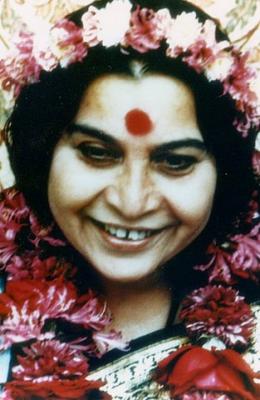
Shri Mataji Nirmala Devi was
Christian by birth, Hindu by
marriage, and Paraclete by duty.
"The Paraclete represents direct,
intimate divine intervention,
supporting and teaching
believers and challenging the
world, as Jesus did. " (D. Stevick
Jesus and His Own, 2011, 290)
But there has to be a Mother and this is the time of Aquarius what we call in Sanskrit as Kumbha, meaning the Aquarius which is the Kundalini, where She nourishes, where She cures you, She redeems you, She guides you, counsels you, and this is the time of the Mother. We had the time of the Father, then of the Son, and now this is the time of the Mother where She has to nourish you, where She has to take you to your ultimate goal that is the Spirit.
The consciousness itself, the way we have been moving in other directions, have been like people think that if a woman starts fighting for her life and then she is asserting the femininity. She is not.
What I'm saying is not meant for women or men. It is meant for every one of us, that we have to become like a mother. Like a Divine Mother, like a person who can nourish people, who can give them love, affection, attention, perseverance, fore-bearing.
This is only possible for a Mother to do it and that motherhood should be awakened in every human being.”
The Paraclete Shri Mataji
Public Program Day 1, Boston, United States—Oct. 11, 1983

“I was amazed myself when I was born to see such ignorant people quarreling over something which they do not know at all—nothing of that kind. They are so ignorant. They do not know there is Power of God working. They cannot feel it and what are they doing?
Whether they are church people, or temple people, or all these scientists, when they talk about God they are at a level from where they cannot talk. But they are not even conscious that they are that level.
This is why we have to know that despite all efforts to destroy our scriptures this Knowledge that you have to become something else— that you are to be reborn—this Knowledge they could not destroy.
They have tried to maneuver it for their own advantage. They have tried to use it for their own building up because they had to have big, big buildings, they must have big, big money projects, and sometimes they also must have some business.
How can you do all these things in the name of God? Just think of it. And they are doing all these mad things and they call it God? And the seeker gets absolutely shocked and surprised that he also gets into the whole whirlpool. He just cannot get out of it because he is a seeker. He says, "Let me go and see for myself what it is. Let me burn my finger here and there and find out for myself."
Now I say again, like all these people have said—"You have to be born again!" They have said it to prepare you all for this Time [of the promised Paraclete sent in the name of Jesus Christ to explain and commence the Resurrection].
It's My fortune that I have to do it. It has to happen. If they had said all these things either they were all false and wrong. So I am here to prove it—not that they were wrong in any way but they were the only people who were enlightened. They had an eyesight to see much deeper than what you can see.
So within us lies that Power and that Power is anxious to give you your second birth. That Power lies as shown, lies in the triangular bone of sacrum and you can see with your naked eyes the rising of this Power.
It has nothing to do with what nationality you have come from, what sort of clothes you are wearing, what sort of hair dress you have—it has nothing to do with this but it has to do something with your inner being.
And while in your inner being there are certain problems which you have created out of your ignorance, and this Power being your Mother—your sweet loving Mother who has been born again and again with you—knows your problems and She knows how to correct it.”
The Paraclete Shri Mataji
London, U.K. — May 12, 1980
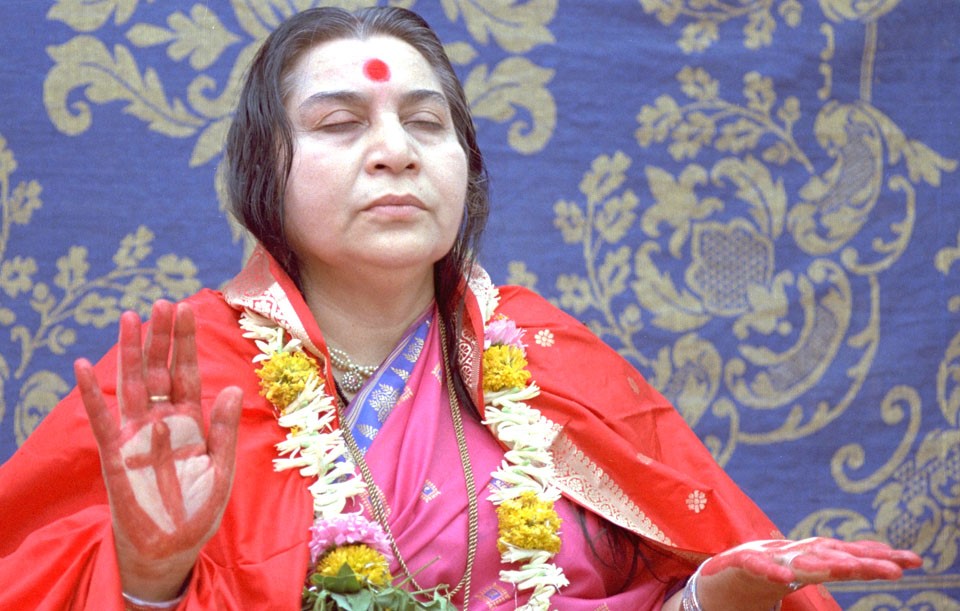
Now I have come.
He has talked about Me. If you read Bible, you'll find He's talked about Me very clearly there.
And I have to do My job and I have come.
You are going to say that it was Christ, who has to do it. If Christ could do it, why did He say that, "I'm going to send you a Comforter?" He talked of [the] future, didn't He?
Why did He say such a thing? We should find out why did He say that, "I will send you the Holy Ghost and the Comforter and the Redeemer and a Counselor?" Why did He say that? Why not look forward to that?
Because we are today after Christ. People don't want to see this point; they want to depend on Christ because He's in their pocket, they can use Him the way they like.
When He has talked, He has said, "Why not see the point?" If this is what Christ is, then it is such a bad thing because people say, "Christ was no good." They say, "What has Christ given us?" Christian nations, what have they done, what have they achieved?
It's a bad name to Him if you do not see [the] completion of His work. I'm here to complete His work...
And the Day of Judgment is today: this is the Day of Judgment; that's why you are confused. This is the Day of Judgment, where you will be judged. And how are you going to be judged?
Through your Kundalini. Your Kundalini is going to be awakened and you'll be judged where you are. That's what it is.
"And those who will be calling Me, 'Christ, Christ' I will not look at them." That's what it is. By calling Him "Christ, Christ" you do not become Christians.
You have to get your Realization, your Baptism in the actual sense. It has to be an actualization.
I'm telling you that if you miss the point, you have missed it forever and ever. Be careful on that point! It's very important. Don't run after things which have no meaning to your consciousness. Try to raise yourself up to this point and understand that the Time has come for you to transform. This is the Time of your Judgment and you have to get to it in a very big way...
Widen yourself. And that's how—though you may think that you are very unassuming, simple people—you are the ones who are going to be. Not those who are successful: they are blinded by their success. Not those who are rich: they are not going to enter into the Kingdom of God. Not those who have a big name — No!
It's you! You are going to enter into the Kingdom of God.
May God bless you.”
The Paraclete Shri Mataji
Public Program Day 1, Boston, United States—Oct. 11, 1983
Disclaimer: Our material may be copied, printed and distributed by referring to this site. This site also contains copyrighted material the use of which has not always been specifically authorized by the copyright owner. We are making such material available to our readers under the education and research provisions of "fair use" in an effort to advance freedom of inquiry for a better understanding of religious, spiritual and inter-faith issues. The material on this site is distributed without profit. If you wish to use copyrighted material for purposes other than “fair use” you must request permission from the copyright owner.

