
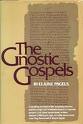
The Gnostic Gospels: "Self-knowledge is knowledge of God; the self and the divine are identical"
"Yet to know oneself, at the deepest level, is simultaneously to know God; this is the secret of gnosis. Another gnostic teacher, Monoimus, says:
Abandon the search for God and the creation and other matters of a similar sort. Look for him by taking yourself as the starting point. Learn who it is within you who makes everything his own and says," My God, my mind, my thought, my soul, my body.”Learn the sources of sorrow:, joy, love, hate ... If you carefully investigate these matters you will find him in yourself.”
The Gnostic Gospels
“The 52 texts discovered in Nag Hammadi, Egypt include "secret" gospels poems and myths attributed to Jesus sayings and beliefs which are very different from the New Testament. Scholar Elaine Pagels explores these documents and their implications.”PBS Frontline
“Scholars investigating the Nag Hammadi find discovered that some of the texts tell the origin of the human race in terms very different from the usual reading of Genesis: the Testimony of Truth, for example, tells the story of the Garden of Eden from the viewpoint of the serpent! Here the serpent, long known to appear in Gnostic literature as the principle of divine wisdom, convinces Adam and Eve to partake of knowledge while "the Lord" threatens them with death, trying jealously to prevent them from attaining knowledge, and expelling them from Paradise when they achieve it. Another text, mysteriously entitled The Thunder, Perfect Mind, offers an extraordinary poem spoken in the voice of a feminine divine power:
For I am the first and the last.
I am the honored one and the scorned one.
I am the whore and the holy one.
I am the wife and the virgin....
I am the barren one, and many are her sons....
I am the silence that is incomprehensible....
I am the utterance of my name.
These diverse texts range, then, from secret gospels, poems, and quasi-philosophic descriptions of the origin of the universe, to myths, magic, and instructions for mystical practice.
Why were these texts buried-and why have they remained virtually unknown for nearly 2,000 years? Their suppression as banned documents, and their burial on the cliff at Nag Hammadi, it turns out, were both part of a struggle critical for the formation of early Christianity. The Nag Hammadi texts, and others like them, which circulated at the beginning of the Christian era, were denounced as heresy by orthodox Christians in the middle of the second century. We have long known that many early followers of Christ were condemned by other Christians as heretics, but nearly all we knew about them came from what their opponents wrote attacking them...
This campaign against heresy involved an involuntary admission of its persuasive power; yet the bishops prevailed. By the time of the Emperor Constantine's conversion, when Christianity became an officially approved religion in the fourth century, Christian bishops, previously victimized by the police, now commanded them. Possession of books denounced as heretical was made a criminal offense. Copies of such books were burned and destroyed. But in Upper Egypt, someone; possibly a monk from a nearby monastery of St. Pachomius, took the banned books and hid them from destruction—in the jar where they remained buried for almost 1,600 years.
But those who wrote and circulated these texts did not regard themselves as "heretics". Most of the writings use Christian terminology, unmistakably related to a Jewish heritage. Many claim to offer traditions about Jesus that are secret, hidden from "the many" who constitute what, in the second century, came to be called the “catholic church.”These Christians are now called gnostics, from the Greek word gnosis, usually translated as “knowledge.” For as those who claim to know nothing about ultimate reality are called agnostic (literally, "not knowing"), the person who does claim to know such things is called gnostic ("knowing"). But gnosis is not primarily rational knowledge. The Greek language distinguishes between scientific or reflective knowledge ("He knows mathematics") and knowing through observation or experience ("He knows me"), which is gnosis. As the gnostics use the term, we could translate it as "insight," for gnosis involves an intuitive process of knowing oneself. And to know oneself, they claimed, is to know human nature and human destiny. According to the gnostic teacher Theodotus, writing in Asia Minor (c. 140-160), the gnostic is one has come to understand who we were, and what we have become; where we were... whither we are hastening; from what we are being released; what birth is, and what is rebirth.
Yet to know oneself, at the deepest level, is simultaneously to know God; this is the secret of gnosis. Another gnostic teacher, Monoimus, says:
Abandon the search for God and the creation and other matters of a similar sort. Look for him by taking yourself as the starting point. Learn who it is within you who makes everything his own and says, "My God, my mind, my thought, my soul, my body.”Learn the sources of sorrow:, joy, love, hate ... If you carefully investigate these matters you will find him in yourself.
What Muhammad 'll discovered at Nag Hammadi is, apparently, a library of writings, almost all of them gnostic. Although they claim to offer secret teaching, many of these texts refer to the Scriptures of the Old Testament, and others to the letters of Paul and the New Testament gospels. Many of them include the same dramatic personae as the New Testament—Jesus and his disciples. Yet the differences are striking.
Orthodox Jews and Christians insist that a chasm separates humanity from Its creator: God is wholly other. But some of the gnostics who wrote these gospels contradict this: self-knowledge is knowledge of God; the self and the divine are identical.
Second, the "living Jesus" of these texts speaks of illusion and enlightenment, not of sin and repentance, like the Jesus of the New Testament. Instead of coming to save us from sin, he comes as a guide who opens access to spiritual understanding. But when the disciple attains enlightenment, Jesus no longer serves as his spiritual master: the two have become equal—even identical.
Third, orthodox Christians believe that Jesus is Lord and Son of God in a unique way: he remains forever distinct from the rest of humanity whom he came to save. Yet the gnostic Gospel of Thomas relates that as soon as Thomas recognizes him, Jesus says to Thomas that they have both received their being from the same source:
Jesus said, “I am not your master. Because you have drunk, you have become drunk from the bubbling stream which I have measured out.... He who will drink from my mouth will become as I am: I myself shall become he, and the things that are hidden will be revealed to him.”
Does not such teaching—the identity of the divine and human, the concern with illusion and enlightenment, the founder who is presented not as Lord, but as spiritual guide—sound more Eastern than Western? Some scholars have suggested that if the names were changed, the"living Buddha"appropriately could say what the Gospel of Thomas attributes to the living Jesus. Could Hindu or Buddhist tradition have influenced gnosticism?
The British scholar of Buddhism, Edward Conze, suggests that it had. He points out that "Buddhists were in contact with the Thomas Christians (that is, Christians who knew and used such writings as the Gospel of Thomas) in South India.” Trade routes between the Greco- Roman world and the Far East were opening up at the time when gnosticism flourished (A.D. 80-200); for generations, Buddhist missionaries had been proselytizing in Alexandria. We note, too, that Hippolytus, who was a Greek speaking Christian in Rome (c. 225), knows of the Indian Brahmins—and includes their tradition among the sources of heresy:
There is ... among the Indians a heresy of those who philosophize among the Brahmins, who live a self-sufficient life, abstaining from (eating) living creatures and all cooked food ... They say that God is light, not like the light one sees, nor like the sun nor fire, but to them God is discourse, not that which finds expression in articulate sounds, but that of knowledge (gnosis) through which the secret mysteries of nature are perceived by the wise.
Could the title of the Gospel of Thomas—named for the disciple who, tradition tells us, went to India—suggest the influence of Indian tradition?
These hints indicate the possibility, yet our evidence is not conclusive. Since parallel traditions may emerge in different cultures at different times, such ideas could have developed in both places independently. What we call Eastern and Western religions, and tend to regard as separate streams, were not clearly differentiated 2,000 years ago. Research on the Nag Hammadi texts is only beginning: we look forward to the work of scholars who can study these traditions comparatively to discover whether they can, in fact, be traced to Indian sources.
Even so, ideas that we associate with Eastern religions emerged in the first century through the gnostic movement in the West, but they were suppressed and condemned by polemicists like Irenaeus. Yet those who called gnosticism heresy were adopting—consciously or not—the viewpoint of that group of Christians who called themselves orthodox Christians. A heretic may be anyone whose outlook someone else dislikes or denounces. According to tradition, a heretic is one who deviates from the true faith. But what defines that"true faith"? Who calls it that, and for what reasons?
We find this problem familiar in our own experience. The term "Christianity," especially since the Reformation, has covered an astonishing range of groups. Those claiming to represent "true Christianity" in the twentieth century can range from a Catholic cardinal in the Vatican to an African Methodist Episcopal preacher initiating revival in Detroit, a Mormon missionary in Thailand, or the member of a village church on the coast of Greece. Yet Catholics, Protestants, and Orthodox agree that such diversity is a recent—and deplorable—development. According to Christian legend, the early church was different. Christians of every persuasion look back to the primitive church to find a simpler, purer form of Christian faith. In the apostles' time, all members of the Christian community shared their money and property; all believed the same teaching, and worshipped together; all revered the authority of the apostles. It was only after that golden age that conflict, then heresy emerged: so says the author of the Acts of the Apostles, who identifies himself as the first historian of Christianity.
But the discoveries at Nag Hammadi have upset this picture. If we admit that some of these fifty-two texts represents early forms of Christian teaching, we may have to recognize that early Christianity is far more diverse than nearly anyone expected before the Nag Hammadi discoveries.
Contemporary Christianity, diverse and complex as we find it, actually may show more unanimity than the Christian churches of the first and second centuries. For nearly all Christians since that time, Catholics, Protestants, or Orthodox, have shared three basic premises. First, they accept the canon of the New Testament; second, they confess the apostolic creed; and third, they affirm specific forms of church institution. But every one of these-the canon of Scripture, the creed, and the institutional structure—emerged in its present form only toward the end of the second century. Before that time, as Irenaeus and others attest, numerous gospels circulated among various Christian groups, ranging from those of the New Testament, Matthew, Mark, Luke, and John, to such writings as the Gospel of Thomas, the Gospel of Philip, and the Gospel of Truth, as well as many other secret teachings, myths, and poems attributed to Jesus or his disciples. Some of these, apparently, were discovered at Nag Hammadi; many others are lost to us. Those who identified themselves as Christians entertained many—and radically differing- religious beliefs and practices. And the communities scattered throughout the known world organized themselves in ways that differed widely from one group to another.
Yet by A. D. 200, the situation had changed. Christianity had become an institution headed by a three-rank hierarchy of bishops, priests, and deacons, who understood themselves to be the guardians of the only"true faith.”The majority of churches, among which the church of Rome took a leading role, rejected all other viewpoints as heresy. Deploring the diversity of the earlier movement, Bishop Irenaeus and his followers insisted that there could be only one church, and outside of that church, he declared, "there is no salvation.” Members of this church alone are orthodox (literally, "straight-thinking") Christians. And, he claimed, this church must be catholic— that is, universal. Whoever challenged that consensus, arguing instead for other forms of Christian teaching, was declared to be a heretic, and expelled. When the orthodox gained military support, sometime after the Emperor Constantine became Christian in the fourth century, the penalty for heresy escalated.”
Elaine Pagels The Gnostic Gospels
Vintage Books, 1979, pp. 16-23
Related Articles
Gnosis is mutual knowing and being known of and by God
The Gnostic Gospels: Self-knowledge is knowledge of God
The mystic makes contact with the god inside
Hinduism is about exploring the very depths of your own soul yourself
Authors of old Asiatic books claimed ultimate truth was discoverable
But if you do not know yourselves, then you dwell in poverty
The failure to attain direct experience of the truth
The real study, in religion, is first-hand experience of God.
For Lao Tze it is the Tao, in Jewish mysticism it is the Shekinah
Spiritual but not Religious
Disclaimer: Our material may be copied, printed and distributed by referring to this site. This site also contains copyrighted material the use of which has not always been specifically authorized by the copyright owner. We are making such material available to our readers under the education and research provisions of "fair use" in an effort to advance freedom of inquiry for a better understanding of religious, spiritual and inter-faith issues. The material on this site is distributed without profit. If you wish to use copyrighted material for purposes other than “fair use” you must request permission from the copyright owner.

