
Gospel of Thomas offers the reader Jesus' 'secret teachings' about the Kingdom of God
Here, as in Luke 17:20, the Kingdom of God is said to be an interior state;"it's within you," Luke says.
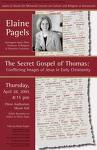
"According to the renowned historian Elaine H. Pagels the Gospel of Thomas 'does not tell the story about the life and death of Jesus, but offers the reader his 'secret teachings' about the kingdom of God.”
"This book opens with the lines, 'These are the secret words which the living Jesus spoke, and the twin, Didymos Judas Thomas wrote them down.' Then there follows a list of the sayings of Jesus. ... Some of these sayings are familiar. We know them from Matthew and Luke — Jesus said, 'I have come to cast fire on the earth.' Or 'Behold, a sower went out to sow,' and so forth.... Others are as strange and compelling as Zen koans. My favorite of these is saying number 70, which says, 'If you bring forth what is within you, what you bring forth will save you. If you do not bring forth what is within you, what you do not bring forth will destroy you.' The gospel opens as Jesus invites people to see....
The Gospel of Thomas also suggests that Jesus is aware of, and criticizing the views of the Kingdom of God as a time or a place that appear in the other gospels. Here Jesus says," If those who lead you say to you, 'look, the Kingdom is in the sky,' then the birds will get there first. If they say 'it's in the ocean,' then the fish will get there first. But the Kingdom of God is within you and outside of you. Once you come to know yourselves, you will become known. And you will know that it is you who are the children of the living father.”
In this gospel, and this is also the case in the Gospel of Luke, the Kingdom of God is not an event that's going to be catastrophically shattering the world as we know it and ushering in a new millennium. Here, as in Luke 17:20, the Kingdom of God is said to be an interior state; 'it's within you,' Luke says. And here it says, 'it's inside you but it's also outside of you.' it's like a state of consciousness. it's hard to describe. But the Kingdom of God here is something that you can enter when you attain gnosis, which means knowledge. But it doesn't mean intellectual knowledge. The Greeks had two words for knowledge. One is intellectual knowledge, like the knowledge of physics or something like that. But this gnosis is personal, like 'I know that person, or do you know so and so.' So this gnosis is self- knowledge; you could call it insight. it's a question of knowing who you really are, not at the ordinary level of your name and your social class or your position. But knowing yourself at a deep level. The secret of gnosis is that when you know yourself at that level you will also come to know God, because you will discover that the divine is within you.
The Jesus of the Gospel of Thomas does appear rather different from the Jesus we encounter in the others. Because the Gospel of Mark, for example, depicts Jesus as an utterly unique being. This is the good news of Jesus of Nazareth, the Son of God. The Gospel of John says that Jesus isn't even a human being at all, but he's a divine presence who comes down to heaven in human shape.... The Gospel of John says, 'God sent his son into the world to save the world.' If you believe in him, you're saved, if you don't believe in him you're already damned, because you haven't believed in the name of the only begotten Son of God.
Now, [in the Gospel of Thomas], this Jesus comes to reveal that you and he are, if you like, twins.... And what you discover as you read the Gospel of Thomas, which you're meant to discover, is that you and Jesus at a deep level are identical twins. And that you discover that you are the child of God just as he is. And so that at the end of the gospel Jesus speaks to Thomas and says, 'Whoever drinks from my mouth will become as I am, and I will become that person, and the mysteries will be revealed to him.' Here, Jesus does not take the role of authority and teacher. In the Gospel of Thomas, the disciples say to Jesus, 'Tell us, what do you want us to do? How shall we pray? What shall we eat? How shall we fast?' Now if you look at Matthew and Luke, Jesus answers the questions. He says, 'When you pray, say, 'Our Father who are in Heaven, hallowed be...' When you fast, wash your face, don't make a show of it. When you give alms do it privately and without being showy.' In this gospel, this Jesus does not answer. He says, 'Do not tell lies, and do not do what you hate, for everything is known before heaven.' Now this answer throws you and me upon ourselves.... Here Jesus, in effect, turns one toward oneself, and that is really one of the themes of the Gospel of Thomas, that you must go in a sort of a spiritual quest of your own to discover who you are, and to discover really that you are the child of God just like Jesus.”
Elaine H. Pagels, FRONTINE: From Jesus to Christ
http://www.pbs.org/wgbh/pages/frontline/shows/religion/story/thomas.html
Web (September 16, 2013)
Elaine Pagels' Search for Christ the Mystic
The "muscular" Christ is back. He's tough on his enemies and his word is absolute. But is that who Christ really was? Barry Boyce talks with Elaine Pagels, the leading authority on Christianity's suppressed gospels.
'Pagels stumbled into her relationship with Jesus as a thirteen-year-old contrarian mildly rebelling against a scientist father who believed religion to be an obsolete phase of human history. She sought the energetic kind of faith that would appeal to a young teenager and joined an evangelical church. There, she later wrote, she found "The assurance of belonging to the right group, the true 'flock' that alone belonged to God.”
As for many of us, the death of important people in Pagels' life has several times occasioned significant changes and realizations. In this case, a friend of hers died in a car accident; she sought solace in her congregation, but found they stopped short of admitting her friend into the kingdom of heaven. He was Jewish and not born again. They refused to discuss the matter and Pagels left the church.
In college, Pagels studied classical Greek in order to read the New Testament in the original. Eventually, she would add six more languages to her arsenal, but Greek opened the way, not only to Christianity but to the pagan spirituality reflected in the epics, poems and plays of ancient Greece. These broadened her notion of what "spiritual" might mean, and the worldviews of ancient peoples became an ongoing part of her investigations. Meanwhile, for Pagels, reading the gospels in the Greek was like reading a mystery novel. "I experienced the gospels in a new way," she has written, "often turning the pages to see what happened next, as if I had never read them before.”
After graduation, she went on to study dance at the Martha Graham School. She is compact and lithe and moves with grace, and it is easy to see how dance could have been a career for her. Modern dance still interests her, as does video artist Bill Viola's work, which also expresses the unseen through movement. (An epigram from Viola opens her latest book: "There is an invisible world out there, and we are living in it.”) But in the end, dance turned out to be just a stopping-off point in the middle of a longer journey. She went back to school, took a master's degree in Greek, and returned to study of the gospels, hoping to find out "What it was about Christianity that I had found so compelling and at the same time so frustrating.”
Harvard, like Princeton and the other early centers of higher education in America, was founded by clergy to educate clergy. Scholars at the Harvard Divinity School and the Harvard department of religion (which has virtually the same faculty as the divinity school) have been dissecting and interpreting the word of God for nearly 400 years. Step by step Pagels' search had led her from a born-again church in California to the Ivy League and the source of the most sophisticated theology of the day. When she entered the doctoral program at Harvard in 1965, she hoped to find in early Christianity a pure form, untainted by all the modern variations and uncertainties. As she recounted to David Remnick in a 1995 New Yorker profile, she told one of her teachers, Krister Stendahl, that she had come to find "The essence of Christianity.” He gave her a long look and retorted, "What makes you think it has an essence?”
Her idea of early Christianity was blown apart further when she made her own discovery of the Nag Hammadi texts, in the file cabinets of professors at Harvard. In these texts—ranging, in her words, from "secret gospels, poems, and quasi-philosophic descriptions of the origin of the universe, to myths, magic, and instructions for mystical practice"—she discovered a version of Jesus that was Zen-like, imaginative and poetic. One of her favorite exhortations, from the Gospel of Thomas, illustrates this new and different savior:
Jesus said, "If you bring forth what is within you, what you bring forth will save you. If you do not bring forth what is within you, what you do not bring forth will destroy you.”
Some of the more mystical pieces of the Nag Hammadi puzzle treated Christ's resurrection as seemingly metaphorical, occurring outside of our temporal realm, and they portrayed God in androgynous terms, or as a yin-yang-like duality: God the father—mother. Some of them sang the praises of a divine mother. One such poem, "Thunder, Perfect Mind," contains a revelation uttered by a feminine power:
I am the first and the last. I am the honored one and the scorned one. I am the whore, and the holy one. I am the wife and the virgin. I am (The Mother) and the daughter... I am she whose wedding is great, and I have not taken a husband... I am knowledge and ignorance... I am godless, and I am one whose God is great.
These texts were likely composed at the same time as the works that were gathered together to make the New Testament, a generation or so after the death of Christ. The gospels of Matthew, Mark, Luke and John are attributed to apostles of Christ, but it is widely agreed that they were written long after their deaths. In fact, the early years of the Christian movement were a prolific time for gospel writers and teachers, and there was no agreed-upon text that represented the "Word of the Lord.” That would change.
When the Emperor Constantine converted to Christianity in 313, the faith was becoming more than a Jewish splinter sect. As it became more mainstream, a powerful orthodox establishment was deciding what was and was not truly Christian. The kinds of texts found hidden at Nag Hammadi were destroyed in great numbers. The only way that Biblical scholars knew that such teachings and texts existed was through a few surviving fragments and by reading denunciations of them composed by those who proclaimed them heretical. Until the jar was found in Egypt.
The Nag Hammadi texts are understood to be the work of teachers who professed to hold esoteric teachings of Christ. Such teachers have come to be called "gnostics," from the Greek word gnosis, which connotes a kind of direct, intuitive knowledge, as opposed to analytical knowledge or belief based on faith. Many people who have taken an interest in the gnostics, such as Carl Jung, regard it as somewhat inevitable that orthodox movements would suppress teachings about such esoteric experiences, because they are so far beyond the control of an institution.'
http://www.mindful.org/in-your-life/spirituality/elaine-pagels-search-for-christ-the-mystic
Web (May 11, 2015)
The Kingdom of God is within you
by CRAIG PEARSON, PH.D. on DECEMBER 6, 2010
"Jesus was once asked when the kingdom of God would come. The kingdom of God, Jesus replied, is not something people will be able to see and point to. Then came these striking words: 'Neither shall they say, Lo here! or, lo there! for, behold, the kingdom of God is within you.' (Luke 17:21)
With these words, Jesus gave voice to a teaching that is universal and timeless. Look into every great religious, spiritual, and wisdom tradition, and we find the same precept — that life's ultimate truth, its ultimate treasure, lies within us.
As Jesus made unambiguously clear, we can experience this inner treasure — and no experience could be more valuable. 'But seek ye first the kingdom of God and His righteousness,' he declared," and all these things shall be added unto you" (Matthew 6:33). From this interior plane of life, he is saying, we will gain all that is needful.
This inner treasure of life has had many names. Plato refers to it as the Good and the Beautiful, Aristotle as Being, Plotinus as the Infinite, St. Bernard of Clairvaux as the Word, Ralph Waldo Emerson as the Oversoul. In Taoism it is called the Tao, in Judaism Ein Sof. Among Australian aborigines it is called the dreamtime, among tribes of southern Africa Hunhu/Ubuntu. The names may differ, but the inner reality they point to is one and the same.
In every case, it's understood that this inner, transcendental reality can be directly experienced. This experience has likewise been given different names. In India traditions it is called Yoga, in Buddhism Nirvana, in Islam fana, in Christianity spiritual marriage. It is a universal teaching based on a universal reality and a universal experience.”
http://www.tm.org/blog/enlightenment/jesus-christ-kingdom-god-within-you/
Web (September 27, 2013)
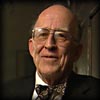
Helmut Koester KNOW THYSELF
Helmut Koester:
"John H. Morison Professor of New Testament Studies and Winn Professor of Ecclesiastical History Harvard Divinity School
One of these documents [found at Nag Hammadi] begins with the scribal note in the margin, 'The Gospel According to Thomas.' And the first sentence of that document says, 'These are the secret words which the living Jesus taught and which Judas Thomas Didymos wrote down.' And then they start a total of over 110 sayings, each introduced by 'Jesus said....' Some of those sayings have parallels in the gospels of Mark, Matthew, and Luke. Some of these have not. Some of these sayings may go back to a very early period of Christianity, some of them may have been added later. The document itself comes from the fourth century.... As with all gospel text, with this one in particular, we have to remember that these texts were fluid, that scribes could add, that scribes could leave out things, that scribes could add comments, or add an interpretation. So we cannot with certainty reconstruct what did the Gospel of Thomas look like around the year 100 or earlier. But it is very likely that it existed at that time, and that a good deal of the material that's now in that manuscript was already in a Greek manuscript that dates back to the first century. Which of course, is very exciting because here we have a collection of sayings of Jesus, additional sayings of Jesus, that were not known before, and the whole beginning of a new field of studies has opened up....
Now what is typical about these sayings is that in each instance, these sayings want to say that if you want to understand what Jesus said, you have to recognize yourself. You have to know yourself, know who you are. It begins with a saying about the Kingdom of God, 'if you seek the Kingdom of God in the sky then the birds will precede you. And if you seek it in the sea, then the fish will precede you, but the Kingdom is in you. And if you know yourself then you know the Kingdom of God.' (The Kingdom of the Father, in fact, it always says in the gospel of Thomas. Normally the Kingdom of the Father, not the Kingdom of God.) 'But if you don't know yourself, you live in poverty.' And poverty is understood as the ignorance of a life in its physical existence. Knowledge is understood to be the knowledge of one's divine origin, of the fact that one has come from the Kingdom. That we are on this earth only in a sojourn....
What does it mean really to know oneself? To know oneself is to have insight into one's own ultimate divine identity. You can go back to understand this to Greek models, which certainly exist. 'Know yourself' is a very old Greek maxim... that is, you have to know that your own soul is divine, and then you know that you are immortal, whereas the body is the mortal part of human existence. Now this is radicalized in the Gospel of Thomas into saying that everything that is experienced physically and through sense perception, everything in this world that you can perceive in this way is nothing. It is, at best, chaos and, at worst, it doesn't even exist in reality. The only thing that really exists is your divine spirit or your divine soul, which is identical in its quality with God himself. And Jesus is the one who teaches that....
[When one truly knows oneself], one understands that one is divine, but also one understands that one is mortal. In such a way, you recognize that this mortality is really meaningless, as physical existence is meaningless. And therefore, death is no longer a problem, but death is a solution, because in death finally all this mortality will fall away, and the true self will be liberated to an independent existence that's no longer dependent on physical existence. And on everything that goes with physical existence, sickness and poverty and so on. And so physical existence is often described as poverty. But when you know yourself you are no longer in poverty.”
A leading authority on the Gospels in early Christianity, Helmut Koester has served as editor of the Harvard Theological Review since 1975. A former president of the Society of Biblical Literature, Koester is also a fellow of the American Academy of Arts and Sciences. Among his numerous publications are books and articles in both German and English, including Trajectories Through Early Christianity (with James M. Robinson). His two-volume Introduction to the New Testament and Ancient Christian Gospels are seminal works in the field. Koester studied at the University of Marburg where he received his doctorate in 1954; he was ordained to the Lutheran ministry in 1956, and began teaching at Harvard Divinity School two years later.
http://www.pbs.org/wgbh/pages/frontline/shows/religion/story/thomas.html
Web (September 16, 2013)
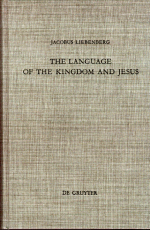
"When the historical Jesus started his pilgrimage into the 20th century he did so with Mk 1:15 as his mandate presented to him by Johannes Weiss on behalf of Jesus of Nazareth. Albert Schweitzer ensured that he not only spoke about this eschatological"Kingdom of God'", but that he arranged (and rearranged — if need be) his life according to its principles, only in order to be confused later by Bultmann with a Geschichte of a totally different kind. However, it was not long before his eschatology was historicised again by introducing his parables into the"life setting"of Jesus of Nazareth. Then, one day, people started asking what he meant by this"Kingdom of God"Which he presented so strikingly in his parables, and he had to admit that he was not quite sure.”
The Language of the Kingdom and Jesus
Jacobus Liebenberg, Walter de Gruyter (October 2000), page 1
JESUS' PROCLAMATION OF THE KINGDOM OF GOD
“Central to the synoptic gospels is Jesus' proclamation of the
Kingdom of God. Jesus' primary mission to his people was to offer
them the possibility of eschatological salvation, which, for the most
part, he expressed by the term 'Kingdom of God.' (A synonym for the
Kingdom of God is the Kingdom of Heaven, found in the Gospel of
Matthew.)...
Kingdom of God in the midst of You (Luke 17:20-21)
"Central to the synoptic gospels is Jesus' proclamation of the Kingdom of God. Jesus' primary mission to the Jewish people was to offer them the possibility of participation in final, or eschatological, salvation, which, for the most part, he expressed by the term"Kingdom of God.” (A synonym for the Kingdom of God is the Kingdom of Heaven, found in the Gospel of Matthew.) Jesus interpreted his exorcisms and healings as manifestations of the Kingdom of God...
20 Being asked by the Pharisees when the Kingdom of God was coming,
he answered them, 'The Kingdom of God is not coming with signs to be
observed; 21 nor will they say, 'Lo, here it is!' or 'There!' for
behold, the Kingdom of God is in the midst of you.'
Luke contains a saying in which Jesus describes the nature of the
appearance of the Kingdom of God; in it he connects the Kingdom with
himself. The Pharisees ask Jesus when the Kingdom of God will come in
17:20a. Jesus' response in 17:20b-21 is constructed in antithetical
parallelism. The negative member of Jesus' response consists of two
coordinating clauses joined by 'nor,' which describe how the Kingdom
of God does not come: 'The Kingdom of God is not coming with signs to
be observed, nor will they say, 'Look, here it is!' or, 'There it
is!' The first way in which the Kingdom does not come is 'with signs
to be observed' (meta paratêrêseôs). In the context, the meaning
of 'signs to be observed' probably describes empirically observable
phenomena associated with the inception of eschatological
fulfillment. Jesus' questioners hold the view that the coming of the
Kingdom of God will be universally recognizable by its accompanying
manifestations, and they want to know when Jesus believes these
premonitory manifestations will begin to occur, thereby heralding the
Kingdom. (On this interpretation 'come' has a future meaning since it
is referring to the future Kingdom of God.) The second way in which
the Kingdom of God does not come is in such a way that someone could
say 'Look, here it is!' or, 'There it is!' The meaning seems to be
the same as 'with signs to be observed.' In other words, Jesus is
saying that, contrary to their expectation, the Kingdom of God will
not come in such a way as to be universally recognized as such. He
rejects the presupposition behind the question, namely that the
Kingdom of God will all at once come as a publicly observable event.
In other words, the Kingdom will not come all at once, as full-blown,
so that no one could deny that it has come. Rather, Jesus' conception
of the Kingdom of God is that it begins inconspicuously, so that it
is possible to deny that it has come at the earliest stages of its
historical development.
The positive member of Jesus' response is the remarkable statement
that the Kingdom of God has already come: 'For behold, the kingdom of
God is in your midst (entos humôn).' Jesus' point is that the Kingdom
of God is in the midst of his questioners insofar as he is in their
midst, so inseparable is he from the Kingdom. Of course, the Kingdom
is in its initial phases and so is still only partially and even
ambiguously present. For this reason, the possibility exists to deny
that it is present at all, in which case Jesus would be seen as
having no salvation-historical significance at all. When it comes to
completion, the Kingdom of God will be undeniable, but until then a
person will be able to accept or reject Jesus' claim that the Kingdom
of God is already present insofar as he is present...
Entering the Kingdom Maimed (Mark 9:43-48 = Matt 18:8-9)
Mark 9:43-48
43 And if your hand causes you to sin, cut it off; it is better for
you to enter life maimed than with two hands to go to hell, to the
unquenchable fire. 44 [omitted] 45 And if your foot causes you to
sin, cut it off; it is better for you to enter life lame than with
two feet to be thrown into hell. 46 [omitted] 47 And if your eye
causes you to sin, pluck it out; it is better for you to enter the
Kingdom of God with one eye than with two eyes to be thrown into
hell, 48 where their worm does not die, and the fire is not quenched.
Matt 18:8-9
8 And if your hand or your foot causes you to sin, cut it off and
throw it away; it is better for you to enter life maimed or lame than
with two hands or two feet to be thrown into the eternal fire. 9 And
if your eye causes you to sin, pluck it out and throw it away; it is
better for you to enter life with one eye than with two eyes to be
thrown into the hell of fire.
Jesus teaches that a person must remove all impediments in order to
to enter the Kingdom of God (eiselthein eis tên basileian tou theou)
(Mark 9:47), which is synonymous with to enter into life (eiselthein
eis tên zoên) (Mark 9:43, 45), since it is better to do without any
so-called advantage than to miss entering the Kingdom of God or into
life. (The term "Kingdom of God" is synonymous with "life.”) This is
expressed metaphorically as being willing to cut off one's hands and
one's feet and being willing to remove one's eye, if necessary. The
analogy between sin and a part of one's body is that, like the
latter, the former may be a cherished part of one's livelihood and
identity, which one may be understandably reluctant to thrust aside
since the loss of it would be keenly felt. One's bodily parts
represent what is closest and most valuable to a person, which must
be given up if it impedes entrance into the Kingdom of God or life.
The consequence of not being willing to sacrifice anything to enter
the Kingdom of God or life is punishment in Gehenna (or eternal
fire). The entrance of which Jesus speaks is a future entrance,
coincidental with final judgment; in fact, one must pass through
final judgment in order to enter the Kingdom of God as future or
life.”
Crandall University
Religious Studies 2033
The New Testament nd Its Context, Professor Barry Smith
http://www.mycrandall.ca/courses/NTIntro/IndexNTIntr.htm
Web (September 16, 2013)
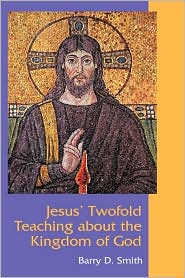
Jesus' Twofold Teaching about the Kingdom of God (New Testament Monographs)
Barry D. Smith
Recent research on Jesus' teaching about the Kingdom of God has in common the assumption that it remains the same throughout the time of his proclamation of it. The data that cannot be harmonized are usually judged to be inauthentic, originating from Christian prophets in the early church.
Smith shows in closely argued detail how essential it is to differentiate two historical contexts for Jesus' teaching about the Kingdom of God. The nature of the Kingdom of God is conditional upon its acceptance and the acceptance of its messenger-which is to say, Jesus' teaching about the Kingdom of God is hypothetical. This is the non-rejection context of Jesus' teaching about the Kingdom of God. But some of Jesus' teaching about the Kingdom of God presupposes a context of the rejection of his message by the majority of Jews and especially the Jewish authorities. In this new context, Jesus teaches that the Kingdom will still come but not in the way first delineated, in the non-rejection context. This can be called the rejection context of Jesus' teaching about the Kingdom of God.
No attempt should be made to assimilate all the data into one historical context. Distinguishing two contexts for Jesus' teaching about the Kingdom of God allows us to appreciate how Jesus modifies his teaching in the light of the rejection of the Kingdom. Without this differentiation of two historical contexts, it is impossible to make sense of Jesus' teaching about the Kingdom of God.
http://www.amazon.com/Twofold-Teaching-Kingdom-Testament-Monographs/dp/1906055688
Web (September 16, 2013)
Nothing less than the Gospel message of salvation is at stake
"In the Book of Acts the Kingdom of God was still the general formula for the substance of Christian teaching...” (Hastings Dictionary of the Bible, Vol. II, p. 855).
On the lips of Jesus the term Kingdom of God unquestionably summarized the very heart of His Message.”The Kingdom of God is the central theme of the teaching of Jesus, and it involves His whole understanding of His own person and work" (Theological Word Book of the Bible, Alan Richardson, p. 119).
"Yet the voluminous discussions of the meaning of the Kingdom of the God, the heart of the Gospel preached by Jesus, and therefore the Christian Gospel, continue to leave the impression that the subject is complex in the extreme, indeed that the truth of the matter is virtually beyond recovery. An enormous amount of scholarly energy has gone into analyzing the biblical and non-biblical evidence in an effort to explain what Jesus taught as His central theme. Can it really be that our New Testament records provide no clear idea of what Christ and the Apostles meant us to understand by the Kingdom of God? Nothing less than the Gospel message of salvation is at stake.”
Anthony Buzzard, The Kingdom of God: Present or Future?
Web (May 13, 2013)
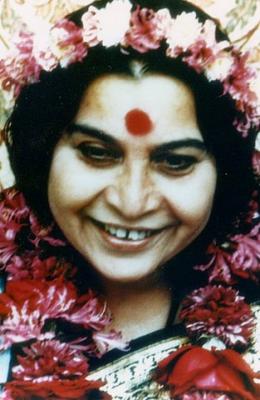
The Spirit-Paraclete “Today we are celebrating the opening of the Sahasrara (Kingdom of God). On this day I must say it was a great happening that took place on all the humanity. It was such an achievement, which I never realized before. Now I can see that without Self-Realization it would have been impossible to talk to people. Then this happened! I thought that how I will talk to people about it because no one would understand Me and it would be a big mistake on My part to say something about Sahasrara because even about Sahasrara (Kingdom of God) nowhere in the scriptures something was described. It was absolutely an ambiguous description I would say where people could not even have thought there is a Realm beyond Sahasrara, and one has to enter that Realm where is the Reality. That time what I saw around Me was darkness and unless and until there are many Lights, people will never realize that how important it is to have Light.”
The Paraclete Shri Mataji Cabella, Italy — June 9, 1996
 Shri Mataji opens the Primordial Sahasrara (May 5th 1970)
The Spirit-Paraclete "Without breaking the Sahasrara we could not have achieved the ascent en masse... To keep Sahasrara open should be very easy if the western brains could understand and be aware of your Mother. When your Mother is the Deity of Sahasrara the only way to be able to keep the Sahasrara open has to be complete surrendering....
The area of the Sahasrara is the realm of God. When the Brahmarandhra opens fully then the heavens open within yourself. The Kundalini, which has risen up and given you Realization, creates the opening by which the Divine starts pouring all its subtleties inside your brain...
All of us can achieve that state of Nirvikalpa... After Nirvikalpa you cannot come down.”
The Paraclete Shri MatajiVienna, Austria — May 4, 1985
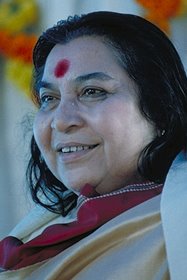
The Spirit-Paraclete "So one has to understand that evolutionary process is absolutely free, without any effort and you can't pay for your evolution. It is spontaneous. Like you have this Mother Earth and you put the seed in it, then it sprouts by itself. What do you do? Nothing. It is spontaneous and that's what exactly happens to you, that spontaneously you achieve that state of the Spirit....
So science cannot answer many questions and one of them is that why are we on this Earth? What is the purpose of our life? What is the goal of our life? What is our identity? This question is not asked and, if asked, they cannot answer. They cannot answer this simple question," Why are we on this Earth?”But one has to know that we are on this Earth to become the Spirit, to enter into the Kingdom of God. This is our purpose. That's why we are here and then to be the instruments of that Divine Power, which is All-Pervading.”
The Paraclete Shri MatajiPhiladelphia, USA — October 15, 1993
-2.jpg)
The Spirit-Paraclete "You cannot force on the organization of God anything. He is on His own, His organization is on His own. Only thing you can do is to enter into His Kingdom and become a part and parcel of that blissful domain.
You would never like to change it either. It is so wonderful. It is so protective, it's so loving, is so gentle, so kind, so compassionate, that you would hate to change that organization, but we do! We try to organize God.
For people who think that is the ultimate you have to seek, it's all arranged to enter into the Kingdom of God. The time has come. This is the Day of Resurrection. These are the days of Resurrection.”
The Paraclete Shri MatajiHampstead, UK — July 22, 1982
Disclaimer: Our material may be copied, printed and distributed by referring to this site. This site also contains copyrighted material the use of which has not always been specifically authorized by the copyright owner. We are making such material available to our readers under the education and research provisions of "fair use" in an effort to advance freedom of inquiry for a better understanding of religious, spiritual and inter-faith issues. The material on this site is distributed without profit. If you wish to use copyrighted material for purposes other than “fair use” you must request permission from the copyright owner.
