Descent Of The Divine Mother
“But today is the day I declare that I am the One who has to save the humanity. I declare I am the One who is Adishakti, who is The Mother of all The Mothers, who is the Primordial Mother, the Shakti, the desire of God, who has incarnated on this Earth to give its meaning to itself; to this creation, to human beings and I am sure through My Love and patience and My powers I am going to achieve it. I was the One who was born again and again, but now in my complete form and complete powers I have come on this Earth not only for salvation of human beings, not only for their emancipation, but for granting them the Kingdom of Heaven, the Joy, the Bliss that your Father wants to bestow upon you.”The Paraclete Shri Mataji, 2 December 1979—London, UK
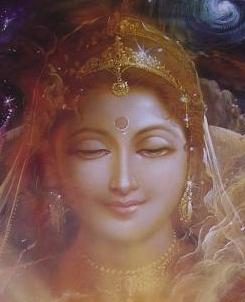
(unlimited power), omnipresent (present everywhere)
Divine Mother of extreme beauty and ageless eternity.
"Therefore a person should ever strive for the
destruction of ignorance, for one's birth is fruitful when
ignorance is destroyed. One thereby attains the end of
human existence and the state of being liberated
while living.”— The Divine Mother (Devi Gita 4.7-8)
"May all the gods attend to what I have to say. By
merely hearing these words of mine, one attains my
essential nature. I alone existed in the beginning;
there was nothing else at all, O Mountain King. My
true Self is known as pure consciousness, the highest
intelligence, the one Supreme Brahman/Thus through
hearing about, reflecting upon, and ascertaining the
Self by the Self, one should also, through intense
meditation, realize that I am in essence the Self...
By this meditation, O King, the noble person will
perceive me directly and then merge into my own
essence since we two are one. By practicing this yoga,
one realizes me as the supreme Self. In that instant,
ignorance and its effects all perish.”
— The Divine Mother (Devi Gita 2.12;/4.40;49-50)
"The Devi insists that liberating knowledge can be
attained here in this world, while still living. Seeking
such knowledge alone makes life worthwhile, and
the attainment of knowledge completely fulfils the
ultimate purpose of existence.” (Brown 2002, 25)
“Now the name Nirmala itself means immaculate;
means the one who is the cleansing power and the
name of the Goddess also. My actual sign name is
Lalita who is the name of the Primordial Mother.
That is the name of the Primordial Mother.”
The Paraclete Shri Mataji
New York, USA—30 September 1981
"In this first saying about the Paraclete Jesus
establishes only the foundation for the whole work
of the Paraclete: that the Spirit will dwell with them
and in them as their own personal guest; the Spirit
will be in them permanently as the new presence
of Jesus.” (Kinn 2004, 128)
"The first essential characteristic of Gnosticism was
introduced above: Gnosticism asserts that 'direct,
personal and absolute knowledge of the authentic
truths of existence is accessible to human beings,'
and that the attainment of such knowledge is the
supreme achievement of human life. Gnosis,
remember, is not a rational, propositional, logical
understanding, but a knowing acquired by
experience.” (Robinson 1990, 10)
Except for quotes and images of Her incarnation
Shri Mataji Nirmala Devi, this site is almost entirely
about Devi, the Divine Feminine. The Devi's yoga
(to unite) requires absolutely discarding all external
rules, rituals and rulers. Only then can meditation and
merging with the Divine Mother within truly begin.
Hence the term "Self-realization", and the means of
realizing Her as our divine core or Self begins here.
(Please note that these quotes represent a miniscule
portion of about 3000 public speeches and private
conversations with disciples over nearly four decades.)
He then told the Great Mother that he wanted to witness exactly how She had descended on Earth after being requested by the gods to save humanity. The Devi told him that She would do so after meditation.
All present raised their Kundalinis collectively and went into the thoughtless state.
When they finished Shri Adhiparasakthi stepped down from Her Golden Throne and said to Kash, “Come down to Earth with Me.”
On April 30, 1994, Kash was told to request from the Great Divine Mother another revelation. The Sahaja Yogi who gave Kash Self-Realization explained that before Shri Mataji incarnated Herself on Earth there was a major discussion in heaven among the Divine Unity concerning human beings. Something drastic had to be done to enlighten humans before they completely destroyed themselves. Despite all the messengers, prophets, and incarnations, despite all the collective wisdom of all the Holy Books, despite all social, educational and economic progress, the human species were now beginning to gather speed as they hurtled down the road of self-destruction. It was time for the Creator to act and save His Creation.
All the Messengers of God Almighty then requested that Shri Mata, The Mother, should at last go down to Earth in human form and lead humankind higher up the evolutionary path by infusing them with a massive burst of enlightenment. Who else but the Adi Shakti would be able to do such a tremendous job of en masse transformation?
Kash was just told to find out how it is possible for someone to descend directly from the Spirit World to Earth.
He agreed and went to meditate in his room. He closed his eyes and said the sacred mantras. Immediately the Divine Energy of the Holy Spirit coiled in his sacrum bone responded. He traveled up the Tree of Life, right from its roots at the base of his spine up towards the Great Lotus Forest (Sahasrara). At the optic chiasma he entered the Narrow Gate and reached the Templum Spiritus Sanctus illuminated by the Everlasting Light.
He bowed down to the Mahadevi and exchanged greetings. Shri Krishna, Ganesha, Jesus, Prophet Muhammad, Guru Nanak, Buddha, Rama, Sita, Vishnu, Laksmi, Shiva and others were already present, sitting in a semicircle facing their beloved Divine Mother.
Her child wished all of them and greetings were returned.
He then told the Great Mother that he wanted to witness exactly how She had descended on Earth after being requested by the gods to save humanity. The Devi told him that She would do so after meditation.
All present raised their Kundalinis collectively and went into the thoughtless state.
When they finished Shri Adhiparasakthi stepped down from Her Golden Throne and said to Kash, “Come down to Earth with Me.”
He walked to Her as Shri Visva-Garbha smiled radiantly in Bliss and Joy. She stretched Her hands with palms downturned. Kash was instructed to do the same, but this time with his palms facing upwards but below Her palms, as they were going down to Earth. He did so and they began to descend through the clouds into the vast emptiness of endless space. (This was the first and only occasion that Kash experienced 'delevitation,' that is, descending down from the Kingdom of God.)
Her child could see asteroids of all sizes and shapes whizzing past. Occasionally tiny dots grew into gargantuan planets and flew by at astronomical speed. Far away distant stars twinkled. Kash was in a cosmic fairyland sparkling with countless suspended universes that stretched into infinity.
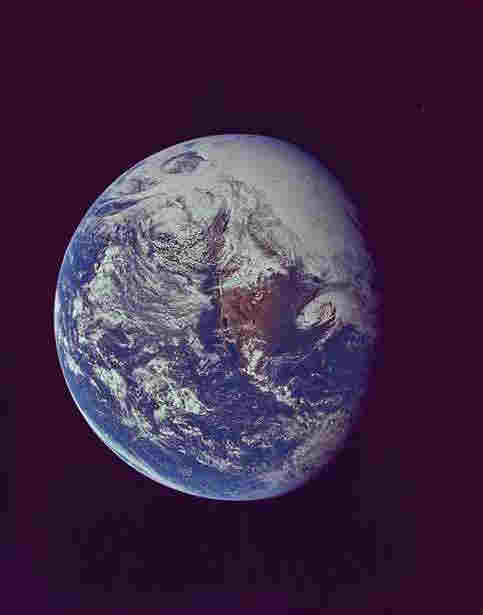
Mother Earth At first Earth was just a tiny dot and he could not recognize it. However, when it grew in size the familiar features of Earth appeared; a blue ball with slight traces of white. Kash knew that it was Mother Earth as he had seen similar sights on television.
As Earth grew larger he could see the outline of the continents and the cloud cover clearly. The womb of humanity was a beautiful blue pearl suspended against a backdrop of infinite, mysterious, dark space.
They came fast through the atmosphere and then slowed down rapidly.
They landed at the right corner of the St. Joseph and 34th. Avenue T-junction. The Holy Spirit had brought Kash back to Lachine, Montreal! He could see the Resurrection of Our Holy Lord Catholic Church and the Saint-Louis school on his left, with rows of houses on both sides of the road behind. Beside the school was the Dairy Queen outlet where he sometimes came with his family for ice cream. The pier jutting out into the seaway, with a weathered red and white lighthouse at the tip, was directly in front. On his right he could see the beach line that ran into a knot of trees at the far end. Across the St. Lawrence Seaway he could see the familiar shoreline where stood a solitary church with a steeple and silvery spire rising above the flat landscape.
The Great Divine Mother stood around with him, casually observing humans, their activities and environment as cars cruised along the picturesque rue St-Joseph. Across the road people were strolling, bicycling, picnicking, fishing, or just sitting around on the benches.
Not even a single earthly creature even glanced at them — They were invisible! Kash was sure of this fact as Shri Mataji was enfolded in a red sari with small colorful flowers and Her dazzling personality, devastating beauty and divine radiance would be obvious to all pedestrians and passengers alike. Yet no one ever looked at Her for She was indeed invisible!
After a while Shri Loka-yatra-vidhayini told Kash that it was time to return. She then held out Her Hands again, asked him to put his palms over Her upturned palms, levitated him, and they began ascending upwards. They swiftly passed through the stratosphere and Earth disappeared from view. They hurtled into the limitless universe and ascended through different dimensions of the Spiritual Worlds. Soon they reached the Jeweled Island, the highest heaven and abode of the Devi.
The Immortal Ones were still there, waiting for their return. Kash again bowed to them and sat down beside Shri Lalita Devi, who was now seated on Her Golden Throne. They then had another collective meditation after which he asked for leave and returned to this frantic world of stock speculators and currency manipulators.
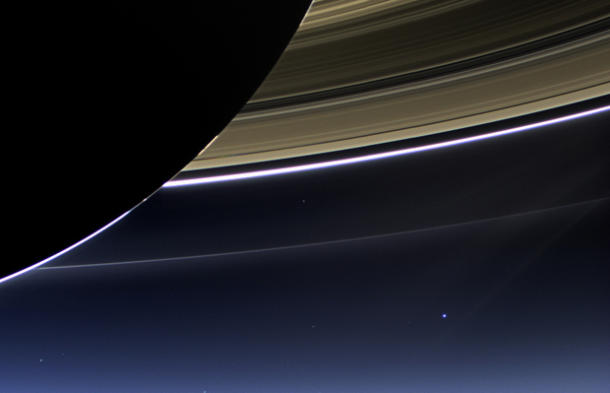
Passing behind Saturn last Friday, NASA's Cassini spacecraft snapped a series of pictures showing the planet and its rings, including planet Earth as a "pale blue dot" 898 million miles away. NASA New NASA photo from Saturn shows Earth as tiny bluish dot
CAPE CANAVERAL, Fla. — Reuters
Published Tuesday, Jul. 23 2013
“A robotic space probe nearly 1.5 billion kilometres from Earth turned its gaze away from Saturn and its entourage of moons to take a picture of its home planet, NASA said on Monday.
The resulting image shows Earth as a very small, blue-tinged dot—paler and tinier than in other photos—overshadowed by the giant Saturn's rings in foreground.
"We can't see individual continents or people in this portrait of Earth, but this pale blue dot is a succinct summary of who we were on July 19," Linda Spilker, Cassini spacecraft lead scientist at the Jet Propulsion Laboratory in Pasadena, California, said in a statement.”
The Globe and Mail
July 23 2013
"Nasa has released photos of the Earth and Moon taken by a spacecraft orbiting Saturn - nearly a billion miles away.
Our planet and its only satellite appear only as dots in the picture, which was taken by the Cassini spacecraft on 19 July.
Scientists wanted to pay homage to the 'Pale Blue Dot' image captured by the Voyager 1 probe in 1990.”
BBC
July 23 2013
The highest of all heavenly realms is the Jeweled Island paradise of the Devi
The supremacy of Bhuvanesvari in the Devi-Bhagavata is marvelously evoked in a detailed description of this paradisial island home of the Goddess, highest of all heavenly realms. The island, lying in the Ocean of Nectar, is forested with a great number of fantastic flowering trees, perfumed with the scent of divine blossoms and resplendent with ornamental lakes and rivers. The palatial structures include a number of walled enclosures, concentrically arranged. within each enclosure dwell various classes of celestial beings, gods and goddesses, and their incarnations. In the enclosure just outside the central circle reside the closest companions or helpers of the Goddess, her great divisions (maha-bhedas), identified as or associated with her avataras and referred to as Mahavidyas. In the innermost enclosure dwells Bhuvanesvari herself. Her distinctness from, and transcendence over, the Mahavidyas is hereby amply demonstrated.
within the final enclosure is the Goddess' own mansion, a magnificent dwelling constructed of wish-fulfilling gems (cintamani). Inside the mansion are situated four mandapas (halls), in which she conducts four different sorts of business: indulging in amorous sport, delivering souls from the bondage of rebirth, discoursing on truth, and consulting with her ministers on running the universe.
within the palace also is the great couch of the five corpses, mentioned earlier. Reclining on this great couch in the midst of her jeweled palace, Bhuvanesvari is described in terms similar to that of the goddess Tripura in the Tripura-Rahasya, and of Lalita (an alternative name of Tripura) in the Brahmanda Purana. Indeed, the Devi Gita's Bhuvanesvari seems especially to fuse the characters of her own self as ruling queen with that of Tripura/Lalita, who as mentioned above is associated with the giving of liberation. Of all the Mahavidyas, it is Bhuvanesvari and Tripua/Lalita who are generally the closest iconographically. Like Bhuvanesvari, Tripura/Lalita is charmingly beautiful, clothed in red, three-eyed and four-armed, bearing a noose and goad, although her other two hands hold a sugarcane bow and flower arrows rather than gesturing Bhuvanesvari's beneficence and assurance of safety. The easy fusion of these two Mahavidyas reinforces the Tantric ideal that the Goddess is the giver of both bhukti and mukti (enjoyment and liberation).”
C. MacKenzie Brown, The Devi Gita: The Song of the Goddess
State University of New York Press (September 1998) pp. 24-25
Mata (1): The Mother as the creative aspect of Brahman (God Almighty); Sacred Mother; the Seer, the Seen and the Seeing.
Visva-Garbha (638th): The entire universe is within Her as She is The Mother of the universe.
Loka-yatra-vidhayini (664th): One who determines the life cycle of the universe. Modern science describes various states of the Universe as De Sitter's universe and Einstein's universe.
Note: On May 22, 1997 at 7:30 a.m. Kash was again asked if they were invisible. He replied that they were. He added that this time their bodies were not in the form of the spirit but flesh and blood. He was asked to elaborate. According to him in the Kingdom of God everyone is semi-transparent, that is, in the ethereal form of the spirit. However, after descending down to Earth he noticed that his body was not in the semi-transparent form of the spirit but that of a human. Even the Holy Spirit was all flesh and blood. Yet they were invisible to all human beings.
The Mahadevi had proved to Kash that She did indeed descend on Earth as requested by the Messengers of God Almighty — in the human form as Shri Mataji Nirmala Devi!"Although She is eternal, when She manifests to accomplish the purpose of the gods, She is said to be born in the world.” Devi-Mahatmya 1.66

"She began her mission of salvation in earnest, establishing a reputation as a faith healer ... Then, on December 2nd 1979, in London, she unequivocally declared her divinity to her followers: 'Today is the day I declare that I am the One who has to save the humanity. I declare, I am the one who is Adi Shakti, who is The Mother of all The Mothers, who is the Primordial Mother, the Shakti, the purest desire of God, who has incarnated on this Earth to give meaning to itself...' Since then, she is most often understood by her followers to be the Devi, the Goddess of Indian mythology, returned to save the world.”
Judith Coney, Sahaja Yoga: Socializing Processes in a South Asian New Religious Movement (1999) p. 27
"Just as Visnu ... Devi, too, promises to return if needed.”
"Devi originated at a time of cosmic crisis and, consequently, her role seems very similar to that of Visnu in his many avataras (incarnations). Just as Visnu promised to manifest himself in order to protect the cosmic balance, Devi, too, promises to return if needed... I am Nirguna. And when I am united with my Sakti, Maya, I become saguna, the Great Cause of this world. This Maya is divided into two, Vidya and Avidya. Avidya Maya hides me; whereas Vidya Maya does not. Avidya creates whereas Vidya Maya liberates.” Devi-Bhagavatam 7. 32. 7-8
The Metaphysical Goddess
The Devi-Mahatmya
Two texts in particular have been most influential in establishing the all-inclusive nature of feminine power. The first and most popular goddess-centred text is the Devi-Mahatmya, originally a section of the Markandeya Purana. The importance of this text, and its uniqueness, are apparent in its independence from the parent text. Thomas Coburn comments that while there are very few complete manuscripts of the Markandya Purana, those of the Devi-Mahatmya are countless. The recitation of the text is still an integral part of goddess worship, where, according to Coburn, it forms a part of "daily liturgy in temples of Durga" and “A central place during the ... festival of Durga Puja.”
It is here, in the Devi-Mahatmya, that the concept of an all-inclusive Goddess is fully elucidated. within a mythical framework of the Goddess's martial deeds, is the assertion that she is the Ultimate Reality, an idea transmitted by inference rather than in direct terms. Mythically, in order to conquer the asuras (demons) that threatened the very existence of the devas (gods), a supremely powerful goddess was created from the combined anger of the gods.
Then from Visnu's face, which was filled with rage, came forth a great fiery splendor (tejas), (and also from the faces) of Brahma and Siva.
And from the bodies of the other gods, Indra and the others, came forth a fiery splendor, and it became unified in one place.
An exceedingly fiery mass like a flaming mountain did the gods see there, filling the firmament with flames.
That peerless splendour, born from the bodies of all the gods, unified and pervading the triple world with its lustre, became a woman.
Devi Mahatmya 2. 9-12
The vital power that emanated from the gods took shape in the feminine form, and from there on was accepted as the Mahadevi, a supreme Goddess in her own right. She is entirely separate from the gods, the embodiment of sakti, and able to produce further powers of her own. When her work is done, she disappears; she does not return to her source, the gods. The text reinforces the conceptual notion of a Great Goddess, Mahadevi, the embodiment of power...
One of the most interesting facets of Devi's character in the Devi-Matahmya is her independence and her challenge to the stereotypes of goddesses previously presented. The Goddess here does not depend on a male consort, and successful manages male roles herself. In battle, for instance, she does not fight with male allies; if she needs assistance, she tends to create female helpers, like Kali, from herself. Her role as Sakti also differs from that of the puranic goddesses as she does not empower the male deities.” Unlike the normal female, Durga does not lend her powers or sakti to a male consort but rather takes power from the male gods in order to perform her own heroic exploits. They give up their inner strength, fire, and heat to create her and in so doing surrender their potency to her.”
The Devi-Mahatmya makes clear that the conceptual goddess cannot be easily categorized. The "Goddess" so carefully outlined in the text leaves the reader in no doubt of the fluidity of her character. She is the personification of all aspects of energy, being simultaneously creative, preservative and destructive.
By you is everything supported, by you is the world created; by you is it protected,
O Goddess, and you always consume (it) at the end (of time).
At (its) emanation you have the form of creation, in (its) protection (you have) the form of steadiness; likewise at the end of this world (you have) the form of destruction. O you who consist of this world!
You are the great knowledge (mahavidya), the great illusion (mahamaya), the great insight (mahamedha), the great memory, and the great delusion, the great Goddess (mahadevi), the great demoness (mahasuri).
Devi-Mahatmya 1. 56-8
This verse makes it clear that the all-encompassing Goddess in this text represents all aspects of power and energy, both positive and negative, as she is described as devi (goddess) and asuri (demoness). The Devi of the Devi-Mahatmya is fully equated with Ultimate Reality, presented as the power behind the functions of the trimurti, the triad of deities—Visnu, Siva and Brahma—who are responsible of the preservation, dissolution and creation of the universe respectively:
You are the primordial material (praktri) of everything, manifesting the triad of constituent strands, the night of destruction (periodic dissolution), the great night (final dissolution), and the terrible night of delusion.
Devi-Mahatmya 1. 59
Devi originated at a time of cosmic crisis and, consequently, her role seems very similar to that of Visnu in his many avataras (incarnations). Just as Visnu promised to manifest himself in order to protect the cosmic balance, Devi, too, promises to return if needed.
The Devi-Bhagavatam Purana
The Devi-Mahatmya is not the only text to offer an all-inclusive concept of female divinity, equated with the principle of Ultimate Reality. The later Devi-Bhagavatam presents a Sakta response to a variety of puranic strands of thought. According to Cheever Mackenzie Brown, its original parts were written in response to the Bhagavata Purana. The Devi Gita, which comprises skanda (book) 7, chapters 30-40 of the Devi-Bhagavatam, is based on the style of the Bhagavad Gita, but is presented from a Sakta perspective. The ninth skanda, according to Brown, is almost a verbatim copy of the "Praktri Khanda" of the Brahmaraivarta Purana, which Brown describes as “A kind of encyclopedia of goddesses", associating them with praktri. The Devi-Bhagavatam also encompasses a version of the Devi-Mahatmya and retells a number of puranic myths. The text is more consistently metaphysically oriented than the earlier Devi-Mahatmya, frequently eulogizing the conceptual goddess who is the power behind all other deities.
That Goddess is Eternal and Ever Constant Primordial Force...
She is the source of Brahma, Visnu and the others and all of these living beings
Without Her force, no body would be able even to more their limbs.
That Supreme Auspicious Goddess is the preserving energy of Visnu, is the Creative power of Brahma, and is the destroying force of Siva.
Devi-Mahatmya 3. 30. 28-30
It is also significant that in the Devi-Bhagavatam, the Great Goddess is explicitly shown to be independent of any male authority and control. Indeed in the previous verses it is the gods that are completely subject to her will, being totally reliant on her power. The goddess/ses of Devi-Bhagavatam are repeatedly portrayed as eternal, the basis of everything, identical with Brahman.
When everything melts away i.e. there comes the Pralaya or general dissolution, then, I am not female, I am not male, nor am I hermaphrodite. I then remain as Brahma with Maya.
Devi-Bhagavatam 3. 6. 2
The Adya or Primordial Sakti is explicitly shown to be the source of all goddesses, from the highest to the lowest forms.
Maha Laksmi is Her sattvaki Sakti, Sarasvaati is Her Rajasik Sakti and Maha Kali is Her tamasik Sakti, these are all feminine forms.
Devi-Bhagavatam 1. 1. 20
The highest forms represent the major facets of her power or energy, the three gunas, encompassing both positive and negative energies. In the Devi-Bhagavatam, the essential character of the Mahadevi encompasses both praktri (material nature), in its unmanifest and manifest forms, and purusa (pure consciousness)—the dual realities of Sankhya philosophy. Unlike Sankhya and other schools of thought, particularly Advaita, the Devi-Bhagavatam portrays praktri in a more positive light; as an integral feature of the Goddess's power. Similarly, the concept of maya (illusion) is also presented positively rather than negatively, as an integral energy inherent in the act of creation.
I am Nirguna. And when I am united with my Sakti, Maya, I become saguna, the Great Cause of this world. This Maya is divided into two, Vidya and Avidya. Avidya Maya hides me; whereas Vidya Maya does not. Avidya creates whereas Vidya Maya liberates.
Devi-Bhagavatam 7. 32. 7-8
Brown points out an interesting and important difference between the conception of maya in the Bhagavata Purana, in which Visnu is the supreme deity, and that in the Devi-Bhagavatam. Whereas in the Bhagavata Purana, Visnu is the "controller and possessor of maya", the Goddess of the Devi-Bhagavatam, as well as wielding the power of maya, actually is maya. There appears to be a much more intimate relationship in the Devi-Bhagavatam between the Goddess and the workings of the cosmos, for as Visnu and Siva resort to their respective saktis for assistance, Devi resorts to no one but herself.
At the Feet of the Goddess: Divine Feminine in Local Hindu Religion
Lynn Foulston, Pages 11-15, Sussex Academic Press 1999
The Mahadevi
Central Theological and Philosophical Characteristics
An underlying theological assumption in texts celebrating the Mahadevi is that the ultimate reality in the universe is a powerful, creative, active, transcendent female being. The Lalita-sahasranama gives many names of the Mahadevi, and several of her epithets express this assumption. She is called, for example, the root of the world (Jagatikanda, name 325), she who transcends the universe (Visvadhika, 334), she who has no equal (Nirupama, 389), supreme ruler (Paramesvari, 396), she who pervades all (Vyapini, 400), she who is immeasurable (Aprameya, 413), she who creates innumerable universes (Anekakotibrahmandajanani, 620), she whose womb contains the universe (Visvagarbha, 637), she who is the support of all (Sarvadhara, 659), she who is omnipresent (Sarvaga, 702), she who is the ruler of all worlds (Sarvalokesi, 758), and she who supports the universe (Visvadharini, 759). In the Devi-bhagavata-purana, which also assumes the ultimate priority of the Mahadevi, she is said to be The Mother of all, to pervade the three worlds, to be the support of all (1.5.47-50), to be the life force of all beings, to be the ruler of all beings (1.5.51-54), to be the only cause of the universe (1.7.27), to create Brahma, Visnu, and Siva and to command them to perform their cosmic tasks (3.5.4.), to be the root of the tree of the universe (3.10.15), and to be she who is supreme knowledge (4.15.12). The text describes her by many other names and phrases as it exalts her to a position of cosmic supremacy.
One of the central philosophic ideas underlying the Mahadevi, an idea that in many ways captures her essential nature, is sakti. Sakti means "power"; in Hindu philosophy and theology sakti is understood to be the active dimension of the godhead, the divine power that underlies the godhead's ability to create the world and to display itself. within the totality of the godhead, sakti is the complementary pole of the divine tendency towards quiescence and stillness. It is quite common, furthermore, to identify sakti with a female being, a goddess, and to identify the other pole with her male consort. The two poles are understood to be interdependent and to have relatively equal status in terms of divine economy.
Texts of contexts exalting the Mahadevi, however, usually affirm sakti to be a power, or the power, underlying ultimate reality, or to be the ultimate reality itself. Instead of being understood as one or two poles or as one dimension of a bipolar conception of the divine, sakti as it applies to the Mahadevi is often identified with the essence of reality. If the Mahadevi as sakti is related to another dimension of the divine in the form of a male deity, he will tend to play a subservient role in relation to her. In focussing on the centrality of sakti as constituting the essence of the divine, texts usually describe the Mahadevi as a powerful, active, dynamic being who creates, pervades, governs, and protects the universe. As sakti, she is not aloof from the world but attentive to the cosmic rhythms and the needs of her devotees.
In a similar vein the Mahadevi is often identified with prakrti and maya. Indeed, two of her most common epithets are Mulaprakrti (she who is primordial matter) and Mahamaya (she who is great maya)... In the quest for liberation prakrti represents that from which one seeks freedom. Similarly, most schools of Hindu philosophy identify maya with that which prevents one from seeing things as they really are. Maya is the process of superimposition by which one projects one's own ignorance on the world and thus obscures ultimate truth. To wake up to the truth of things necessarily involves counteracting or overcoming maya, which is grounded in ignorance and self-infatuation. Liberation in Hindu philosophy means to a great extent the transcendence of embodied, finite, phenomenal existence. And maya is often equated precisely with finite, phenomenal existence. To be in the phenomenal world, to be an individual creature, is to live enveloped in maya.
When the Mahadevi is associated with prakrti or maya, certain negative overtones sometimes persist. As prakrti or maya she is sometimes referred to as the great power that preoccupies individuals with phenomenal existence or as the cosmic force that impels even the gods to unconsciousness and sleep. But the overall result of the Mahadevi's identification with prakrti and maya is to infuse both ideas with positive dimensions. As prakrti or maya, the Devi is identified with existence itself, or with that which underlies all existent things. The emphasis is not on the binding aspects of matter or the created world but on the Devi as the ground of all things. Because it is she who pervades the material world as prakrti or maya, the phenomenal world tends to take on positive qualities. Or perhaps we could say that a positive attitude toward the world, which is evident in much of popular Hinduism, is affirmed when the Devi is identified with prakrti and maya. The central theological point here is that the Mahadevi is the world, she is all this creation, she is one with her creatures and her creation. Although a person's spiritual destiny ultimately may involve transcendence of the creation, the Devi's identification with existence per se is clearly intended to be a positive philosophical assertion. She is life, and to the extent that life is cherished and revered, she is cherished and revered.
As sakti, prakrti, and maya, the Devi is portrayed as an overwhelming presence that overflows itself, spilling forth into the creation, suffusing the world with vitality, energy, and power. When the Devi is identified with these well-known philosophical ideas, then, a positive point is being made: the Devi creates the world, she is the world. and she enlivens the world with creative power. As sakti, prakrti, and maya, she is not understood so much as binding creatures to finite existence as being the very source and vitality of creatures. She is the source of creatures—their mother—and as such her awesome, vital power is revered.
The idea of brahman is another central idea with which the Devi is associated. Ever since the time of the Upanishads, brahman has been the most commonly accepted term or designation for the ultimate reality in Hinduism. In the Upanishads, and throughout the Hindu tradition, brahman is described in two ways: as nirguna (having no qualities or beyond all qualities) and saguna (having qualities). As nirguna, which is usually affirmed to be the superior way of thinking about brahman, ultimate reality transcends all qualities, categories, and limitations. As nirguna, brahman transcends all attempts to circumscribe it. It is beyond all name and form (nama-rupa). As the ground of all things, as the fundamental principle of existence, however, brahman is also spoken of as having qualities, indeed, as manifesting itself in a multiplicity of deities, universes, and beings. As saguna, brahman reveals itself especially as the various deities of the Hindu pantheon. The main philosophical point asserted in the idea of saguna brahman is that underlying all the different gods is a unifying essence, namely, brahman. Each individual deity is understood to be a partial manifestation of brahman, which ultimately is beyond all specifying attributes, functions, and qualities.
The idea of brahman serves well the attempts in many texts devoted to the Devi to affirm her superior position in the Hindu pantheon. The idea of brahman makes two central philosophical points congenial to the theology of the Mahadevi: (1) she is ultimate reality itself, and (2) she is the source of all divine manifestations, male and female (but especially female). As saguna brahman, the Devi is portrayed as a great cosmic queen enthroned in the highest heaven, with a multitude of deities as the agents through which she governs the infinite universes. In her ultimate essence, however, some texts, despite their clear preference for the Devi's feminine characteristics, assert in traditional fashion that she is beyond all qualities, beyond male and female.”
David R. Kinsley, Hindu Goddesses: Visions of the Divine Feminine in the Hindu religious tradition
University of California Press (July 19, 1988) pp. 133-37
"The veneration of Devi can be traced as far back as 20,000 BC.”
"By you this universe is borne, By you this world is created, O Devi, by you it
is protected.” (Devi-Mahatmya).
Throughout India, devotees honour Devi in their temples and at wayside shrines.
Flowers garland her image with brightness, the light of countless lamps
illuminate her presence and the blood of thousands of animals stains the stones
of her altars crimson.
The Goddess is older than time, yet time itself. She is formless, yet to be
found in all forms. Her presence is in all things, yet she transcends all
things. She is ever-changing, yet eternally changeless. She is both the womb
from which all life flows forth and the tomb to which all life returns. Devi the
Shining One source of the life-giving powers of the universe, who is experienced
by her ecstatic worshipers as the Primal Cause and Mother of the World.
Roots
Pre-dating the patriarchal Male Trinity by thousands of years, the Goddess was
once worshipped throughout the ancient world. Now, only in India does her cult
remain widespread and part of a vibrant, living tradition in which her presence
empowers and stirs the hearts of her devotees with adoration and devotion.
The veneration of Devi can be traced as far back as 20,000 BC. A bone image of
the Great Mother was discovered at Mirzapur in Uttar Pradesh dating back to that
period. She was also revered at Harappa and Mohenjo-Daro in the Indus Valley
from 2,500 BC. Closely associated with the land itself, villagers in rural India
paid tribute to the Earth Goddess, adorning branches of trees and placing
shrines within them which carried her image. Smooth, oval-shaped stones also
marked her sacred sites.
Women were her channels and it was through them her rituals were performed,
rites for the dead and ceremonies to promote fertility and fruitfulness of the
land.
The Goddess reigned supreme until the patriarchal Aryans invaded the country in
1500 BC. The Harappan culture declined as these nomadic herding people initiated
a new age in which their male Gods became predominent. But the worship of Devi
could not be entirely suppressed. It was absorbed and transformed to accommodate
the new situation.
The Goddess became united in a Divine Marriage with the Gods of the Male
Trinity: Sarasvati with Brahma, Lakshmi with Vishnu, and Parvati, Kali and Durga
with Siva. Once given a priestly blessing, veneration of the Goddess as the
God's consort was incorporated in the regular rituals. As Sakti, she became the
powerful spiritual energy without which the God was unable to act.
Facets
The Goddess is multi-faceted, known by myriad names and personified in many
forms. As well as responding to the names of Parvati, Lakshmi, Sarasvati and
Sakti, she also manifests under the titles of Gauri, Uma, Sati, Aditi, Maya,
Ganga, Prakriti, Gayatri, Tara, Minaksi, Mahadevi, Kundalini, Durga, Kali,
Chamunda and in many other guises.
The great mountain peaks of the Himalayas Annapurna, Nanda Devi and
Chomo-Lung-Ma (known to Westerners as the world's highest mountain, Everest) all
testify to her divine presence. Like the facets of a diamond, these varying
forms of the Great Universal Energy that is Devi are merely reflections of the
countless aspects that make the whole, the Absolute.
Creator and Preserver
As Virgin and Mother, the Goddess is considered to be the very spring from which
every kind of love flows into the world. From the vast ocean of her being the
morphogenetic field that produces all forms the Goddess gives birth to all
living things. The pouring forth of this love-energy from her timeless, formless
source into the field of time constitutes a sacred mystery.
Representations of the Goddess as a crouching woman giving birth to the manifold
forms of her creation can be found in Indian art. As the Sky-Goddess Aditi, she
pervades all space and is mother to the Gods so revered by the Indo-Aryans.
Maya the Sanskrit word for "magic" and "Illusion" describes her role as the
originator of all material things, all that is perceptible to the senses.
Displaying the protective and maternal side of her nature, she revels in her
multitudinous manifestations and joyfully embraces the bounty of her gifts.
Sculptures adorning Hindu temples frequently depict the Virgin Goddess as a
young, beautiful and voluptuous woman. Sometimes she stands on her own, at
others she is paired with her God-consort.
As Earth Mother, she is also a deity closely associated with Nature and
fertility. Images of her priestesses, the Yoginis and Saktas, often incorporate
organic forms such as branches or vines, symbolising Nature in its most
instinctive form, proliferous and fruitful. Plants, leaves and flowers are
commonly used in Indian medicine and, when they appear in portrayals of the
Earth Mother they are considered to reflect the magical powers with which she is
endowed.
Although on one level, her naked body signifies the physical beauty and
attraction of the Eternal Feminine, it also symbolises the discarding of
illusion and, therefore, freedom from attachment.
Adorned with jewels and ornaments, she represents all that is precious. She
alone is the eternal jewel whose brilliance encompasses and illuminates the
universe.
Carved images of the Goddess and her Yoginis formulate the visual language which
conveys the essence of the philosophy lying at the core of her worship, which is
so little understood by most Westerners. Gazing at sculptures depicting the
joyous physical expression of love, they tend to miss the symbolism of the
divine ecstasy associated with the union of male and female energies that
transcend, transform and liberate the soul from the wheel of karma.
One of the most ancient cults of the Goddess is that of Sarasvati, who is both
worshipped as a sacred river of the same name and as the instigator and
protectress of the spoken word, as well as all intellectual and artistic
pursuits.
One of the most recent forms of her manifestation is that of Bharat Mata, Mother
India, a militant aspect of the Goddess that is much concerned with the cause of
Hindu nationalism.
Another manifestation is that of the beneficent Lakshmi, bringer of prosperity
and abundance. During the autumn festival of Diwali, people all over the country
light lamps in her honour to guide her into their homes.
The Goddess is also revered as Sati the pre-Vedic Virgin Bride who epitomises
the loyal and virtuous wife who is faithful to her husband even unto death. This
idea of wifely perfection is dear to the Indian way of thinking. Although in a
metaphysical sense it means Sati is totally at one with her own true being, it
is also an ethical concept. Sadly, the idea of the "perfect wife" who is
faithful unto death developed into the practice of suttee, in which a dutiful
spouse was expected to accompany her husband to the world beyond through
self-immolation voluntarily or otherwise in the flames of his funeral pyre.
In her aspect of the Great Mother, Devi's devotees believe the presence of the
Goddess exists within all her creations. She is their Mother. She gives them
life. She nurtures them through her physical manifestations and she is present
in their times of need. Through her worship, too, her devotees can transcend the
world of illusion and reach out to her true being.
To know the Goddess is to experience Being-Consciousness and bliss itself. But
Devi demands total surrender on the part of her followers before she condescends
to reveal herself in her divine state. Her fervent devotees must learn to see
her presence in all things. She must become the bedrock and the meaning of their
life. Then, and only then, can they aspire to experience her blessings in their
totality.
Even as in the psychological process of accepting the dark side of our own
nature to achieve a harmonious wholeness, it is necessary to understand the
Goddess in her terrible aspect also. For even as she is the bestower of life, as
Kali the personification of all-consuming Time she is also its destroyer, to
whom, at the appointed time, all manifested things return. They are absorbed
into her being, there to await rebirth in yet another cycle of cosmic creation.
Destroyer
As Devimahatma, Mahadevi or Durga (one of her most ancient titles), the
eternally existent mother who nurtures and protects her offspring, the Goddess's
influence swept across North India and was particularly popular in the regions
of Bengal and Rajasthan.
Famous for her prowess in battle, Durga the Unassailable used the strength of
her will, her knowledge and force of action, to defeat the purveyors of evil and
to vanquish the demonic forces upsetting the balance of the universe.
Riding on a lion or tiger, her multiple arms wielding auspicious weapons, she
was Cosmic Energy personified. When her mission was fulfilled she returned to
her mountain home, promising to nourish the earth and protect her worshipers,
only returning should her divine force be needed again.
At the height of this great cosmic battle, Durga was aided by the awesome Kali,
who burst from her forehead to devour or crush the army of demons. As Kali drank
the seed-blood of her enemies, she rendered impotent the destructive phallic
power of her assailants.
Black Kali represents the Crone aspect of the Triple Goddess. With her
dishevelled hair and lolling blood-drenched tongue, she presents a fearsome
figure.
As the active power of Time, her three eyes look to past, present and future.
Her thin waist is encircled by a girdle of human hands, symbolising the
accumulated deeds of karma. Around her neck hangs a rosary of fifty skulls, each
one inscribed with a magic letter of the Sanskrit alphabet representing the
sacred word, or mantra, which vibrates within the primordial creative energy of
the universe.
The Dark Goddess's four hands are also symbolic of her function: one wields a
sword to cleave the threads of bondage, another grasps a severed head,
representing the annihilation of the ego. Her two remaining hands are poised in
gestures to dispel fear and inspire her devotees with spiritual strength.
Paintings and sculptures sometimes depict the fearsome Goddess standing on the
inert body of her consort, Siva, awakening him into action with her sheer
primordial power and energy.
As Smashanakali she resides in cremation grounds and her priestesses, the
Dakinis or Skywalkers, undertake the role of Angels of Death.
Terrible though her aspect as Destroyer undoubtedly is, the mystical experience
of the Goddess in this form can liberate the devotee from ego-consciousness and
spiritually unite him with the Goddess in her oceanic formless state.
One of her most frequented temples is that of Kalighat in Kalikata, Anglicised
to Calcutta, the city that derives its name from the Goddess.
During the three-day-long annual autumn festival of Durga Puja, seven or eight
hundred male goats are slaughtered in her honour at Kalighat alone.
Before human sacrifice was prohibited in 1835, male children, too, were
sometimes beheaded to placate Kali.
In today's festivities, an image of Durga is fashioned from clay, painted and
lavishly decorated, then paraded through the streets and cast into the waters of
the holy Ganges.
Symbolic representations
Abstract forms can also depict the Goddess in her various forms.
As Creator she is symbolised by a downward pointing triangle, the yoni,
representative of female sexuality.
As Preserver, she takes the form of a straight line, and as Destroyer she is
recognised in the form of the circle.
In her unmanifested state as the Source of all life, the Goddess is depicted
simply as a dot, the bindu, or seed-state of her being.
Sakti
Tantric texts date back to about 600 AD, but the basis of many of their ideas go
back to much earlier times. Even today, the worship of the Eternal Feminine as
the cosmically creative energy of her consort Siva, is widely practised in
Nepal, Bhutan and Tibet, as well as India.
Tantrics practise the sexual adoration of the feminine life-force as Sakti and
through controlled sexual intercourse maithuna seek to awaken the spirit within
to a state of heightened awareness, breaking through the limiting physical
boundaries to an ecstatic union with the divine in her Absolute and timeless
state.
To raise the kundalini, or serpent power, so that the spiritual energies ascend
through their psychic channels and energy centres within the subtle body the
chakras to culminate in enlightenment, involves a number of processes. Methods
such as meditation, breath control, the saying of mantras, the contemplation of
yantras, visual symbols which concentrate the mind, all play an important role.
As Kundalini, the Goddess assumes the form of the ancient and powerful symbolic
image of the serpent or snake, so shunned by Christianity.
Yet, in whatever form, Devi's magic still remains. As the Great Triple Goddess
she is today widely worshipped throughout India.
To her followers, she is both the Energy which is life itself and the Source to
whose depths all living things return.
At the time of Kali Yurga, or cosmic dissolution, her devotees believe the
physically manifested universe will once again withdraw itself into the formless
depths of the Goddess until a new gestation period commences and the cyclic
rhythm of creation is once again set into motion.
"Who dares misery, love
And hug the form of death,
Dance in destruction's dance
To him The Mother comes.” (Vivekananda)
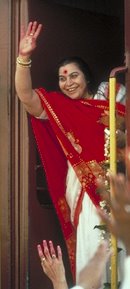
Shri Mataji Nirmala Devi
“Today is the nineteenth Sahasrara Day, if you count the day the Sahasrara was opened as the first. I have to tell you the story about the Sahasrara Day, about which it was decided long time back, before I incarnated. They had a big meeting in the heavens. All the thirty-five crores of gods, the Deities, were there present to decide what is to be done. This is the ultimate that we have to do to human beings — to open their Sahasrara, to open their awareness to the Spirit, to the real Knowledge of the Divine, to remove the darkness of ignorance. And it had to be spontaneously because it has to work the living force of God. Also it had to be very quick.
So all the Gods requested that I, the Adi Shakti, has to take the birth. They all tried their best. They did whatever was possible. The saints were made by them but very few. They incarnated and people made religions out of them which were perverted and brought them a bad name. No Reality in those religions. These religions were money oriented or power-oriented. There was no Divine Force working, actually it was all anti-divine. How to now turn human beings away from these superficial religions, these perverted paths of destruction? How to tell them about all these established organizations? For ages they have been ruling, making money, making power.
It was a tremendous task; it had to be done with great patience and Love. It was very delicate work also because they believed in those religions — innocent people, simple people — to blast them that this is all nonsense, they are not religions, they are against the Incarnations, against all the prophets, against all the saints. That's why all the real saints had to suffer.
It's a powerful work that was to be done, and that's why the Adi Shakti had to take birth on this Earth.”
THE MOTHER: Messiah-Paraclete-Ruh-Devi
Fregene, Italy — May 8, 1988
“This is the first time the Puja of the Adi Shakti is being done. All the Shaktis arise from the Adi Shakti. And also the Shaktis of Mahakali, Mahalakshmi, Mahasaraswati. All these Shaktis get absorbed back in Her. Only the Adi Shakti can do this work because She has supremacy over all the Chakras. She is the One who controls the various permutations and combinations of the Chakras...
Till mankind does not get Self-Realization till then he cannot go straight for very long. After Lord Jesus Christ the ordinary people started following the religion started by Paul and then everything started going wrong. In this way in every religion things went wrong because religion became difficult and inaccessible. In Modern Times people spoke very wrongs things about Kundalini.
Now the question arose how mankind should be told that there is God, there is Truth, and it is in the form of the Spirit. So it was necessary for the Adi Shakti to incarnate because only She could do this work. She had to come amongst mankind and take the birth of a human being, by which She could understand what are the problems and faults in human beings...
This new Job was such that all the Deities, the saints, the Incarnations and all great people had to come. They had to come into the bodily form of the Adi Shakti who had to incarnate. And that is why this Incarnation has come, that the whole world can rise, can evolve. The Divine which has made this Universe, this world, would never want His creation be destroyed at the hands of humans. And that is why this Work is so tremendous.”
THE MOTHER: Messiah-Paraclete-Ruh-Devi
Calcutta, India — April 4, 1990
“So I said at Sahasrara I had to be Mahamaya. I had to be Mahamaya. I had to be something that people cannot recognize Me easily. But Deities? No.
This Mahamaya had to come on this Earth, not the Adi Shakti in Her purest form. It's too much. So She was covered with this.”
THE MOTHER: Messiah-Paraclete-Ruh-Devi
Fregene, Italy — May 8, 1988
“They say that at Sahasrara when the Goddess will appear, She will be Mahamaya. Is it possible to be anything else in the world of today to come on this Earth? Any type of Incarnation could have been in great trouble because human beings in their ego are highest in Kali Yuga. So they are quite stupid and they are capable of doing any kind of harm or violence to a Divine personality. It is not at all possible to exist in this world as anything else than Mahamaya...
It has no power or any intention of giving you wrong ideas or something that is false. It is there whatever, it is Truth. So in a way to say that Mahamaya is the one which deludes is wrong...
I need not be before you; I can be just here in Nirakar, in formless, but how to communicate? how to have a rapport? For that, one has to come in the form of Mahamaya so that there is no fear, there is no distance. One can come close and understand, because if this Knowledge has to be given, if Realization has to be given, people have to at least sit before the Mahamaya.”
THE MOTHER: Messiah-Paraclete-Ruh-Devi
Cabella, Italy — May 8, 1994
"According to the Hindu view, the entrance of God into the strife of the universe is not a unique astounding entrance of the transcendental essence into the welter of mundane affairs (as Christianity, where the Incarnation is regarded as a singular and supreme sacrifice, never to be repeated), but a rhythmical event, conforming to the beat of the world ages. The savior descends as a counterweight to the forces of evil during the course of every cyclic decline of mundane affairs, and his work is accomplished in a spirit of imperturbable indifference. The periodic incarnation of the Holy Power is a sort of solemn leitmotiv in the interminable opera of the cosmic process, resounding from time to time like a majestic flourish of celestial trumpets, to silence the disharmonies and to state again the triumphant themes of the moral order...
The descent is represented in Indian mythology as the sending forth of a minute particle (amsa) of the infinite supramundane essence of Godhead — that essence itself suffering thereby no diminution; for the putting forth of a savior, the putting forth even of the mirage of the universe, no more diminishes the plenitude of the transcendent and finally unmanifested Brahman than the putting forth of a dream diminishes the substance of our own unconsciousness.”
Heinrich Zimmer, Philosophies of India
Princeton University Press (1969) pp. 389-90
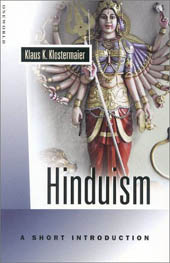
"'The later patriarchal religions and mythologies,' wrote Erich Neumann in a richly documented study, The Great Mother, 'have accustomed us to look upon the male god as a creator ... But the original, overlaid stratum knows of a female creative being.' Neumann assumes for the whole region of the Mediterranean a universally adopted religion of the Great Mother goddess around 4000 B.C.E., which was revived around 2000 B.C.E. and spread through the whole of the then known world. In this religion the Great Goddess was worshipped as creator, as Lady of men, beasts, and plants, as liberator and as as symbol of transcendent spiritual transformation.
The Indus civilization also belongs to that tradition in which the cult of the Great Goddess was prominent. Numerous terracotta figurines have been found: images of The Mother Goddess of the same kind that are still worshipped in Indian villages today...
The connections between Saktism, Mohenjo-Daro civilization, and Mediterranean fertility cults seem to be preserved even in the name of the Great Mother: "Uma for her peculiar name, her association with a mountain and her mount, a lion, seems to be originally the same as the Babylonian Ummu or Umma, the Arcadian Ummi, the Dravidian Umma, and the Skythian Ommo, which are all mother goddesses.”The name Durga seems to be traceable to Truqas, a diety mentioned in the Lydian inscriptions of Asia Minor. There is a common mythology of this Great Mother: she was the first being in existence, a Virgin. Spontaneously she conceived a son, who became her consort in divinity. With her son-consort she became mother of the gods and all life. Therefore we find the Goddess being worshipped both as Virgin and Mother.”
K. K. Klostermaier, Hinduism: A Short History,
Oneworld Pub., 2000, p. 188-9

"The question remains as to whether some kind of spiritual evolution is in progress, whether large amounts of people gradually taking up meditation and other forms of inner practice will create a critical mass of global enlightenment, or whether we will continue in what could be called the Brazilian rain forest mode. In the past, this theory goes, a small number of mystics, ascetics, monastics, wandering mendicants, and other followers of the Perennial Philosophy were capable of providing the spiritual oxygen that helped the rest of the world to breathe and that sustained the mainstream practice of religion with all its surface anomalies. These days it seems increasingly questionable whether this approach will be sufficient to redeem a crippled planet; on the whole, the evolutionary theory makes more sense. But how long will it take? The Bolivian visionary Oscar Ichazo said some years ago, 'In the past eras the mystical trip was an individual matter, or at least a matter of small groups, but no longer. This is what is new in human history. Everybody can now achieve a higher degree of consciousness... . The vision of humanity as one enormous family, one objective tribe, may once have been utopian. Now it is a practical necessity.'"
Peter Occhiogrosso, The Joy of Sects
Bantam Doubleday Dell Publishing Group, Inc., (1996) p. xxii.

“She is not only the Power of God as the whirling wheel of life in its birth-bringing and death-bringing totality; She is also the Force of the Centre, which bestows Consciousness and Knowledge, Transformation and Illumination. Thus Brahma prays to the Great Goddess: "Thou art the pristine spirit, the nature of which is bliss; thou art the ultimate nature and the clear light of heaven, which illuminates and breaks the self-hypnotism of the terrible round of rebirth, and thou art the one that muffles the universe, for all time in thine own very darkness.”
Eric Neuman, The Great Mother
Princeton University Press (1963) p. 333.
"Indeed, the absence of feminine symbolism for God marks Judaism, Christianity, and Islam in striking contrast to the world's other religious traditions, whether in Egypt, Babylonia, Greece, and Rome, or in Africa, India, and North America, which abound in feminine symbolism... The Greek terminology for the Trinity, which includes the neuter term for spirit (pneuma) virtually requires that the third 'Person' of the Trinity be asexual. But the author of the Secret Book has in mind the Hebrew term for spirit, ruah, a feminine word; and so concludes that the feminine 'Person' conjoined with the Father and Son must be The Mother. The Secret Book goes on to describe the divine Mother:... (She is) ... the image of the invisible, virginal, perfect spirit... She became The Mother of everything, for she existed before them all, The Mother-father [matropater] ... The Gospel to the Hebrews likewise has Jesus speak of 'my Mother, the Spirit.' In the Gospel of Thomas, Jesus contrasts his earthly parents, Mary and Joseph, with his divine Father—the Father of Truth—and his divine Mother, the Holy Spirit... According to the Gospel of Philip, whoever becomes a Christian gains 'both father and mother' for the Spirit (ruah) is 'Mother of many.' ... Besides being the 'first universal creator,' who brings forth all creatures, she also enlightens human beings and makes them wise.” (Pagels 1989, 48-54)
"In my graduate Semitics program at UCLA, one of the languages I had to study was Syriac, a dialect of Aramaic written with rounded letters reminiscent of modern Arabic. Syriac was the language of people living in northern Mesopotamia, from at least 300 BC until the time Arabic became dominant in the region, around 1000 AD. ... One striking puzzlement of the texts, at least to me, was the constant reference to the Holy Spirit as 'she'. I was aware, of course, that in Aramaic (and hence in the dialect known as Syriac) the natural gender of the word 'spirit' was feminine;" (Nettelhorst, www.theology.edu/ Web. February 4, 2013)
"If the experiences of the Holy Spirit are grasped as being a 'rebirth' or a 'being born anew', this suggests an image for the Holy Spirit which was quite familiar in the early years of Christianity, especially in Syria, but got lost in the patriarchal empire of Rome: the image of The Mother. If believers are 'born' of the Holy Spirit, then we have to think of the Spirit as the 'mother' of believers, and in this sense as a feminine Spirit. If the Holy Spirit is the Comforter, as the Gospel of John understands the Paraclete to be, then she comforts 'as a mother comforts' [cf.. John 14.26 with Isa 66.13). In this case the Spirit is The Motherly comforter of her children. Linguistically this brings out the feminine form of Yahweh's ruach in Hebrew. Spirit is feminine in Hebrew, neuter in Greek, and masculine in Latin and German.” (Moltmann 1997, 35)
"In this first saying, then, we know very little beyond this amazing promise: the Paraclete will be our own internal presence, the new presence of Jesus, and will act as 'the Spirit of truth.' But that in itself is most important for our prayer life: to know that the same internal presence of the Spirit of Jesus will be within us and within every believer; the Paraclete is our own personal possession; the very Spirit of Jesus is with us always. Though we never saw Jesus in the flesh, we now possess him and know him in his Spirit. We can relate to this Spirit just as we would relate to Jesus. In terms of our prayer, then, we should not imagine Jesus as the risen Lord, far removed from us, but we can pray to this Spirit of Jesus as intimately and individually present within us. What a powerful gift this is for our prayer life! Our whole spirituality can be described simply as a personal, intimate relationship to Jesus as 'the Way, the Truth and the Life'; and this one assurance of Jesus tells us that this Spirit of Jesus is the real, personal, intimate link with Jesus himself.” (Kinn 2004, 128)
"Before Jesus' passion, he promised that the Father and he would send his disciples 'another Counselor' (John 14:16, 26; 15:26; 16:7). The Counselor or Paraclete, from the Greek word parakletos (meaning one who gives support), is a helper, adviser, strengthener, encourager, ally, and advocate. Another points to the fact that Jesus was the first Paraclete and is promising a replacement who, after he is gone, will carry on the teaching and testimony that he started (John 16:6-7).
Paraclete ministry, by its very nature, is personal, relational ministry, implying the full personhood of the one who fulfills it. Though the Old Testament said much about the Spirit's activity in Creation (e.g., Gen. 1:2; Ps. 33:6), revelation (e.g., Isa. 61:1-6; Mic. 3:8), enabling for service (e.g., Exod. 31:2-6; Judg. 6:34; 15:14-15; Isa. 11:2), and inward renewal (e.g., Ps. 51:10-12; Ezek. 36:25-27), it did not make clear that the Spirit is a distinct divine Person. In the New Testament, however, it becomes clear that the Spirit is truly a Person distinct from the Father as the Son is. This is apparent not only from Jesus' promise of 'another Counselor,' but also from the fact that the Spirit, among other things, speaks (Acts 1:16; 8:29; 10:19; 11:12; 13:2; 28:25), teaches (John 14:26), witnesses (John 15:26), searches (1 Cor. 2:11), determines (1 Cor. 12:11), intercedes (Rom. 8:26-27), is lied to (Acts 5:3), and can be grieved (Esp. 4:30). Only of a personal being can such things be said.” (Packer 2001, 143)
"The similarities and the differences may be listed summarily: the teaching of the Paraclete will be centered on Jesus and his teaching; the Paraclete will extend the range of Jesus' teaching to the world; the Paraclete will advance the disciples' understanding of 'the truth,' which is identical with Jesus; the presence of the Paraclete with the disciples will be permanent, in contrast with that of Jesus, which had to be withdrawn; the presence of the Paraclete will be invisible and inward.” (Metzger, Coogan 1993, 204)
"Both literary and iconographic materials give the general impression that the ten Mahavidyas are different forms of an overarching, transcendential female reality, who is usually referred to simply as the Mahadevi (great Goddess). An underlying assumption of many saktas texts is that the highest reality is the Great Godddess, and this infinitely great being manifests herself in a wide variety of forms. Indeed, this is perhaps the central feature of Hindu sakta theology in those texts. Many myths in sakta literature describes a goddess, or the goddess, as producing other goddesses from her own body. In such cases she often announces that she assumes different forms at different times to maintain cosmic stability, to bless a particular devotee, or out of a sense of sport or playfulness. The theological idea is that ultimate reality, which is female in essence and form, displays herself in a great variety of ways for different purposes.” (Kinsley 1998, 18-20)
"Devi originated at a time of cosmic crisis and, consequently, her role seems very similar to that of Visnu in his many avataras (incarnations). Just as Visnu promised to manifest himself in order to protect the cosmic balance, Devi, too, promises to return if needed.” (Foulston 1999, 13)
"The Adi Shakti is the great Mother... She also incarnates, either in her own right (as Sri Durga 1000 years ago) or in one of her many aspects... She has incarnated, for instance, in her Mother aspect as The Mother of Christ (Mary); in her wife aspect as Sri Sita in the case of Sri Rama; and Sri Radha, the wife of Sri Krishna. She was the sister (Nanaki) of the ... Guru Nanak... Today her most complete incarnation is living on the earth to start the Golden Age; in this incarnation her name is Sri Mataji Nirmala Devi. (ibid.)
The Advent also elaborates on the different ways in which Sri Mataji embodies all the aspects of the Goddess, starting with ancient Hindu scripture. Thus in the Sri Lalita Sahasranama, a liturgy to the Thousand Names of the Goddess, the 153rd name is Nishkalanka. This, the author notes, is the full form of the name Kalki—who, it is believed, will come in the end days to oversee the destruction of evil and the creation of a new cycle of ages—and a reference to Sri Mataji's claim to be Kalki herself. In the same text, he goes on, her 110th name is kundalini, a reference to Sri Mataji's power to raise kundalini for self-realisation.” (Coney 1999, 105)
"The Divine Mother occupied a prevailing place among the Puranas deities. She is the Adi Shakti. As Maha-Devi She is the wife of the supreme God Shiva, being known under different other names: Bhairavi (the Terrible) when Shiva becomes Bhairava; Uma (Light), in Kena Upanishad; Haimvati (the daughter of the Himalayas); Jagadamba or Jagan-mata (The Mother of the World); Durga (the Inaccessible); Parvati (the Mountaineer); virgin Gauri (the Yellow or Brilliant); Kali (the Black) first mentioned in the Vedas where She was associated with Agni, later as the wife of Shiva. In the Puranas we find Her as Lakshmi (the Luck), Vishnu's wife, ... This enumeration might further continue with Bhavani, Chandi or Chandika, Shyama (the Black) and the others that reach the number of one thousand names, all mentioned in the Sri Lalitambika Sahasranama Stotram.
She has always been the Shakti, the Power of the corresponding masculine incarnation when appearing in the human form, as a Mother, Wife or Daughter, for example: Sita—Rama's wife; Radha—Krishna's wife; Draupadi—wife of the Pandavas; Mary—Jesus' mother; Fatima—Muhammad's daughter and Hazrat Ali's wife. She has now manifested at the end of the Kali Yuga to announce the dawn of the golden age, Satya Yuga.” (Costian [Ph.D.] 1995, 270-72)
"Himalaya's request for Devi's instruction, inspired by her boon of becoming his daughter, sets the stage for the teachings proper of the Devi Gita. In the following two chapters the Goddess expounds her own true nature and her relation to the world, and in the remaining seven chapters describes the various paths to the supreme goal through yoga, knowledge, and devotion. A noteworthy characteristic of the gita genre is the fusion of the ideals of devotion and knowledge. In the case of the Devi Gita, it is one's devotion to the Goddess that inspires her, as it were, to reveal the highest truths and deepest mysteries of life. Such knowledge leads to mergence into or oneness with the Goddess, as Himalaya's request makes clear.” (Brown 1998, 82)
"The Great Goddess is both wholly transcendent and fully immanent: beyond space and time, she is yet embodied within all existent beings; without form as pure, infinite consciousness (cit) ... She is the universal, cosmic energy known as Sakti, and the psychophysical, guiding force designated as the Kundalini (Serpent Power) resident within each individual. She is eternal, without origin or birth, yet she is born in this world in age after age, to support those who seek her assistance.” (Brown 1998, 2)
"The Tao is called the Great Mother: empty yet inexhaustible, it gives birth to infinite worlds. It is always present within you. You can use it any way you want.” Tao Te Ching 6
"4.34. Smaller than an atom, greater than the greatest is the Self dwelling in the heart of each being... 4.40. Thus through hearing about, reflecting upon, and ascertaining the Self by the Self, one should also, through intense meditation, realize that I am in essence the Self.” (Brown 2009, 153)
"The Goddess spoke: 6.1. Cultivating the yogas just described, one should meditate on me as the true form of Brahman with sincere devotion, assuming the proper posture, O King.
Comment: The Goddess is about to describe what is traditionally called Brahmavidya, or knowledge of Brahman. Her introduction makes clear that this Brahmavidya is knowledge of the Goddess herself, for she is 'the true form of Brahman' (brahma-svarupini).” (Brown 1998, 203)
Disclaimer: Our material may be copied, printed and distributed by referring to this site. This site also contains copyrighted material the use of which has not always been specifically authorized by the copyright owner. We are making such material available to our readers under the education and research provisions of "fair use" in an effort to advance freedom of inquiry for a better understanding of religious, spiritual and inter-faith issues. The material on this site is distributed without profit. If you wish to use copyrighted material for purposes other than "fair use" you must request permission from the copyright owner.

