
Both Devi and Shri Krishna caution against the contradicting scriptures
Author: Manus AI
Date: December 07, 2025
Table of Contents
- 1. Introduction: The Crisis of Contradictory Scriptures
- 2. Shri Krishna's Prophetic Warning in the Bhagavad-Gita
- 3. The Devi's Emphasis on Direct Knowledge Over Textual Ritualism
- 4. A Comparative Analysis of Scriptural Inconsistencies
- 5. Resolution Through Direct Experience: The Role of the Adi Shakti
- 6. Conclusion: Beyond the Letter to the Spirit
- 7. References
1. Introduction: The Crisis of Contradictory Scriptures
The world's diverse religious traditions offer a vast repository of sacred texts that have guided humanity for millennia. However, a critical examination of these scriptures reveals a landscape fraught with contradictions, inconsistencies, and mutually exclusive claims. This textual discord poses a significant challenge to the sincere spiritual seeker, creating what the Bhagavad-Gita describes as a dark forest of delusion.
This paper explores the shared cautioning from two of Hinduism's most revered divine figures—Shri Krishna and the Devi (the Divine Mother)—against an over-reliance on scriptures that are often contradictory. It argues that both traditions ultimately point toward a path of direct experiential knowledge (aparoksha jnana) as the means to transcend textual confusion and attain genuine spiritual realization.
2. Shri Krishna's Prophetic Warning in the Bhagavad-Gita
Thousands of years ago, in a dialogue with his disciple Arjuna, Shri Krishna issued a profound warning that anticipated the scriptural confusion of the modern era. At a time when only the Sanatana Dharma existed, long before the codification of the world's major religions, He prophesied the rise of conflicting texts. In the Bhagavad-Gita, He advises Arjuna:
Thou shalt go beyond the scriptures of times past and still to come.
When thy mind, that may be wavering in the contradictions of many scriptures,
Shall rest unshaken in divine contemplation,
Then the goal of Yoga is thine. [1]
This passage is a direct call to transcend the limitations of scriptural literalism. Krishna identifies the contradictions of many scriptures
as a source of wavering and delusion. The solution He offers is not a more refined intellectual analysis or a new, definitive text, but a state of being: a mind unshaken in divine contemplation.
This points to a state of inner realization where the truth is experienced directly, rendering the external authority of conflicting texts secondary.
3. The Devi's Emphasis on Direct Knowledge Over Textual Ritualism
The same emphasis on direct knowledge is a cornerstone of the Shakta traditions, which venerate the Divine Mother, or Devi, as the ultimate reality. The Devi-Gita, a key text within the Devi Bhagavata Purana, repeatedly prioritizes knowledge (jnana) over ritual or blind faith. The Devi declares that liberation is a direct consequence of this inner knowing:
Furthermore, the Devi asserts her own supreme, unmediated reality, independent of any text. In the Devi Sukta of the Rigveda, she proclaims her cosmic sovereignty: I have created all worlds at my will without being urged by any higher Being, and dwell within them.
[3] This establishes the Devi not as a subject to be understood through scriptures, but as the very source of consciousness that makes understanding possible. The scriptures, from this perspective, are mere pointers, not the ultimate reality itself. The Bahvricha Upanishad reinforces this, stating, She alone is Atman. Other than Her is untruth, non-self.
[4]
4. A Comparative Analysis of Scriptural Inconsistencies
The warnings of Krishna and the Devi are validated by a comparative study of world religions, which reveals numerous and significant contradictions both within and between sacred texts. For example, the Christian Bible contains two different creation narratives in the Book of Genesis. Genesis 1 presents a structured, six-day creation, while Genesis 2 offers a different sequence of events. [5] Similarly, the instructions given to Noah regarding the animals to be taken on the ark differ between Genesis 6 and Genesis 7. [5]
Between religions, the contradictions are even more stark. Major world religions propose mutually exclusive soteriological claims. For instance, traditional interpretations within Catholicism, Islam, and Judaism have historically posited exclusionary paths to salvation, a situation that cannot be logically reconciled. [6] These discrepancies underscore the problem of relying on any single scripture or tradition as the final arbiter of truth. The very existence of such contradictions suggests that the ultimate truth must lie beyond the texts themselves.
5. Resolution Through Direct Experience: The Role of the Adi Shakti
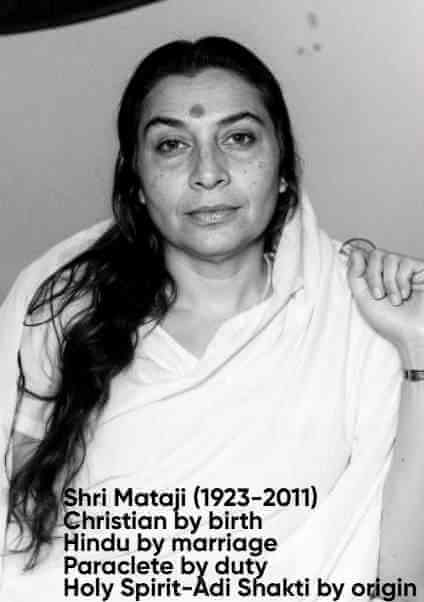
If scriptures are contradictory and unreliable as the final authority, how is the seeker to find truth? Both Krishna and the Devi point to the same solution: direct experience through divine contemplation and the awakening of inner knowledge. This is the path of Yoga and the realization of the Self (Atman). In the modern era, the teachings of Shri Mataji Nirmala Devi have brought this ancient message to the forefront. Identifying herself as the Adi Shakti, the primordial, all-pervading power of God, she has emphasized that the ultimate truth is not to be found in books, but within the human being.
Shri Mataji's teachings center on the process of Self-realization (Atma-sakshatkara), an inner awakening that allows the individual to experience the divine reality directly. She stated, I am the Adi Shakti... I am the One who has come on this Earth for the first time in this Form to do this tremendous task.
[7] This awakening, she explained, is the key to transcending the religious divisions and scriptural confusions that have plagued humanity. It is the fulfillment of Krishna's prophecy and the ultimate gift of the Devi: the direct, unmediated experience of truth.
6. Conclusion: Beyond the Letter to the Spirit
The cautions issued by both Shri Krishna and the Devi against the contradictions in scriptures are not a rejection of sacred texts, but an invitation to go beyond them. They highlight the limitations of intellectual and dogmatic approaches to spirituality and point toward a higher path of direct perception. The inconsistencies within and between religious scriptures serve a profound purpose: they compel the sincere seeker to look beyond the written word and seek the living truth within. The ultimate goal, as indicated by these great divine teachers, is to shift the locus of authority from the external text to the internal, realized Self, thereby achieving a state of unshaken divine contemplation
where all contradictions dissolve into the unity of direct experience.
References
[1] Mascaro, Juan, trans. The Bhagavad Gita. Penguin Classics, 1962, pp. 52-53.[2] Devi Gita, 7.31-32, as cited in "Devi Gita: Revelation of the Divine Feminine in the Devi Bhagavatam." adishakti.org.
[3] Devi Sukta, Rigveda 10.125.8, as cited in the source material.
[4] Bahvricha Upanishad 1.5, as cited in the source material.
[5] Ehrman, Bart D. "50 Contradictions in the Bible: The Most Shocking Differences." The Bart Ehrman Blog, 23 Jan. 2025.
[6] Singh, Jagbir. "Both Devi and Shri Krishna caution against the contradicting scriptures." adishakti.org, 11 Feb. 2006.
[7] Shri Mataji Nirmala Devi, March 21, 1983, as cited in the source material.
February 11, 2006
In adishakti_sahaja_yoga@yahoogroups.com," jagbir singh"
wrote:
I would like to quote from the Bhagavad-Gita about a topic that, as far as I know, is not discussed by the priests and pandits. Perhaps then we will be more forgiving of business students not understanding Parthasarathy's teaching:
Thou shalt go beyond the scriptures of times past and still to come.
When thy mind, that may be wavering in the contradictions of many scriptures,
Shall rest unshaken in divine contemplation,
Then the goal of Yoga is thine."
Shri Krishna proclaimed this priceless prophecy of contradicting scriptures thousands of years ago because He foresaw that disagreements and controversies of future scriptures would confuse and delude humankind. When He spoke these words there was only the Sanatana Dharma. There was no Hinduism, Judaism, Buddhism, Christianity or Islam, and no Torah, Dhammapada, Bible or Qur'an. Yet He prophesied that the texts of religious organizations - the scriptures of times past and still to come - would contradict one another.
This is the exact situation today. In these modern times there are so many scriptural discrepancies that the minds of seekers are deluded and in doubt. Those genuinely looking for Truth in various scriptures and religions are confused and sometimes shocked by what they find.
Every religion is tainted with falsehood and discrepancies. Every House of Worship is perverted and corrupted. Every guru is teaching his or her own version of Truth. Only fools and fundamentalists do not feel disturbed if the 'truth' they are preached is contradicted by other Messengers and Scriptures. Their blind faith does not question glaring falsehood as the herd instinct gives them security in numbers.
A billion Catholics claim that the five billion pagans will be tormented in the Inferno. A billion Muslims swear that more than five billion infidels will burn in hell. The few million Jews affirm that the rest of humankind may jump in the lake as far as their jealous god is concerned.
If any historian ever carries out a research of the scriptural contradictions he or she will understand the meaning of blind faith, misrepresentation, forgery, falsehood, and fundamentalism. The Torah, Bible and the Qur'an have so many contradictions, some even defying history, that truth loses its meaning.
"But save for these laws regulating caste there is no other unifying element in all Hinduism. There are two major sects in the religion, and at least fifty-seven sub-sects, each seeking to attain salvation with the aid of its own gods and ceremonies. Christianity, which is even more intensively divided, is at least united by its unanimous recognition of the uniqueness of Jesus. Hinduism has no such common doctrine. It is true that about 300 A.D. an attempt was made to create such a doctrine by combining the three main Hindu gods into a universally acceptable trinity; but the attempt failed dismally. Brahma, the chief god in that trinity, never became popular save with the priests and philosophers. He was not nearly concrete enough a deity for the plain folk to grasp and believe in and now there are only a couple of temples in all of India that are devoted to his worship. And Vishnu and Shiva, the two other gods in the trinity, always remained distinct and separate, continuing to attract distinct and separate followings." (www.easternreligions.com/)"The Jesus Seminar attempts to change that through its conferences, press releases, books, webpage, etc. The goal is: 'to bring the quest of the historical Jesus of Nazareth to the center of a global forum.' That is, to extract what the participants have concluded to be the actual words and actions of Jesus from ancient writings, and present these to the public.
Their conclusions differ greatly from what Christian denominations have historically taught. They are also in major conflict with the current beliefs of most present-day conservative Christians. Fellows of the Seminar do not regard Christian Scriptures as inerrant. They do not believe that the authors were uniquely inspired by God. Rather, they view the Bible as a very human document, composed by writers who actively promoted their own theological beliefs (or those of the group to which the writers belonged). The Seminar sees within early Christian writings the evolution of religious thought. The fellows study this over the approximately 18 decades from the time of the execution of Jesus (circa 30 CE) to about 310 CE. They see many passages in conflict with each other and with the historical record." (www.religioustolerance.org/)
"For centuries Muslims have been taught to believe that the Qur'an has been preserved in its original Arabic form since the beginning of time itself, and preserved intact from the period of the 'sending down' of the book to Muhammad, right on down till the present. They have been taught that the text which we read now was uniquely inspired, in that there were no intermediary agents who could possibly pollute the integrity of the script.
At the same time they have also been taught that this suggested textual perfection of the book proves that the Qur'an must be the Word of God, as no one but Allah could have created and preserved such a perfected text. This sentiment has become so strongly established in the Muslim world that one will rarely find a Muslim scholar willing to make any critical analysis of its content or of its structure, as to do so would usually be detrimental to his or her health. However, when an analysis is made by a Western scholar upon the Qur'an, that analysis is roundly castigated as being biased from the outset, and even 'satanic,' and therefore, unworthy of a reply.
But that does not stop the analysis from being undertaken, for the Qur'an when held up to scrutiny finds itself lacking in many areas.
As we have already discussed, we find problems with its sources, its collation, its literary makeup, its supposed uniqueness, and problems even with its content. It is not difficult to find numerous contradictions within the Qur'an, a problem which Muslims and the Qur'an has attempted to alleviate by conveniently allowing for the 'law of abrogation.' But even more devastating towards the integrity of this supposed perfect 'divine book,' are the numerous errors which are found in its pages. It is therefore to those errors which we will now turn in our continuing quest to ascertain whether, indeed, the Qur'an can claim to be the true, and 'perfect' Word of God, as Muslims have so often maintained since the very inception of their faith." (www.debate.org.uk/)
On the Path to Self-Realization
Both Devi and Shri Krishna cautioned against the contradicting scriptures which severely hinder Self-realization. Even with all the Devi's guidance and revelations it took me more than a decade of meditation to firmly and finally realize that "The supreme divinity, Lalita, is one's own blissful Self." "She alone is Atman. Other than Her is untruth, non-self." So always remember these priceless Truths for the rest of your lives and you will be assured of moksha and immortality! What else is Self-realization other than realizing that the Devi/Shakti/Divine Mother/Aykaa Mayee within is one's own blissful Self?
According to www.hinduism.com: "The Bhagavad Gita is universally regarded as the single most influential philosophical text shaping spiritual thought and life. Spoken by Lord Krishna to his devotee Arjuna, the Gita's seven hundred verses provide an ultimate guide to self-realization. It reveals the essential nature of man, his environment and his relationship with the Almighty, like no other work. The teaching of the Bhagavad Gita is said to free you from all sense of limitation."
Thou shalt go beyond the scriptures of times past and still to come.
When thy mind, that may be wavering in the contradictions of many scriptures,
Shall rest unshaken in divine contemplation,
Then the goal of Yoga (Self-realization) is thine.
And once the Devi/Shakti/Divine Mother/Aykaa Mayee is realized within to be one's own blissful Self, the mind will begin to rest unshaken in divine contemplation and the goal of Yoga (Self-realization) is thine. I would like to emphasize "begin."
In conclusion I will again quote Swami Vivekananda:
"Religions of the world have become lifeless mockeries ...
If there is ever to be a universal religion, it must be one which will have no location in place or time, which will be infinite like the God it will preach, and whose sun will shine upon the followers of Krishna and Christ, on saints and sinners alike; which will not be Brahmanic or Buddhist, Christian or Mohammedan, but the sum total of all these, and still have infinite space for development; which in its catholicity will embrace in its infinite arms, and find a place for every human being, from the lowest groveling savage not far removed from the brute, to the highest man towering by the virtues of his head and heart above humanity, making society stand in awe of him and doubt his human nature.
It will be a religion which will have no place for persecution or intolerance in its polity, which will recognize divinity in every man and woman, and whose whole scope, whose whole force, will be centred on aiding humanity to realise its own true, divine nature."
I think Swami Vivekananda is also telling us that we can only understand our own divine nature by Self-realization. For millennia religious institutions and sects have never been able to give Self-realization, and never will. The day you realize your Self you will never step into any temple, gurdwara, church, synagogue or mosque to seek the Divine. If you still need to do so then be assured you still have not realized your Self ... just like the countless millions of religious masses over the ages.
You shall go beyond the scriptures of times past and at present none to come.
When your mind, that may be wavering in the contradictions of many scriptures,
Shall rest unshaken in divine contemplation and Silence,
Then the goal of Self-realization and surety of liberation is yours.
jagbir