
Ramana Maharshi (1879-1950) - Sage of Arunachala Hill
—- In adishakti_sahaja_yoga@yahoogroups.com," my2 pai"
wrote:
>
> Shri Mataji has also mentioned in earlier days when She was in
> England that Shri Ramana Maharshi (1879 - 1950) was an incarnation
> of Shiva.
>
Ramana Maharshi
"Distracted as we are by various thoughts, if we would continually
contemplate the Self, which is Itself God, this single thought would
in due course replace all distraction and would itself ultimately
vanish;. The pure Consciousness that alone finally remains is God.
This is Liberation. To be constantly centered on one's own all-
perfect pure Self is the acme of yoga, wisdom, and all other forms of
spiritual practice. Even though the mind wanders restlessly, involved
in external matters, and so is forgetful of its own Self, one should
remain alert and remember:
'The body is not I.'
'Who am I?' Enquire in this way, turning the mind backward to its
primal state. The enquiry 'Who am I?' is the only method of putting
an end to all misery and ushering in Supreme Beatitude. Whatever may
be said and however phrased, this is the whole truth in a nutshell.”
Ramana Maharshi
On This Page:
Who is Ramana Maharshi
Ramana Maharshi, Life Summary
Advent and Early Years
Maya (Illusion) Falls Away
Arrival at Tiruvannamalai
Complete Absorption in the Self
Back Into the World
Ramana Maharshi, In the Words of Devotees
Ramana Maharshi, Love of Animals
Ramana Maharshi and the Sacred Hill, Arunachala
More Reminiscences of Ramana Maharshi
Ramana Maharshi, the End and After
Who is Ramana Maharshi?
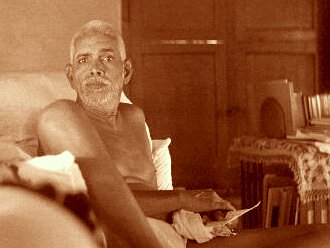
Ramana Maharshi (Maha or great, Rishi or Enlightened Being) was the
awe inspiring sage who's presence graced the renowned sacred
Arunachala hill during much of the 20th century. He was known
throughout India and to many in the rest of the world as the silent
sage whose peaceful presence and powerful gaze changed the lives of
the many who came into his presence. In silence he radiated peace and
contentment like a powerful beacon, effecting a change in anyone who
came within his sphere. He encouraged people to look within and
decide whether they were actually the body or the changeless eternal
self within. His powerful example and inner influence led many people
to experience this inner self as the same self behind all awareness,
above the transient mind, emotions, and body.
Like so many Great Ones who come down to this Earth on a divine
mission, he was born a seemingly ordinary mortal, and at a certain
point in his life, the illusion or Maya of individuality fell away
from him and in an instant of realization he grasped that his inmost
awareness was actually that of the Universal Self, the ageless Atma,
or Eternal Awareness within all. There was no desire for or struggle
for enlightenment. Instead, the sun of Self Awareness arose
spontaneously, without an external guru and without the usual period
of spiritual striving.
Advent and Early Years
He was born to a devout father and mother in a small village near
Madurai in the south of India on December 30th, 1879. That day the
Arda holiday was being celebrated. The Nataraja or dancing Shiva
image was displayed to commemorate the event. In this image, God
Shiva, symbolic of the Absolute Awareness, is dancing the dance of
life and creation as he beats on his drum the tempo of alternating
universal manifestation (birth) and pralaya (death or withdrawal);
the cycle that is reflected in the coming and going of all forms from
the largest cosmic forms to the seemingly insignificant and minute.
Just as the Nataraja image was being put away, the future Maharshi
was born. It is said that a blind midwife attending his birth saw a
brilliant light just as the baby emerged.
The child was formally named Venkateswaram after the family deity and
was called popularly Venkataraman. He grew into youth a seemingly
normal boy. He was strong and liked sports more than his studies and
he had a very special characteristic. When he slept, he went into
such a deep sleep that he could not be woke up in any manner. His
fellow students took advantage of this by carrying him off to various
places and even thrashing him in his sleep since they were afraid of
his strength while awake.
When Venkataraman was sixteen a significant incident occurred which
began the stirring of a deep slumbering spiritual force within him.
One of his elderly relatives one day happened to mention the holy
hill called Arunachala in passing. The mere hearing of the name
Arunachala had a magical effect on the boy and generated an internal
excitement which he could not understand. He asked where this holy
hill was and was told it was in the area known as Tiruvannamalai. The
image of the holy hill impressed itself on his psyche and later the
image of that hill drew him to itself after a turning point in his
life.
Shortly after that, the boy read a book on the lives of saints who
were devotees of God Shiva. Reading of their exemplary lives of
saintliness and renunciation he was thrilled and vowed to emulate
their ways in his own life. This thought took root in his mind and
began to fill his consciousness. A year later it culminated in an
experience that forever changed his life and the lives of all who
came to know him.
Maya (Illusion) Falls Away
In his seventeenth year, in full health and in normal waking state he
was suddenly overwhelmed with the fear of death and fully convinced
that death was imminent. The inexplicable feeling would not leave so
the boy began to ponder on the meaning of death. He was alone in his
upper story room at the time so he decided to act out death and
inquire into the meaning of it. He laid down with his arms stiffly at
his sides as if dead, held his breath and said to himself;"Now death
has come but what does it mean? What is it that is dying? The body
dies and is carried off to the cremation ground and reduced to ashes.
But with the death of the body, am I dead? Am I the body? This body
is now silent and inert but I feel the full force of my personality
and even the voice of the 'I' within me, apart from the body. So I am
the Spirit transcending the body. The body dies but the spirit that
transcends it cannot be touched by death. That means that I am the
deathless Spirit.” The awareness of this knowledge took full
possession of him, not at the level of mere mental awareness but at
the deeper level of complete spiritual self-awareness. He suddenly
became the Spirit and knew himself as That, no longer identifying
himself as merely the body form that had been called Venkataraman.
Self realization was instantaneous, complete, and irreversible. His
ego was lost in a flood of pure Self awareness.
Ramana at 21"From that moment onwards the 'I' or Self focused
attention on itself by a powerful fascination. Fear of death had
vanished once and for all. Absorption in the Self continued unbroken
from that time on. Whether the body was engaged in talking, reading
or anything else, I was still centered on 'I'.”
The young sage told no one of his inner conversion and for a while
continued to carry on the role of student and family member. But
others around him noticed a complete change in his outlook. He
completely lost interest in sports, studies and his former friends.
Rather than the strong personality that inspired fear in his
compatriots, he now became meek, humble, indrawn, and indifferent to
his surroundings. He avoided company and preferred to sit alone,
absorbed in the complete concentration of the universal Self.
Almost every evening he went to the Minakshi temple at Madurai and
stood in quiet exaltation before the images of saints and gods
depicted within the temple. Waves of emotion overcame him and tears
flowed profusely from his eyes as he stood contemplating the images
before him.
His elder brother, Nagaswami, noticed his inner absorption and
criticised him for his laziness and indifference . His teachers too
observed his lack of interest in his studies. One day, approximately
two months after his awakening, as he was copying a lesson given to
him as a punishment for his poor performance he was suddenly struck
by the futility of continuing with the charade. He pushed his books
aside and sunk into the contemplation of the inner Self. His brother
who was watching him made the following remark: "What use is all this
to one like you.” Like an arrow proceeding to its target the remark
stuck in his mind and caused the young Venktaraman to evaluate his
life in relation to his new state of egolessness. He realized that as
a sadhak who wanted to give up everything, he had no right to accept
the hospitality of hearth and home. Internally he made the decision
to leave his home and his former life behind and proceed onward to a
life of spirituality.
The image of the Holy Hill of Arunachala and Tiruvannamalai fixed
itself before his mind's eye, beckoning him to the life of a solitary
sage. Taking only the clothes on his back and a few rupees for
railway fare, he stealthily left home on August 29th, 1896 leaving
the following note behind:
"I have set out in quest of my Father in accordance with his command.
This (referring to himself) has only embarked on a virtuous
enterprise. Therefore no one need grieve over this act and no money
need be spent in search of this.”
On the second day of traveling by rail he arrived at the town of
Mombalappattu and walked another ten miles in the direction of the
holy hill on foot until darkness set in. He first went to a nearby
temple called Arayaninallur which was built on a large rock. As he
sat within the pillared hall he had a vision of an intensely bright
light enveloping the entire place. Absorbed in samadhi he stayed
until he was aroused by the temple priests who wanted to lock the
place for the night. He followed some worshipers to another temple
nearby and there became lost in samadhi once again. When the priests
had finished their duties food was served to the other worshipers but
none was offered to him. However the temple drummer was impressed
with his devout appearance and shared some rice with him and directed
him to go to a Shastri's house nearby for water.
Tired and thirsty he left the place and walked a distance to the
Shastri's house and there fainted from exhaustion. He was given water
and slept the night at that place. The next day was the highly
auspicious holiday Gokulastami day commemorating the birth of Avatar
Krishna. Venktaraman wanted first to procure some food and then
proceed the final thirty miles to Tiruvannamalai by train if
possible. But by then his money was gone. The only possession he had
of value were his gold Brahmin ear rings with small inlaid rubies. He
stood outside a house and asked the owner for some food. In India it
is customary to give food to wandering sadhus and the lady of the
house was glad to give food to the noble and pure looking Brahmin lad
on the auspicious day of Sri Krishna's birth. After eating, he
offered to sell the valuable gold earrings to the owner of the house
but he would accept only enough rupees to pay for the train fare to
carry him on the final leg of the trip to Tiruvannamalai. The good
lady of the house bid him take the Gokulastami offerings of sweets
with him on his journey and he departed for the train station.
Arrival at Tiruvannamalai
He finally arrived in Tiruvannamalai on September 1st, three days after having started. With joy rising up inside him he proceeded directly to the great temple dedicated to the Creator manifested as Arunachala. Normally there would have been other people about and the inner temple doors would be closed but he found the place desolate of people and all the doors were standing open as if in silent welcome. He finally stood overcome with bliss before his Father Arunachaleswar.
After a while he wandered into town and someone called out and asked if he wanted to have his head shaved in the tradition of a sanyasi. Without hesitation he had his beautiful long black hair shaved off. He threw away his remaining rupees and from that day onward, never again handled money. He also threw away the packet of sweet offerings the kind lady had sent him off with.”Why give sweets to this block of a body?”he thought to himself. He removed the sacred thread given to him as a sign of the Brahmin caste and threw away all of his clothing except for a small loin cloth he made from his cast off clothes.
He returned to the temple, having completed these acts of renunciation. He remembered that the scriptures enjoined a bath after having the head shaved but he thought;"Why give this body the luxury of a bath?.” Just then there was a brief shower so that before he entered the temple he had had his ceremonial bath - given by providence.
Complete Absorption in the Self
He now began his life of complete inner absorption in the great Universal Self. He sat in various places within the temple complex, avoiding contact with people as much as possible. For days, and weeks on end he was lost in samadhi, unconscious of the world and his body. Insects and vermin crawled over his legs and chewed his flesh but he was completely unaware of it. His consciousness was swimming in the vast ocean of Universal Awareness. His body began to lose weight and weaken but he took no notice of it.
"I knew nothing, had learned nothing before I came here. Some mysterious power took possession of me and effected a thorough transformation. I knew nothing and planned nothing. When I left home in my 17th year, I was like a speck swept on by a tremendous flood. I knew not my body or the world, whether it was day or night. It was difficult even to open my eyes. The eyelids seemed to be glued down. My body became a mere skeleton. Visitors pitied my plight as they were not aware how blissful I was. It was after years that I came across the term Brahman when I happened to look into some books on Vedanta brought to me. Amused, I said to myself, 'Is this known as Brahman!?!"
One of the sadhus in residence at the temple noticed the fine young brahmin lad, lost to the world in samadhi and adopted him into his care. A few pious souls came occasionally and forced him to eat food from their hands. The young Maharshi was barely aware of their presence or what he was eating, and never spoke or appeared to take any notice of what was going on. Seeing the frightful condition of his body, finally a group of devotees picked him up bodily and carried him out of the damp, dark temple recesses and to the nearby shrine to Subramaniam. Here he continued to sit motionless in samadhi, dead to his surroundings.
Occasionally, the Brahmana Swami, as the young Venkataraman had been dubbed, would wander about in an apparent trance. In one of these states, he moved into the temple gardens and sat among the tall bushes, lost in samadhi. He would occasionally come to partial consciousness and wonder where he was and how he had gotten there.
"Sometimes I opened my eyes and it was morning, sometimes it was evening. I did not know when the sun rose and when it set.”
Less than a year after the Maharshi's arrival in Tiruvannamalai he acquired his first permanent devotee, one Palaniswami, who was destined to stay with him the rest of his life. The devotee had formerly totally committed himself to the worship of God Vinyaka (Ganesh) in the form of a statue, but when he saw the Brahmana Swami lost to the world in samadhi with no attendant, he was thrilled to his core and vowed to offer his life to taking care of the living Swami instead.
Daily, Palaniswami would take the food offerings of the many visiting devotees who came to view the sadhu in deep samadhi and offer some food to the Maharshi. The Maharshi would consent to accept a small mouthful of food each day and the rest was returned to devotees as prasad (offerings of a holy person). Even so he would eat only if the food was put in his hand or mouth.
By now the young Maharshi's body was neglected and unkempt. His hair was matted, his fingernails grew long and started to curl. His body had become weak. Still, he spent all his time in trance, hardly knowing what was going on around him. One of the visiting devotees decided to perform ceremonial worship of the Maharshi using camphor lights, sandal paste, flowers and other ritual offerings. He succeeded the first day but when he returned to repeat the performance the Maharshi had written in charcoal on the walls above him"This is service enough for this", meaning that the food was all that should be offered to the body.
The many devotees were extremely surprised to know that the young swami could read and write as most of them had not even ever heard him speak. Many had assumed he had taken a vow of silence, but in reality, he was so indrawn in samadhi that he had no desire to speak or communicate with others.
Back Into the World
About this time, in order to shield the Maharshi from the many visitors who were coming daily, Palaniswami moved him to a nearby mango orchard whose gates could be locked. It was here that the Maharshi began to come back to a more normal waking consciousness, though still ever centered in the Absolute. Palaniswami used to always have spiritual books in the Indian Tamil language with him which he attempted to study. But he had difficulty doing so because of his weak grasp of the Tamil language. After seeing Palaniswami struggling to understand the scriptures, the Maharshi finally consented to reading the Tamil books himself and then giving Palaniswami a summary of the teaching contained in the books. The Maharshi's deeply rooted intuitive wisdom from being in constant touch with the Inner Self allowed him to understand even the most abstruse scriptural passages at a glance. His phenomenal memory retained the passages so that even years later he could quote from them.
Besides the Tamil books, Palaniswami sometimes brought books in the ancient Sanskrit (the so called language of the gods) and in two other Indian languages, Telegu and Malayalam. Thus besides Tamil and English, the Maharshi gained familiarity with many languages.
From the mango orchard, the Maharshi moved to a small temple on the outskirts of Tiruvannamalai. Here he decided to stop relying on others for food and in the ancient tradition of sanyasis he went out daily to beg for his own food. He was still maintaining silence so he would stand in front of a house and clap his hands and if brought food, he would eat it then and there. He never begged at the same house twice and never accepted any invitations to come into a house.
Shortly after that at the beginning of the year 1899, he began living in a cave on the sacred hill of Arunachala itself. From that point on he spent the next 23 years living in one cave or another on the mountain.
"It was in 1908 that I first contacted Sri Ramana Maharshi, then in the Virupaksha Cave, when I was a boy of twelve. Had you seen him in those days, you would hardly have taken him for a mere human being. His figure was a statue of burnished gold. He simply sat and sat, and rarely spoke. The words he spoke on any day could easily be counted. He had an enchanting personality that shed a captivating luster on all, and a life-giving current flowed from him charging all those nearby, while his sparkling eyes irrigated those around him with the nectar of his Being.”
T. K. Sundaresa Iyer, At the Feet of Bhagavan
In 1922 Ramana Maharshi moved down to a lower spur of the hill and there an ashram slowly grew up around him. Throughout this period the number of devotees that came to him increased in number until, eventually the ashram had people living there all year round.
The earliest devotees seldom heard him speak but over time he gave occasional guidance or answered questions. When people began to live at the ashram full time, several women started to come daily to prepare meals. The sage was highly skilled at cooking and used to help out early each morning to get the day's food ready. Really his contact was only to bless and guide the lives of the people around him. Later in the day, he would recline in the hall and the devotees would sit around him in silent meditation. He never called himself guru or even admitted the guru disciple relationship. Who is to teach and to whom when all are the very same Self.
Teachings of Ramana Maharshi
Destroy the power of mind by seeking it. When the mind is examined its activities cease automatically. Look for the source of mind. That source may be said to be God or Self or Consciousness. Concentrating on one thought, all other thoughts disappear; finally that thought also disappears.
Daily he would take an afternoon walk along the rocky paths of the Arunachala hills, and this continued for many years. After his walk, devotees would gather around to ask questions, sing sacred songs or repeat vedic chants. The people who came to him had very diverse backgrounds and beliefs but all got whatever teachings were most appropriate for their own stage of spiritual ripeness. The Maharshi's highest teaching was pure non dualistic Advaitha philosophy. He taught people to enquire: "Who are you"And to follow this inquiry back to the very source of thoughts, the source of the I, which was the Universal Self. This inquiry is called Vichara and the Maharshi said on several occasions that it was the best course for senior or ripe spiritual aspirants. For others the path of Bhakti (devotion) or Karma (action) was more suitable to them.
How the Maharshi got his name
Ganapati Sastri quivered with emotion as he walked up to the Virupaksha cave. Luckily for him the Swami was seated alone on the outer pial. Sastri fell flat on his face and held the Swami's feet with both hands and his voice trembled with emotion as he cried: "All that has to be read I have read. Even Vedanta Sastra I have fully understood. I have performed japa (repetition of a holy name) to my heart's content. Yet I have not up to this time understood what tapas is. Hence have I sought refuge at thy feet. Pray enlighten me about the nature of tapas.”For fifteen minutes the Swami silently gazed at Sastri as he sat at his feet in anxious expectation. None came to interrupt them at the time. Then the Swami spoke in short and broken sentences in Tamil: (translation)
"If one watches whence this notion of 'I' springs, the mind will be absorbed into that. That is tapas. If a mantra is repeated, and attention directed to the source whence the mantra-sound is produced, the mind will be absorbed in that. That is tapas.”
This instruction filled Sastri's heart with joy. He stayed for some hours and ascertained the Swami's name from the attendant Palaniswami to be Venkatarama Ayyar. Sastri immediately composed five stanzas in praise of the Swami in which he contracted his name to Ramana which has stuck to the Swami ever since. In the letter which Sastri wrote next day he added that he must henceforth be called 'Maharshi' since his teaching was quite original.
From: Bouquet of Spiritual Instruction by Viswanathan Sri Ramanasramam
The people who were drawn to Ramana Maharshi had very diverse spiritual and religious backgrounds. If anyone worshipped a deity or followed a particular religion that person was encouraged to pursue perfection in their own chosen religion. Many who came to him saw in his presence vivid visions of their own beloved Deity or favorite form of worship. Although miracles took place all around the Maharshi, they took place in a most natural and straight forward fashion. He said on many occasions that there was no separate ego within him to perform a miracle therefore whatever happened occurred naturally through divine will. Although healings sometimes took place among devotees, the Maharshi himself took no notice of his own body. As he grew older, the body exhibited many maladies but he only said he was not the body and refused to identify himself with any of the ills. In 1950, a malignant cancer brought the incarnation to a close. Although many devotees requested him to cure himself, and there is no doubt he could have if he had the independent will and desire to do so, he only said that everything would come alright soon. Even during the final days when an ordinary mortal would have been in the most intense writhing pain, the Maharshi continued to give darshan to devotees, himself remaining in bliss of samadhi, far above the trials of the body. At the very moment of his final breath, a majestic meteor floated slowly above the Arunachala hill lighting the night sky. Thus the earthly sojourn began with a flash of light witnessed by the blind midwife at the moment of birth, and ended with the light of an unearthly meteor gliding through the night sky.
Bhagavan lived for fifty-four years in full awareness of his pristine, immortal Self. Only by seeing this with our own eyes could we understand that such a state, or ideal, existed and was attainable.
From time to time, God, in his mercy, ushers into the world messengers to guide and awaken mankind to the ultimate goal of life.
N. Balaram Reddy, My Reminiscences
Ramana Maharshi - In The Words of Devotees
Any factual account of the Maharshi's life is bound to be dry and lifeless compared to the first hand descriptions of those fortunate devotees who were drawn to his presence. Therefore let their words paint a true picture of the Ramana Maharshi they knew and loved.
Note that the majority of the books referenced below can be purchased either from Ramanashram in India, or from the Arunachala Ashram in New York. There are also downloadable books, additional stories, excerpts, and newsletters on the Ramanashram web site.
.................................
How He Received People
Nobody could guess about the way Bhagavan would meet people. The high and mighty of the land would not get even a blank look, while some insignificant looking wanderer would become the object of his concentrated attention for hours and days. On the other hand eminent people would sometimes be taken up by him and given the immense blessing of being the center of his interest. Once Pranavananda Swami came to the Ashrama. He was utterly exhausted. He sat on the steps of the temple and could not move any further. Bhagavan was told about it. He came out at once, sat at the feet of Pranavananda Swami and started rubbing his legs, saying: "You had a long way to walk, Grandpa. Your legs must be paining you very much.”The old swami protested in vain; Bhagavan had his way and massaged the swami's feet.
From: Sri Ramana Leela by Krishna Bhikshu,
.................................
His Look Sent Us Into Samadhi
Bhagavan's look was real magic. You could not do anything but just look into his eyes, which would transform you into Samadhi. Everyone in the hall used to feel Bhagavan was looking at them alone. This was the true experience of each one of us. In his inimitable way he was giving the glance of grace to each and everyone seated in the hall. Bhagavan's look used to take us deep into Samadhi. Just by looking into his eyes, we came to know what meditation is. This was, and is, the common experience of all devotees. You ask anyone and you will get the same reply.
Once he gave me such a look and for a very long time I was absorbed in Samadhi. Bhagavan was reading the newspaper, letters were being brought in, normal activity was going on, but I was oblivious of the happenings outside of me. In fact, I was unaware of my body.
Ramani Ammal
.................................
Between two thoughts there is an interval of no thought. That interval is the Self, the Atman. It is pure Awareness only.
From: Jnana Vasishtha
.................................
Just Being With Him, My Mind Would Stop
When I was able to sit for long hours in Bhagavan's presence my mind would just stop thinking and I would not notice the time passing. I was not taught to meditate and surely did not know how to stop the mind from thinking. It would happen quite by itself, by his grace. I would sit, immersed in a strange state in which the mind would not have a single thought and yet which would be completely clear. Those were days of deep and calm happiness. My devotion to Bhagavan took firm roots and never left me.
Sampurnamma
.................................
I believe the most unique characteristic of Bhagavan was the power of his presence. In Bhagavan we found a being that was surcharged with the Reality to such an extent that coming into his presence would effect a dramatic change in us. This Divine Power of his presence was something remarkable, entirely outstanding in this century. But why just this century? It must be so for many centuries.
N. Balaram Reddy, My Reminiscences
.................................
The Memory is Ever Present in My Heart
Bhagavan was one day reading and explaining Tirupuhazh in Tamil to Alamelammal of Madura. I did not know Tamil and I could only look on. I saw a change in Bhagavan. A light was shining from within him. His face was radiant, his smile was beaming, his eyes were full of compassion. His words reverberated in the mind and were instantly and deeply understood. All my being was carried upwards on a current of strange vibrations. The memory of this experience is ever present in my heart. A great joy has remained with me that I was privileged to sit at the feet of the Divine Being.
Varanasi Subbalakshmi
.................................
His Body Radiated Spiritual Power
Bhagavan's attendants had told me that his body was like a furnace. Only then, when he sat so close to me, did I understand what they meant. I felt spiritual power emanating from his body like an electric dynamo. I was thrilled to the core of my being.
N. Balaram Reddy, My Reminiscences
.................................
In His Presence, Doubts Were Automatically Cleared
Apart from the greatness of Bhagavan's Presence and the tremendous power of His silence, I noticed the strange way the doubts in one's mind got answered through someone else present in the Hall. The doubt you had, somebody in the Hall would express to Bhagavan and Bhagavan would not only give the answer but look at you with a smile, as if to say, 'Has your doubt been cleared?'
From Moments Remembered, by M.G. Shanmugam
.................................
Teachings of Ramana Maharshi
God, Who is immanent, in His Grace takes pity on the loving devotee and manifests Himself according to the devotee's development. The devotee thinks that he is a man and expects a relationship as between two physical bodies. But the Guru, who is God or the Self incarnate, works from within, helps the man to see his mistakes and guides him in the right path until he realizes the Self within.
.................................
Only The Maharshi Asked for Nothing
I went to Arunachala for the first time with Sri Rami Reddi. We had our food in the town and then went to the Ashrama. In those days there was very little there-a hut for Bhagavan and another over his mother's samadhi (place of burial). Bhagavan had just finished his food and was washing his hands. He looked at us intently.”Did you have your food?”He asked.”Yes, we had it in town.” "You could have had it here," he replied. I stayed with him for three days. He made a great impression on me. I considered him to be a real Mahatma, although his ways were very simple. Most of the cooking was done by him in those days. The Ashrama lived from hand to mouth and usually only rice and vegetable soup were prepared. When I was about to leave, I asked Bhagavan: "Bhagavan, kindly show me a good path.” "What are you doing now?”he asked.”When I am in the right mood, I sing the songs of Thyagaraja and I recite the holy Gayatri. I was also doing some pranayama but these breathing exercises have upset my health.” "You had better stop them. But never give up the Advaita Dristhi (non dual vision).”At that time I could not understand his words. I went to Benares for a month, returned to Pondicherry and spent five months there. Wherever I would go people would find some fault or other with me: "You are too weak, not fit for yoga, you do not know how to concentrate, you cannot hold your breath, you are unable to fast, you need too much sleep, you cannot keep vigils, you must surrender all your property...”Only Bhagavan asked for nothing, found fault with nothing. As a matter of truth, there was nothing in me that entitled me to his grace. But it did not matter with Bhagavan. He wanted me, not my goodness. It was enough to tell him"I am yours," and for him to do the rest. In that way he was unsurpassed.
Krishna Bhikshu
.................................
Teachings of Ramana Maharshi
Our real nature is mukti (the liberated state). But we are imagining that we are bound and are making various strenuous attempts to become free, while we are all the time free.
Our wanting mukti is a very funny thing. It is like a man who is in the shade voluntarily leaving the shade, going into the sun, feeling the severity of the heat there, making great efforts to get back into the shade and then rejoicing 'How sweet is the shade. I have after all reached the shade!'
.................................
The Blissful Atmosphere of Ramana
My first darshan of Bhagavan Sri Ramana was in January, 1921 at Skandashrama, which is on the eastern slope of Arunachala and looks like the very heart of the majestic hill. It is a beautiful quiet spot with a few coconut and other trees and a perennial crystal-clear spring. Bhagavan was there as the very core of such natural beauty.
I saw in him something quite arresting which clearly distinguished him from all others I had seen. He seemed to live apart from the physical frame, quite detached from it. His look and smile had remarkable spiritual charm. When he spoke, the words seemed to come out of an abyss. One could see immaculate purity and non-attachment in him and his movements. I sensed something very refined, lofty and sacred about him. In his vicinity the mind's distractions were overpowered by an austere and potent calmness and the unique bliss of peace was directly experienced. This I would call Ramana lahari, athe blissful atmosphere of Ramana.' In this ecstasy of grace one loses one's sense of separate individuality and there remains something grand and all-pervading, all-devouring. This indeed is the spirit of Arunachala which swallows up the whole universe by its gracious effulgence.
Swami Viswanatha
.................................
The Young Brahmin Saint
I lost my husband when I was sixteen. I went back to my mother's house and lived there as a widow should, trying to pray to and meditate on God. My mother's mind too was devoted to the spiritual quest and religion was the main thing in her life. Once we went on a pilgrimage to Kaveri Pushkaram and on our way back we stopped at Arunachala. There we were told that a young Brahmin saint had been living on the hill for the past ten years. The next morning we went up the hill along with others with whom we were traveling. At Mulaipal Tirtha we cooked our food, ate and had some rest. Then we went further and found the young Swami near Virupaksha Cave. There was a brick platform at the entrance of the cave and he was sitting on it. As soon as I saw him, I was at once convinced that God Arunachala Himself had come in human form to give salvation to all who approached Him. He was about thirty at the time, and wonderful to look at; he was bright and shining like burnished gold, his eyes were blooming and clear, like the petals of a lotus. He looked at us for a long time. The peak of Arunachala was towering over our heads, the huge towers of the temple were below and an immense silence surrounded the Swami. Then the ladies started whispering. One wanted to pray for a child for her daughter-in-law who was barren, but another was saying that the Swami was too exalted for such worldly matters. Finally the Swami was told of the young wife's sorrow. He smiled and lifted his folded hands to the sky as if saying : "All happens by the will of the Almighty.”
Varanasi Subbalakshmi
.................................
In the evening he would sit on a wooden cot near the well and gaze at Arunachala in deep silence. His face would glow with an inner radiance which would appear to increase with the deepening darkness.
Krishna Bhikshu
.................................
A Pool of Peace
In the morning I had darshan of Sri Bhagavan in the old Hall. As our eyes met, there was a miraculous effect upon my mind. I felt as if I had plunged into a pool of peace, and with eyes shut, sat in a state of ecstasy for nearly an hour. When I came to normal consciousness, I found some one spraying the Hall to keep off insects, and Sri Bhagavan mildly objecting with a silent shake of his head.
G.V.Subbaramayya
.................................
"Peace can reign only when there is no disturbance by thought. When the mind has been annihilated there will be perfect peace.”
.................................
His Love for a 'Worthless' Devotee
His great love for me, a worthless devotee, bound me firmly to his feet. Again and again I wanted to leave the Ashrama, but he held me for my good, more powerfully than I held on to him. Whenever I was collecting courage to tell Bhagavan about my desire to leave, he would seem to read my thoughts and forestall me by giving me something special to do. I felt I had too much to do and that my life was being wasted.
One day Bhagavan was looking at me intently and said: "It looks as if you are still hankering after meditation.”I replied: "What have I got except endless work in the kitchen?”Bhagavan said with deep feeling: "Your hands may do the work but your mind can remain still. You are that which never moves. Realize that and you will find that work is not a strain. But as long as you think that you are the body and that the work is done by you, you will feel your life to be an endless toil. In fact, it is the mind that toils, not the body. Even if your body keeps quiet, will your mind keep quiet too? Even in sleep the mind is busy with its dreams.”
I replied: "Yes, Swami, it is as natural for you to know that you are not your body as it is for us to think that we are the body. I had a dream recently in which you were explaining this very point. I was dreaming that I was working in the kitchen and you were having your bath in your usual place behind the bamboo mat partition. You asked: 'Who is it?' I replied: 'Who shall I say I am?' You said: 'Exactly so, you are nothing of which something can be said.' Now, just remember that was my dream and it was quite clear.
"Why can't I remember always that I am not the body?”
"Because you haven't had enough of it," he smiled.
Varanasi Subbalakshmi
.................................
Bhagavan Radiated Tremendous Peace
Bhagavan was a very beautiful person; he shone with a visible light of aura. He had the most delicate hands I have ever seen with which alone he could express himself, one might almost say talk. His features were regular and the wonder of his eyes was famous. His forehead was high and the dome of his head the highest I have ever seen.
Bhagavan always radiated tremendous peace, but on those occasions when crowds were attracted to the Ashram such as Jayanthi, Mahapooja, Deepam and such functions, this increased to an extraordinary degree. The numbers seemed to call up some reserve of hidden force, and it was a great experience to sit with him at such times. His eyes took on a far-away look and he sat absolutely still as if unconscious of his surroundings, except for an occasional smile of recognition as some old devotee prostrated.
A. W. Chadwick, A Sadhu's Reminiscences of Ramana Maharshi.
.................................
S. S. Cohen, First Darshan of Ramana Maharshi
The third of February 1936, early morning, saw my horse-cart rolling on the uneven two-and-a-half-mile road from Tiruvannamalai railway station to Ramanashram. I was led to a small dining room, at the door of which I was asked to remove my shoes. As I was trying to unlace them, my eyes fell on a pleasant looking middle-aged man inside the room, wearing nothing but a kaupin, with eyes as cool as moonbeams, sitting on the floor before a leaf-plate nearly emptied, and beckoning me with the gentlest of nods and the sweetest smile imaginable.
I was alone in the Hall with him. Joy and peace suffused my being - such a delightful feeling of purity and well-being at the mere proximity of a man, I never had before. My mind was already in deep contemplation of him - him not as flesh, although that was exquisitely formed and featured, but as an unsubstantial principle which could make itself so profoundly felt despite the handicap of a heavy material vehicle.
S.S. Cohen, Memoirs and Notes
.................................
There is no floor! Where can I sit?
The older German woman, whose name is Ilse, then started to tell us that she visited the Master in the mid 1940s and had been coming to the Ashramam since then. Being of Jewish descent, she had fled Nazi Germany and was teaching in India. After hearing of Bhagavan she traveled by train to Tiruvannamalai and then took a bullock cart to the Ashramam. She said," I was wearing a frock, and was dirty from the long journey. I felt that I should wash and change into more appropriate attire before going to see the sage. I was standing at the door of the Old Hall (that is the southern door that is now closed and leads into the Samadhi Hall) when someone urged me to go to him right away. I walked in and stood in front of the sofa, when He made the gentlest of gestures, inviting me to sit down. That is when everything disappeared. There was no sofa, no hall, no Maharshi, no me. The thought came athere is no floor. Where can I sit?' I don't know how long I stood there, but eventually I did sit down.”
Geeta Bhatt
.................................
Ramana Maharshi's Love of Animals
Origin of Lakshmi the Ashram Cow
A villager had a dream in which he was told to offer his next calf to Ramanasramam. He brought his cow and the calf to Bhagavan. The jungle around the Ashram was thick at that time and there were cheetahs. The Ashram people were perplexed and refused the offer, but the villager was taking his dream seriously and would not take the calf away. The mother cow had to remain with the calf to feed her. Finally, the cow and the calf were entrusted to a devotee in the town. The calf became the famous cow Lakshmi. She grew up and had three calves within a few years. She would come daily to the Ashram to have her meals, graze on the Ashram land, enter the Hall and sit contentedly near Bhagavan. In the evening, she would go back to the town as other women did.
Once Lakshmi came into the Hall. She was pregnant at that time. It was after lunch time when Bhagavan was reading the newspapers. Lakshmi came near and started licking the papers. Bhagavan looked up and said: "Wait a little, Lakshmi.”But Lakshmi went on licking. Bhagavan laid his paper aside, put his hands behind Lakshmi's horns and his head against hers. Like this they stayed for quite a long time. I stood nearby looking at the wonderful scene. After some ten minutes or so, Bhagavan turned to me and said: "Do you know what Lakshmi is doing? She is in Samadhi.”
I looked at her and tears were flowing in streams down her broad cheeks. Her breathing had stopped and her eyes were fixed on Bhagavan. After some time Bhagavan changed his position and asked: "Lakshmi, how do you feel now?”Lakshmi moved backward, as if reluctant to turn her tail towards Bhagavan, walked round the Hall and went out.
Shantammal, Eternal Bhagavan
.................................
Animals Treated as Equals
I looked around. Squatting on the floor or sitting in the Buddha posture or lying prostrate face down, a number of Indians prayed-some of them reciting their mantras out loud. Several small monkeys came into the hall and approached Bhagavan. They climbed onto his couch and broke the stillness with their gay chatter. He loved animals and any kind was respected and welcomed by him in the ashram. They were treated as equals of humans and always addressed by their names. Sick animals were brought to Bhagavan and kept by him on his couch or on the floor beside him until they were well. Many animals had died in his arms. When I was there he had a much-loved cow who wandered in and out of the hall, and often lay down beside him and licked his hand. He loved to tell stories about the goodness of animals. It was remarkable that none of the animals ever fought or attacked each other.
Mercedes de Acosta, Here lies the Heart
.................................
The Maharshi Nurses Newborn Squirrels
In the roof of the Old Hall, squirrels would build nests. Once, some new-born squirrels dropped on Bhagavan's sofa. Their eyes remained yet unopened and the size of each baby may not have been more than an inch; they were very red in color with fresh flesh, absolutely tender to touch. The Mother squirrel ignored them. Now what to do? How to feed and attend to such tender things?
The baby squirrels were in the palm of Bhagavan. Bhagavan's face glowed with love and affection for them. While there was a question mark in the faces of those who surrounded Bhagavan, He Himself was happy and cheerful. He asked for some cotton to be brought. He made a soft bed for them. He also took a bit of cotton and squeezed it to such a tiny end, the end portion looked like a sharp pin. He dipped it in milk and squeezed milk into the tiny mouths. At regular intervals, Bhagavan repeated this act of compassion. He tended them with great care and love till they grew up and ran around. They did not run away, only ran around their 'Mother'. Kinder far than their own mother!
V. Ganesan, Moments Remembered
.................................
Keeps Company with Dying Deer
Once an Ashram deer was attacked by some animal and the wounds turned from bad to worse. Sri Bhagavan sat near the deer and held its face in his hands, looking at its tearful eyes. Sri Bhagavan sat like that for a couple of hours. Chinnaswami asked my uncle who was standing close to look after the deer and relieve Sri Bhagavan. Sri Bhagavan heard this but did not make any response. Sri Bhagavan sat there till the deer breathed its last. That was the compassion that Sri Bhagavan had for that deer. Soon after, Sri Bhagavan went to the hall. There is a Samadhi for the deer in the Ashram.
From: Dr. K. Subrahmanian, A Tribute
.................................
Ramana Maharshi and the Sacred Hill, Arunachala
Arunachala, Home to Many Siddhas
Arunachala is one of the oldest and most sacred of all India's holy places. Sri Bhagavan declared that it is the 'Heart of the earth, the spiritual center of the world.' Sri Shankara spoke of it as Mount Meru. The Skanda Purana declares," Of all, Arunachala is the most sacred. It is the heart of the world. Know it to be the secret and sacred Heart-center of Shiva.”Many saints have lived there, merging their sanctity with that of the hill. It is said, and confirmed by Bhagavan, that to this day Siddhas (Sages with supernatural powers) dwell in its caves, whether with physical bodies or not, and some are said to have seen them as lights moving about the hill at night.
Arthur Osborne, Ramana Maharshi and the Path of Self Knowledge
.................................
Ocean of Nectar, Full of Grace,
Engulfing the universe in Thy Splendor!
O Arunachala, the Supreme Itself!
be Thou the Sun
and open the lotus of my heart in Bliss.
Hymn to Arunachala, From: five Stanzas to Arunachala
.................................
The Legend of Arunachala
In the legend of Arunachala, Vishnu represents the ego or individuality and Brahma the mentality, while Shiva is Atma, the Spirit. The main purport of the legend is that Shiva once appeared as an infinite column of light. Because the column of Light was so dazzling and impossible to look upon, both Brahma and Vishnu prayed to Shiva to take a more benevolent and accessible form so that all beings could worship Him and realize the goal of life. Shiva accordingly took the form of the Arunachala Hill, declaring: "As the moon derives its light from the sun, so other holy places will derive their sanctity from Arunachala. This is the only place where I have taken this form for the benefit of those who wish to worship me and obtain illumination. Arunachala is OM itself. I will appear on the summit of this hill every year at Kartikai in the form of a peace giving beacon.”Kartikai is that day of the year when the constellation of Kartikai (the Pleiades) is in conjunction with the full moon - usually in November. On that night each year a huge bonfire is built on top of the hill and appears from a distance as a great fiery beacon. It is observed throughout the area and especially by the thousands of devotees who circumambulate the hill, like a living garland, slowly moving along the eight mile trail that surrounds the base of the holy hill.
.................................
Am I Not Always With You?
In my coming and going I sometimes had to walk in the dark along a jungle path skirting the hill and I would feel afraid. Bhagavan noticed it once and said: "Why are you afraid, am I not with you?” Bhagavan's brother, Chinnaswami, the manager of the Ashrama, asked me, when I came at dusk: "How could you come all alone? Were you not afraid?”Bhagavan rebuked him: "Why are you surprised? Was she alone? Was I not with her all the time?”
Once Subbalakshmiamma and myself decided to walk around the hill. We started very early, long before daybreak. We were quite afraid of the jungle-there were snakes and panthers and evil-doers too. We soon saw a strange blue light in front of us. It was uncanny and we thought it was a ghost, but it led us along the path and soon we felt safe with it. It left us with daylight.
Another time we two were walking around the hill early in the morning and chattering about our homes and relatives. We noticed a man following us at a distance. We had to pass through a stretch of lonely forest, so we stopped to let him pass and go ahead. He too stopped. When we walked, he also walked. We got quite alarmed, and started praying: "Oh, Lord! Oh, Arunachala! Only you can help us, only you can save us!"The man said suddenly: "Yes, Arunachala is our only refuge. Keep your mind on Him constantly. It is His light that fills all space. Always have Him in your mind.”We wondered who he was. Was he sent by Bhagavan to remind us that it is not proper to talk of worldly matters when going around the hill? Or was it Arunachala Himself in human disguise? We looked back, but there was nobody on the path! In so many ways Bhagavan made us feel that he was always with us, until the conviction grew and became a part of our nature.
Sampurnamma the Ashram Cook
.................................
Bearing and tending me in the world
in the shape of my father and mother,
Thou didst abide in my mind,
and before I fell into the deep sea
called Jaganmaya (universal illusion) and was drowned,
Thou didst draw me to Thee, Arunachala, Consciousness Itself,
... such is the wonder of Thy Grace!
From: The Necklet of Nine Gems
.................................
Arunachala is Shiva Himself
Our happiness in the presence of Sri Bhagavan was comparable to the joy of the hosts of Shiva on Mount Kailasa. Sri Bhagavan used to say," Kailasa is the abode of Shiva; Arunachala is Shiva Himself. Even in Kailasa things are as they are with us here. Devotees go to Shiva, worship Him, serve Him, and hear from him the interpretation of the Vedas and Vedanta day in and day out.”So it was Kailasa at the foot of the Arunachala Hill, and Arunachala Paramatma in human form was Bhagavan Sri Ramana Maharshi.
T.K. Sundaresa Iyer
.................................
What is the Way to Salvation?
My parents were farmers and my village is thirty miles from Tiruvannamalai. Yearning for male progeny my mother and father offered prayers to Lord Vinayaka (Ganesh). Thereafter, I and my younger brother were born.
In my twentieth year, I came to know that the Kartikai Festival in Tiruvannamalai was a grand affair. I became restless with a longing to see it and left home for Arunachala. The night before I left I had a dream of a sanyasin clad in only a loin cloth and surrounded by brahmacharins. Adjacent to the hill was his hermitage where he gave me darshan seated on a tiger's skin.
The next day I started off for Arunachala, but was not used to walking long distances. I stopped in a village on the way and went to the house of a family I knew. When they saw my haggard looks they restrained me from continuing. I was locked in a room.
The time of the festival was running out. Because of my persistent demands I was finally released. Only two hours were left before the lighting of the deepam (light) on the hill and I had yet fifteen miles to cover. In a frenzy, totally unconscious of my body, I ran. I felt as if I floated in the air. I reached Arunachala at 5:30 p.m. and had darshan of the deepam when it was lit at 6 p.m. Afterwards I went to the Esanya Mutt and the people there welcomed me and asked me to stay.
The next morning I started off for giripradakshina (circumambulation) of Arunachala. Sri Ramanasramam was on the way and, as everyone was going into the Ashrama to have darshan of Bhagavan, I followed. The moment I saw him I was overcome with emotion and cried out," When will I be rid of this bondage?”I was visibly shaken. Bhagavan kindly gestured to me that I should sit. I sat down for an hour and was unconscious of my body. I had an urge to stay on there and asked Chinnaswami (the Ashrama manager) for permission. He said," You are young. What can you do? Go back home.”But I did not leave. I said," Please give me any work. Bhagavan will give me the strength.” As I would not leave, Chinnaswami relented and finally asked me to remove the weeds from the flower garden. With much enthusiasm I did the work of two people. Bhagavan also praised my work.
I would daily attend to the work given to me and when free would sit in meditation. That was my only routine. One day I asked Bhagavan," Swami, what is the way to salvation?”
"The way you came," was his simple reply. The moment I heard him say this my mind froze.
Rangaswamy, Ramana Jyothi Journal
.................................
A Visit to Ramanashram
I left the hall (of the Maharshi's Samadhi) and walked onto the sacred mountain, up the rocky paths towards the summit of Arunachala. There, kneeling in the sun in a secluded circle of rocks, I did what thousands of pilgrims through the ages have done before me and will do after: I praised the God of Light and asked for liberation in this life, so as to serve God in the body.
Andrew Harvey, Hidden Journey
.................................
More Reminiscences of Ramana Maharshi
Know Who You Are !
It was in 1919 that I first came to Sri Bhagavan. He was then living at Skandasramam on the slope of the Hill Arunachala. His mother and brother lived with him. Palaniswami used to attend to his few personal wants. Plague had driven away most of the inhabitants of the town and consequently visitors to Sri Bhagavan were few. I was, therefore, left alone with Sri Bhagavan most of the time. I related to him all the spiritual practices I had been doing, what I had been studying, and what experiences I had. At that time I was very unhappy because in spite of all I had done I was unable to experience samadhi. After patiently hearing me out, Bhagavan quoted from Kaivalya Navaneet
"If you realize who you are, there is no cause for sorrow.” "So if you come to understand who you are, then there is peace," said Bhagavan.
Well, I did not know what was meant by"know who you are.”Bhagavan went on to explain that the mind is only a bundle of thoughts and that if I seek the source of all thoughts I would be drawn into the Heart. He simultaneously pointed to his Heart. Bhagavan was looking at me intently and I focused my attention in the manner he instructed me and within a few minutes I was led into samadhi. I was thrilled. Coming to my senses we went for lunch. Then again, I sat before him and by a single look he put me into that blissful state. This experience occurred again and again-during all seventeen days that I stayed with Bhagavan. I was like one intoxicated. I was absolutely indifferent to everything. I had no curiosity to see anything, no desire whatsoever. What I did I did most mechanically. I would have continued to live in this state if it had not occurred to me that it was not proper to partake of the food that was offered to Sri Bhagavan by his devotees without paying anything.
I thought that he had initiated me into the experience of Brahman and that I had nothing more to gain by staying in his presence. I, therefore, returned to my native place and began to practise meditation in a room in my house all by myself. I could succeed to gain and retain that experience only for a few days; it started to diminish gradually and at last one day it was lost. I could not regain the experience. I decided to return to Sri Bhagavan. This I did, and great good fortune awaited me when I came.
Kunju Swami
.................................
The Stillness of His Mind Haunted Me
1939.”Bhagavan," I said on a day then near my hut," I feel a strong urge to go on Yatra (pilgrimage). I feel that I need a change for some months, which I intend spending in holy places.”He smiled approval and enquired about the date and time of my starting and whether I had made arrangements for my stay in the various places I was to visit. Extremely touched by his solicitude, I answered that I was going as a sadhu, trusting to chance for accommodation.
For three months thereafter I lay on a mat in Cape Comorin, immensely relieved of the mental tension which the Master's physical form had caused me. In solitude I plunged into reflections on his blissful silence and calm repose. The stillness of his mind haunted me everywhere I went - in the beautiful, gem-like temple of the youthful virgin goddess, on the shores of the vast blue ocean around me and the sand dunes, in the fishing villages and endless stretches of coconut groves, which ran along the seashore and the interior of the Cape. I felt his influence in the depth of my soul and cried: "Oh Bhagavan, how mighty you are and how sublime and all pervasive is the immaculate purity of your mind! With what tender emotions do we, your disciples, think of your incomparable qualities, your gentleness; your serene, adorable countenance; your cool, refreshing smiles; the sweetness of the words that come out of your mouth; the radiance of your all-embracing love; your equal vision towards one and all.
S.S. Cohen, Guru Ramana
.................................
A Jnani has No Separate Will of His Own
In the evening Sri Bhagavan recalled a marvelous occurrence. He said," Some time ago, a paralytic was brought in a conveyance and brought into the Hall in the arms of some persons and placed before me. I was looking at him as usual. After about half an hour, the man with some effort got up by himself, prostrated, and rising came forward and handed to me a notebook. I found it to be his horoscope wherein it was stated that he would have darshan of a Mahatma by whose Grace he would be cured miraculously. The man after expressing his fervent gratitude walked by himself to his conveyance outside the Hall. All people present were struck with wonder which I also shared because I had not consciously done anything for him.”Now Sri Bhagavan again repeated that a Jnani could not have any sankalpa (will) of his own.
Subbaramayya, My Reminiscences of Bhagavan Sri Ramana Maharshi
.................................
Bhagavan once remarked, referring to himself," In this state it is as difficult to think a thought as it is for those in bondage to be without thoughts.”I also remember him telling us," You ask me questions and I reply and talk to you. If I do not speak or do anything, I am automatically drawn within, and where I am I do not know.”
N. Balaram Reddy, My Reminiscences
.................................
Initiated into the Search for the Self
In 1927, three other ladies and I went to Tiruvannamalai. By that time Bhagavan had come down from the hill and was living in a hut near his mother's samadhi (grave). We rented a place in the town, had a bath and went to see him. He was seated on a cot in a grass- thatched shed. Muruganar was by his side. As soon as I saw him I knew he was God in human form. I bowed to him and said," The dream of my life has come true. Today I am blessed. Grant that my mind does not trouble me anymore.”
Bhagavan turned to Muruganar and said: "Ask her to find out whether there is such a thing as mind. If there is, ask her to describe it.”
I stood still, not knowing what to say. Muruganar explained to me," Don't you see? You have been initiated in the search for the Self.”
Shantammal
.................................
Teachings of Ramana Maharshi
Don't entertain thoughts of imperfection, the lack of desirable qualities, etc. You are already perfect. Get rid of the idea of imperfection or the need for development. There is nothing to realize or annihilate. You are the Self. The ego does not exist. Pursue the Enquiry and see if there is anything to be realized or annihilated. See if there is any mind to be controlled. The effort is being made by the mind which, in reality, does not exist.
.................................
Ramana Maharshi - An Avatar of Skanda
In 1908, from January to March, Nayana (Ganapati Muni) lived with the Maharshi at the Pachai Amman Temple. One early morning Nayana and other disciples were all sitting in front of the Maharshi who was, as usual, indrawn. The Muni saw a sparkling light come down from the sky and touch the forehead of the Maharshi six times. The Maharshi also was aware of what was happening. Immediately the Muni had the intuitive realization that the Maharshi was none other than an incarnation of Lord Skanda.
Sri K. Natesan
This was later confirmed in an indirect way by the Maharshi himself. Skanda by tradition was a son of God Shiva. He presides over the process of enlightenment and is also called Subramanium, Karttikeya (Child of the Pleiades), Murugan and other names.
.................................
An Invisible Being Accompanies Him
During those days I had a dream. A resplendent lady with a luminous face was seated by Bhagavan's side on the sofa and Bhagavan was adorning her with meticulous care. Another lady, as beautiful and full of light and splendor, was moving about the Ashram, doing all kinds of service. I asked Bhagavan how it was that he was giving so much attention to one and none to the other. Then I woke up. When I told my dream to Muruganar, he told me that it was true that an invisible being was always near Bhagavan. She was the Goddess of Salvation and Muruganar had composed several songs about her.
Shantammal
.................................
Gives Boon of Vision of Rama
In May 1933 on my 36th birthday, after the usual bath and prayers, I sat in Sri Bhagavan's presence in a pensive mood. I addressed a prayer in the Tamil viruttam style to Sri Bhagavan complaining," O Bhagavan, I have completed three-and-a-half decades and yet have not had the experience of the real you. Pray let me have this day the touch of your grace.”Handing over this slip of paper I prostrated before him. Bhagavan bade me sit down and gazed steadily at me; I was still in a pensive and meditative mood. All of a sudden I lost body- consciousness and was absorbed in Sri Maharshi. I was turned inward and the voice of Bhagavan bade me see whatever I desired. I felt that if I could have the darshan of Sri Rama my life would be fruitful, as I was very much devoted to Sri Rama. I had then immediately a darshan of Sri Rama, with Sita, Lakshmana, Bharata, Satrughna and Hanuman. The ecstasy of the vision defied description; I simply sat on with Maharshi perhaps gazing on me without my being aware of his gaze. Two hours may thus have passed in pin-drop silence, lost in the vision, until it vanished. I prostrated at the feet of Sri Maharshi, with tears of ecstasy in my eyes and my hair standing on end. To Bhagavan's enquiry I replied that I, of course, had seen my dear Rama.
T.K.Sundaresa Iyer
.................................
Meeting a"Long Distance"Devotee
After reaching London, I took an early opportunity to go to Epsom, which was about three quarters of an hour journey by train to meet Mrs. Victoria Doe at her quiet residence, at 17, St. Martins Avenue. It was on May 19, 1946, Mrs. Doe, who was nearing 80, lived with her only daughter, Miss Leena Doe. She had never come to India, never seen Bhagavan Sri Ramana in flesh and blood. Yet I was deeply moved by her devotion to Him. She had read about Him, prayed to Him, meditated on Him and lived in Him day in and day out. There was something trans-mundane, something related to a sphere other than the physical world that occasioned my visit to this elderly lady, who was a recluse to the social life in England. It seems she had written to the Ashram that much as she would have liked to go over to India to have a darshan of Sri Bhagavan, her circumstances did not permit it, and that she was very desirous of at least meeting some one who had seen him and had the good fortune to sit at his feet. Hence, the visit I paid her on the suggestion from the Ashram, was, in fact, the fulfillment of her long cherished desire.
Mrs. Doe, with shaking hands, took from her shelves sheaves of letters received from the Ashram and after kissing them with great reverence handed them over to me for perusal. All those were letters from the Ashram and had been meticulously preserved by her for many years. She had also with her all the English Publications of Sri Ramanasramam. She opened one of the books and running her shaky finger along the inscription on the first page"With Gracious Blessings from Sri Bhagavan", burst into tears of joy and devotion. When she composed herself, she said"Mr. Nambiar, how lucky you are to have been able to be with Him, to see Him and hear Him speak. Here we treasure these books and letters as representing Him. Now He has sent you here. I feel that He is with us now.” Such love, such devotion to the Sage, so tenderly expressed, moved me to the depths of my being. Verily His Kingdom is the Heart of the devotee, and I have always found Him there enthroned.
K. K. Nambier
.................................
In the Self There is No Space-Time
Mr. and Mrs. S. were visitors from Peru to the Ashram. The couple narrated all their story to Bhagavan, all the privations they had undergone to have a look at Sri Maharshi. Bhagavan was all kindness to them; He heard their story with great concern, and then remarked: "You need not have taken all this trouble. You could well have thought of me from where you were, and so could have had all the consolation of a personal visit.”This remark of Sri Bhagavan they could not easily understand, nor did it give them any consolation as they sat at His feet like Mary. Sri Maharshi did not want to disturb their pleasure in being in His immediate vicinity, and so He left them at that.
Later in the evening Sri Maharshi was enquiring about their day-to- day life, and incidentally their talk turned to Peru. The couple began picturing the landscape of Peru and were describing the sea- coast and the beach of their own town. Just then Maharshi remarked: "Is not the beach of your town paved with marble slabs, and are not coconut palms planted in between? Are there not marble benches in rows facing the sea there and did you not often sit on the fifth of those with your wife?”This remarks of Sri Maharshi created astonishment in the couple. How could Sri Bhagavan, who had never gone out of Tiruvannamalai, know so intimately such minute details about their own place? Sri Maharshi only smiled and remarked: "It does not matter how I can tell. Enough if you know that in the Self there is no Space-Time.”
.................................
Ramana Maharshi's Detachment from the body
Once at Skandasramam, after Bhagavan and I had a bath and he was drying his body with a towel, I noticed that down from his knee to his ankle the skin had peeled off and blood was oozing. I asked him what the matter was with his leg. He said he did not know. I asked," Is it not from your legs that blood is oozing? You seem to know nothing about it!"He replied very casually," When I was sitting down, the fire from the charcoal brazier in which incense powder was being burnt might have burnt my skin and caused this sore.”I at once sent for some ointment and applied it to his legs. From this I learned how, completely detached from his body, Bhagavan lived only in the Self
Yogi Ranganathan
.................................
Ramana Maharshi, End of the Body, and After
Visit From District Medical Officer
I was left alone with Bhagavan. As usual, he did not speak with me. I was also silent. But the vibrations that emanated from him were celestial. His body must have been in terrific, mortal pain, but his heavenly spirituality was unaffected by it. A rapturous thrill electrified my entire being.
I administered to his body; but I was hardly conscious that I was a District Medical Officer. I was conscious only of an intense desire to worship this illumined soul. I had learned that Bhagavan did not allow devotees to touch his feet. But I felt a deep urge within me not only to touch his blessed feet but to press them lovingly. I took courage in both my hands and pressed them. The wonder of wonders! Bhagavan let me do so! His grace was abounding. I considered myself in the seventh heaven. I glorify those few minutes of my life.
Dr. Lt. Col. P. V. Karamchandani
.................................
Final Darshan
The end came on the 10th of April, 1950. That evening the sage gave darsana to the devotees that came. All that were present in the Asrama knew that the end was nearing. They sat singing Ramana's hymn to Arunachala with the refrain Arunachala-Shiva. The sage asked his attendants to make him sit up. He opened his luminous and gracious eyes for a brief while; there was a smile; a tear of bliss trickled down from the outer corner of his eyes; and at 8:47 p.m. the breathing stopped. There was no struggle, no spasm, none of the signs of death. At that very moment, a comet moved slowly across the sky, reached the summit, of the holy hill, Arunachala, and disappeared behind it.
T.M.P Mahadevan, Bhagavan Ramana
.................................
Departure from the Body
On the final evening, thousands were cramped into the ashram grounds around Bhagavan's room. A gloomy mood enveloped the area, as Bhagavan's end was anticipated at any moment. The fan being waved over Bhagavan's body by the attendant was visible through the door, and all eyes were fixed on it. knowing that when it ceased moving, Bhagavan's heart would have ceased beating.
Shortly there after, the fan stopped, the famed meteor slowly floated across the heavens, and it was all over. The light that illumined the earth as Bhagavan Sri Ramana Maharshi had now merged with the Eternal Light, the source of all creation.
N. Balaram Reddy, My Reminiscences
.................................
A Big Star in the Sky!
Later in the evening, after dinner, my wife and I with children came out into the courtyard and were discussing among ourselves where to sit, when suddenly my younger son, Vijayan started looking at the sky.”Papa, see what is in the sky, a big star?”We all looked up. Somewhere in the western sky was a bright meteor moving at an unusual speed, too slow for a shooting star, and too fast for an aircraft. My immediate intuition was about Bhagavan and I exclaimed," It is Bhagavan passing away.”
K. K Nambiar, Guiding Presence of Sri Ramana
.................................
A Luminous Shooting Star Unlike Any Other
At about 9 p.m., Monsieur Cartier-Brassen, the French photographer, who has been here for about a fortnight with his wife, related an experience of his to me.”It is a most astonishing experience," he said. "I was in the open space in front of my house, when my friends drew my attention to the sky, where I saw a vividly-luminous shooting star with a luminous tail, unlike any shooting star I had before seen, coming from the South, moving slowly across the sky and, reaching the top of Arunachala, disappeared behind it. Because of its singularity we all guessed its import and then raced to the Ashram only to find that our premonition had been only too sadly true: the Master had passed into Mahanirvana at that very minute.”Several other devotees in the Ashram and in the town later told me that they too had seen the tell-tale meteor.
S. S. Cohen, Memoirs and Notes
.................................
Where Shall I Go? I Shall Always Be Here
When Sri Ramana lay dying, people went to him and begged him to remain for a while longer as they needed his help. His reply is well known.
"Go! Where can I go? I shall always be here.”
A.W. Chadwick, A Sadhu's Reminiscences of Ramana Maharshi
.................................
Was He Not Purna (Complete) From Birth?
I have often wondered about the great event which formed a turning point in Bhagavan's life, the dramatisation of the act of death he conducted about six weeks before he left Madurai (his childhood home) for good. Was it this dramatisation alone that transformed the school boy into a sage? Was he not purna (complete) even from the instant of His birth on December 30th, 1879? Did not the blind lady who delivered Him see a bright light as he was born? Was there not a link between this light and the meteor that cut a golden path across the sky and faded over Arunachala at the moment of His passing? Did He not at the age of ten contemplate on death when His father died? Was it not a fact that in His youth nobody could wake Him up from sleep, even by severely beating Him? I sincerely feel that out of compassion for us, and so we may not swerve from His teachings, he chose to hide the Supreme State He was experiencing from the very day of His birth. His decision to wear only a kaupina (loin cloth) after throwing away all his possessions on September 1st, 1896 was not for His own edification. It was for us He did this. He Himself later observed"Some power acts through the body of a Jivanmukta (realized being) and uses his body to get the work done.”
Sri V.S. Ramanan
.................................
Teachings of Ramana Maharshi
If a man considers he is born he cannot avoid the fear of death. Let him find out if he has been born or if the Self has any birth. He will discover that the Self always exists, that the body which is born resolves itself into thought and that the emergence of thought is the root of all mischief. Find where from thoughts emerge. Then you will abide in the ever-present inmost Self and be free from the idea of birth or the fear of death.
.................................
I Am Not the Body
At first people felt lost (after his passing), they had relied too much on the personal form, though Bhagavan himself had repeatedly warned them: "You attach too much importance to this body, I am not the Body.”
Still it was only natural that this body should be missed, though as time went on the loss became gradually less keen, his presence was felt so strongly in the Ashram, and daily the feeling of this actual presence grew. A visitor remarked to me lately," One does not miss the presence of Bhagavan in the Ashram, he is there just as he was before.”And this is true. He is there and he is surely working and the Ashram will grow in strength and renown as time goes on.
There have been dark days since that night three years ago. But, those days are past. The Ashram has taken on a new life. There is a new feeling in the air and the stagnation is over. The Veda Patasala school has been revived and pujas are now performed so carefully and enthusiastically that the whole place rings up with the vibrations thus set up. I went away never to return, but he brought me back. And now I thank him every day that I have been allowed to take part in this renaissance. It is thrilling to the core to feel it happening. One should have known that it was bound to be like this all the time, for how could anything happen to the place he had sanctified with his presence for so long. The whole of India was blessed by his life, how much more so the place in which he made his home.
Major Allen Chadwick
.................................
If You Look within, I Am There
(At the time of Bhagavan's passing) I was at Rajapalayam. That night I saw a blue light beautifully rising up into the sky. I knew Bhagavan had left the body. I felt that I did not want to live after that and started a fast. By fasting I wanted to drop the body. After five or six days of not touching food I had several visions. In one of them I was taken inside the Arunachala Hill and saw there rishis performing yagnas and yoga. I also saw Sri Bhagavan seated there. Some munis or rishis offered some prasad to Bhagavan. Then Sri Bhagavan himself gave it to me, and I was made to eat. I remembered that I was fasting, but couldn't refuse Bhagavan's prasad. How can I say that it was a dream? I consider it was Bhagavan's grace alone. He also said to me," You say and repeat 'I have gone away, I have gone away'. Where have I gone? I am right here. You are not looking inward. If you look within, I am there.”
For many days afterwards the smell of that prasad lingered. The aroma even spread all through the house. My brother and sisters kept talking about it. When I was fasting, my brother and sister were also fasting with me. The morning following that vision we started taking food again.
In the dream I also remember Bhagavan was seated near a tank and rishis and munis were serving him. He looked splendid, gracious, magnanimous, and magnificent. It was a beautiful sight. I saw there Kamadhenu, the celestial cow, the celestial tree, and many other wonderful things. It was a divine sight indeed. From that day onwards I had no thought at all that Bhagavan had left us. He is all pervading, and I experienced him particularly in my heart. I no longer felt sorrow. He is even here now. When I came again to Tiruvannamalai I was filled with bliss. You can feel Bhagavan's presence every minute. Right this very minute I feel his Divine Presence. I have no unhappiness. I am happy all the time. Sri Bhagavan's Presence is so overpowering.
Rajapalayam Ramani Ammal
.................................
A Devotee in Romania
First, I would like to tell you a little story which made me wonder how life can be sometimes unpredictable and yet so beautiful. There is a friend of mine in Romania who is a fully qualified medical doctor. She earns about $50 a month, which is almost less than what a person needs to live on in Romania. She is working about two hundred miles from Bucharest in the only office which services a group of villages. Everyday she wakes up at 5 a.m., takes an unheated train, changes two buses, or hitchhikes on trucks to travel to those remote villages. Her husband left her and went to France four years ago. Lately, she had been suffering with headaches, anxiety and increasing moments of depression. One day she happened to read a book wherein something about Bhagavan was mentioned. Other names were also mentioned in that book, but somehow only Ramana Maharshi's name kept coming back to her. When she told me briefly about this experience I had the sudden idea to send her my photo of Sri Ramana. And one day (this was when she had just started to take some anti-depressant medicine), exhausted, she felt like sitting on the floor. She then shifted into the padmasana position-without really knowing what she was doing-and gazed at that photo of Ramana, which she had come to love dearly. She then gave over all her pain and suffering to Bhagavan and was immediately filled with so much peace and love that she at once quit the medicine and felt at peace and at ease. She now gathers the necessary courage and strength each day by simply gazing into the eyes of Bhagavan.
I wanted to write this to you and share my wonderment at how a sincere call of the heart can be responded to even when the person lives far away in a remote area, knows no English, knows nothing of the spiritual teachings which have been, in fact, forbidden in her country for almost fifty years. She didn't really talk much about what she experienced. She said with these things it is better to remain silent, with which I totally agree.
Yolanda Levi, letter sent to New York Arunachala Ashram
.................................
"If we progress the world progresses. As you are, so is the world. Without understanding the Self what is the use of understanding the world? Without Self-knowledge, knowledge of the world is of no use. Dive inward and find the treasure hidden there. Open your heart and see the world through the eyes of the true Self. Tear aside the veils and see the divine majesty of your own Self.”
Ramana Maharshi - Sage of Arunachala HillRamana
https://www.cosmicharmony.com/Sp/Ramana/Ramana.htm
Disclaimer: Our material may be copied, printed and distributed by referring to this site. This site also contains copyrighted material the use of which has not always been specifically authorized by the copyright owner. We are making such material available to our readers under the education and research provisions of "fair use" in an effort to advance freedom of inquiry for a better understanding of religious, spiritual and inter-faith issues. The material on this site is distributed without profit. If you wish to use copyrighted material for purposes other than "fair use" you must request permission from the copyright owner.

