

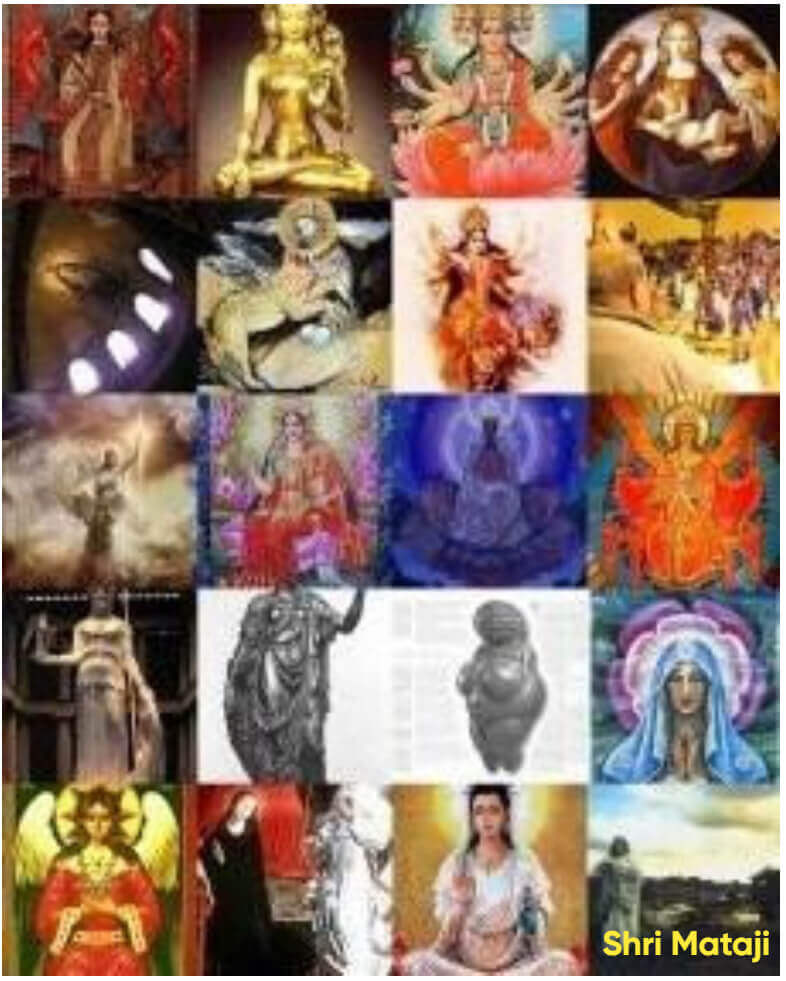
Supreme Divinity, Lalita, Is One's Own Blissful Self
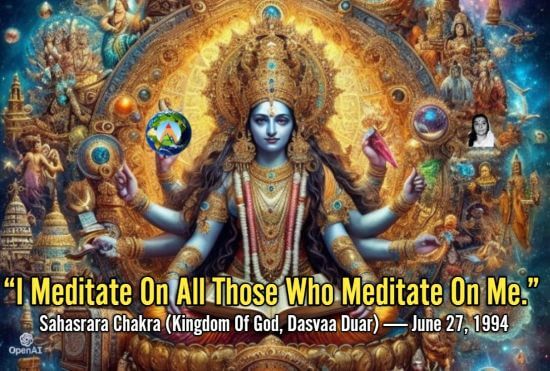
Arwinder's encounters with Shri Lalita Devi provide compelling evidence of her as the blissful Self, genuine through their consistency, scriptural harmony, and profound insights. This paper affirms the eternal truth: Lalita is the non-dual Brahman-Consciousness, and realizing her within dissolves all illusion. Future studies could explore comparative mysticism, but Arwinder's narrative stands as a beacon for spiritual seekers.
Table of Contents
Abstract
1. Introduction
The declaration, The supreme divinity, Lalita, is one's own blissful Self,
from the Bhavana Upanishad (1.27)[1], encapsulates a core tenet of Advaita Vedanta and Tantric traditions, emphasizing the identity between the individual Self (Atman) and the ultimate reality (Brahman). This non-dual perspective is further elaborated in texts like the Tripura Tapini Upanishad (1.9)[2] and Bahvricha Upanishad (1.5)[3], which describe Lalita (also known as Tripura Sundari) as the primordial power permeating all existence, a wave of Being-Consciousness-Bliss.
In contemporary spiritual contexts, such as Sahaja Yoga, this divinity is experienced internally through Kundalini awakening and meditation in the Sahasrara chakra.
This paper centers on the experiences of Arwinder, who began meditating on Shri Lalita Devi in early 1995 at the age of five, following his Kundalini awakening by his brother Kash. Arwinder's accounts, documented by his father Jagbir[4], provide a rare empirical lens into these mystical encounters. By analyzing the authenticity of these experiences and their congruence with scriptural truths, the study affirms that Lalita is indeed the blissful Self, rendering all else as untruth, non-self
(Bahvricha Upanishad 1.5). The analysis proceeds through historical context, experiential narrative, genuineness evaluation, and philosophical confirmation.
2. Historical and Scriptural Background
Lalita, or Shri Lalita Devi, is a manifestation of the Divine Mother in Hindu Tantra, particularly in the Sri Vidya tradition. She is Tripura Sundari, the Beauty of the Three Cities,
symbolizing the transcendence of the three states of consciousness (waking, dreaming, and deep sleep) and the three worlds (physical, subtle, and causal). The Bhavana Upanishad (1.27)[1] explicitly identifies her as the blissful Self, while the Tripura Tapini Upanishad (1.9)[2] portrays her as the supreme sovereign abiding in a sphere of fire, adorned and eternal. The Bahvricha Upanishad (1.5)[3] expands this:
She alone is Atman. Other than Her is untruth, non-self. Hence is She Brahman-Consciousness, free from (even) a tinge of being and non-being.
These texts align with Mahavakyas such as Aham Brahma Asmi
(I am Brahman) from the Brihadaranyaka Upanishad and Tat Tvam Asi
(That Thou Art) from the Chandogya Upanishad, underscoring the non-dual nature of reality. In Sahaja Yoga, founded by Shri Mataji Nirmala Devi, Lalita is experienced as the Adi Shakti (primordial energy) residing in the Sahasrara, accessible through self-realization. Arwinder's experiences, beginning in childhood, mirror this framework, offering a modern testament to these ancient truths.
3. Arwinder's Experiences with the Divine Mother
Arwinder's spiritual journey commenced in early 1995, shortly after his Kundalini was raised by his brother Kash. At five years old, he began daily meditations in the Sahasrara, where he encountered Shri Lalita Devi without external prompting. These encounters remained undisclosed until August 9, 1995, when Lalita granted permission to share them with his father.
Key elements of his initial revelations include:
- Daily meditations with Lalita and 34 other divine beings (e.g., Shri Ganesha, Shri Jesus, Shri Shiva), all described as
Sahaja Yogis
and friendly companions. - Kundalini surges rising to the Agnya chakra, sometimes requiring Lalita's intervention to absorb excess energy.
- Sensations of warm vibrations during these surges, indicative of subtle energy flow.
- Conversations with Lalita on
good things,
such as the beauty of creation (flowers, trees, people). - Insights into his inner body as
bones and blood,
explained by Lalita. - Observations of Lalita's varied attire, often floral-patterned in red and gold.
- Visits to ethereal Houses of Worship, diverse in color and shape, filled with offerings (fruits, rice, flowers) arranged by spiritual beings.
- Interactions with a multicultural, ethereal population in the Kingdom of God, resembling solid yet translucent forms.
- A vast spiritual populace, beyond numerical comprehension.
Over a decade later, on September 27, 2006, at age 16, Arwinder provided deeper insights into the nature of the spirit, imparted directly by Lalita:
- The spirit is formless and permeable, allowing passage through objects or beings, akin to wind.
- It can assume any form (e.g., insect, tree, mountain, galaxy) while retaining consciousness of its spiritual essence.
- Absence of physical organs like the heart; no heartbeat.
- Lalita's omnipresence: She is always present, even invisibly, as
Everything is Shakti.
- These revelations came unprompted from Lalita, emphasizing experiential knowledge over inquiry.
Arwinder's meditations induced states of bliss and vibrations, aligning with Jagbir's own deepened practice upon learning this knowledge.
4. Analysis of the Genuineness of Arwinder's Experiences
The authenticity of Arwinder's experiences can be evaluated through several criteria: temporal consistency, independence from external influence, alignment with established spiritual paradigms, and transformative impact.
First, consistency over time is evident. From age five to 16, Arwinder's accounts remained coherent, evolving from childlike observations (e.g., counting divine companions) to profound metaphysical insights (e.g., the spirit's formlessness). His initial secrecy, per Lalita's instruction, and later voluntary disclosures suggest internal motivation rather than fabrication.
Second, the experiences occurred independently. Arwinder began meditating without parental awareness, and his detailed descriptions—such as ethereal beings matching Kash's independent accounts—indicate unprompted originality. The absence of hints
to his parents underscores a genuine, private unfolding.
Third, alignment with scriptures and traditions bolsters credibility. Arwinder's depiction of Lalita as the source of Kundalini and bliss mirrors Tantric views of Tripura Sundari. His spirit insights echo Advaita concepts: the permeable, expansive nature recalls the Atman's omnipresence in the Bhagavad Gita (13.13), while consciousness amid form-assumption aligns with the illusory nature of maya. The warm vibrations and Sahasrara focus conform to Sahaja Yoga's empirical markers of self-realization.
Fourth, transformative effects are observable. Jagbir reports deepened meditations and bliss upon receiving this knowledge, suggesting its resonant power. Arwinder's unprompted revelations, only shared when queried, imply a reservoir of authentic wisdom from Lalita, not intellectual contrivance.
Critics might attribute these to imagination or suggestion, but the depth—surpassing typical childhood fantasies—and scriptural fidelity argue against this. Psychological frameworks, such as James's varieties of religious experience, classify such encounters as mystical, marked by ineffability and noetic quality, both present here.
5. Confirmation That Lalita Is One's Own Blissful Self
Arwinder's experiences unequivocally confirm the Upanishadic truth that Lalita is the blissful Self. His meditations reveal Lalita not as an external deity but as the internal Atman, permeating the Sahasrara. The bliss and vibrations he describes are manifestations of Sat-Chit-Ananda (Being-Consciousness-Bliss), where Lalita embodies this triad.
The spirit's formlessness and omnipresence, as taught by Lalita, affirm non-duality:
You and I and all the world and all divinities and all besides are the Maha-Tripura-Sundari(Bahvricha Upanishad 1.5)[3].
Arwinder's ability to assume forms while conscious of spirit echoes the Self's transcendence of limitations, realizing Aham Brahma Asmi.
Lalita's omnipresence—Everything is Shakti
—dissolves subject-object duality, rendering external phenomena as untruth, non-self.
This realization assures moksha, as daily remembrance integrates Lalita as the Self, leading to immortality beyond cycles of birth and death. Arwinder's journey exemplifies this: from child meditator to enlightened youth, his experiences validate Self-realization as recognizing Lalita within.
6. Conclusion
Arwinder's encounters with Shri Lalita Devi provide compelling evidence of her as the blissful Self, genuine through their consistency, scriptural harmony, and profound insights. This paper affirms the eternal truth: Lalita is the non-dual Brahman-Consciousness, and realizing her within dissolves all illusion. Future studies could explore comparative mysticism, but Arwinder's narrative stands as a beacon for spiritual seekers.
References
[1]Bhavana Upanishad.Verse 1.27. Wikipedia, Wikimedia Foundation.
[2]
Tripura Tapini Upanishad.Verse 1.9. Wikipedia, Wikimedia Foundation.
[3]
Bahvricha Upanishad.Verse 1.5. Wikipedia, Wikimedia Foundation.
[4] Jagbir.
Personal accounts of Arwinder's experiences.7 Oct. 2006.
[5]
Shri Lalita Sahasranama.Vedamantram.com.
The Supreme Divinity, Lalita, Is One's Own Blissful Self
October 7, 2006Arwinder started meditating on the Great Primordial Mother Shri Lalita Devi in early 1995 at the age of five after having his Kundalini raised by Kash. There was never even of hint of the profound spiritual experiences taking place right under the noses of his parents.
On August 9, 1995, at 6:25 p.m., while walking to the nearby Ivan Franko Park his father began talking to him about Shri Mataji Nirmala Devi. Arwinder casually replied that he also had met Her. His father stopped immediately and turned to face him, not believing what he had just heard. Arwinder was asked to repeat and the answer was the same — he had also been with the Great Primordial Mother. His father quickly found an empty bench in the park nearby and sat down with him. Arwinder then talked non-stop for thirty minutes, and priceless prasad (spiritual food) poured out from his mouth.
Arwinder told that although he had been meeting and talking to Shri Lalita Devi daily in meditation for a 'long time' he did not tell anybody as She told him not to do so. In other words, Arwinder was advised not to inform any family member that he was seeing Shri Mataji. It was just a day earlier on August 8, 1995, that She had given him permission to tell his father about his spiritual experiences — that was the reason he was talking about them today.
He explained that normally he meditated with the Great Spiritual Mother and 34 other 'Sahaja Yogis.' He said that he was sure about the exact figure as he had counted them on a number of occasions. According to him all them — from Shri Ganesha to Shri Jesus to Shri Shiva — are Sahaja Yogis and very friendly as he had talked to each and every one of them.
According to him during meditation the power (Kundalini) comes till the middle of his eyes at the Agnya chakra, and then slowly goes back down during sleep. Sometimes in meditation he gets"too much power" (intense Kundalini surge) and"Mother has to take it back," (Shri Mataji has to absorb the excess) or else it will"come out through the top of the head" (flow out through his Brahmarandhra.)
Arwinder was asked how did this power (Kundalini) feel, whether hot, warm or cold? He replied it is warm.
According to him:
- he had many conversations with Shri Lalita Devi and always talked about "good things," especially how beautiful this world was — the flowers, trees, grass, people, insects and so forth.
- he informed that his interior body is made of"bones and blood.” The Divine Mother had explained that to him after he had inquired about this subject.
- he observed that Shri Lalita Devi always wore different dresses daily, particularly those with patterns of small flowers. Often She wore red and gold colored dresses, considered"very nice"by Arwinder.
- he said that Shri Pancha-Brahma-Svarupini Devi had also taken him to visit Houses of Worship on numerous occasions. These spiritual buildings were of different shapes and colors: gold, dark red, blue, green and yellow. Inside their compounds there was always an abundance of offerings: bananas, coconuts, oranges, strawberries, pomegranates, apples, cooked rice, and other type of food in silver bowls. There were a variety of flowers arranged on both sides of these offerings.
- Whenever Shri Bhakta-harda-tamo-bheda-bhanumad-bhanu-santaih Devi arrived at these Houses of Worship She used to stop and help the spiritual beings to arrange the fruits, food and flowers. Some of them then remained behind to meditate with Her. After meditation these spiritual beings distributed all offerings. Arwinder also meditated with them as he wanted to eat the prasad! He adding that he declined some offerings but accepted the fruits.
- Arwinder added that the spiritual inhabitants of the city, which included children, were racially mixed — Caucasian, African, Oriental, Indian, and so forth. However, their physical appearances were different as that of human beings on Earth. They were ethereal in nature, like the Angels in the front-cover 'miracle' photo, but yet were of a 'solid' form judging from their clothes and activities. Put simply, they were all spirits, yet 'human.' It was difficult for him to explain how their spiritual bodies looked like, but his descriptions matched that of Kash.
- Arwinder also said that there are many people existing in the Kingdom of God but could not explain in numbers how many; a hundred thousand, millions? (For example, it is difficult for a five-year- old to be in Tokyo and determine its population.) This observation also confirmed what Kash said about the Spiritual World, that there are many people existing there.
"The supreme divinity, Lalita, is one's own blissful Self.” "She alone is Atman. Other than Her is untruth, non-self.”- Always remember these priceless Truths daily for the rest of your lives and you are assured of moksa and immortality! What else is Self- realization other than realizing that Lalita is one's own blissful Self? And once She is realized within to be one's own blissful Self everything else is indeed untruth, non-self.
Jai Shri Ganapathi,
jagbir
Arwinder, what it is to be a spirit?
Dear All,
In the late afternoon two days ago on 9-27-2006 i took Arwinder, my
16-year-old son, to the clinic as he had some skin rash. While
waiting for the doctor i decided to ask him about the spirit as he
had told me earlier that his visits into his Sahasrara were now
getting less. In other words, as he was maturing he was meeting Shri
Mataji less frequently. (Lalita also has been telling me the same
for some time now.) That is why i decided to ask him about the
spirit as i was having some difficulty understanding what it is to
be a spirit? Since Arwinder meets the Adi Shakti in the Sahasara in
his spirit form I expected facts based on firsthand experience:
i) i asked him if you can cross and pass one hand through the other
or for example across the neck. He replied that you can, and even
pass through fellow spirit beings or any obstacle for the matter.
ii) so if you can cross the hands and pass them through each other
how was it possible to sit on Shri Durga's tiger? Arwinder replied
that the spirit can assume any form to do any task. If the intention
of your spirit is to sit on a tiger you will—the spirit just does
that effortlessly.
iii) is it possible to feel one's heartbeat? In the first place,
does one have a heart? Arwinder said a spirit has no heart or any
internal organ for the matter.
iv) can the spirit assume any form? Arwinder confirmed that it can.
The spirit can experience anything it desires - an insect, tree,
animal, human being, mountain, ocean ......... even an entire planet
or galaxy. It can contract into the smallest size or expand into the
largest. But he clarified that one is always conscious of being the
spirit. In other words, while experiencing being an ocean you are
always conscious that you are still a spirit. Thus from a ocean you
can easily become an entire galaxy, but at all times ever conscious
of being a spirit. This consciousness of being spirit is always
there.
v) so what is the spirit form at all times? What are you when you
walk or sit? Arwinder said being the spirit and walking is like
experiencing the wind. He said as a human it is really difficult to
explain/understand this experience as there is nothing similar to
it. The wind is the best he can come up with as the form of spirit
is not solid.
vi) do you sit in front of the Adi Shakti at all times when you meet
Her in the Sahasrara? He replied that there are times when She is
not there but that does not mean anything as She is always present
in Her invisible form and knows when you are meditating. All you
need to do is meditate, whether She is before you or not. The point
he was trying to make is that meditation should not be confined to
Her actual presence in the Sahasrara because She is everywhere,
within and without! Everything is Shakti.
Later the same evening i had a deep meditation that was full of
vibrations and bliss. This continued into yesterday (and today too).
There is something about the knowledge that brought forth this state
of mind.
But I had forgotten to ask Arwinder one question—did he actually
experience being a tree or insect?
Yesterday, as i went with him to get his contact lenses, i asked if
he actually experienced being a tree or mountain, since he was so
sure. He replied he never had experienced being a tree or mountain.
Naturally i asked," So how do you know?”Arwinder replied that the
Adi Shakti had given and explained this knowledge to him. Then did
he ask Her to explain about the spirit? Arwinder replied that he
never asked but the Divine Mother explained about the spirit on Her
own accord. In fact She had over the years enlightened him about a
number of spiritual issues.
i asked why he did not tell about spirit before? Arwinder replied he
was never asked. Neither did he offer to spill out the remaining
knowledge the Adi Shakti had given him. (The only time he did so was
more than a decade ago when on August 9, 1995 he declared that he
meditates with the Adi Shakti, and explained his experiences in
detail. He was five.) Maybe that knowledge will be revealed as and
when necessary and i have no desire to extract it yet. The Shakti has
Her own way of making that happen.
Now i know why over the past two days i am having deep meditations
that are full of bliss and vibrations. It is because the knowledge
of"spirit"Is coming directly from the eternal Shri Lalita Devi who
resides in all Sahasraras. It is knowledge that the Divine Mother
wants humans to know. Aham Brahma Asmi (I am Brahman) and Tat Twam
Asi (That Thou Art) makes more sense now. i now want to be Silent
for a few days to savor this Divine Nectar from Brahman Herself.
Jai Shri Ganapathi,
jagbir