
The Gospel of Thomas Prologue: These are the words of the Secret ... revealed by the Living Yeshua.

"The Message of the Comforter does not detract in any way from the teachings of Jesus the Christ. It does not encroach on the long-established system of organised, orthodox belief. On the contrary, the World Mother is coming into physical manifestation at this critical time to expound the teachings of the Christ, to present them in a form that will be acceptable to all God's children, to draw the peoples of the earth together, to unite, to bind, to gather the scattered flocks of the human family; to function as the Comforter of the world during the period described in the Scriptures as "the last tribulations," and to prepare the physical bodies of the human race to receive the Spirit of Christ.” (Brandt 1936, 4)"
“Actually, thank God they have found out now the book written by Thomas who has described Gnostic way of life, where gnya means 'to know.' In Sanskrit language, gnya means 'to know'. Gnya!
So he has described very nicely the gnostic life. This was the Gnostic Bible, or whatever we call it, saying about a personal experience of achieving God-realization, Self-realization. It talks about Sahaja Yoga out and out.”
THE MOTHER: Messiah-Paraclete-Ruh
Christmas Puja, Pune, India
25 December 1987
“This living process is very clearly described in Indian scriptures since ancient times. There are 108 Upanishadas in the Sanskrit language which have exposed the knowledge about Kundalini awakening and the spiritual ascent. Also it is indicated in other scriptures of other countries. In the Bible it is called the tree of life and it is quoted that, 'I will appear before you like tongues of flames.' When the Kundalini rises, She passes through various centres which look like tongues of flames when enlightened.
The Cool Breeze of the Holy Ghost of Pentecost is this power that you can feel in Sahaja Yoga. In the Gospel of St. Thomas, very clearly describes the Sahaja experience as the ultimate of our religious life. Also it says we must look after our centres. This Kundalini has to ascend and pierce through six subtle centres which are placed in the spinal cord and in the brain. The last breakthrough is the actualisation of the baptism as one feels the Cool Breeze of the Holy Ghost emitting out of one's fontanel bone area.”
THE MOTHER: Messiah-Paraclete-Ruh
First English Book
Pneumatology is developed historically and eschatologically, in the sense that the history of the Church, the communion of saints and the forgiveness of sins are to be interpreted as the history of the future; while the eschatology of the resurrection of the body and life everlasting are to be seen as the future of history. That is why we understand this mediation of eschatology and history as the presence of the Holy Spirit.” (Studebaker 2014)
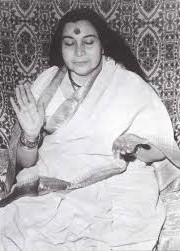
The Gospel of Thomas was obviously popular and circulated widely. Only the formation of the Christian canon of Scriptures and its use in the liturgy and as a counterpart to the Law and the Prophets limited its influence, so that it gradually lost its position in Christianity. Even so, its impact is astonishing. As we have mentioned, Hippolytus of Rome quoted it at the beginning of third century in Rome. Puech found a quotation of logion 5 on a linen band of an Egyptian mummy from the fifth century,19 and a great part of the Gospel of Thomas was discovered in Chinese Eastern Turkmenistan Turkmenistan among the so-called Turfan fragments, which had a Manichean background.20 This means that it spread from Syria to Rome, Egypt, and even to the border of China.” (Pokorny 2011, 5)
“Early Christians also were called Gnostics because they knew. It means to know on your central nervous system, not mentally. That's why as soon as Paul took over Christ's disciples ran away.
And when Thomas came to India he hid all the knowledge about Reality in a jar in Egypt. This was because he would have been persecuted by people who were interested in organizing religion, in making money out of it...
Now, it is for you people to bring back the glory of Christ, to bring back the dharma of Christ, to reflect the great image of Christ. When people say that you have no ideals, I'm amazed. Who could be a better ideal than Jesus Christ? Can't think of anybody better, but nobody tries to follow Him, only try to use Him for wrong purposes.
So for us the ideal is Christ. Of course, I don't expect you to crucify yourself. But always be able to sacrifice, coping with all the discomforts and problems and not talking about yourself, not worrying about yourself, not discussing others and judging others, but giving assurances that now we are at this level, we'll be at a higher level and all the world has to come up to that level. Very positive talking, very positive thinking and very positive doing is the way you can really follow Christ. Whatever He had to do, He did it with such great sense and beauty. That is what it is.
So we have to be born like Christ today. We are all born like Christ because we are born without a father, by the Holy Ghost, just like Christ was born. But look at Him and look at yourself, born the same way as He was born. So you must respect yourself as He respected Himself and the way He worked out His resurrection. In the same way, you all have to work out your resurrection, and that is very important.”
THE MOTHER: Messiah-Paraclete-Ruh-Devi
New Delhi, India—March 21, 1992
“Thomas was one of the twelve disciples of Lord Jesus Christ. Thomas in Hebrew means 'The Twin'. So he was also known as 'Didymus' which meant 'The Twin' in Greek. The Malankara Orthodox Syriac Church is one of the oldest Churches in Christendom and the most ancient in India was established by St.Thomas, one of the Apostles of our Lord God Jesus Christ, in 52.A.D. Christanity came to India much before it went to Rome or Western Europe.The syrian Christians of Kerala constitute the most ancient Christian community of India. Their form of Christianity is apostolic and derived directly from Apostle St.Thomas.” Orthodox Theological Seminary, Kerala, India (Retrieved March 5, 2012)
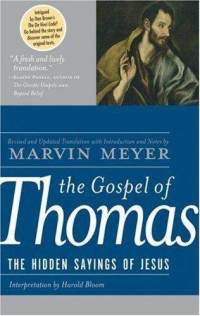
“But the Jesus of the Gospel of Thomas is not interested in coercion, nor can anyone coerce in his name. The innocence of gnosticism is its freedom from violence and fraud, from which historical Christianity cannot be disentangled. No one is going to establish a gnostic church in America, by which I mean a professedly gnostic church, to which tax exemption would never be granted anyway. Of course we have gnostic churches in plenty: the Mormons, the Sothern Baptists, the Assemblies of God, Christian Science, and most other indigenous American denominations and sects. These varieties of the American religion, as I call it, are all involuntary parodies of the gnosis of the Gospel of Thomas. But ancient Gnosticism is neither to be praised nor blamed for its modern analogues. What is surely peculiar is the modern habit of employing 'gnosis' or 'gnosticism' as a conservative or institutionalized Christian term of abuse. An elitist religion, Gnosticism almost always has been a severely intellectual phenomenon, and the Jesus of the Gospel of Thomas is certainly the most intellectualized figure among all the versions of Jesus through the ages.”
The Gospel of Thomas: The Hidden Sayings of Jesus
Marvin Meyer, HarperOne; 2nd edition (October 9, 1992) pp. 134
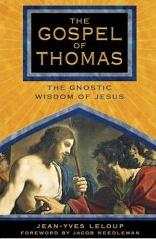
PROLOGUE
These are the words of the Secret.
They were revealed by the Living Yeshua.
Didymus Judas Thomas wrote them down.
(CF. JER 36:1, 37:4; BARUCH 1; 1 COR 24:44; REV 4:9, 10:6)
“Some would translate 'pocryphal words' in the literal sense of the
Greek word apokruphos, which simply means 'hidden.' But this prologue
implies much more than that: Yeshua has come to reveal to us the
Words of the Secret, of the Human and of the Divine: God in Human and
Human in God ... the secret of Being and of Love. In the Gospel of
Matthew he invites us to 'pray to the Father who is there, in
secret,' and not to be rigid in our justice, like the Pharisees and
hypocrites. The God of Love who dwells in the depths of human
beingness is a secret, and it is from these hidden depths that we can
act, think, and speak in true freedom.
Yeshua, the Living, the Awakened One, reveals through his words, his
life, and his acts the secret that all human beings can realize and
manifest. He fully incarnates life and love, which is why he is given
the name the Living One, the revealer of that which we can attain if
we allow ourselves to be and live in the Presence of God.
Didymus Judas Thomas, the 'twin' (didymos, in Greek), is Jesus'
intimate friend who has compiled these words. They were written down
by Thomas, which could mean the apostle himself during the time of
Yeshua or perhaps another author who represented the lineage of
Thomas. (According to later tradition, Thomas died in Madras, India,
and his tomb is still venerated today.) But what is important for us
is to read these scriptures so as to come closer to the Word: to hear
the voice and secret of the Living One within us.”
Jean-Yves Leloup, The Gospel of Thomas
Inner Traditions (2005) p. 60
Prologue
These are the hidden sayings that the living Jesus spoke and Judas Thomas the Twin recorded.
“These are the hidden sayings that the living Jesus spoke: The incipit, or opening of the document, provides what is most likely the earlier version of the title. A second, later title is given at the end of the document: 'The Gospel According to Thomas.' A similar incipit opens another document from the Nag Hammadi Library, Book of Thomas 138, 1-4: 'The hidden sayings that the savior spoke to Judas Thomas, which I, Mathaias, in turn recorded. I was walking, listening to them speak with each other.'
'hidden sayings': or, 'secret sayings,' 'obscure sayings' (so Bentley Layton, The Gnostic Scriptures, p. 380). The Nag Hamaddi Secret Book of James 2,7-16 has James describe how such hidden sayings were recorded: 'Now the twelve followers [were] all sitting together, recalling what the savior had said to each of them, whether in a hidden or an open manner, and organizing it in books [And I] was writing what is in my [book].'
'the living Jesus': probably not the resurrected Christ as commonly understood, but rather Jesus who lives through his sayings.”
Marvin Meyer, The Gospel of Thomas: The Hidden Sayings of Jesus
HarperCollins Publishers (1992) p. 77
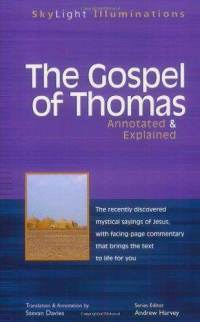
Incipit: These are the hidden sayings that the living Jesus spoke and that Didymus Judas Thomas wrote down. 1
“1. The 'hidden-ness' of the sayings has to do with their enigmatic character. The meaning of these sayings is hidden within them as, for example, leaven is hidden in dough (saying 96) or a treasure might be hidden in a field (saying 109). The Gospel of Thomas is optimistic that what is hidden will be revealed (sayings 5, 6, 108). These are not sayings that were supposed to be kept secret from other people, though, for roughly half of them are found in Matthew's and Mark's and Luke's Gospels, so it's likely that they were all commonly known and widely circulated.”
Stevan Davies, The Gospel of Thomas
Shambhala Library (July 2004), pp. 2-3
These are the hidden logia
which the living Jesus spoke
and Didymos Judas Thomas recorded
“Note 1. There is no English word adequate for the Greek word that is presented here as logia. Literally, 'sayings' might be used, but that fails to convey the attitude changing quality.
Note 2. The Coptic word here for 'hidden' is the same as in logion 109 for the hidden treasure within the field. In the turbulent time of the Master's place and time, it was normal practice to hide treasures thus; and hence they were likely to be found by anyone searching thoroughly.
It would be a great mistake to think of these words to be secret, or esoteric, or for some cult, or only for the initiated. Their inner meanings are treasures, to be manifested to anyone who has the urge to seek them.”
Hugh McGregor Ross, The Gospel of Thomas
Watkins Publishing (2006) p. 90
Incipit: These are the secret sayings that the living Jesus spoke and Didymus Judas Thomas recorded.
“This prologue provides the reader with the first entrance into the world of the text: the voice of a narrator speaks directly to the readers in suggestive language about 'secrets' spoken by a 'living' speaker introducing them to these mysterious characters and orienting them to what follows. This world evoked by presences and secret sayings, of recorders and living speakers, come to the readers in a text; the text conjures these textual realities and makes them speak in the mind of the readers. The world it constructs captivates the readers, and reveals to them the world recorded by Didymos Judas Thomas.
What voices emerge from the textual world? The brief initial statement introduces a narrator who mediates among the reader, Jesus and the recorder of the sayings: the text evidences a number of different and simultaneous perspectives on the material presented. The narrator's voice provides the primary discourse from narrator to reader: that narrative voice conveys the apparent direct address of Jesus to the reader. Even though that narrative voice recedes to an almost inaudible and simple declarative 'Jesus says,' it nonetheless dominates the discourse by intruding at almost every turn to position itself between Jesus' speech and the reader. The continual repetition by the narrator that 'Jesus says' seem to defer to Jesus' voice, while actually underscoring the dominance of the narrator's control of the saying given. The narrator mediates and provides the context for the transmission of the sayings of Jesus, subtly, sometimes imperceptibly, sometimes by omission, but always by direct interjection. The narrator's voice dominates.
The narrator not only provides the medium for Jesus' sayings, but also displaces the voice of Judas Didymos Thomas who, presented in the third person, becomes simply a discursive authority, a designated repository for the sayings of the living Jesus which the narrator presents. The displacement of Judas Didymos Thomas, as a kind of mentioned locus of authority, at once provides a place for that tradition, while rejecting its definitive status. In order of priority, the narrator's voice takes precedence over Jesus' and over the authority of Judas Didymos Thomas, because it is the narrator who tells the reader who speaks and who records. The text's primary voice remains the narrator's, Jesus' voice provides the message refracted by the narrative, and Judas Didymos Thomas' voice provides the authority counterpoised to that of Jesus.
The discursive voices also construct a reader of, or listener to, the sayings as a primary character in the text. Both the narrator and Jesus address the readers directly, the narrator by direct intervention (so as to mean 'Reader, this is what the living Jesus says'), and Jesus by direct address to the 'you' of the sayings audience (one example among many, 's for you [be as sly] as [snakes ...]'). This constructed readership has important implications: the instruction and challenge of these sayings have their direct reference to readers, who do not passively mouth, but receive the material which the narrator conveys as from Jesus' own mouth, but who function as active agents in the development of their own understanding and way of life. That is, the imperative of the text lies with the readers who really have been constructed as seekers after the secret sayings of the living Jesus. The message, delivered directly to the reader whether by Jesus or the narrator, emphasizes the central role of reader to the text...
This invisible narrator mirrors the secrecy of the sayings: 'These are the secret sayings....' The narrator informs the readers that these sayings have a restricted audience: the narrator grants the readers entrance into a select group of those selected by the narrator to hear the secret sayings. The secrecy has two fields of meaning: the Greek word apokryphos implies that the sayings are obscure and difficult to interpret; the Coptic word hep implies that few can read them because they are not readily available. These sayings present the readers, as the narrator points out, with difficult and puzzling sayings that will challenge them.
The sayings comes from the 'living Jesus' (Kaestli 1979: 389). They are secret and troubling sayings that come from one present in the community. The fact that Jesus is 'living' draws attention to itself. It implies that for others, there are sayings from a 'dead' Jesus, that is, their Jesus is not really present to them in speaking the sayings. But for this community, the one to which the narrator extends the invitation, their Jesus lives, speaks, and continues to challenge. The narrative world includes a Jesus fully present, speaking, and capable of being recorded and transmitted to others...
The readers, then, have entered into a different and new world at the invitation of one who knows both the living words of Jesus and the authoritative traditions of Judas, also called Thomas. That narrative world presents difficult material from the mouth of a present and speaking Jesus, and it is the struggle with that challenging material that brings the reward, as the next saying relates.
Saying 1
And he said, 'Whoever discovers the interpretation of these sayings will not taste death.'”
Richard Valantasis, The Gospel of Jesus
Routledge; 1 edition (June 29, 1997) pp. 50-54
Coptic Prologue: “The sayings speak not of dead knowledge, nor of ancient knowledge, not even of eternal knowledge, but a present knowledge.”
P. Oxy 654.1-3a [Coptic Prologue]
These are the [secret] sayings [that] the living Jesus spoke, [and Judas, who is] also
The brief Prologue orients the reader to what follows. It is a kind of "title page," a marketing device for letting readers know what is to follow. The title page, or Prologue, relates that the reader may expect sayings. Collections of sayings were common in antiquity (Kloppenborg 1987: 263-316): these collections provided a means for training people in specific kinds of education (as in scribal schools), or in philosophical traditions, or in mystical knowledge. Sayings, or aphorisms, were a common educational device.
The fact that these are secret sayings adds some specificity. Their secrecy at once explains the audience and the mode of expression. The audience, the proposed readership, the buyers, are not common people, or just anyone. These sayings have been collected for a particular, and entitled readership—one capable of entering into this conversation (Koester 1990a: 124-28). They are esoteric because they are not written as discursive descriptions or as a philosophical tractate, but as sayings. Sayings demand that the audience puzzle over their meaning, and, therefore, only the capable will understand them. Secrecy also defines the mode of expression: these sayings are difficult and challenging elements to puzzle about. The sayings do not speak plainly or directly, but in a hidden way, a mysterious way about things that are at once obvious and riddling. These secret sayings of the living Jesus, then, present difficult and perplexing material to a select group of people (Kaestli 1979: 389).
The "living" Jesus presents these sayings. The sayings speak not of dead knowledge, nor of ancient knowledge, not even of eternal knowledge, but a present knowledge. Jesus lives within the loosely confederated group in which these sayings operate; whoever puzzles through these difficult sayings encounters a living voice, a real person, speaking to them. This evokes presences, immediacy, life in a context in which the study of the sayings evokes the living presence of the speaker of the sayings.
The title page also mentions the recorder of the sayings, Judas, who is also known as Thomas. This identification of the recorder provides the lens through which the sayings of the living Jesus are viewed. Jesus does not speak directly, but through the recordings of Thomas. Thomas defines what the readers will know; Thomas determines what voice Jesus has by presenting some sayings, and, presumably, not recording or transmitting others. The readers hear Jesus, but that Jesus has been carefully defined (or edited) by Judas/Thomas. That particular lens constructs a pattern of authority in a very subtle way. Jesus speaks as a living presence, that living presence depends upon Thomas' recording, the readers' understanding depends upon Thomas. The readers of these secret sayings become followers of Thomas' understanding of the secret sayings of Jesus. The readers have been constituted as a "community" of people following the understanding of Jesus recorded by Judas/Thomas.”
Richard Valantasis, The Gospel of Jesus
Routledge; 1 edition (June 29, 1997) pp. 31-2
Would Thomas Believers be accepted by most Jews, Christians, Muslims, Buddhists, or Hindus today?
“Jesus knew that what he was teaching was not simply a rehash of the standard fare of organized religion at his time. It's not only that his teachings did not articulate typical Judaism in the first century. Those teachings would be equally foreign to typical Christianity or typical Buddhism or typical Islam today. For Jesus was teaching a mystical awareness that, while undergirding all the great traditions, eludes their exoteric identity, that is, the external face of religion dealing only with surface realities.
Would Thomas Believers be accepted by most Jews, Christians, Muslims, Buddhists, or Hindus today? I think not. Too much has been invested in the forms and formulas of current religion. Too much is at stake for those who wield religion to gain political control over other people or even over whole countries. Too much would be risked for those who see the purpose of religion as keeping people at a level of spiritual infantilism, providing them with a nursery world filled with nostalgia and childhood comfort foods.
55 Jesus said: He who does not hate his father and
mother cannot be a disciple of mine. He who
doesn't hate his brothers and sisters and bear his
cross as I do will not be worthy of me.
Since this text can also be found in the canonical gospels, we find countless commentaries reminding us of the outlandish hyperbole so common in Middle Eastern discourse. Jesus is talking about priorities, not about literally hating others, especially the very parents we are enjoined to honor by one of the Ten Commandments. And yet, I think we must be cautious in declawing this teaching.
Families are sometimes hazardous to our health. They can function like the 'old wineskins' in the last saying. They often represent change-resistant habits. 'This is how we've always done it.'”
Ron Miller, The Gospel of Thomas
Skylight Paths Publishing (2004) pp. 13-14
The Gospel of Thomas
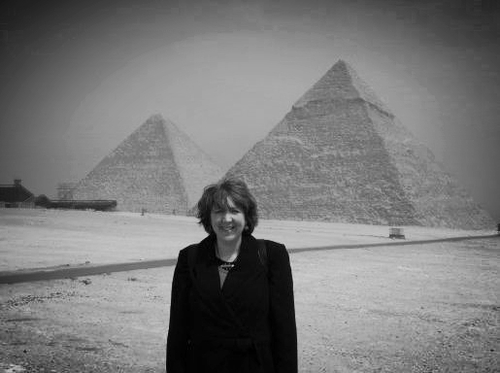
April Deconick visiting the Giza Pyramids, Cairo, 2015 “Where Did The Gospel Of Thomas Come From?
We have known about the existence of an early Christian gospel named the Gospel of Thomas since the early third century because it is mentioned by Hippolytus, who even quotes an elaborate recension of saying 4. In the late 1800s, Professors Grenfell and Hunt dug up a hoard of papyri in Oxyrhyncus, Egypt. Three of these Greek papyri fragments are pages of the Gospel of Thomas, although their identification as such was not made certain until the 1950s when a full Coptic version was noticed among another papyri find from 1945 near Nag Hammadi, Egypt. This latter find was a cache of leather bound books - we have twelve of the books and part of the thirteenth - and these are housed today in Old Cairo at the beautiful Coptic Museum. The three Oxyrhynchus fragments are housed today at Harvard, Oxford, and British Library.
How does the Gospel of Thomas compare to the New Testament gospels?
The Gospel of Thomas is quite different from the New Testament gospels in that it is a gospel of sayings of Jesus. Most sayings are introduced with the simple attribution "Jesus said," one listed after the other. Narrative is practically absent from the Gospel of Thomas, at least in terms of the type of narrative details and elaborate settings for the sayings that we find in the New Testament gospels. In this way, the Gospel of Thomas is closer in genre to the reconstructed Q, the synoptic sayings source that has been postulated as a major literary source for Matthew and Luke. The Gospel of Thomas is not Q, but it does represent the type of gospel that Q might have been.
There are a number of sayings of Jesus that we find in the synoptic gospels that have parallels (although in different recensions) in the Gospel of Thomas. There are several sayings in Thomas that have parallels in John, but on the level of thematic allusions rather than direct recensions. And there are a number of sayings in the Gospel of Thomas that are unique, unparalleled in the New Testament gospels.
What Is Thomas' Relationship To The New Testament Gospels?
Since the discovery and translation of the Gospel of Thomas in the 1950s, scholars have mainly been in two camps on this. Either they argue that Thomas is a gospel that was based on the New Testament gospels and "perverted" the sayings to meet some heretical theological agenda, or they argue that Thomas is a gospel that was independent from the New Testament gospels and preserved sayings of Jesus from an early Jewish Christian literary source or from early oral tradition. There are good (and bad) arguments for both cases, and essentially the field is at a stalemate on the question.
My own work is trying to get us past this, to think about it in different terms. If the Gospel of Thomas is a text that was very old and grew over time, then we probably have a complicated relationship to the New Testament gospels. On the one hand we would expect some of the sayings in the Gospel of Thomas to represent early independent traditions, before the Synoptics were even written. But as the Gospel of Thomas was adapted over time, its sayings naturally would be adjusted to the knowledge of other texts and to the memory of other texts. Add to this the fact that scribes when copying and translating texts into new languages felt quite free to alter the wording to fit more precisely their knowledge and memory of other texts, and we have a very complex situation of secondary orality and scribal adaptation. By the way, we find all of these operational in the Gospel of Thomas I think.
So what this means is that arguments for dependence aren't going to cut it anymore. We have before us the difficult task of figuring out what type of dependence we are talking about, alongside the acknowledgment that dependence in our late document does not necessarily mean dependence of the original Gospel of Thomas on the Synoptics.
Is The Gospel Of Thomas Gnostic?
The quick answer to this is "no.” The spirituality in this gospel has been misunderstood and mislabeled from the very beginning of its interpretative history. The reason for this has to do with the fact that until the Nag Hammadi texts were found, we didn't know what Gnostic really was. Scholars tended to apply it very loosely to any text or tradition that they believed to be dualistic and anti-world or body, which expressed the opinion that within the human being was "light" redeemable through gnosis or knowledge. After studying the Nag Hammadi texts for fifty years, we now realize that this is a nonsense definition because it is so broad as to be useless. Instead we have come to realize that Gnostic spirituality is marked by a distinctive set of features including direct contact with a transcendent God through specific ritual practices, an innate spirit that is consubstantial with God, a transgressive attitude toward established religions and their scriptures, and seeker orientation that was very inclusive, spanning a variety of philosophies and religions in antiquity.
The spirituality in the Gospel of Thomas is a form of early Christian mysticism. It was a contemplative type of Christianity that grew in Syria as well as Alexandria. The idea was that each person had the choice to grow into God's Image or to remain stunted due to Adam's decision. If the person chose to grow, then the divinization process was gradual and included not only ritual activities like baptism and eucharist, but also instructional and contemplative activities. Part of the process then was living as Jesus lived - it was imitative. The other part was contemplating who and where Jesus was. This contemplative life led to heavenly (or interiorized) journeys and visions of God. Eventually the faithful would become like Jesus, replacing their fallen image with the image of God. This contemplative Christianity is not heretical, but an early form of eastern orthodoxy!”
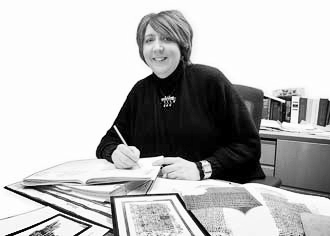
April DeConick writing at Illinois Wesleyan University 2004 Why Wasn't The Gospel Of Thomas Included In The New Testament?
“The process of the canonization of the New Testament was long and involved. It took almost four hundred years. The date we traditionally give to its closure is 367 CE, when Bishop Athanasius of Alexandria records the books in the NT as being those we have in it today. There are many reasons for Thomas' exclusion, not the least among them political - it was a text that in the third century was used by the Naassene Gnostics (who rewrote it for their own purposes) and the Manichaean Gnostics (who used it liberally in their liturgies). Once a text began to be used by a heretical group, it became suspicious, especially if this happened in the third or fourth centuries. Texts included had to have:
— apostolic connections - something Thomas had
— be used in liturgy across the Mediterranean world - which Thomas wasn't, since it was a distinctive Syrian text with some distribution in Egypt
— predate 150 CE - which Thomas did
— support the theology of the framers of the canon - which Thomas didn't, since it was anti-marriage and pro-mysticism or "revelatory"
What Does The Gospel Of Thomas Tell Us About Jesus?
Given its use by at least two heretical groups in the third century, its emphasis on seeking new revelation, its stance against marriage and procreation, and its limited distribution and use in liturgy, it didn't have a chance to become part of the New Testament.
This gospel understands Jesus to be a charismatic figure. By this I mean, Jesus continues to live in their community even after he has died. His spirit continues to speak to this community of faithful, and they continue to record his teachings. They do not appear to have made any distinction between the "historical" Jesus before death and the "spirit" Jesus after death, at least in terms of authority or historicity of his words. The Jesus that emerges in the Gospel of Thomas is not entirely foreign to the New Testament portrayals, particularly as we see him emerge in the Gospel of John - but also, as we see him in Mark, teaching publicly to the crowds and privately his mysteries to a few close followers. His message is either similar to the New Testament Jesus, or contiguous with him. He teaches against carnality and succumbing to bodily desire. He's an advocate for celibacy. He preaches that the Kingdom of God is here, that people must make a choice whether to enter it or not, that this choice requires an exclusive commitment to him and God, that the going is tough and few will be able to make it. He demands a lifestyle of righteous living, promises rewards including personal transformation and revelation.”
https://aprildeconick.com/gospel-of-thomas-articles/
Web (Retrieved 2017-06-05)
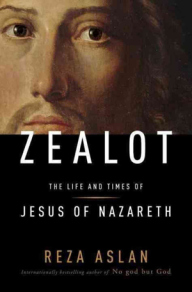
“The Jesus that is uncovered in the process may not be the Jesus we expect; he certainly will not be the Jesus that most modern Christians would recognize. But in the end, he is the only Jesus that we can access by historical means.”
“It is a miracle that we know anything at all about the man called Jesus of Nazareth. The itinerant preacher wandering from village to village clamoring about the end of the world, a band of ragged followers trailing behind, was a common sight in Jesus' time—so common, in fact, that it had become a kind of caricature among the Roman elite. In a farcical passage about just such a figure, the Greek philosopher Celsus imagines a Jewish holy man roaming the Galilean countryside, shouting to no one in particular: "I am God, or the servant of God, or a divine spirit. But I am coming, for the world is already in the throes of destruction. And you will soon see me coming with the power of heaven.”
The first century was an era of apocalyptic expectation among the Jews of Palestine, the Roman designation for the vast tract of land encompassing modern day Israel/Palestine as well as large parts of Jordan, Syria, and Lebanon. Countless prophets, preachers, and messiahs tramped through the Holy Land delivering messages of God's imminent judgment. Many of these so-called"false messiahs"We know by name. A few are even mentioned in the New Testament. The prophet Theudas, according to the book of Acts, had four hundred disciples before Rome captured him and cut off his head. A mysterious charismatic figure known only as"The Egyptian"raised an army of followers in the desert, nearly all of whom were massacred by Roman troops. In 4 b.c.e., the year in which most scholars believe Jesus of Nazareth was born, a poor shepherd named Athronges put a diadem on his head and crowned himself"King of the Jews"; he and his followers were brutally cut down by a legion of soldiers. Another messianic aspirant, called simply"The Samaritan," was crucified by Pontius Pilate even though he raised no army and in no way challenged Rome—an indication that the authorities, sensing the apocalyptic fever in the air, had become extremely sensitive to any hint of sedition. There was Hezekiah the bandit chief, Simon of Peraea, Judas the Galilean, his grandson Menahem, Simon son of Giora, and Simon son of Kochba—all of whom declared messianic ambitions and all of whom were killed for doing so. Add to this list the Essene sect, some of whose members lived in seclusion atop the dry plateau of Qumran on the northwestern shore of the Dead Sea; the first-century Jewish revolutionary party known as the Zealots, who helped launched a bloody war against Rome; and the fearsome bandit-assassins whom the Romans dubbed the Sicarii (the Daggermen), and the picture that emerges of first-century Palestine is of an era awash in messianic energy.
It is difficult to place Jesus of Nazareth squarely within any of the known religiopolitical movements of his time. He was a man of profound contradictions, one day preaching a message of racial exclusion ("I was sent solely to the lost sheep of Israel"; Matthew 15:24), the next, of benevolent universalism ("Go and make disciples of all nations"; Matthew 28:19); sometimes calling for unconditional peace ("Blessed are the peacemakers for they shall be called the sons of God"; Matthew 5:9), sometimes promoting violence and conflict ("If you do not have a sword, go sell your cloak and buy one"; Luke 22:36).
The problem with pinning down the historical Jesus is that, outside of the New Testament, there is almost no trace of the man who would so permanently alter the course of human history. The earliest and most reliable nonbiblical reference to Jesus comes from the first-century Jewish historian Flavius Josephus (d. 100 c.e.). In a brief throwaway passage in the Antiquities, Josephus writes of a fiendish Jewish high priest named Ananus who, after the death of the Roman governor Festus, unlawfully condemned a certain"James, the brother of Jesus, the one they call messiah," to stoning for transgression of the law. The passage moves on to relate what happened to Ananus after the new governor, Albinus, finally arrived in Jerusalem.
Fleeting and dismissive as this allusion may be (the phrase 'the one they call messiah' is clearly meant to express derision), it nevertheless contains enormous significance for those searching for any sign of the historical Jesus. In a society without surnames, a common name like James required a specific appellation—a place of birth or a father's name—to distinguish it from all the other men named James roaming around Palestine (hence, Jesus of Nazareth). In this case, James' appellative was provided by his fraternal connection to someone with whom Josephus assumes his audience would be familiar. The passage proves not only that"Jesus, the one they call messiah"probably existed, but that by the year 94 c.e., when the Antiquities was written, he was widely recognized as the founder of a new and enduring movement.
It is that movement, not its founder, that receives the attention of second-century historians like Tacitus (d. 118) and Pliny the Younger (d. 113), both of whom mention Jesus of Nazareth but reveal little about him, save for his arrest and execution—an important historical note, but one that sheds little light on the details of Jesus' life. We are therefore left with whatever information can be gleaned from the New Testament.
The first written testimony we have about Jesus of Nazareth comes from the epistles of Paul, an early follower of Jesus who died sometime around 66 c.e. (Paul's first epistle, 1 Thessalonians, can be dated between 48 and 50 c.e., some two decades after Jesus' death). The trouble with Paul, however, is that he displays an extraordinary lack of interest in the historical Jesus. Only three scenes from Jesus' life are ever mentioned in his epistles: the Last Supper (1 Corinthians 11:23-26), the crucifixion (1 Corinthians 2:2), and, most crucially for Paul, the resurrection, without which, he claims," our preaching is empty and your faith is in vain" (1 Corinthians 15:14). Paul may be an excellent source for those interested in the early formation of Christianity, but he is a poor guide for uncovering the historical Jesus.
Then there are the gospels, which present their own set of problems. After all, the gospels are not, nor were they ever meant to be, a historical documentation of Jesus' life. These are not eyewitness accounts of Jesus' words and deeds. They are testimonies of faith composed by communities of faith written many years after the events they describe. Simply put, the gospels tell us about Jesus the Christ, not Jesus the man.
In the end, there are only two hard historical facts about Jesus of Nazareth upon which we can confidently rely: the first is that Jesus was a Jew who led a popular Jewish movement in Palestine at the beginning of the first century c.e.; the second is that Rome crucified him for doing so. By themselves these two facts cannot provide a complete portrait of the life of a man who lived 2,000 years ago. But when combined with all we know about the tumultuous era in which Jesus lived—and thanks to the Romans, we know a great deal—these two facts can help paint a picture of Jesus of Nazareth that may be more historically accurate than the one painted by the gospels. Indeed, the Jesus that emerges from this historical exercise—a zealous revolutionary swept up, as all Jews of the era were, in the religious and political turmoil of first-century Palestine—bears little resemblance to the image of the gentle shepherd cultivated by the early Christian community.
Consider this: Crucifixion was a punishment that Rome reserved almost exclusively for the crime of sedition. The plaque the Romans placed above Jesus' head as he writhed in pain—"King of the Jews"—was called a titulus and, despite common perception, was not meant to be sarcastic. Every criminal who hung on a cross received a plaque declaring the specific crime for which he was being executed. Jesus' crime, in the eyes of Rome, was striving for kingly rule (i.e. sedition), the same crime for which nearly every other messianic aspirant of the time was killed. Nor did Jesus die alone. The gospels claim that on either side of Jesus hung men who in Greek are called lestai, a word often rendered into English as"thieves"but that actually means"bandits"And was the most common Roman designation for an insurrectionist or rebel.
Three rebels on a hill covered in crosses, each cross bearing the racked and bloodied body of a man who dared defy the will of Rome. That image alone should cast doubt upon the gospels' portrayal of Jesus as a man of unconditional peace almost wholly insulated from the political upheavals of his time. The notion that the leader of a popular messianic movement calling for the imposition of the"Kingdom of God"—a term that would have been understood by Jew and gentile alike as implying revolt against Rome—could have remained uninvolved in the revolutionary fervor that had gripped nearly every Jew in Judea is simply ridiculous.
Why would the gospel writers go to such lengths to temper the revolutionary nature of Jesus' message and movement? To answer this question we must first recognize that almost every gospel story written about the life and mission of Jesus of Nazareth was composed after the Jewish rebellion against Rome in 66 c.e. In that year, a band of Jewish rebels, spurred by their zeal for God, roused their fellow Jews in revolt. Miraculously, the rebels managed to liberate the Holy Land from the Roman occupation. For four glorious years, the city of God was once again under Jewish control. Then, in 70 c.e., the Romans returned. After a brief siege of Jerusalem, the soldiers breached the city walls and unleashed an orgy of violence upon its residents. They butchered everyone in their path, heaping corpses on the Temple Mount. A river of blood flowed down the cobblestone streets. When the massacre was complete, the soldiers set fire to the Temple of God. The fires spread beyond the Temple, engulfing Jerusalem's meadows, the farms, the olive trees. Everything burned. So complete was the devastation wrought upon the holy city that Josephus writes there was nothing left to prove Jerusalem had ever been inhabited. Tens of thousands of Jews were slaughtered. The rest were marched out of the city in chains.
The spiritual trauma faced by the Jews in the wake of that catastrophic event is hard to imagine. Exiled from the land promised them by God, forced to live as outcasts among the pagans of the Roman Empire, the rabbis of the second century gradually and deliberately divorced Judaism from the radical messianic nationalism that had launched the ill-fated war with Rome. The Torah replaced the Temple in the center of Jewish life, and rabbinic Judaism emerged.
The Christians, too, felt the need to distance themselves from the revolutionary zeal that had led to the sacking of Jerusalem, not only because it allowed the early church to ward off the wrath of a deeply vengeful Rome, but also because, with the Jewish religion having become pariah, the Romans had become the primary target of the church's evangelism. Thus began the long process of transforming Jesus from a revolutionary Jewish nationalist into a peaceful spiritual leader with no interest in any earthly matter. That was a Jesus the Romans could accept, and in fact did accept three centuries later when the Roman emperor Flavius Theodosius (d. 395) made the itinerant Jewish preacher's movement the official religion of the state, and what we now recognize as orthodox Christianity was born.
I have been studying the life and time of Jesus of Nazareth for much of the last twenty years in an attempt to uncover, as much as possible, the Jesus of history, the Jesus before Christianity: the politically conscious Jewish revolutionary who, 2,000 years ago, walked across the Galilean countryside, gathering followers for a messianic movement with the goal of establishing the Kingdom of God but whose mission failed when, after a provocative entry into Jerusalem and a brazen attack on the Temple, he was arrested and executed by Rome for the crime of sedition. The result of my two decades of academic research is my latest book, Zealot: The Life and Times of Jesus of Nazareth.
There are those who consider such an endeavor to be a waste of time, believing the Jesus of history to be irrevocably lost and incapable of recovery. But I believe that if we expose the claims of the gospels to the heat of historical analysis, we can purge the scriptures of their literary and theological flourishes and forge a far more accurate picture of the Jesus of history. Indeed, I am convinced that if we commit to placing Jesus firmly within the social, religious, and political context of the era in which he lived—an era marked by the slow burn of a revolt against Rome that would forever transform the faith and practice of Judaism—then, in some ways, his biography writes itself.
The Jesus that is uncovered in the process may not be the Jesus we expect; he certainly will not be the Jesus that most modern Christians would recognize. But in the end, he is the only Jesus that we can access by historical means.
Everything else is a matter of faith.”
Reza Aslan, Zealot: The Life and Times of Jesus of Nazareth
Random House (July 16, 2013) pp. xxiii-xxxi
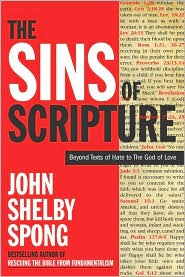
“In addition to homosexuality and anti-Semitism, there was the way women have been treated in Christian history. The two largest Christian churches in the world, the Roman Catholic and the Orthodox tradition, still refuse to ordain women and the conservative Protestant churches continue to argue about something they call 'headship,' which means that no woman should be allowed authority over a man. After this, other themes began to occur to me with some regularity. There was the issue of child abuse in the Western world that has operated under the rubric of 'proper discipline,' which constituted another offence historically rooted in biblical quotations. There was the enormous religious negativity that attacks family planning and the subsequent environmental impact of overpopulation, all the while rooting itself in biblical authority in order to give its negativity credibility. Christian voices in our world continue to employ words that reveal nothing less than arrogance toward other religions, whose adherents they regard as fit subjects not dialogue but for conversion. This attitude is regularly enforced with biblical claims that a particular religious tradition possesses the certainty of the ultimate truth of God that is seen first as religious bigotry and later as religious prosecution. So the idea of doing a book to expose and challenge what I began to call first the 'terrible texts of the Bible' and later 'the sins of scripture' grew in its appeal. My purpose was to lay bare the evil done by these texts in the name of God.
Even that, however, was not enough to convince me to undertake the discipline required to write another book. As a committed Christian who has spent a lifetime studying the Bible and whose life has been deeply shaped by that study, I was not interested in writing what was beginning to sound like a negative, Bible-bashing book. I have passed the point in life when I find fulfillment in doing deconstruction. There had to be more to it than that. Exposing the misuse of scripture can, I believe, be done only in the context of introducing people to a proper was to engage this holy book of the Judeo-Christian tradition. So I began to research the 'terrible texts of the Bible,' not just to lay bare the negativity, but with the hope of recovering that ultimate depth of the texts which I believe enables me to acknowledge the divine image in the face of every person, to see the love of Christ for every person and to assist in the call into life by the Spirit for every person. Only when the way to connect these positive ideas to an analysis of the 'terrible texts of the Bible' became clear did this book finally take shape. It would be another, and I hope timely, attempt to rescue the Bible from those who first literalize it and then so badly misuse it.”
John Selby Spong, The Sins of Scripture
HarperOne (2006) pp. xii-xiv
“In the history of the Western world, however, this Bible has also left a trail of pain, horror, blood and death that is undeniable. Yet this fact is not often allowed to rise to consciousness. Biblical words have been used not only to kill, but even to justify that killing. This book has been relentlessly employed by those who say they believe it to be God's Word, to oppress others who have been, according to the believers, defined in the 'hallowed' pages of this text as somehow subhuman. Quotations from the Bible have been cited to bless the bloodiest of wars. People committed to the Bible have not refrained from using the cruellest forms of torture on those whom they believe to have been revealed as the enemies of God in these 'sacred' scriptures. A museum display that premiered in Florence in 1983, and later traveled to the San Diego Museum of Man in 2003, featured the instruments used on heretics by Christians during the Inquisition. They included stretching machines designed literally to pull a person apart, iron collars with spikes to penetrate the throat, and instruments that were used to impale the victims. The Bible has been quoted throughout Western history to justify the violence done to racial minorities, women, Jews and homosexuals. It might be difficult for some Christians to understand, but it is not difficult to document the terror enacted by believers in the name of the Bible.”
John Selby Spong, The Sins of Scripture
HarperOne (2006) p. 5
As Upadhyay has stated, “The negative plate of Jesus, developed in a solution of Hinduism, brings out hitherto unknown features of the portrait.”
“In chapter 26, 'Indian Christian Spirituality,' J. Valiamangalam identifies different forms of Christian presence in India. According to Thomas Christians, the message of Christianity entered India in the first century of the Common Era through the preaching of St. Thomas, one of the apostles of Jesus. The various Christian denominations have been active in the Indian scene from early times. Valiamangalam points out that in course of time, the Christians have changed their attitude with regard to their missionary work in India. The works and writings of persons like Swami Vivekananda, Rabindranath Tagore, Sri Aurobindo, and Mahatma Gandhi have greatly helped the Christians to appreciate the spiritual wealth of Hindu and other religions of Indian origin. 'However, this change towards openness is yet to grow fully in depth and width in order to become the general character of Christian presence in India.' In order to do so, Christian spirituality needs to have serious and sincere encounters with Indian spiritual traditions. Valiamangalam points out that, except in Kerela, generally Christianity has been looked upon as a foreign religion. The reason is that the major portions of Thomas Christians in Kerela came from the high castes in the Hindu society. In addition, Thomas Christians retained the native customs in their daily life and actively interacted with the Hindu community in their social religious lives. This was, however, before the Synod of Diamper, which, as it were, transplanted a Syrian or European church to India and placed restrictions on religious interaction with the Hindus. There are, however, attempts in the present time to recover the Christian spirituality of the pre-Diamper period, and the 'Christian Ashram' movement reflects the Christian openness to Hindu spirituality. Christianity, in its turn, has greatly influenced Hinduism, particularly the modern Hindu religious movements like Brahmo Samaj, and also persons like Mahatma Gandhi, Sri Aurobindo, Ramakrishna Paramahamsa, and Swami Vivekananda. Gandhi stands as one of the prime examples of enrichment through Hindu and Christian interaction. Gandhi's confession, 'It was the New Testament which really awakened me to the rightness and value of passive resistance. The Bhagavad Gita deepened the impression,' is to the point. Valiamangalam feels that it is this enrichment gained by deepest contact with Hindu spirituality that should mold the spirituality of Indian Christianity. As Upadhyay has stated, 'The negative plate of Jesus, developed in a solution of Hinduism, brings out hitherto unknown features of the portrait.' It is in the directions given by persons like Abhisiktananda, a Catholic priest, who reflect deeply the spirit of interactions between Christianity and Hinduism and their mutual enrichment, that the future of Indian Christianity seems to lie. The author concludes that a church without rigid institutional formalities is perhaps the best basis for a genuine Indian Christianity or even for a world religious culture.”
K. R. Sundararajan, Hindu spirituality: Postclassical and Modern
Motilal Banarsidass, (Jan 30 2004) xxxiv-xxxv
Inner Religion
“One of the great ironies of religious history is that, although the religions that came out of the Near East—Judaism, Islam, Christianity—adamantly reject most of Hinduism's fundamental teachings, their mystical traditions—the Kaballah, Sufism, and Christian Gnosticism—reflect Hindu insights in almost every detail. Numerous students of comparative religion, from Muslim scholar Al Buruni in 1000 C.E. to the world famous writer Aldous Huxley nearer our own time, have expressed their amazement at the parallels between the major mystical traditions of the world and Hinduism...
Hinduism is by far the most complex religion in the world, shading under its enormous umbrella an incredibly diverse array of contrasting beliefs, practices, and denominations. Hinduism is by far the oldest major religion. It has had more than enough time to develop a diversity of opinions and approaches to spirituality unmatched in any other tradition. ...
Turning On Your Light
If karma and reincarnation form the spinning wheel of the cosmic process, the Inner Self is the unmoving axle around which the wheel turns.
'Know Thyself' was the advice chiselled over the portico at the Oracle of Delphi in ancient Greece. No religion has ever taken the quest for self-knowledge as seriously as Hinduism. At its core, Hinduism is not about believing what somebody else tells you about the nature of your soul, or accepting what others claim about God. Hinduism is about exploring the very depths of your own soul yourself. And about getting to know God personally...
Secrets Of The Subtle Bodies
Inner realities are legitimate realities to Hindus. They're not cavalierly dismissed as outdated superstitions like they are in the West. We Westerners for the most part only hear about miracles that happened in the Palestine 2,000 years ago. In India, however, every generation of Hindu has been exposed to living saints and yogis who demonstrate what seems like superhuman abilities to the uninitiated.
In India, science and religion have always worked hand in hand. There has been no burning at the stake of scientists in India! There the exploration of inner realities is considered just as valid as research into the outer world of nature. While Hinduism produced some of the greatest natural scientists in history, it also excelled in the science of spirit, pioneered by the inner researchers called yogis...
The Inner Self
Scientists in the West consider consciousness a by-product of the nervous system that ends in death. The sages of India don't buy this. During out-of-body travel they experience their consciousness moving independently of their body. The great masters have also reported remaining conscious and alert after their previous bodies died, and journeying through other inner worlds. To them the physical body is the by-product of consciousness, not the other way around! The Inner Self is called Atman in Sanskrit. The Atman is who you really are—not your physical and subtle bodies, all of which are perishable. The Atman exists beyond space and time. It is the undying reality, your fundamental inner being and truth...
The Inner Sun
The Tripura Rahasya compares the Inner Self to a splendid gem locked in a chest that's fallen in the sea and become covered with mud. You have to find the chest, clean off the mud, and break open the lock. Then you'll see for yourself the shining gem of incalculable value. All Hindu spiritual practices are designed with the ultimate goal of helping us find the 'pearl of great price' that lies buried in our minds and encrusted with the mud of our generally petty, run-of-the- mill thoughts. That gem is the pure, undying awareness that illuminates our lives.”
Linda Johnsen, The Complete Idiot's Guide to Hinduism,
Alpha; 1st edition (October 11, 2001) pp. 76 - 109
Was It Even Possible That the Gospels Could Have Been Written by the People Whose Names Were Put on Them Later?
“It is highly unlikely. The literacy rate in Israel towards the close of the Biblical period is variously reckoned to have been about 1.5% to perhaps about 3%. It’s hard for us to grasp the significance of this today since we have grown accustomed to literacy rates of about 95%. Even in the days of Roman rule the literacy rate was unlikely to have gone above 3% so only very few could read, and even fewer could write well. Only very few could write complex works of prose like the Gospels of the New Testament.
People who attain that standard of literacy were certainly the elite, and you can rest assured that none of them were people who eked out a living by fishing on the shores of the Lake of Galilee.
JOHN’S ORDINARY LANGUAGE ARAMAIC, NOT GREEK
John, the Son of Zebedee, the disciple of Jesus and alleged author of the Fourth Gospel, lived for a long, long time. He lived long enough to know Polycarp, [229] Bishop of Smyrna, (a town on the west coast of modern Turkey). (p.319) Polycarp and the Christians at Smyrna followed the custom of John of celebrating Easter on the day after the Spring Equinox, whether it fell on a weekday or not. In contrast, most early Christians celebrated Easter on the first Sunday after the first full moon after the Spring Equinox.
This calculation of Easter is tied in with the question of whether the Last Supper of Jesus with his disciples was a Passover meal, celebrated the night before Passover. The witness of John would imply it was not. If the Last Supper had been a Passover Meal, then the events of the next day, Passover itself, which included the hauling of Jesus before the various assemblies such as the Sanhedrin, could never have taken place. Passover was a sacred festival on which no work was permitted.
But whatever John was he was certainly poor — a peasant. His ordinary language would have been Aramaic, not Greek, and certainly not the eloquent Greek of the Gospel that bears his name. The Greek of the Gospel of John is a beautiful, sophisticated and eloquent language. The opening verse reads: “In the beginning was the word, the word was with God, and the word was God.”[230] Many consider the first chapter of the Gospel to have been an ancient Christian hymn.
PETER AND JOHN WERE ILLITERATE (‘Agrammatos’)
Furthermore, to add insult to injury, in the Acts of the Apostles both John and Peter are described as ‘agrammatos’ in Greek. You’ll find that tactfully translated in modern versions of Acts as ‘unschooled’. However, a more blunt translation would say that Peter and John were ‘illiterate’ — the correct translation of ‘agrammatos’. Peter, the first Pope, was illiterate. The Greek of the Gospel of John is a sublime form of Greek, and most assuredly, whoever wrote it was not an illiterate person.
Papias (AD 70 — c. 163) was Bishop of Hierapolis, modern Pamukkale, a town just south of present-day Istanbul. He was a contemporary of Polycarp and is an important source of early Christian oral tradition. Papias says that John Mark wrote his Gospel in Rome, based upon the preaching of Peter. Mark was not a disciple of Jesus, in fact he had never met Jesus, and obviously therefore wasn’t an eye witness to the events of his mission.
MATTHEW COPIES CLOSE TO 90% FROM MARK
Let’s look back at those three Synoptic Gospels, Matthew, Mark and Luke, and let’s accept, as we saw earlier, that Mark is the first Gospel. The next Gospel in chronological order is Matthew, supposedly written by Matthew who was an Apostle of Jesus. And what we find is that Matthew copies close to 90% of the actual text of Mark into his own Gospel. “Luke” in turn copies about 65% of Mark into his own Gospel. This is why it is impossible to deny that Mark, not Matthew, was the first Gospel.
It is noteworthy that Mark never calls Jesus ‘God’. Nor does he claim that Jesus existed as a divine being within the Godhead before his earthly life. Furthermore, Mark has no account of the birth of Jesus, miraculous or otherwise. And he has no account of any appearances of Jesus after he rose from the dead.
It was at least ten years after Mark that Matthew’s Gospel appeared. This means that the two elements that the later Church tradition began to emphasize as the very foundations of the Christian faith — the virgin birth and the post-resurrection appearances — do not appear at all in the original Gospel of the New Testament, which raises the question: were those two elements part of the original Christian message?
What if Matthew the Apostle was actually the author of the Gospel that bears his name? It is clear that the Apostle Matthew was a disciple of Jesus, and an eyewitness of all that transpired during the ministry of Jesus. If Matthew’s Gospel were written by Matthew the Apostle, why would he need to borrow 80% of his stuff from someone else (Mark) who was not an eye witness to the mission of Jesus?
The ‘Matthew’ Gospel adds in or corrects Jewish elements which Mark had omitted. An example is (Mark 9:4) where Elijah is named before Moses. But Matthew (17:3), in his revised version of Mark’s Gospel text, puts Moses before Elijah, because Moses was far more important to the Jews than Elijah. Mark (11:10) refers to the “Kingdom of our Father,” “Father” meaning David. No Jew would refer to David as “our Father,” because it was Abraham (Matthew 3:9) who was the Father of the Jews. So it appears that “Matthew” altered his source (Mark) to bring it more into line with the traditional Jewish belief about the status of Abraham.
To put all this into perspective let’s look at Matthew the Apostle again. He was a tax collector by profession, who of course was looked down upon and despised by the Jews. He would have been an outcast from the Jewish religious community. Why would he be supporting that community in a Gospel?
Peter was a confidante of Jesus obviously. But Peter was illiterate. Why would Matthew alter the recollections of Peter? To make Peter’s view more consistent with Jewish teachings. So if it seems to be the case that Matthew copied most of his Gospel from Mark, and most of the rest from other sources, it would suggest that Matthew didn’t have any personal connection with Jesus and did not witness his life and his teachings. We can conclude then that the author of the second Gospel was not Matthew the Apostle.
Most scholars now suspect that the anonymous author of Matthew’s Gospel was very likely to have been a Greek-speaking Jew who lived outside of Palestine in the Jewish Diaspora. He corrected many of the non-Jewish statements in Mark. It is also noteworthy that when Matthew quotes from the Old Testament he uses the Greek Septuagint and not the Hebrew text. This gives further weight to the conviction that the author of the Gospel of Matthew was a Greek speaking Jew.
Mark also makes mistakes about Jewish geography. For example, in Mark Chapter 7:31 it is stated that Jesus travelled out of Tyre through Sidon (north of Tyre) to the Sea of Galilee which is south of Tyre. In other words, it would be the equivalent of saying that someone drove from New York to Chicago through Los Angeles. In short, whoever wrote this narrative of Mark’s Gospel was not familiar with the geography of Israel and did not know where those towns were. Those errors could hardly have been made if the author really was Mark the travelling companion of Peter, who was a native of the area.
If the author of the Greek text of Matthew actually was Matthew the tax collector, his work would have made him an outcast from the Jewish religious family. Furthermore, he was Aramaic speaking. The Gospel that we have under his name doesn’t seem to be a translation from Aramaic, because if you know both languages it would be easy to detect an Aramaic origin for the document.
In short, it appears that attributing the authorship of these two Gospels to Mark, the disciple of Peter, and to Matthew, the tax collector who was one of the twelve apostles of Jesus, is impossible to sustain.
LUKE COPIES ABOUT 65% FROM MARK
So, if the evidence doesn’t support Mark and Matthew as the authors of the Gospels that bear their names, what about Luke? Luke also borrows heavily from Mark. As I mentioned, 65% of the Gospel of St. Mark is transferred in a beautiful act of sacred plagiarism into the Gospel of St. Luke.
Most experts agree that Luke wrote the Acts of the Apostles as well as the Gospel that bears his name. In the Acts of the Apostles, Luke refers to John Mark who was the secretary of Peter at Rome. But he never identifies John Mark, the associate of Peter, as one of his major sources, which would be strange if Luke believed that John Mark wrote the Gospel that has his name.
It seems then that the effort to construe John Mark as the author of Mark’s Gospel was an attempt that had not yet been made in the time of Luke. In short, Luke changed Mark, which was written by an anonymous author, to suit his own purposes. For example, Luke gives an entirely different slant to the Passion Narratives of Jesus. Mark talks about Jesus being oppressed and suffering and being cast out. Whereas in Luke, Jesus is absolutely unaffected by any of these external things that were happening to him.
DUE TO INCONSISTENCIES BETWEEN THE AUTHOR OF ACTS (allegedly LUKE) AND PAUL, IT IS HIGHLY UNLIKELY THAT AUTHOR OF ACTS WAS AN ASSOCIATE OF PAUL
The Acts of the Apostles, as I already stated, is customarily attributed to Luke. Luke was a travelling companion of Paul. So if Luke wrote the Acts of the Apostles, and was travelling all around the place with Paul, then what Luke says about Paul’s doings should harmonize with what Paul says about his own doings? But this is also not so.
The author of the Acts of the Apostles says in the first chapter (1:21-26) that he is not going to call anyone an ‘Apostle’ unless they were disciples of Jesus during his ministry. Fair enough. Paul obviously was not one of the disciples of Jesus. He never even met Jesus, apart from that awkward encounter on the road to Damascus. But despite never having met Jesus, Paul himself insists several times in his letters that he is a fully paid-up, card-carrying Apostle (I Cor. 9, 1-2). He is contradicting the account of Luke, who was supposed to be his travelling companion, and if he was, then he should know everything about Paul.
Paul is stated by the author of Acts (Acts 13:31) to recognize the higher authority of the ‘original’ Apostles who had witnessed what Jesus did and said during his ministry. But Paul himself in effect says: “I am as good as any of those guys, even though I wasn’t there.” That’s stated in the Letter to the Galatians, 2.6. This translation is admittedly free, but the heart of the matter is unaltered. In fact, I think that on the occasion when Paul wrote that Letter to the Galatians, he was having a bad day. When he was referring to the original Apostles, the twelve who were with Jesus, he says of them; “those who seem to be important”. And he says: “whatever they were makes no difference to me — they added nothing to my message.”
So later in the same chapter, when Peter, the head of the Apostles, comes to Antioch in Syria, Paul tells us about Peter: “I opposed him face to face because he was wrong, and I chastised him for his hypocrisy”. Even though Paul had never met Jesus, apparently he interpreted his mystical encounter with Jesus on the road to Damascus as equivalently conferring on him the status of Apostle. In fact, however, that mystical encounter, far from that being an apostolic mandate, was the direct opposite, a chastisement for Paul’s persecution of the early Christians.
Paul’s name has traditionally been attached to fourteen of the Books of the New Testament as we have it today. In short more than half the New Testament is supposed to have been written by him. But doubts have been raised for a very long time about whether Paul was really the author of seven of these documents that bear his name: to wit, the Letter to the Ephesians, the Letter to the Colossians, the Letter to the Hebrews, the second Letter to the Thessalonians, and 1 Timothy, 2 Timothy and Titus. [231] Scholars don’t believe that Paul was the author of those works, but that they were forged in his name.
Certainly, in the case of four of these Letters it seems clear that Paul’s name was simply tagged on. Why? Apparently the use of his name was to gain acceptance and status for the documents. (p.324) The authenticity of Thessalonians and Colossians is also in doubt. But, generally, scholars accept that the other seven letters are written by Paul. We also know of four other genuine letters of Paul that didn’t survive — they have been lost. If Scripture is supposed to be preserved and inspired by God, how did these letters get lost?
Concentrating on the Letters of Paul that are accepted as genuine, we can contrast Paul with what the author of Acts (attributed to Luke) says about the same matters. For example, the author of Acts in Chapter 9 states that Paul consulted Ananias, and preached in the synagogue in Damascus after his conversion. After a few days he travelled down from Damascus to Jerusalem. There Barnabas introduced Paul to quite a range of the original Apostles. But Paul himself says he “did not consult anyone” after his conversion, but travelled into Arabia. He says he didn’t go down to Jerusalem for three years after his conversion. And when he did he only met two Apostles, Peter and James, the brother of Jesus (Galatians 1:16-19).
Given all of these inconsistencies between the author of the Acts of the Apostles, allegedly Luke, who was a daily travelling companion of Paul, and Paul himself, it seems highly unlikely that whoever wrote the Acts was an associate of Paul. The view among Biblical scholars today is that the author of Luke/Acts was likely someone from the area Paul traversed in his missionary journeys.”
Miceal Ledwith, Saving Jesus
Edessa Code, LLC, USA, p.318-325
Notes:
[229] Bishop of Smyrna. Died 155 AD.
[230] John 1:1: ‘[Greek rendition]’
[231] For example see, Sanders, E.P., Paul and Palestinian Judaism, 1977, and Just, Felix, S.J., Ph.D.:
The Deutero-Pauline Letters. "The author of Mark was not an eyewitnesses of Jesus, and wasn't friends with any of the disciples nor any other witnesses who could have easily corrected many of his mistakes. The evidence is that (1) the author uses a lot of existing stories (both Hebrew and Greek) and wrote them into the text with Jesus as the centre of the story, instead of the original characters. (2) He didn't speak Aramaic (Jesus' language) and wrote in Greek, not Hebrew, even having Jesus quote a Greek mistranslation of the Old Testament13. (3) Some details such as what Jesus said in his personal prayers is made-up. (4) He included multiple copies of the same story (but often with different details - evidence that he was using passed-on stories that had diverged over time). This often results in internal contradictions and inconsistencies. (5) The unfamiliarity with Jewish ways of life. There was no-one to correct his blunders such as misquoting the 10 commandments, attributing God's words to Moses, and having Jews buy things on the Sabbath.
Many of the Gospel of Mark's mistakes were edited and corrections were attempted by Matthew and Luke when they made their own copies of Mark (together there are only about 30 verses that they didn't copy).” "The Gospel According to Saint Mark" by Vexen Crabtree (2006)
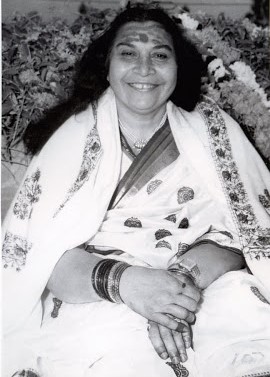
"As the spirit is in the Gospel proper, so the Spirit-Paraclete is a benefit that Jesus will broker to believers. But as with the other benefits that Jesus provides, the source of the Paraclete is with God. The Father sends the Paraclete via Jesus. Ultimately, the Paraclete is sent to perpetuate the availability of access to God's patronage... As the true Spirit, the Paraclete stands apart from the false spirits of the world. Consequently, to call the Spirit-Paraclete the truth is to make a competitive claim against those opponents. While the Spirit-Paraclete is the true broker, the brokers they rely on are impostors.” (Brown 2004, 233)
“In his life time which was so very short, whatever he has said, every word is great. But as I told you that this Paul tried to completely change, re-edit the Bible and he's put lots of things in there. Whatever weaknesses he has, he has put them nicely.
Now recently I've got a book which was hidden in a jar in Egypt for about, till fifty years they discovered it, and this book is called as the Library of Hammadi. The place was called Hammadi were it was discovered, and what Christ has said, what Thomas has written. When Thomas was coming to India he put all these things there, is very interesting.”
THE MOTHER: Messiah-Paraclete-Ruh-Devi
Christmas Puja, Ganapatipule, India Tour, December 25 1992
“Paul never even met Christ, and just made up lies. And we know what he saw was supra-conscious. Actually, he was a bureaucrat who killed one of Christ's disciples, Stephen, and saw Christianity as a good platform to jump on for his forum. He fought with everyone. Thomas disappeared and his treatises were found 50 years ago in Egypt. It's all sahaja.”
THE MOTHER: Messiah-Paraclete-Ruh-Devi
Talk with Spanish Sahaja Yogis—October 12, 1994
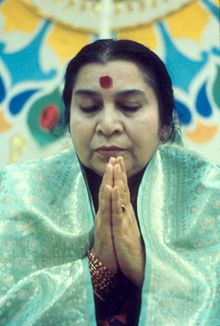
"For Moltmann, resurrection is the beginning of the rebirth of the whole creation, and it is "the rebirth of Christ.” Believers are possessed by the Spirit of the resurrection and through it are born again to a hope for eternal life. Like resurrection, rebirth is inception of a new form of human life. It is the anticipation of the resurrected life that Christ already holds. Moreover, in the event in which believers are born again to become children of God and heirs of his kingdom, the efficacies of Christ and the efficacies of the Spirit interpenetrate. We can call it either justification, or regeneration, but still we are describing the operation of the Spirit. Thus Moltmann concludes that experiences of the Spirit are unfathomable depth, because in them God himself is present in us, so that in the immanence of our hearts we discover a transcendent depth. If this Spirit of God is "the Spirit of the resurrection" then we are possessed by a hope which sees unlimited potentialities ahead, because it looks towards God's future. In his words, "The transcendent depths of the divine Spirit and the eschatological breadth of the Spirit of the resurrection mean that we cannot talk about our —rebirth' or —regeneration' as if it were a one-and-for-all experience, something finished and done with that is now behind us. We are still involved in the experience of renewal, and the becoming-new travels with us.” In short, there is a growth in faith and a growth in the new life of the Spirit.”
“This is the day for us to remember that Christ was born on this earth as a man. He came to this earth, and before him stood a task to enlighten the human consciousness so that people can understand that they are not this body, and Spirit; that we can see the actual implementation of this in people's minds.
The mission of Christ was His resurrection, that is, that you [] the Spirit, not the body. And He showed his resurrection, as He climbed into the realm of the Spirit, who He was because He was the Pranava. He was a Brahma, Mahavishnu He was, as I already told you, telling of His birth. And He came to this earth in bodily form like a man. He wanted to show one more thing: that the Spirit has nothing to do with money, has nothing to do with power. He is all-powerful, all-pervading.”
THE MOTHER: Messiah-Paraclete-Ruh-DeviThe Message of Christ
Caxton Hall, London, U.K.—December 10, 1979
“So, rejoice that here in Agnya Chakra, Christ is born anew within you. And He was there, and you know how can always ask for His help. We need to understand the main thing that you came this time to get everything that was promised in the sacred books, not only in the Bible, but in all the scriptures of the world. Today it's time that you should become a Christian and Brahmin, and pir only through the awakening of your Kundalini. No other way out...
So today, at this moment, when we celebrate the great event of Christ's life, let us recognize that Christ is born within us. And Bethlehem is within us. No need to go to Bethlehem - He is inside you. He is there and we must take care of him. He is still only a child and you should respect him. You must take care of him.”
THE MOTHER: Messiah-Paraclete-Ruh-Devi
The Message of Christ, Caxton Hall, London, U.K.—December 10, 1979
“He's (Jesus Christ) sitting in a position of Agnya Chakra controlling pineal and pituitary. By that, He controls our conditioning. If we follow Him, then we cannot be conditioned by anything because He talked of Spirit only. Spirit cannot be conditioned, conditioned by anything. Whatever is good, that will be accepted; good, congenial to the Spirit.”
THE MOTHER: Messiah-Paraclete-Ruh-Devi
Christ Conditioning and Ego
Ganapatipule, India—December 24, 1995
"The standards by which the world rendered its judgment on Jesus are so embedded in its way of seeing things that it cannot on its own free itself of them and reverse its opinion. The inward, convicting work of the Spirit — the word from beyond the world — is required if the world is to come to recognize the vindicated Jesus. The divine Paraclete, and no lessor agency, must show the world how wrong it was about him who was in the right. From that revolutionary, divinely imparted insight, a new understanding of righteousness and an alternative ordering of human society can develop.” (Stevick 2011, 254)
“Before we start, the celebrations of the birth of Christ, we have to little bit review what we have done after His Birth, so that we understand where do we stand in relation to Him. For He was the Son of a Virgin so that even the slightest blot on His name should not be created. Because He was to do the greatest job, of creating for us Agnya awareness, which would help us to suck in all our sins, all our conditionings, and all our egos. And the great personality was created for such a great work within ourselves. But unfortunately, we have spoilt both these institutions within us to such an extent that it is the most difficult task to give realisation to Christians...
We have to be clean. We have to be resurrected. We are resurrected people. Christ has resurrected us. But you have to think how much he has to work for us. The more you try to be in unison with negativity, we harm Him more, we torture Him more, we trouble Him more. The one who was born in the manger in the most difficult circumstances, where everybody requires comfort, who from the very beginning went through hazardous life till His death. His birth itself, you can see, was in a cow-shed. None of you are born in a cow shed. And while the Christians are so particular about comforts, most surprising is, why Christ was born in a cow shed? In a very, very cold night Christ was born. Nothing much to cover; sparkling beauty it was.
Now we have to keep Him within ourselves comfortably. We are not going to give Him that manger in our Agnya Chakra. Manger of thoughts and a crown of thought-that we are not going to give Him. We are going to make Him comfortable by not accepting negativity as a sympathy. You have to be kind towards your auspiciousness and holiness so that Christ enjoys His stay there in your Agnya. That we do not torture Him by our useless ideas, uncomfortable behaviours, inauspicious appearances and unholy acceptance of wrong ideas. Try to respect Him; there He stands. Try to make Him very comfortable. I wish I could do that, but He resides in everybody's Agnya Chakra. If He was only in my Agnya, I would have given Him the greatest comforts, but He wants to be manifested in every body's Agnya.
So I have to request you as a Mother to look after Him, give Him a nice cradle, give Him a comfortable time, because He is born to give you your resurrection. He has taken up such a great responsibility to suck all your conditioning and to suck all your ego, but that does not mean that you put stones on top of it. It's like, sometimes I find the conditioning of some of the people in the West is so great, that a big mountain is failing on this little child. And sometimes I find a big a bad breath. Horrible breath of ego, it stinks, blowing like a big wind towards the Agnya, horrible stink coming out of this terrible type of a ego. Absolutely not the way to treat the King of Kings who is born within you. You are so respected that Christ is born within your Agnya But you must respect your Agnya Chakra.
Your attention should be in the Centre so that no wobbliness-imagine put a child-like they say, a child is to put on the wings. So this Agnya Chakra is to be kept very clean, healthy and holy. The attention should be holy. The attention outside is still not very holy, should be 'detached' attention. If you start seeing through your Agnya it should project a power of holiness, so that anybody who looks at your eyes should know that serenity is flowing from these eyes, and not lust and greed and aggression. All this we can achieve because we have got Christ within our Agnya. Accept Him there. He is born, yet to grow. I am sure Sahaja Yogis will understand the importance of the Agnya Chakra.”
THE MOTHER: Messiah-Paraclete-Ruh-Devi
Christmas Eve Talk, Pune, India—December 24, 1982

"Five separate Paraclete sayings can be distinguished, all in the farewell discourses (1) 14:16-17; (2) 14:26; (3) 15:26-27; (4) 16:4, 6-11; (5) 16:12-15 (cf. 1 John 2:1-2). The brief form of the first two sayings modulates into the more expansive ones that follow. In the process there is also a shift in statements about the sending of the Paraclete: Nos. 1 and 2; the Father (however, No. 2 has the supplement 'in my name'); Nos. 3 and 4, 'I' (with No. 3 adding 'from the Father').116 The Paraclete is more accurately described as the 'Holy Spirit' (No. 2) or as the 'Spirit of Truth' (Nos. 1, 3, 5), who stands over against the world. The world cannot recognize it but the Spirit is promised to the disciples as an abiding gift (No. 1). [The Paraclete's] function is to remind them of the teaching of Christ (No. 2) or the testimony of Christ (No. 3), and especially the anticipation of the final judgment of the world, for [the Paraclete's] appearance means that sin, righteousness, and judgment will be revealed (No. 4). Such leading 'into all the truth' makes present the sending of Christ, for the Paraclete will speak with the authority of the Risen One; [the Paraclete] will also announce future events which [the Paraclete] will hear from the Risen Christ (No. 5).” (Strecker 2000, 505)
“Whatever it is, we have to know also that the Bible is not completely representing Christ, as it has happened with every book. So, there are problems and, as in every religion, people have gone astray from their right path and are spoiling the name of the people who have been divine and who started those religions. Also, is happened in the Christian nations. Just the opposite of what Christ has said, they're doing.
For us, one has to realize that He came on this Earth to open our Agnya chakra, which is a very difficult thing. Sahasrara is not difficult as Agnya. Agnya chakra is a very constricted chakra on which He resides. And He has said, 'You have to forgive yourself and forgive others.' This is the mantra of the Agnya chakra.”
THE MOTHER: Messiah-Paraclete-Ruh
Christmas Puja, Ganapatipule, India—December 27, 1994
“The enlightened people were called as Gnostics. This comes from the Sanskrit word Gna which means knowledge. But knowledge does not mean what one knows through the brain, because brain or intelligence takes one to rationality, which has no wisdom behind it. Rationality can take one anywhere, can justify anything, as it is not absolute. So one has to go beyond rationality, develop higher senses of Divinity by which one can understand the real problems, and the actual solutions of all these problems.”
THE MOTHER: Messiah-Paraclete-Ruh
Sahaja Yoga (1990), pp. 21-22
“They faced such problems, these Gnostics, that the people started calling them heretics, and also said, ‘This is blasphemy.’ ... You can imagine what was the situation, that time, to talk about knowledge, or about reality. But today it's not so; we can openly talk about it. Nobody can arrest us for that, and nobody can say that we are blasphemy, or doing blasphemy, or heretics. They may say, but they cannot charge us with that. We cannot be arrested, because the Church is not that strong now, thank God.”
THE MOTHER: Messiah-Paraclete-Ruh-Devi
India Tour, Alibag, India—December 29, 1991
Religion is not about obeying the gods, but transcending them in order to find spiritual union with the supreme source of all existence. The Gnostics, she says, were the first to view traditional religion as the opiate of the masses, the drug that keeps people satisfied to serve the gods and their kings as obedient slaves and vassals.Obedience and submission, the traditional postures of worship, are turned upside down by the Gnostics, as the individual person is no longer viewed as a mere mortal created by a powerful god to do his bidding.
Who were these radical Gnostics? Professor DeConick shows that, contrary to popular sentiment, Gnosticism is not a heretical religion with a particular set of myths, rituals, and beliefs that were transmitted from one Gnostic church to the next until it was successfully suppressed and defeated by the Catholic Church. Nor is it a figment of the imaginations of Catholic leaders who conjured the Gnostic heresy in order to suppress alternative forms of Christianity in the second century. She argues that Gnosticism was very real and remains with us even today.”
https://aprildeconick.com/ancient-new-age/
Web (Retrieved 2017-06-09)
THE APOCALYPSE OF THE SPIRIT-PARACLETE
The fulfillment of the promised divine eschatological instruction
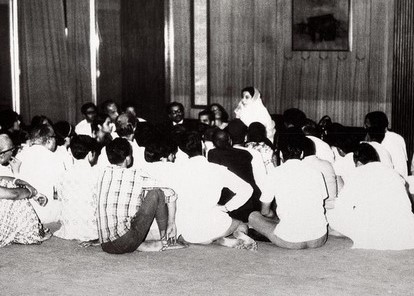
“The Paraclete will come (15:26; 16:7, 8, 13) as Jesus has come into the world (5:43; 16:28; 18:37)... The Paraclete will take the things of Christ (the things that are mine, ek tou emou) and declare them (16:14-15). Bishop Fison describes the humility of the Spirit, 'The true Holy Spirit of God does not advertise Herself: She effaces Herself and advertises Jesus.' ...
It is by the outgoing activity of the Spirit that the divine life communicates itself in and to the creation. The Spirit is God-in-relations. The Paraclete is the divine self-expression which will be and abide with you, and be in you (14:16-17). The Spirit's work is described in terms of utterance: teach you, didasko (14:26), remind you, hypomimnesko (14:26), testify, martyro (15:26), prove wrong, elencho (16:8), guide into truth, hodego (16:13), speak, laleo (16:13, twice), declare, anangello (16:13, 14, 15). The johannine terms describe verbal actions which intend a response in others who will receive (lambano), see (theoreo), or know (ginosko) the Spirit. Such speech-terms link the Spirit with the divine Word. The Spirit's initiatives imply God's personal engagement with humanity. The Spirit comes to be with others; the teaching Spirit implies a community of learners; forgetful persons need a prompter to remind them; one testifies expecting heed to be paid; one speaks and declares in order to be heard. The articulate Spirit is the correlative of the listening, Spirit-informed community.
The final Paraclete passage closes with a threefold repetition of the verb she will declare (anangello), 16:13-15. The Spirit will declare the things that are to come (v.13), and she will declare what is Christ's (vv. 14, 15). The things of Christ are a message that must be heralded...
The intention of the Spirit of truth is the restoration of an alienated, deceived humanity... The teaching role of the Paraclete tends to be remembered as a major emphasis of the Farewell Discourses, yet only 14:26 says She will teach you all things. (Teaching is, however, implied when 16:13-15 says that the Spirit will guide you into all truth, and will speak and declare.) Franz Mussner remarks that the word used in 14:26, didaskein, "means literally 'teach, instruct,' but in John it nearly always means to reveal.” (Stevick 2011, 292-7)


Stephen E. Witmer, Divine instruction in Early Christianity
“Jesus therefore predicts that God will later send a human being to Earth to take up the role defined by John .i.e. to be a prophet who hears God's words and repeats his message to man.”
M. Bucaille, The Bible, the Qur'n, and Science
“And when Jesus foreannounced another Comforter, He must have intended a Person as distinct and helpful as He had been.”
F. B. Meyer, Love to the Utmost
“The Paraclete has a twofold function: to communicate Christ to believers and, to put the world on trial.”
Robert Kysar, John The Meverick Gospel
“But She—the Spirit, the Paraclete...—will teach you everything.”
Danny Mahar, Aramaic Made EZ)
“Grammatical nonsense but evidence of the theological desire to defeminize the Divine.”
Lucy Reid, She Changes Everything
“The functions of the Paraclete spelled out in verses 13-15... are all acts of open and bold speaking in the highest degree.”
David Fleer, Preaching John's Gospel
“The reaction of the world to the Paraclete will be much the same as the world's reaction was to Jesus.”
Berard L. Marthaler, The Creed: The Apostolic Faith in Contemporary Theology
Bultmann calls the “coming of the Redeemer an 'eschatological event,' 'the turning-point of the ages.”
G. Ladd, A Theology of the New Testament
“The Paraclete equated with the Holy Spirit, is the only mediator of the word of the exalted Christ.”
Benny Thettayil, In Spirit and Truth
“The divine Paraclete, and no lessor agency, must show the world how wrong it was about him who was in the right.”
Daniel B. Stevick , Jesus and His Own: A Commentary on John 13-17
Stephen Smalley asserts that “The Spirit-Paraclete ... in John's Gospel is understood as personal, indeed, as a person.”
Marianne Thompson, The God of the Gospel of John
“The Messiah will come and the great age of salvation will dawn (for the pious).”
Eric Eve, The Jewish context of Jesus' Miracles
“The remembrance is to relive and re-enact the Christ event, to bring about new eschatological decision in time and space.”
Daniel Rathnakara Sadananda, The Johannine Exegesis of God
“The Spirit acts in such an international situation as the revealer of 'judgment' on the powers that rule the world.”
Michael Welker, God the Spirit
The Paraclete's “Appearance means that sin, righteousness, and judgment will be revealed.”
Georg Strecker, Theology of the New Testament
“While the Spirit-Paraclete is the true broker, the brokers they rely on are impostors.”
T. G. Brown, Spirit in the writings of John
“The pneumatological activity ... of the Paraclete ... may most helpfully be considered in terms of the salvific working of the hidden Spirit.”
Michael Welker, The work of the Spirit
“The pneuma is the peculiar power by which the word becomes the words of eternal life.”
Robert Kysar, Voyages with John
“The gift of peace, therefore, is intimately associated with the gift of the Spirit-Paraclete.”
Francis J. Moloney, The Gospel of John
“This utopian hope, even when modestly expressed, links Jesus and the prophets to a much wider history of human longing.”
Harvey Cox, The Future of Faith
“Because of the presence of the Paraclete in the life of the believer, the blessings of the end-times—the eschaton—are already present.”
Robert Kysar, John
“They are going, by the Holy Spirit's power, to be part of the greatest miracle of all, bringing men to salvation.”
R. Picirilli, The Randall House Bible Commentary
“The Kingdom of God stands as a comprehensive term for all that the messianic salvation included... is something to be sought here and now (Mt. 6:33) and to be received as children receive a gift (Mk. 10:15 = Lk. 18:16-17).”
G. Ladd, A Theology of the New Testament
“But today is the day I declare that I am the one who has to save the humanity. I declare I am the one who is Adishakti, who is the Mother of all the Mothers, who is the Primordial Mother, the Shakti, the desire of God, who has incarnated on this Earth to give its meaning to itself; to this creation, to human beings and I am sure through My Love and patience and My powers I am going to achieve it.
I was the one who was born again and again. But now in my complete form and complete powers I have come on this Earth not only for salvation of human beings, not only for their emancipation, but for granting them the Kingdom of Heaven, the joy, the bliss that your Father wants to bestow upon you.”
THE MOTHER: Messiah-Paraclete-Ruh
December 2, 1979—London, UK
“I am the one about which Christ has talked... I am the Holy Spirit who has incarnated on this Earth for your realization.”
THE MOTHER: Messiah-Paraclete-Ruh
“Tell all the nations and tell all the people all over the Great Message that the Time of Resurrection is here. Now, at this time, and that you are capable of doing it.”
THE MOTHER: Messiah-Paraclete-Ruh
Cowley Manor Seminar, UK—July 31, 1982
“This is the transformation that has worked, of which Christ has talked, Mohammed Sahib has talked, everybody has talked about this particular time when people will get transformed.”
THE MOTHER: Messiah-Paraclete-Ruh
Chistmas Puja, Ganapatipule, India—25 December 1997
“The Resurrection of Christ has to now be collective Resurrection. This is what is Mahayoga. Has to be the collective Resurrection.”
THE MOTHER: Messiah-Paraclete-Ruh
Easter Puja, London, UK—11 April 1982
“Announce it to all the seekers of truth, to all the nations of the world, so that nobody misses the blessings of the Divine to achieve their meaning, their absolute, their Spirit.”
THE MOTHER: Messiah-Paraclete-Ruh-Devi
“The main thing that one has to understand is that the time has come for you to get all that is promised in the scriptures, not only in the Bible but all the scriptures of the world.”
THE MOTHER: Messiah-Paraclete-Ruh-Devi
“You see, the Holy Ghost is the Mother. When they say about the Holy Ghost, She is the Mother... Now, the principle of Mother is in every, every scripture — has to be there. Now, the Mother's character is that She is the one who is the Womb, She is the one who is the Mother Earth, and She is the one who nourishes you. She nourishes us. You know that. And this Feminine thing in every human being resides as this Kundalini.”
THE MOTHER: Messiah-Paraclete-Ruh-Devi
Radio Interview, Santa Cruz, USA—1 October 1983
“But there is a Primordial Mother which was accepted by all the religions; even the Jews had it... In India, this is called as Adi Shakti. In every religion they had this Mother who was the Primordial Mother.”
THE MOTHER: Messiah-Paraclete-Ruh-Devi
TV Interview, Los Angeles, USA—11 October 1993
“It is the Mother who can awaken the Kundalini, and that the Kundalini is your own Mother. She is the Holy Ghost within you, the Adi Shakti, and She Herself achieves your transformation. By any talk, by any rationality, by anything, it cannot be done.”
THE MOTHER: Messiah-Paraclete-Ruh-Devi
“She is your pure Mother. She is the Mother who is individually with you. Forget your concepts, and forget your identifications. Please try to understand She is your Mother, waiting for ages to give you your real birth. She is the Holy Ghost within you. She has to give you your realization, and She's just waiting and waiting to do it.”
THE MOTHER: Messiah-Paraclete-Ruh-Devi
Public Program Mar 22 1981—Sydney, Australia
“The Kundalini is your own mother; your individual mother. And She has tape-recorded all your past and your aspirations. Everything! And She rises because She wants to give you your second birth. But She is your individual mother. You don't share Her with anybody else. Yours is a different, somebody else's is different because the tape-recording is different. We say She is the reflection of the Adi Shakti who is called as Holy Ghost in the Bible.”
THE MOTHER: Messiah-Paraclete-Ruh-Devi
Press Conference July 08 1999—London, UK
Disclaimer: Our material may be copied, printed and distributed by referring to this site. This site also contains copyrighted material the use of which has not always been specifically authorized by the copyright owner. We are making such material available to our readers under the education and research provisions of "fair use" in an effort to advance freedom of inquiry for a better understanding of religious, spiritual and inter-faith issues. The material on this site is distributed without profit. If you wish to use copyrighted material for purposes other than "fair use" you must request permission from the copyright owner.

 THE GOSPEL OF THOMAS PROLOGUE