The Fourth Commandment
The commandments, 'You shall not commit adultery, You shall not kill, You shall not steal, You shall not covet,' and any other commandment, are summed up in this sentence, 'You shall love your neighbour as yourself.' Love does no wrong to a neighbor; therefore love is the fulfilling of the law.”
“Jesus said to his disciples: "Love one another even as I have loved you.”[1]
In response to the question about the first of the commandments, Jesus says:
"The first is, 'Hear, O Israel: The Lord our God, the Lord is one; and you shall love the Lord your God with all your heart, and with all your soul, and with all your mind, and with all your strength.' The second is this, 'You shall love your neighbour as yourself.' There is no other commandment greater than these.”[2]
The apostle St. Paul reminds us of this: "He who loves his neighbor has fulfilled the law. The commandments, 'You shall not commit adultery, You shall not kill, You shall not steal, You shall not covet,' and any other commandment, are summed up in this sentence, 'You shall love your neighbour as yourself.' Love does no wrong to a neighbor; therefore love is the fulfilling of the law.”[3]
(1. Jn 13:34; 2. Mk 12:29-31; cf. Deut 6:4-5; Lev 19:18; Mt 22:34-40; Lk 10:25-28; 3. Rom 13:8-10.)
Joseph Cardinal Ratzinger, Catechism of the Catholic Church,
U.S.C.C. Inc., 1994, p. 530.
The 10 Commandments in the New Testament
A full list of the 10 Commandments is given twice in the Old Testament (Exodus 20 and Deuteronomy 5), and each commandment is mentioned many more times. But some have argued that obeying the 10 Commandments would not be required of Christians if they are not listed in the New Testament.
Actually, the Old and New Testaments make up a unified whole, and God's spiritual law and His thinking do not change (Malachi 3:6; Hebrews 13:8).
Still, all of the 10 Commandments are mentioned in the New Testament, and as a group they are called:
The way to"enter into life" (Matthew 19:17-19).
Necessary to be"called great in the kingdom of heaven" (Matthew 5:19).
"Holy, just and good" (Romans 7:12).
"Spiritual" (Romans 7:14).
"The royal law" (James 2:8).
"The law of liberty" (James 2:11-12).
"The love of God" (1 John 5:3).
"Not burdensome" (1 John 5:3).
If we are becoming more like Jesus Christ and practicing God's way of love, we will fulfill the law (Romans 13:8-10). The saints, those who will enter the Kingdom of God, are those who "keep the commandments of God and the faith of Jesus" (Revelation 14:12).
As we said, God shows us how to love through the 10 Commandments.
Many Christian churches today would agree that most of the commandments are still important, but they teach that the 10 Commandments as a whole no longer apply. Specifically, they feel the commandment about the Sabbath does not apply to Christians under the New Covenant. But the New Testament shows that the apostles and the New Testament Church continued to remember the Sabbath day.
The Sabbath is one of the 10 Commandments that shows us how to love God in the way He wants to be loved. We can't figure that out on our own—only God can tell us how He wants to be loved and worshipped. That's why the New Testament not only shows the example of Sabbath-keeping Christians, but tells us," There remains, then, a Sabbath-rest for the people of God" (Hebrews 4:9, New International Version).”
www.https://lifehopeandtruth.com/
Web (January 3, 2014
Pope Paul IV, who hated Jews, drew up the Bull Cum nimis absurdum "stressed that the Christ-killers, the Jews, were by nature slaves and should be treated as such.” They were enclosed to a particular area called "ghetto," after the Venetian Foundry.
The good news of the Bull: Jews were not slaughtered wholesale. Bad news: Jews to sell their property to Christians at absurdly low prices; barred from commercial activity; had their books burnt; forced to wear yellow hats in public; speak only Italian or Latin; never to employ Christians; never to be addressed as "signor" or "sir," even by beggars; only one synagogue per city; only one entrance per ghetto; all Jews to be locked at night.
This anti-semitism tradition was carried on by Innocent III and the Fourth Council of the Lateran in 1215. “A succession of popes reinforced the ancient prejudices against Jews, treating them as lepers unworthy of the protection of the law. Pius VII was followed by Leo XII, Pius VIII, Gregory XVI, Pius IX — all good pupils of Paul IV.” Leo XII (1823-9) even forbade vaccination against smallpox for Jews during an epidemic.
During Pope Clement XIV's (1769-74) pontificate"There were four thousand murders in the city.”
Our Holy Father Pope Innocent VIII issued a Bull in December 1484 that considered the "outpourings of insane old women under torture were accepted as part of the Christian faith.” This set off one of the greatest genocide in human history. Hundreds of thousands of women were burnt for prolonging the winter, delaying harvest, causing stillborn births in both human and animals, loss of sexual appetite, and so forth.
Pope Marcellinus (296-304) was executed for offering sacrifices to idols and his headless body lay rotting in the street for twenty-six days before being buried.
Emperor Constans went to Rome to patch things up with Pope Vitalian (657-72.) He was knifed in his bath on the way back.
In 823 AD Rome, Theodorus the primicerius and Leo the nomenclator, were murdered in the papal palace. Pope Paschal defended the murderers and anathematized the victims, pronouncing their deaths to be acts of justice.
Pope Calixtus (199-217) was tossed to his death through a window by a drunken mob.
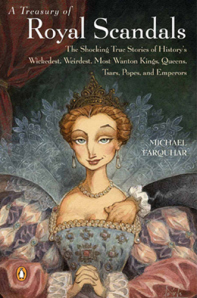
A Treasury of Royal Scandals: The Shocking True Stories History's Wickedest, Weirdest, Most Wanton Kings, Queens, Tsars, Popes, and Emperors
Michael Farquhar, Penguin Books; (10) edition (May 1, 2001)
Part IV - Mum Was A Monster Pop Was A Weasel
"We Are Not Abused, We Are Abusive"
Queen Victoria reigned longer than any British monarch before or since, and considering her vigilance in keeping him politically and socially impotent while she lived, her longevity was perhaps her final and greatest disservice to her eldest son and heir, the future King Edward VII.
The rigid, repressed Victoria was never a particularly cozy mum, candidly acknowledging early on that she derived "no especial pleasure or compensation" from her large brood of children. Even when they were tiny babies, Victoria regarded them as distasteful little creatures. "I have no tendre for them," she once remarked," till they have become a little human; an ugly baby is a very nasty object ... and the prettiest is frightful when undressed ... as long as they have their big body and little limbs and that terrible frog-like action.”
Victoria displayed a particular enmity toward Prince Edward almost from the beginning. "The hereditary and unfailing antipathy of our Sovereigns to their Heirs Apparent seems thus early to be taking root," Lord Grenville noted, while Lord Clarendon later said that the queen's dislike of the Prince of Wales was “A positive monomania with her. She got quite excited while speaking of him, and it quite irritated her to see him in the room.”
The young prince was gregarious and fun-loving—everything his mother forced herself not to be, and with her driving fear that he would grow up to be like her debauched Hanoverian uncles, the queen prescribed a torturously rigid upbringing that stifled the boy's natural inclinations for enjoyment. His rebellion from the constraints imposed did little to endear him to his mama, who bombarded him with criticism and rarely missed an opportunity to register her disappointment in him. "I am in utter despair!" the queen wrote her daughter Vicky in 1858. "The systematic idleness, laziness—disregard of everything is enough to break one's heart, and fills me with indignation!"
On another occasion, Victoria spoke of "The sorrow and bitter disappointment and the awful anxiety for the future this causes us.” Even her son's appearance seemed to annoy her. "Handsome I cannot think him," she sniffed," with that painfully small and narrow head, those immense features and total want of a chin.” It was an ironic critique coming from a woman who could very well have been describing herself and who at least admitted of Edward: "He is my caricature.”
The chasm between mother and son widened considerably upon the death of Victoria's husband, Prince Albert, to whom she was fanatically devoted and for whose death she loudly blamed Edward. It was enough to make any son feel special. The prince had been caught in a youthful indiscretion with an actress, and the morally sensitive Albert was devastated by the scandal surrounding his son. Coincidentally, he died a short time later. Victoria could not be convinced that it was typhoid, not grief, that carried her beloved away. In her gloom, the queen declared that she could never look at Edward again "Without a shudder.” With his typical good nature and kindness, however, the prince overlooked his mother's cruel accusations and remained solicitous and devoted to her.
During Victoria's morbid, self-imposed seclusion that would last for decades, the crepe-draped queen remained determined to keep the Prince of Wales away from anything even remotely resembling responsibility. She was convinced, unjustly, of Edward's inherent unworthiness. "What would happen if I were to die next winter!" she wrote her daughter. "One shudders to think of it: it is too awful a contemplation... . The greatest improvement I fear will never make him fit for his position.” On another occasion she confided," I often pray he may never survive me, for I know not what would happen.” All important state papers were kept from the prince, providing zero training for his future role. Removing a key from his pocket, Edward's little brother, Leopold, once said: "It is the Queen's Cabinet key, which opens all the secret despatch boxes... . The Prince of Wales is not allowed to have one.”
Warm-hearted as he was, Edward couldn't help but resent how insignificant his mother made him feel. "I am not of the slightest use to the Queen," he once complained. "Everything I say or suggest is pooh-poohed and my brothers and sisters are more listened to than I am.” The more the queen kept him away from responsibility, the more Edward turned to other idle distractions like gambling and womanizing. This only confirmed in Victoria's mind how unworthy he really was.
Never trusting his judgment, the queen even tried to control Edward's private life long after he was married. Lord Stanley noted in 1863 that all London was gossiping about the "extraordinary way" in which the queen insisted on directing "The Prince and Princess of Wales in every detail of their lives. They may not dine out, except with previous approval... . In addition, a daily and minute report of what passes at Marlborough House [their London residence] has to be sent to Windsor.”
Throughout it all, the prince handled the mistrust and disapproval with dignity and good humor, always remaining a respectful and dutiful son. After he inherited the throne in 1901 at age fifty-nine, King Edward VII would reign with distinction for nine years, proving his mother's attitude toward him totally unfounded. He lent his name to a genteel era, and was nicknamed Edward the Peacemaker for his adroit efforts to keep Europe from war. He was a good king, his mother be damned.
Editorial Reviews
From Publishers Weekly
In another royal expose, Farquhar, a writer at the Washington Post, duplicates some of the ground covered in Karl Shaw's Royal Babylon, such as Peter the Great's delight in administering torture (he had his son lashed to death) and the way Britain's Queen Mary cajoled her subjects into giving her their household treasures ("I am caressing it with my eyes," she would coyly coo). Written in a provocative tabloid style (with headings like "We Are Not Abused. We Are Abusive," “A Son Should Love His Mother, But...” and "All the Holiness Money Can Buy"), Farquhar publicly washes the dirty laundry of not only European royalty, but also of Roman emperors and popes. Murderers and torturers who slept with their siblings (and other relatives), the emperors of Rome excelled at corruption. The maniacal pedophile Tiberius Caesar (A.D. 14-37) left the corpses of his many victims to rot on the Gemonian Steps, which descended from the Capitol to the Forum, or alternatively enjoyed watching them being thrown from a cliff (“A contingent of soldiers was stationed below to whack them with oars and boat hooks just in case the fall failed to do the trick"). Many popes were no better. Not content with just rooting out Christian heretics by launching a bloody crusade against the Cathars in southern France, Innocent III (1160-1216) declared himself ruler of the world. He sacked Constantinople and massacred every Muslim he could find. Like Royal Babylon, this gossipy string of anecdotes is a popularized rather than an authoritative history and perfect for travel reading.
“In the Torah, these words are never referred to as the Ten Commandments. In the Torah, they are called Aseret ha-D'vareem (Ex. 34:28, Deut. 4:13 and Deut. 10:4). In rabbinical texts, they are referred to as Aseret ha-Dibrot. The words d'vareem and dibrot come from the Hebrew root Dalet-Bet-Resh, meaning word, speak or thing; thus, the phrase is accurately translated as the Ten Sayings, the Ten Statements, the Ten Declarations, the Ten Words or even the Ten Things, but not as the Ten Commandments, which would be Aseret ha-Mitzvot.
The Aseret ha-Dibrot are not understood as individual mitzvot; rather, they are categories or classifications of mitzvot. Each of the 613 mitzvot can be subsumed under one of these ten categories, some in more obvious ways than others. For example, the mitzvah not to work on shabbat rather obviously falls within the category of remembering the sabbath day and keeping it holy. The mitzvah to fast on Yom Kippur fits into that category somewhat less obviously: all holidays are in some sense a sabbath, and the category encompasses any mitzvah related to sacred time. The mitzvah not to stand aside while a person's life is in danger fits somewhat obviously into the category against murder. It is not particularly obvious, however, that the mitzvah not to embarrass a person fits within the category against murder: it causes the blood to drain from your face thereby shedding blood.
List of the Aseret ha-Dibrot
According to Judaism, the Aseret ha-Dibrot identify the following ten categories of mitzvot. Other religions divide this passage differently. Please remember that these are categories of the 613 mitzvot, which according to Jewish tradition are binding only upon Jews. The only mitzvot binding upon gentiles are the seven Noahic commandments.
1. Belief in G-d
This category is derived from the declaration in Ex. 20:2 beginning," I am the L-rd, your G-d...”
2. Prohibition of Improper Worship
This category is derived from Ex. 20:3-6, beginning," You shall not have other gods...” It encompasses within it the prohibition against the worship of other gods as well as the prohibition of improper forms of worship of the one true G-d, such as worshiping G-d through an idol.
3. Prohibition of Oaths
This category is derived from Ex. 20:7, beginning," You shall not take the name of the L-rd your G-d in vain...” This includes prohibitions against perjury, breaking or delaying the performance of vows or promises, and speaking G-d's name or swearing unnecessarily.
4. Observance of Sacred Times
This category is derived from Ex. 20:8-11, beginning," Remember the sabbath day...” It encompasses all mitzvot related to shabbat, holidays, or other sacred time.
5. Respect for Parents and Teachers
This category is derived from Ex. 20:12, beginning," Honor your father and mother...”
6. Prohibition of Physically Harming a Person
This category is derived from Ex. 20:13, saying," You shall not murder.”
7. Prohibition of Sexual Immorality
This category is derived from Ex. 20:13, saying," You shall not commit adultery.”
8. Prohibition of Theft
This category is derived from Ex. 20:13, saying," You shall not steal.” It includes within it both outright robbery as well as various forms of theft by deception and unethical business practices. It also includes kidnapping, which is essentially "stealing" a person.
9. Prohibition of Harming a Person through Speech
This category is derived from Ex. 20:13, saying," You shall not bear false witness against your neighbor.” It includes all forms of lashon ha-ra (sins relating to speech).
10. Prohibition of Coveting
This category is derived from Ex. 20:14, beginning," You shall not covet your neighbor's house...” "
https://www.jewfaq.org/10.htm

Religious Wars
"An important item in the indictment which a candid sociologist would bring against the Roman branch of Christianity is its terrible record of instigating wars in its own interest. Setting aside the promptness of the clergy of every country to support the national authorities without any regard to justice (the Buddhist priests in Japan, the Italian priests in the rape of Abyssinia, the attack on France, etc.), the Papacy has in the course of eleven centuries initiated wars in its own interest, and to the grave injury of the peoples involved, which have helped to retard the progress of civilization and cost tens of millions of lives. The wars it set afoot for the recovery or protection of its temporal possessions from the eighth century, when such wars had millions of victims, to the nineteenth have drained Italy, France, and Germany of blood century after century. The Crusades , summoned by the Popes in whatever spirit they were conducted, led to appalling losses and ended in futility. Scores of times they flung nation against nation because some monarch refused to submit to them and was declared deposed; and they blessed aggressive wars — of the Normans in England, the English in Ireland, etc. — because kings offered to do them feudal service. The Thirty Years War, which according to all historians put back for a century the civilization of half Europe, lost an unknown number — certainly millions of lives and led to epidemics of vice, was incited by the Papacy and the Jesuits as — their agents. The most amazing feature is that in our own day the Pope can pose as a serene advocate of peace while he incites to war in the interest of his Church as explicitly as Gregory VII or Innocent III did. From the date of his accession (and for some years earlier as Secretary of State) the present Pope repeatedly demanded "The extinction of Bolshevism in Spain, Mexico, and Russia"; that is to say, revolt (aided by Italy and Germany in a savage war) in Spain, the annexation of Mexico by the United States, and war upon Russia by Germany. The entire Catholic Press of the world supported his demand, and it was frequently reproduced (sympathetically) in the Times and other organs. He remained also in close alliance with Japan during its series of vile aggressions, and he attempted to paralyse America's assistance to Britain, when Germany treacherously attacked Russia, by inciting the great body of American Catholics to cause trouble and facilitate that destruction of Russia for which he hoped. Throughout 1946 the Church has made frantic efforts to drive America into war with Russia.”
J. McCabe, Rationalists Encyclopaedia
https://www.big-lies.org/rationalism/joseph-mccabe-religious-wars.html
Web (October 22, 2013)
"Popery's Plague of Paedophile Priests
Shake not the hand of this newly-modelled heathenism and foully-corrupted Christianity.
Professor Arthur Noble
Texe Marr's book Catholic Empire of the Queers—An Expose of Pedophile1 Homosexual Priests and Lesbian Nuns (available from Amazon at US$ 7.00) is an eye-opener. The author, widely known for his in-depth research into the filth underlying the external glitter of the Vatican and its global 'peace' jaunts, exposes and documents how the Roman Catholic Church has become the lair of legions of depraved homosexuals and paedophiles who now "comprise the majority of priests and nuns" (emphasis mine). The reader will discover how priests who prey on altar boys and children in Church-run orphanages have "turned the altars and pews of churches into Sodomite beds"; how Lesbian nuns have "come out of the closet" (!) and arrogantly proclaimed their perverted lifestyle; how the Vatican has been forced to pay out millions of dollars in court settlements to victims of sexual molestation by priests.
Adding details to Pulitzer Prize-winning writer Garry Wills' assertion that priests live in a "shadowy underworld of secrecy, evasion and misrepresentation", Marr reports that this is nothing less than the prophesied emergence of a "sacrilegious New Religious Order — a Catholic Empire of the Queers.”
Yet, despite the exposure, the atrocities persist in multiplying, and the Vatican continues to cover them up. Reports from the United States demonstrate that there has been no change in depravity ongoing for centuries. Jason Berry, an expert on paedophile priests, revealed in an editorial in the Los Angeles Times of May 17, 1992, that "since 1982, more than 400 U.S. Catholic priests or brothers have been reported to church or civil authorities for molesting children.” The number today, almost a decade later, could well be in the region of 1,000. After researching the New York Times Index for sex crimes committed by Roman Catholic priests in the 1990's alone, one researcher said he was "Absolutely aghast at the magnitude of debased depravity running rife in the Catholic Church, victimizing the innocent and betraying their trust.” He asked the discerning reader to consider the "untold numbers of molestations which go unreported, or cloaked in secrecy by the Catholic Church" and the "Innumerable incidents which go unreported in countries around the world — countries which do not have freedom of the press.” He concludes that the "depth of sin of the Catholic Church boggles the mind.”
Of the hundreds of known and probably thousands of unknown cases, that of 'Father' James Robert Porter, reported in the New York Times of July 15, 1992, is one of the most horrific. It involved more than 100 men and women who said they were sexually assaulted by Porter as children. John Daignault, a psychologist at Harvard Medical School, described them as "The largest single group of victims of one perpetrator, in a position of authority, in psychology's history.” [New York Times, December 4, 1992.] One writer called it the "true story of a demented demigod shuffled from diocese to diocese, raping at will"— a story which "could not have been written by even the most fertile imagination in the world of fiction.”
To this can be added the string of recent paedophile priest scandals in Britain, Belgium, France, Germany and several other countries — all of which serve to underline the unsurpassed moral corruption and sexual vice endemic in the Roman Church. The flood of cases amply demonstrates that Rome has not changed one iota since the days of Luther, who led the revolt against its inherent rottenness.
As the Pope continues his global jetsetting, consider, therefore, the true nature of the unchanged system that he is promoting. The contrived glitter of the welcome ceremonies conceals rife putrefaction; the mellifluous words of 'peace' are a veneer for the preparation of war against 'heretics'; the 'pologies' refer to the excesses of the 'sons and daughters of the Church' and never acknowledge the guilt of the Church itself; the hypocritical words of 'remorse' for past 'mistakes' are followed by the beatification of the very perpetrators of the evils committed; the plea for 'tolerance' is a ruse to promote Popery to the eventual exclusion of all other religions; and the outstretched hand of 'friendship', if grasped, will drag you towards the bloody fate once suffered at the hands of Rome by the victims of the Crusades, the Protestant martyrs, and the Jews.
Shake not the hand of this newly-modelled heathenism and foully-corrupted Christianity. It is the clutch of The Mother of Harlots, whose doom is assured, and that of all who enter into her parlour.”
https://www.ianpaisley.org/article.asp?printerFriendly=true&ArtKey=paed
Web (October 22, 2013)
Bid to stop priests seeing children alone
"Australia's Roman Catholic bishops are seeking to ban their priests from having any private contact with children, in an attempt to check damaging sex abuse scandals....
The Church in Australia has been shaken by allegations of widespread paedophilia, particularly in its teaching orders. After a number of convictions of priests and teaching brothers in Catholic schools, Australian bishops made an apology to victims of sexual abuse a year ago.”
www.telegraph.co.uk/, 26 September 1997

The Judas Chair The Inquisition
"To assist people in repenting, the Inquisitors used any torture method they could think of, with the theoretical restriction that they couldn't break the skin. The Inquisitors came up with numerous gadgets to work within this restriction. They included:
The Judas Chair: This was a large pyramid-shaped "seat.” Accused heretics were placed on top of it, with the point inserted into their anuses or genitalia, then very, very slowly lowered onto the point with ropes. The effect was to gradually stretch out the opening of choice in an extremely painful manner.
The Head Vice: Pretty straightforward concept. They put your head into a specially fitted vice, and tighten it until your teeth are crushed, your bones crack and eventually your eyes pop out of their sockets.
The Pear: A large bulbous gadget is inserted in the orifice of choice, whether mouth, anus or vagina. A lever on the device then causes it to slowly expand whilst inserted. Eventually points emerge from the tips. (Apparently, internal bleeding doesn't count as "Breaking the skin.”)
The Wheel: Heretics are strapped to a big ol' wheel, and their bones are clubbed into shards. Not very creative, but quite effective.
Methods of execution weren't much better. Since death was the eventual outcome, the skin-breaking point was rendered largely moot. While burning at the stake was the most widely used method, being cost-effective and providing a fun spectacle for the whole family, there were other approaches used in special cases:
Sawing: Heretics were hung upside-down and sawed apart down the middle, starting at the crotch.
Disembowelment: Not the nice kind of disembowelment, where a samurai slits you wide open like a fish and you die in moments. No, that's not good enough for the Inquisition. A small hole is cut in the gut, then the intestines are drawn out slowly and carefully, keeping the victim alive for as much of the process as possible.
The Stake: Depending on how unrepentant a heretic might be, the process of burning at the stake could vary wildly. For instance, a fairly repentant heretic might be strangled, then burned. An entirely unrepentant heretic could be burned over the course of hours, using green wood or simply by placing them on top of hot coals and leaving them there until well done.
The last burning organized by the Inquisition was in 1834, when the Spanish Inquisition was officially abolished. But though Torquemada's legacy has been laid to rest, the Inquisition lives on.
Based in Vatican City, the Holy Office of the Inquisition is still one of the most powerful branches of the Church hierarchy. In 1965, the P.R.-sensitive Pope Paul VI rebranded the Inquisition as the Congregation of the Doctrine of the Faith, but it was still basically the Inquisition.”
The Inquisition
www.rotten.com/library/history/inquisition/
Web (October 22, 2013)

Von Wernich came to court in a
bulletproof vest Argentine priest in murder trial
By Daniel Schweimler
BBC News, Buenos Aires
Friday, 6 July 2007
A trial has begun in Argentina of one of the most notorious figures of the military government in power between 1976 and 1983.
Roman Catholic priest and former police chaplain Christian Von Wernich is accused of involvement in seven murders and 41 cases of kidnapping and torture.
He escaped prosecution under amnesty laws which were later declared unconstitutional.
Security is tight. More than 100 witnesses have special protection.
He served as chaplain to the Buenos Aires provincial police force, and he is accused of using his office to win the trust of prisoners before passing information to the police torturers and killers who were holding them.
He is also reported to have attended a number of torture sessions himself and reassured the police that they were doing God's work.
He escaped prosecution after the democratic governments that followed the military passed amnesty laws.
Father Von Wernich worked under a false name in Chile, but investigators tracked him down and he was arrested four years ago.
BBC, Friday, 6 July 2007

LA Church 'grees abuse pay deal'
More than 500 people allegedly abused by Los Angeles Catholic priests are to receive a record-breaking compensation pay-out, their main lawyer says.
The deal, which a judge must approve, is reported to be worth $660m (£324m). With the alleged abuse dating back to the 1940s, lawyer Ray Boucher said it was payment of a long overdue debt....
The reported figure of $660m dwarfs the $157m settlement paid out by the diocese of Boston following a child sex scandal which became public in 2002.
The Los Angeles payment, which amounts to an average of $1.3m for each plaintiff, takes the total paid out by US dioceses to $2bn since 1950, with Los Angeles paying about one quarter of that....
Since 2002 nearly 1,000 people have filed such claims against the Roman Catholic Church in California alone.
In February 2004, a report commissioned by the Church said more than 4,000 Roman Catholic priests in the US had faced sexual abuse allegations in the last 50 years.
BBC, Sunday, 15 July 2007

 THE FOURTH COMMANDMENT