Prophecies Of Nostradamus




“The Moon in the full of night over the high mountain,
The new wise one with a lone brain seen there:
By her disciples invited to be immortal,
Eyes at noon, Hands on bosoms, bodies in the fire.”
Century 4:31
Manuela Dunn Mascetti and Peter Lorie,
Nostradamus: Prophecies for Women, Simon & Schuster, 1995, p. 128
The Moon in the full of night over the high mountain,
The new Wise One with a lone brain seen there
For the first time ever the whole world is invited to watch every full moon with the naked eye � without any material aid like telescopes or binoculars � and they will see the face of a woman on it! Kash was pointed the full moon of October 1995 by his father. Instantly, without even a second's hesitation, he said that it was Shri Mataji's face. Shri Sarachandra-nibhanana Devi is the new Wise One who is seen there on the full moon. She is Shri Pratipanmukhya-rakanta-tithi-mandala- pujita Devi. She is Shri Rakenduvadana Devi.
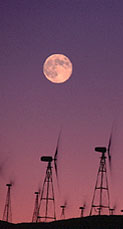
Nearly two years later, on the evening of 14 August 1997, Lalita and her father walked to the Lachine Blockbuster Video store to purchase Pooh's Grand Adventure: The Search For Christopher Robin. On the way home they picked up some chips and soft drinks from the Maxi supermarket. As they walking back three-year-old Lalita pointed at the moon and said these words: "Look, the moon is sleeping but got no pillow." Her father laughed at this innocent observation and asked her if she was sure. She answered, "Yes, the moon is sleeping and will give light." Then she added these words, "Yes, the moon got two eyes, and a mouth also, and one nose." Instant Bliss and Joy descended on her father � Lalita had recognized a Sure Sign of the Great Adi Shakti in the sky above. A three-year-old child was able to distinguish a face on the moon that was not even full. Lalita had seen the face of the new Wise One although it was a waxing gibbous moon, being full only a few days later on August 18. (If this is the case, then it would not be a problem for mature adults to see the Celestial Signs observed by children.)

“Another gnostic writing, called the Great Announcement, quoted by Hippolytus in his Refutation of All Heresies, explains the origin of the universe as follows: From the power of Silence appeared "a great power, the Mind of the Universe, which manages all things, and is a male ... the other ... a great Intelligence ... is a female which produces all things." Following the gender of the Greek words for "mind" (nous � masculine) and "intelligence" (epinoia � feminine), this author explains that these powers, joined in union, "are discovered to be duality ... This is Mind in Intelligence, and these are separable from one another, and yet are one, found in a state of duality." This means, the gnostic teacher explains, that:
There is in everyone [divine power] existing in a latent condition ... This is one power divided above and below; generating itself, making itself grow, seeking itself, finding itself, being mother of itself, father of itself, sister of itself, spouse of itself, daughter of itself, son of itself � mother, father, unity, being a source of the entire circle of existence.
How did these gnostics intend their meaning to be understood?”
Elaine Pagels, The Gnostic Gospels
Random House, N.Y., 1989, p. 50-1.
The "lone brain" refers specifically to the infinite Knowledge and Wisdom of this Wise One, that is, Shri Candranibha Devi. Humans think that they are possessed with knowledge despite having hardly even used 5% of their brains, a capacity attained by few. The other 95% has yet to be utilized as modern society has just begun to gather information, and are a long way to reach, say, Einstein's intellect. Even if they manage to attain a 10% capacity they can hardly be regarded as intelligent. Humans today have more knowledge than those thousand years ago. A thousand years from today they will have more knowledge. From here we may keep on expanding until the end of eternity. In the ancient books it is written that even the great Messengers of God do not have total Knowledge of the Ultimate Reality. Is it then too far-fetched to suggest that we hardly have used even 1% of our brain capacity to comprehend that the nature of Ultimate Reality, the afterlife of our spirit self?
What then is the nature of Knowledge? Let's use Earth as an example. Knowledge about it encompasses and penetrates everything, there being no mysteries, mistakes or delusion. In other words everything about Earth has to be understood: History, Geography, Botany, Biology, Physics, Chemistry, Archaeology, Engineering, Nuclear Physics, Biochemistry, Molecular Electronics, Astronomy, Communications, Politics, Animal Husbandry, Diagnostics, Surgery, Electromagnetism, Seismology, Biotechnology, Navigation, Ecology, Criminology, Forensic Science, Anthropology, Entomology, Herpetology, Paleontology, ...)
Then one has to regress into Time, before the creation of this universe, receding, back to the initial Primordial Beginning. Then we have to find out about universes prior to this one. Put simple, this is not the first, original universe as others were destroyed at the time of the Great Dissolution. The Universe has its own Cosmic Seasons. How far back are we to go back before we reach the origin of Primordial Time, the beginning of the Beginning? Is it now believable that we have hardly utilized 1 % of our brain capacity?
Then there is pure Knowledge. Knowledge with a capital K because it is eternal. This Knowledge may be summed up as Spirit � your spirit, my spirit, those of all others and the Creator. All other knowledge is impermanent and leads to eventual death. The Knowledge of the Spirit is within, and not without. This Knowledge empowers humans to travel and surf the edge of the ever-expanding universe. This Knowledge enables them to enter any portal of Time and witness the precise portion of Cosmic History. This Knowledge leads to the Pure River of the Water of Life on whose sides grow the Tree of Life. This Knowledge enables liberated souls to return to Earth and lead their fallen brethren out of bondage and delusion to a life eternal. This Knowledge leads to the Kingdom of God Almighty. How much do you and me know of this Knowledge?
The Lone Brain, with Her limitless Knowledge, has come to illuminate the puny, little-utilized brains of humans. If Shri Manasvini Devi's Knowledge is compared to human knowledge She definitely qualifies as the only person on this planet having brains that are fully utilized. It is just like comparing a human to an ant, and only humans may be said to have brains proper, i.e., a high level of material intelligence and knowledge over other life forms. In the same way it is like comparing the Supreme Spirit to a human, and only the Great Primordial Mother may be logically said to have brains proper, i.e., an infinite level of spiritual Intelligence and Knowledge concerning the Universe and regressing back to the origin of Primordial Time. That is what Nostradamus meant by the Lone Brain.
We humans should not even think of comparing our brains to Hers. We might read all the speeches or listen to all the talks of Shri Mataji Nirmala Devi and rationalize that this Knowledge could be learnt. All the Knowledge that Shri Mahabuddhih Devi has bestowed to humankind is rudimentary, a kindergarten class for spiritual tots. That is why Sahaja Yoga is just a single leaf on the branch of Nirmala Vidya (Pure Knowledge) growing in the Great Forest of the Adi Shakti! We humans do not possess the mental capacity to understand Her Knowledge: “All the brain activity goes against pure intelligence. One has to understand that this pure intelligence is not to be soiled by our thinking. Thinking is just an empty process of the mind. We have to go beyond this mind.” So what Knowledge do we really possess?

“Now, you might say, 'Mother, it is very fantastic to hear about ourselves, but you don't know how fantastic you are. Like you take a small little box of a television to some remote village. All the people will say, "What is this? Is just a box?" Why, you tell them that there is going to be, you can easily see lots of films in it. They won't believe. Once it is connected only that they'll be amazed at the television, the way it is showing all kinds of things because it is built-in and also it is built-in in you. All this is there which is within you, which you can easily verify it. It's absolutely tangible and then you know the value of your life and then you know the purpose of your life.
This is what it is. In this short time, I don't know how much I can tell you about it. Now, you have here beautiful lights and beautifully they're lit up. You have to use only one switch. It all comes up. If I have to tell you the history of electricity, how it came to this country, then to your city and all that, it would be very boring. But if it is built-in, why not have the Light? So, I would say that you should have the Light and you should know what you are. First you get that Light and then we will see about the rest of the Knowledge.”
Shri Matta Devi
Philadelphia, USA � October 15, 1993
“Everything in Sahaja Yoga cannot be explained. I cannot explain. I cannot because you don't have those Powers to understand.”
Shri Tapa-Trayagni-Samtapta Samahladana-Chandrika Devi
You Have To Be In Nirvikalpa, Vienna, Austria � May 4, 1985
“Knowledge does not mean intelligence. The real skill is that we have the Knowledge on our fingers, our hands. The full awakening of the Kundalini is Knowledge. You can awaken the Kundalini of others by this Knowledge.”
Shri DharmaDharma-Vivarjita Devi
Sarachandra-nibhanana (129th): Her face is beautiful like the full moon in saradrtu.
Pratipanmukhya-rakanta-tithi-mandala-pujita (610th): The 15 phases of the Moon from 'Pratipat' to 'Purnima' are Her manifestations. She is worshipped as 15 Nityas from 'Kamesvari' to 'Chitra' to whom the 15 phases of the Moon correspond.
Rakenduvadana (314th): Having a beautiful face like the full moon.
Candranibha (592th): Luminous like the moon.
Manasvini (930th): The controller of mind or intelligence.
Mahabuddhih (223rd): The greatest intelligence.
Tapa-Trayagni-Samtapta Samahladana-Chandrika (357th): Moonlight which delightfully soothes those that are scorched by the three fires name Adhyatmika, Adhibhautika, and Adhidaivika. She soothes those scorched by the afflictions and worries of physical, mental and spiritual nature.
Matta (576th): The attitude of intoxicated realisation of Brahman which makes the devotee unaware of the universe of name and form.
Note: Full Moon dates are based on Eastern Standard Time. Because of time zone differences, the Full Moon may occur on a different date in your region.
| 2000 | 2001 | 2002 | 2003 | 2004 | 2005 | 2006 | |
| January | 20 | 9 | 28 | 18 | 7 | 25 | 14 |
| February | 19 | 8 | 27 | 16 | 6 | 23 | 12 |
| March | 19 | 9 | 28 | 18 | 6 | 25 | 14 |
| April | 18 | 7 | 26 | 16 | 5 | 24 | 13 |
| May | 18 | 7 | 26 | 15 | 4 | 23 | 13 |
| June | 16 | 5 | 24 | 14 | 3 | 22 | 11 |
| July | 16 | 5 | 24 | 13 | 2/31 | 21 | 10 |
| August | 15 | 4 | 22 | 12 | 29 | 19 | 9 |
| September | 13 | 2 | 21 | 10 | 28 | 17 | 7 |
| October | 13 | 2 | 21 | 10 | 27 | 17 | 6 |
| November | 11 | 1/30 | 19 | 8 | 26 | 15 | 5 |
| December | 11 | 30 | 19 | 8 | 26 | 15 | 4 |
By her disciples invited to be immortal
Her disciples all over the world are daily asking Her to have a long healthy life. The exact words are: "Shri Mataji, we the Sahaja Yogis of the world, desire and pray for your good health and long life."
They have been doing so for years and will probably keep on doing so even if Shri Maha Avatar Shri Nirmala Devi reaches a very old age. They understand that Her presence on Earth is critically needed to turn the tide of global self-destruction. "For anyone who looks calmly and objectively at the situation that human beings have got themselves into, it will be obvious that unless we achieve a breakthrough into a higher form of awareness, a higher value system, we cannot come out of this mess we have created by subjugating ourselves to matter and to animal instincts, and therefore, to our self-destruction."
Daily thousands are beseeching Her to live on, despite advancing age. Indirectly they are inviting Her to be immortal, but like all incarnations of God Almighty, She will have to leave Mother Earth. This Divine Drop will merge back into the Cosmic Ocean of Reality that is within all. She is Immortal. So are you and me!

“ ... apocalypses (from the Greek apokalypsis: revelation) describe in cryptic language, understood by believers the sudden, dramatic intervention of God in history on behalf of the faithful elect. Accompanying or heralding God's dramatic intervention in human affairs will be cataclysmic events of cosmic proportions, such as a temporary rule of the world by Satan, signs in the heavens, persecutions, wars, famines, and plagues.
Although apocalyptic writers do examine the present, determining whether current afflictions are fulfilment of past apocalyptic prophecies, such writers generally concentrate on the future � on the future overthrow of evil, on the coming of a messianic figure, and on the establishment of the Kingdom of God and of eternal peace and righteousness. The wicked are described as consigned to hell and the righteous or elect as reigning with God or a Messiah in a renewed earth or heaven.”
Encyclopedia Britannica

“That's what it is today. I do not know that what it is to that we are now in the Blossom Time, as I call it, because many flowers are born and they are to become the fruits. This is the Resurrection Time, which is described in all the scriptures, but it's not like this, the way they had described us. Something wrong with them that all the dead bodies who are in the graves will come out of the graves. I mean, how much is left out of them, God knows. Must be some bones or maybe some skulls there. So they'll come out of the graves and they will get their Resurrection. This is a very wrong idea.
Once I happened to meet a fellow, a Muslim from Bosnia and he told Me, "I want to die for my religion, for God's sake." I said, "But why? Who told you to die?" He said, "Now, if I die in the name of God, I'll be resurrected." I said, "It's all wrong. That's not the way it is going to work out. Resurrection is going to work out this way that at this time, all these souls will take their birth. All these souls will take their birth and they will be resurrected as human beings they'll have to come."
That's why we find all kinds of funny people these days, all kinds of cruel, criminal, all kinds of idiotic, stupid, I mean very queer, weird, funny ideas which find such, such a variety of people and such a tremendous population that we should understand they have to have their chance of Resurrection. But how many will come? That's the point. How many are going to come?”
Shri Mano-vachamagochara Devi
Philadelphia, USA � October 15, 1993
Mano-vachamagochara (415th): Beyond the grasp of mind and speech. Mind cannot comprehend Her nor speech describe Her. 'Yato Vacho nivartante'; where words turn back. (Annapurna Upanishad 2.) 'Yanneti neti vachanaih nigama avochuh'; Whom Vedas describe by the words "not this" "not this." Mind and speech are Her creations very far removed from Her. As such, they cannot comprehend Her.
Eyes at noon, hands on bosoms, bodies in the fire.
Eyes at noon actually mean to concentrate on the Sahasrara, the top of the head, during meditation. In Sahaja Yoga meditation this has the effect of the eyes looking upwards. This is unlike standard meditation, practiced by most Buddhist and Hindu disciplines, where one concentrates on the space between the eyebrows and keep the eyes at morning (gazing down at eight or nine o'clock). The Great Primordial Goddess resides in the Templum Spiritus Sanctus and meditates individually with each disciple. Even the mere attention on Her in the Great Lotus Forest has the immediate effect of producing vibrations and enhancing the state of thoughtless awareness. Experienced Sahaja Yogis always put their attention on the fontanel bone area and this cause the 'eyes to be at noon.'
Hands on bosoms means putting the right hand on the left breast � the heart where resides the Spirit � and saying the mantras of Shri Jagdamba (Universal Mother) and Shri Shiva/Parvati (Universal Father/Mother.) The hands are also kept on the bosom during the process of Self-Realization and the desire is expressed to the Supreme Spirit within to grant enlightenment. This desire to be awakened from darkness and ignorance must be wished by each seeker before the Divine Deity manifests itself. (Humans are absolutely free to do as they please and are under no obligation to get their second birth. They have to do so on their own free will, knowing full well that they will be taking part in the Resurrection and bear all its consequences.)
The disciple leads the prana until Mooladhara.
The air thus inspired awakens the lower Fire which was asleep.
Amritananda Upanishad
Bodies in the fire refer to the Kundalini coursing through the bodies of all Self-realized souls. This Kundalini is sometimes seen as a spiritual fire within. In meditation it rushes through numerous chakras and nadis and purifies them. In the ancient Hindu texts it says that only by Self-Realization will this Kundalini or Fire be rekindled, awakening the seeker to Inner Reality.
Thus, "bodies in the fire" means that as the disciples meditate on the Wise One (whose Face is on the full moon) with their right hands on their left hearts, their bodies are cleansed and purified by the spiritual fire of the Kundalini.
“Alex Walker, a member of the Findhorn Community, has written that this new epoch is likely to witness a rejection of the past: " ... where differences have been emphasized, not only distinctions between groups within the human family and nature, body and soul, and masculine and feminine ... We believe that the future will be largely concerned with rediscovering and rebuilding our connectedness to each other, to nature and to the unseen spiritual realms, so that we may become whole as individuals, as species, even as a planet."
But if science and religion are to partake of the infusion of cosmic energy, which we are told will kick-start this new stage of evolution, then they will have to assimilate the idea that man is no longer the centre of creation but an active, responsible participant in its development.
Mind, or consciousness, is the eternal part of man and it may well be that the Divine is pure Mind Energy. Our evolution, our future and the future of this planet may therefore depend on our willingness to bring into manifestation the very future we wish for ourselves.
The scientists who shared Einstein's mystical sense of wonder never lost sight of this idea. The English physicist and astronomer Sir James Jeans (1877-1946) once stated, "The stream of human knowledge is impartially heading towards a non-mechanical reality. The universe begins to look more like a great thought than a great machine. Mind no longer appears to be an accidental intruder into the realm of matter. We are beginning to suspect that we ought rather to hail it as the creator and governor of this realm."
If organized religion is to survive into the New Age, it cannot fossilize its teachings but must accept the idea that no single tradition has the monopoly on truth.
The New Age philosopher Alan Watts once wrote, "Irrevocable commitment to any religion is not only intellectual suicide, it is positive un-faith because it closes the mind to any new vision of the world." ...
The Benedictine monk and mystic Bede Griffiths considered an appraisal of orthodox religion essential if we are to survive the coming crisis. " ...The only way is to rediscover the perennial philosophy, the traditional wisdom, which is found in all ancient religions and especially in the great religions of the world. But those religions have in turn become fossilised and each have to be renewed ... so that a cosmic, universal religion can emerge ... This is the task for the coming centuries as the present world order emerges from the ashes of the old."
The credo of this new religion will be Unity. Not the bland unity of "One World" envisaged in the popular imagination, but an echo of the Unity of the universe, Unity in diversity, Unity in the underlying theme of the Ageless Wisdom.
"Between heaven and earth, there is a unity reflected, on the one hand in the real or supposed influence of the sun, stars and planets on the life of plants, animals and men and on the medicines derived from them, and, on the other hand, in the repetition of the structures from which sprang the notions of macrocosm and microcosm." (Paraclesus) ...
The greatest threat to this vision of our development in the next century is our fear, our fear of change, fear of discovering a greater reality in which we would no longer be the centre of creation. As T.S. Eliot once remarked, "Human kind cannot bear much reality." ”
Paul Roland, Revelation: Wisdom of the Ages,
Ulysses Press, 1995, p. 156-57.

“In the search for pure consciousness we have to eliminate any possible object. Schools of thought and of spirituality are founded with this aim in view. To reflect upon an object may indirectly give us a glimpse of how our consciousness operates, but it will not disclose to us the nature of consciousness. Pure consciousness is not reflective consciousness; it is thus not self-consciousness; it cannot be consciousness of consciousness. Where one sees nothing, understands nothing, there is the infinite. Pure consciousness is established in its own greatness or even not in it. It has no support; it is self-illuminating and self-illumined. Nothing can be its object.
The texts are emphatic. Though one does not understand � how can you understand the understander? � it is by understanding that you understand that you do not understand. The Upanishads are thoroughly consistent. There is no rhetoric here. These are sober statements: It is not understood by those who understand. It is understood by those who do not understand.
This Upanishad or instruction is to be taken literally, that is, as meaning what it says. Our nonunderstanding is real, and is certainly a nonunderstanding of it, Brahman, but nevertheless it is already a certain understanding, it is an understanding that we do not understand and thus it is included in the sum total of our imperfect understanding: "not understood by those who understand." But there is still more. Those who say that they know, certainly know, but they know only what they do know, which is very little. They truly know, but what they know is always the known, not the knower. The understanding of our ignorance is not the same thing as either infinite ignorance or blessed ignorance, which does not understand itself. They are doubly ignorant, for in addition they are conceited, thinking that their not-knowing is a superior form of knowledge. The Upanishads dismiss them altogether. In this realm there can be no pretense. The next point also is to be taken literally. "It is understood by those who do not understand," not by those who understand that they do not understand it. These latter are the truly ignorant (knowers of their own ignorance). It is understood, on the contrary, by those who really do not understand in such a way that they do not even understand that they do not understand, much less think that they understand. To understand one's own nonunderstanding is not true understanding; not to understand that one understands, that is, the nonunderstanding of the understander, is the true understanding. Innocence cannot be forged or feigned.
It is with the discovery that pure consciousness is not self-consciousness that the discourse on Brahman starts. Brahman is not the object of consciousness, or even the subject. Brahman is pure consciousness. Our mahavakya can be rendered by simply saying that "consciousness is" or by affirming "there is consciousness." It is not said that consciousness is being or that being is consciousness. Pure consciousness has no support. Brahman is this nonsupport; Brahman is not a substance. Thus the understanding of Brahman does not allow for reflection, that is, for a second understanding of the understanding. If you really understand Brahman, you do not understand that you understand it (this would be a second awareness and by this very fact would furnish the proof that the first understanding of Brahman was not exhaustive). If you understand that you understand, then you do not understand Brahman, but only your own understanding (of it). Finally, if you do not understand (not if you pretend that you do not understand, but if you really do not understand), because there is nothing, no-thing to understand, then you really understand (Brahman). Needless to say, this is only absolutely true of Brahman. In any other instance we are no longer dealing with pure consciousness. Consciousness, then, is not a substance, but an action, an act. Brahman has no consciousness, and thus no self-consciousness. Brahman is consciousness.
This is the point to which this Great Saying leads us. From the bringing together of the epistemic and ontic questions effected by this mahavakya, there emerges a total vision of the universe.”
Professor Raimundo Panikkar, The Vedic Experience
Higher Mind
“Our first decisive step out of our human intelligence, our normal mentality, is an ascent into a higher Mind, a mind no longer of mingled light and obscurity or half-light, but a large clarity of the spirit. Its basic substance is a unitarian sense of being with a powerful multiple dynamization capable of the formation of a multitude of aspects of knowledge, ways of action, forms and significances of becoming, of all of which there is a spontaneous inherent knowledge ... It is a luminous thought-mind, a mind of spirit-born conceptual knowledge.
But here in this greater Thought there is no need of a seeking and self-critical ratiocination, no logical motion step by step towards a conclusion, no mechanism of expression or implied deductions and inferences, no building or deliberate concatenation of idea with idea in order to arrive at an ordered sum or outcome of knowledge ...
This higher consciousness is a Knowledge formulating itself on a basis of self-existent all-awareness and manifesting some part of its integrality, a harmony of its significances put into thought-form. It can freely express itself in single ideas, but its most characteristic movement is a mass ideation, a system or totality of truth-seeing at a single view; the relations of idea with idea, of truth with truth are not established by logic but pre-exist and emerge already self-seen in the integral whole. There is an initiation into forms of an ever-present but till now inactive knowledge, not a system of conclusions from premises or data; this thought is a self-revelation of eternal Wisdom, not an acquired knowledge.
This is the Higher Mind in its aspect of cognition; but there is also the aspect of will, of dynamic effectuation of the Truth: here we find that this greater more brilliant Mind works always on the rest of the being, the mental will, the heart and its feelings, the life, the body, through the power of thought, through the idea-force. It seeks to purify through knowledge, to deliver through knowledge, to create by the innate power of knowledge.”
Sri Aurobindo, The Future Evolution of Man
“As we approach the millennium from this beautiful, tender, fragile, magnificent place that is our home, we see various themes of our time emerging. These are an awareness of the interconnectedness of individual people, of communities, of species, and a growing sense of responsibility for life.
Recently there has been an explosion of knowledge from esoteric traditions that has never before been available so widely to the uninitiated. Age-old prophecies have decreed that the time to reveal these teachings is now. It is no accident, I believe. Anyone who has drawn to them has access, for example, to Native American ritual, esoteric mystical traditions of the East and West, sacred practices that lead to the contacting of a higher wisdom. It seems to be part of the evolution of the species in time of need, when the Earth is in danger of terminal pollution and deep fragmentation among her inhabitants.
I see the last half of the twentieth century as a time when Spirit and spiritual practices are coming out of the closet as reverence and responsibility are coming back into our lives. With the growing awareness of a mind-body-spirit interconncetedness, it is clear that a healthy body and an enriched mind are not enough. There is an imperative to connect deeply with a higher Power, with new kinds of family of choice, with one's self in a deeply spiritual way... .
And there has been a shift in the American Zeitgeist, as well. From a self-directed frenzy of consumerism and reckless devouring of natural resources and throwaway relationships, we see a new imperative to connect, to find a deeper purpose in life.
As we move into the new millennium, the still small voice is becoming a mighty roar. We have more dedication, better tools, a deeper sense of how little time may be left and how to use it fully as we lurch toward yet another level in evolution � where we will achieve a true awareness of inteconnectedness, responsibility, and reverence.”
Deborah Goleman Wolf, Psychotherapy as Sacred Art
(Deborah Goleman Wolf, Ph.D., was trained as a folklorist/anthropologist and integrative therapist. She is in private practice in New York City, trains and supervises peer counselors at the Manhattan Center for Living, and is on the board of the New York Open Center. Source: Georg and Trisha Lamb Feuerstein, Voices on the Threshold of Tomorrow, The Theosophical Publishing House, Quest Books, 1993, p. 239-40.)

“On the Threshold of Tomorrow
To speak of a global crisis is a clich� � nonetheless an obvious truth. Parents do not know what to say to their children; two-thirds of humanity are living an economically wretched life; and the other third suffers from depressions, ambitions, fears, and worse scourges....
We have reached the bottom. And this may trigger a revelatory experience � if we have eyes to see and ears to hear. It is the revelation that the economic problem is not just economics, the political troubles not mere political corruption, the technological cancer not a sheer moral question (of a better use), the scientific quandries not only a scientific question, the ecological situation not solved by a better treatment of resources. More, not even the human problem is an exclusive human affair.
This revelation is the disclosure, on a higher spiral than previously, that we need to reestablish both a divine friendship with the cosmic and a cosmic awareness of the divine.
A comotheandric insight is emerging all over the world: We are all engaged in an adventure that concerns not only the human destiny, but the divine and cosmic dimensions of reality as well. Out of the darkness of our times, and at a price of an unimaginable amount of suffering, a new/old awareness is dawning upon us. It is our responsibility to live up to this challenge and to contribute to overcoming � not to denying � the prevalent two-dimensional view of reality � as if time and space were all that there is. We should awaken to our theanthropocosmic dignity.
I sum it all up suggesting that we should sit � not sleep � on the threshold!”
Georg and Trisha Lamb Feuerstein
Voices on the Threshold of Tomorrow
Raimon Panikkar, D.Th., D.Sc., Ph.D., is emeritus professor of religious studies at the University of California and an ordained Catholic priest. He has written about three hundred articles and thirty books, including The Silence of God, Myth, Faith and Hermeneutics, The Vedic Experience, and The Intrareligious Dialogue. Source: Georg and Trisha Lamb Feuerstein, Voices on the Threshold of Tomorrow, The Theosophical Publishing House, Quest Books, 1993, p. 370-71.
Disclaimer: Our material may be copied, printed and distributed by referring to this site. This site also contains copyrighted material the use of which has not always been specifically authorized by the copyright owner. We are making such material available to our readers under the education and research provisions of "fair use" in an effort to advance freedom of inquiry for a better understanding of religious, spiritual and inter-faith issues. The material on this site is distributed without profit. If you wish to use copyrighted material for purposes other than "fair use" you must request permission from the copyright owner.

 THE FACE ON THE MOON