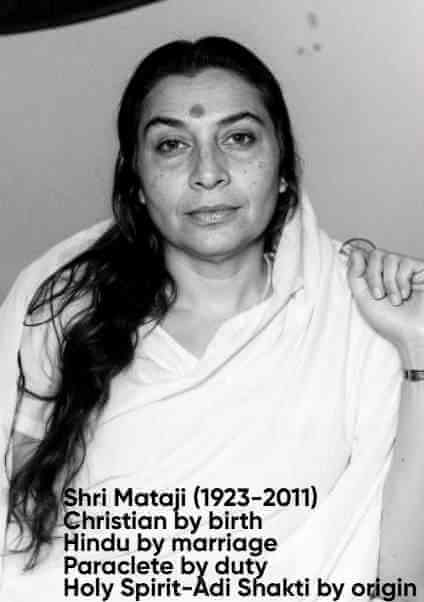
Shri Mataji: Many people ask Me questions: 'What about death?'
This page shares Shri Mataji Nirmala Devi's esoteric teachings on death—not as an end, but as a transition. The Spirit is eternal, untouched by decay, and continues beyond the body. Death is not to be feared but understood as part of the divine cycle of evolution. Through Sahaja Yoga and Self-realization, seekers experience the Spirit directly and transcend the illusion of mortality. Shri Mataji affirms that the soul's journey continues, guided by the Divine Feminine, toward ultimate union with the Paramchaitanya. The Comforter has come to reveal the truth: death is not darkness—it is awakening.
An Inquiry into the Eternal Soul and the Illusion of Death
Introduction
The question of what happens after death has been a central theme in spiritual and philosophical discourse throughout human history. Shri Mataji Nirmala Devi, a prominent spiritual teacher, directly addresses this question by asserting that death, as commonly understood, does not exist. Her message of the Resurrection is not merely a promise of a future event but a confirmation that we are eternal souls having a temporary physical experience. This paper will examine Shri Mataji's teachings on death and the eternal nature of the soul, supported by scriptural evidence from various traditions and the growing body of research on near-death experiences (NDEs). By synthesizing these diverse sources, we will demonstrate that the human soul (Atma) is eternal and that our earthly existence is but a temporary sojourn before returning to our true Home.
Shri Mataji's Teachings on Death and Resurrection
Shri Mataji's core teaching on death is that it is an illusion for those who have achieved Self-Realization. She states, [1]
This teaching emphasizes that the fear of death is "absolutely absurd" for those who have realized their true nature as the eternal spirit. The body is merely a temporary vessel, a "dress" that can be changed, while the soul, the true self, persists. This perspective aligns with the concept of the Resurrection, not as a one-time historical event, but as an ongoing process of spiritual awakening and liberation from the cycle of birth and death.
Scriptural Confirmation of the Eternal Soul
The concept of the eternal soul is a cornerstone of many of the world's scriptures. The Bhagavad Gita, a foundational text of Hinduism, provides a clear and powerful articulation of this truth. In Chapter 2, Verse 20, Lord Krishna tells Arjuna: [2]
This verse from the Bhagavad Gita is echoed in the Upanishads, which are philosophical texts that form the theoretical basis for the Hindu religion. The Katha Upanishad, for example, states: [3]
Even in the Christian and Islamic traditions, we find echoes of this understanding. In the Gospel of Matthew, Jesus tells his disciples: [4]
This verse clearly distinguishes between the mortal body and the immortal soul, suggesting that the soul survives physical death. While the theological interpretations may differ, the underlying principle of a non-physical, enduring self is a common thread.
Near-Death Experiences: Scientific Evidence for the Afterlife
In recent decades, the phenomenon of near-death experiences (NDEs) has provided a new and compelling line of evidence for the survival of consciousness after death. Thousands of individuals from all walks of life have reported remarkably similar experiences while clinically dead or close to death. These experiences often include a sense of leaving the physical body, traveling through a tunnel towards a brilliant light, and being reunited with deceased loved ones. The University of Virginia's Division of Perceptual Studies has been at the forefront of NDE research for over 50 years, collecting and analyzing thousands of cases. [5]
One of the most well-documented cases is that of Pam Reynolds, who underwent a radical brain surgery that required her to be clinically dead for an extended period. During this time, she reported making several verifiable observations about the surgical procedure that she could not have known through normal sensory channels. [6] The Pam Reynolds case, along with countless others, provides strong evidence that consciousness can exist independently of the brain and that the "Home" that so many NDErs describe is a real and universal destination.
Conclusion
Shri Mataji's message of the Resurrection is a powerful reminder that we are not merely physical beings destined for oblivion. Her teachings, supported by the wisdom of ancient scriptures and the modern science of near-death experiences, confirm that we are eternal souls on a journey of self-discovery. The fear of death is a product of our identification with the temporary physical body, and the key to overcoming this fear is to realize our true nature as the immortal Atma. As we awaken to this reality, we understand that death is not an end but a transition, a return to our eternal Home.
References
[1] Shri Mataji Nirmala Devi. "Many people ask Me questions: 'What about death?'" adishakti.org, 25 Feb. 2008.[2] Swami Mukundananda. "Bhagavad Gita: Chapter 2, Verse 20." Holy Bhagavad Gita.
[3] Paramahansa Yogananda. "Katha Upanishad." yogananda.com.au.
[4] BibleHub. "Matthew 10:28." BibleHub.
[5] University of Virginia School of Medicine. "Near-Death Experiences." Division of Perceptual Studies.
[6] Wikipedia. "Pam Reynolds case." Wikipedia, 20 Sept. 2025.

So this happening that we are afraid of death is absolutely absurd for Sahaja Yogis. What is there to think even about your death? There is nothing like death for you because you have got eternal life. It's not that you continue with the same body. You may go on changing your dress but you are living, you are aware. And you know even if this body is not there you will be there, all the time. I will agree for Sahaja Yoga, for anything that is to be done in the name of Reality. So you must know your position as eternal beings — what is your work, what is your idea, what you have to do. So one has to get rid of this idea of death because death does not exist for you. It is finished... your spirit is free.
And when you die what happens to you is a very simple thing; that you feel liberated, absolutely, and then you feel your freedom completely, and you can decide what to do. It's all under your own guidance, your own desires, everything works out. You don't feel that you have come out of your body and this is what I should tell you: That there should be no fear of death but on the contrary, should be welcomed because you will feel much more liberated, much more at ease...
This body is finished is a very good idea. So troublesome it is. The most sticky thing we have is this body... So to forget about death is the easiest thing to do.”
The Messiah-Paraclete-Ruh-Devi
To Achieve Complete Freedom, May 7, 1995 — Cabella, Italy
"The Upanishads do not teach a death experience, but an experience of life. Ultimately there is no experience of death and the death experiment is, in the last analysis, unreal because the"subject"Who died was not real. The supreme Upanishadic experience is discovered precisely by realizing that the experiment of death is only a psychological experience, made by the immortal atman.
The Vedic experience is one of liberation, of freedom from everything. It thus includes freedom or liberation from time. What both fascinates and haunts Upanishadic Man is not anything that comes after, but that which has no after. As long as we are entrammeled in the net of mere temporal existence, we are in the clutches of death, even if we postpone death by a sequence of successive existences. An afterlife is as inauthentic a life as a prelife. The piercing of the skin of time as with a needle, without either hurting or destroying the spatiotemporal epidermis and yet transcending it, is what liberation is all about...
Now, the end is not death and dissolution, nor is it an indefinite and horizontal repetition of one and the same circle. One of the discoveries of the Vedic wisdom is precisely that, whereas time is circular, Man is not, so that for him it is not a question of beginning all over again. On the contrary, it is imperative that he escape the enclosure of the circle. The circularity of time indicates its ontic finitude, whereas Man is infinite. Man has to break the circularity of time in order to reach the ontological fullness of his being. To enter into this other nontemporal, but no less real, sphere is to attain realization, to reach liberation from the encirclement of time and freedom from temporal chains. It is a truly new life, not in the sense of a"recycled"life but in the sense of a new type, a new kind of life, indeed, the only real and authentic life.”
Professor Raimundo Panikkar, The Vedic Experience
https://www.cybrlink.com/vedtoc.htm
"Modern Man wonders about death and weaves innumerable theories about it; he seems to be sure about only one thing: its factual reality and thus its inevitability. In spite of startling news produced now and then by the scientific shamans of our age, contemporary Man seems at a loss when he is confronted with one of the most ancient myths of mankind: the possibility of avoiding death. Because death is seen to be inevitable, modern society tends to wipe out from the memory of the living all dealings with the dying and the dead. The fundamental Vedic attitude is almost the opposite: it does not reckon with death's inevitability and it does not try to smuggle death away from everyday life.
According to this vision, which is common to other cultures as well, death is not inevitable; it is only accidental. You die if your life is snatched away before you reach maturity, or before you marry, or if something unexpected happens to you which prevents you from achieving what you yourself or society was expecting of your life. Death is limited to this rupture, this misfortune, this accident. Thus it is always an unnatural event, and it is always akala mrtyu, untimely death.
On the other hand the old Man," the Man of long life," as the Vedas call him, the one who has lived his life, who has fulfilled his life span, his ayus, does not die; he does not experience a break and, thus, a trauma; he has simply consumed the torch and exhausted the fuel. The flame of his life goes on and it burns in his sons, his daughters, his children's children, his friends, his work, and in his ideas which are scattered to the four winds. Even his body, with its own energy, has already enriched the earth on which he has walked, the rivers in which he has bathed, and the living beings with whom he has been in communication and communion. Only the last gifts of his body and breath still remain to be given away. The old Man does not die; he simply finishes his commerce with life and achieves the transmission of all that he himself has received, as the Upanishads describe. He cancels the constitutive rna, the debt of gratitude for the gift of his existence. The natural extinction of one particular carrier of life or the completion of one's own life is not death.
Indeed, not every Man who is old in years reaches long life, maturity, and thus immortality. It is not a question of mere number of years but of growth, for which the passing of years — the hundred autumns — is certainly required but of which it is not the only condition. Time, in fact, is more than its measurement by the passing of days and seasons; it is the qualitative coefficient of human growth itself. To disentangle the immortal from the mortal, to liberate himself from the claws of death, is the task of every Man. On the one hand there is the asu or life-principle, the power of life or vital strength, which is assimilated in some traditions to the ahamkara, the selfish ego of unfulfilled desires and unachieved projects. This ego is not pure, later periods will say, inasmuch as it consists of unburnt karmas; it is this ego that is afraid of death, because it must certainly die. There is, on the other hand, the personal atman, that spark of the paramatman, which does not die. Jiva, in spite of the variety of meanings given by different schools, could also be another word for immortal Man.”
Professor Raimundo Panikkar, The Vedic Experience
https://www.cybrlink.com/vedtoc.htm
"For Hindus, death is nobly referred to as mahaprasthana," the great journey.”When the lessons of this life have been learned and karmas reach a point of intensity, the soul leaves the physical body, which then returns its elements to the earth. The awareness, will, memory and intelligence which we think of as ourselves continue to exist in the soul body. Death is a most natural experience, not to be feared. It is a quick transition from the physical world to the astral plane, like walking through a door, leaving one room and entering another. Knowing this, we approach death as a sadhana, as a spiritual opportunity, bringing a level of detachment which is difficult to achieve in the tumult of life and an urgency to strive more than ever in our search for the Divine Self. To be near a realized soul at the time he or she gives up the body yields blessings surpassing those of a thousand and eight visits to holy persons at other times. The Vedas explain," As a caterpillar coming to the end of a blade of grass draws itself together in taking the next step, so does the soul in the process of transition strike down this body and dispel its ignorance.”Aum Namah Sivaya"
Satguru Sivaya Subramuniyaswami
(Himalayan Academy, 1998, www.hinduismtoday.kauai.hi.us/welcome.html)