The Baptism Of Allah (Sibghatu Allah)
"The Baptism of God, and who is better than God to baptize? Him do we worship" (chap. ii). this is the translation from the Quran... The spiritual baptism is the direct work of God Himself. As a fuller or a laundress washes the linen or any other object with water; as a dyer tints the wool or cotton with a tincture to give it a new hue; and as a baptist blots out the past sins of the true penitent believer, so does God Almighty baptize, not the body, but the spirit and the soul of him whom He mercifully directs and guides unto the Holy Religion of Islam. This is the "Sibghatu Allah," the Baptism of Allah, which makes a person fit and dignified to become a citizen of the Kingdom of Allah and a member of His religion.” Encyclopaedia of Islam, Mufti M. Mukarram Ahmed, page 214

The Baptism of Allah;
And who can baptise better than Allah?
And it is He whom we worship.
surah 2:138 Al Baqarah (The Heifer)
The spirit of GOD (Rouh'u Allah) is within you
(Receive) the baptism of Allah, and who is better than
Allah in baptising? and Him do we serve.”
Quran 2:129 - Shakir "Not only this, but we Muslims also believe in a ritual purification with water (ghusl) upon conversion. But I think that we Muslims differ on the fact that the Christians say that a priest or another religious person must do it...whereas the Quran says that Allah does the best baptism. In other words, it's probably a reflection of shirk to necessitate another person to do the washing. Muslims believe that Allah does it directly and no intermediary needed.”
"The best Islam is within you - the spirit of GOD (Rouh'u Allah) is within you. There is no such thing that truth lies outside of you. The ultimate truth lies within you. Please, take advantage of that blessing. It will be your ultimate weapon against falsehood.”www.free-minds.org
The Ruh (Rouh) of Allah
"Rouh = Soul?
This is the single biggest misconception that people have made which helped distort the issue of 'who we are'.
In Arabia, when someone dies, the people say: 'let us pray on his Rouh!'
Also, when they speak about someone dying, the say: 'his Rouh has left him'.
In schools, they teach our kids that the 'Soul' is the 'Rouh' and that is what will die and be judged and punished or rewarded...
However, the story changes when we look at what GOD has to say:
"GOD takes the 'Nafs' when death comes, and also at the time of sleep...” (39:42)
"No 'Nafs' dies except by GOD's leave, at a predetermined time...” (3:145)
"Every 'Nafs' tastes death, then you receive your recompense on the Day of Resurrection...” (3:185)
.”..You shall not kill the 'Nafs' that GOD has made sacred, except in the course of justice...” (6:151)
.”..she said: my Lord, I have wronged my 'Nafs.”..” (27:16)
Well, you get the picture!
GOD tells us that our 'Soul' is called 'Nafs', and that this 'Nafs' is what is taken at death and what is judged on j-day (then rewarded or punished). The 'Nafs' is YOU, it is your entire being, it is your slate, which is burdened or lightened by your actions...
So, if the 'Soul' is the 'Nafs', then what is the Rouh?
Rouh = Spirit.
"While a barrier separated her from them, we sent to her Our 'Rouh'. He went to her in the form of a human being.” (19:17)
"They ask you about the 'Rouh'. Say: 'The 'Rouh' comes from my Lord. And you were not given knowledge, except little.” (Quran 17:85)
It becomes apparent to the reader that the 'Rouh' is from GOD and it is the accumulation of 'knowledge' that will assist the human being in his life...It is best described as 'Spirit'.
You see, animals also have 'Nafs' just like we do (it is their life-force), yet, you do not see monkeys building spaceships nor turtles working on computers!
The 'Rouh' is the gift that GOD gave to our species to allow us the advantage of 'knowledge'.
"Once I perfect him (the human), and blow into him from My 'Rouh', you shall fall prostrate before him.” (15:29)
All animals can communicate with one another (remember the birds speaking to Solomon?). However, it is only man that has 'knowledge'.
The 'Rouh' is GOD's gift to us, and it is only GOOD. The information that the 'Rouh' provides each of us is to be used for our benefit, but we have the 'choice' to use it for evil (like nuclear fission being used to make a bomb).Some unfortunate news about the 'Rouh': It will NEVER approach you and save the day. for example, you are struggling to understand something. If you don't ask GOD for help, it won't go;"hey, here is the answer!"no, you have to approach it. Also, it will always be LITERAL. you will have to be specific of what you are asking. Note, you don't have to say this out loud. You can just think of it - because many times, humans have hard time expressing what exactly they want to ask. With the spirit of god, you don't have to worry about this - as long as you get the intention of asking, the spirit will know the question...as much as you wanted to ask and that ALONE (though it knows all the questions you know - it is not going to answer anything you did not ask).
Thus if we can summarize what we have up to this point.
The human being so far is made-up of:
1. The 'Soul' - Nafs (the is YOU, the real person, what makes choices and what will be judged);
2. The 'Spirit' - Rouh (this is a gift from GOD, it is NOT yours, you do not own it, all people have access to it - like the Quran. it's purpose is to help provide answers and knowledge to help your Soul make the right decisions)....
The best Islam is within you - the spirit of GOD (Rouh'u Allah) is within you. There is no such thing that truth lies outside of you. The ultimate truth lies within you. Please, take advantage of that blessing. It will be your ultimate weapon against falsehood.” 1
The Baptism of Allah by His Ruh for Believers to commence Al-Qiyamah
i. Sit comfortably on the ground.
ii. Take off your shoes so as to have a better contact with the earth.
iii. Please familiarize with instructions 1-9 where the hand is placed on different parts of the body. The intensity of experience depends on your sincerity and pure desire. The procedure can also be familiarized in Arabic.

1. Put your right hand on your heart and silently in your heart ask the following question 3 times (you may also use Ma Adi (Primordial Mother):
Ruh of Allah (Ma Adi, Mother), am I the spirit?


2. Putting your right hand on the upper part of your abdomen on the left-hand side of your body, silently ask the following question 3 times:
Ruh of Allah (Ma Adi, Mother), am I my own master?


3. Put your right hand on the lower part of your abdomen, on the left-hand side of your body, and ask the following question 6 times:
Ruh of Allah (Ma Adi, Mother), please give me pure Divine Knowledge.


4. Put your right hand again on the upper part of your abdomen on the left-hand side of your body, and silently affirm the following phrase 10 times:
Ruh of Allah (Ma Adi, Mother), I am my own master!

00000000000
5. Putting your right hand again on your heart on the left-hand side of your body, silently affirm the following phrase 12 times with confidence:
Ruh of Allah (Ma Adi, Mother), I am the pure spirit!

000000000000000000000000000000
6. Now place your right hand on the left-hand side of your neck, where it joins the shoulder, and turn to your right. In order to free this centre, it is necessary to get rid of all feelings of guilt. Repeat the following phrase 16 times with conviction:
Ruh of Allah (Ma Adi, Mother), I am not guilty!


000000000000000000000000000000
7. Put your right hand on your forehead and lightly press the temples. Here it is necessary to forgive. Silently, and with sincerity, say the following phrase several times:
Ruh of Allah (Ma Adi, Mother), I forgive everyone in general!


000000000000000000000000000000
8. Put your right hand on the back of your head and this time ask for forgiveness for all the mistakes that you have ever committed, but without feeling guilty. Repeat the following phrase several times:
O Divine Power, if I have done anything wrong knowingly or unknowingly, please forgive me!


000000000000000000000000000000
9. Now put your right palm on top of your head, spread out your fingers and press hard with the palm of the hand. Gently massage the scalp in a clockwise movement and, with humility, ask 7 times:
Ruh of Allah (Ma Adi, Mother), please give me the Baptism of Allah (Self-Realization).


000000000000000000000000000000
Put your hand down and with eyes still closed remain in silence for a few minutes, with your attention still on His Ruh.
Instructions on how to meditate daily on His Ruh/Spirit
Before beginning daily meditation on His Ruh/Spirit within you may want to do follow the instruction below for the first few weeks/months. This is because the deliberate, conscious movements will help trigger the Winds of Qiyamah and and improve meditation.
Once you are established in regularly meditating and daily feeling the Winds of the Resurrection you may relinquish them and meditate as you wish:
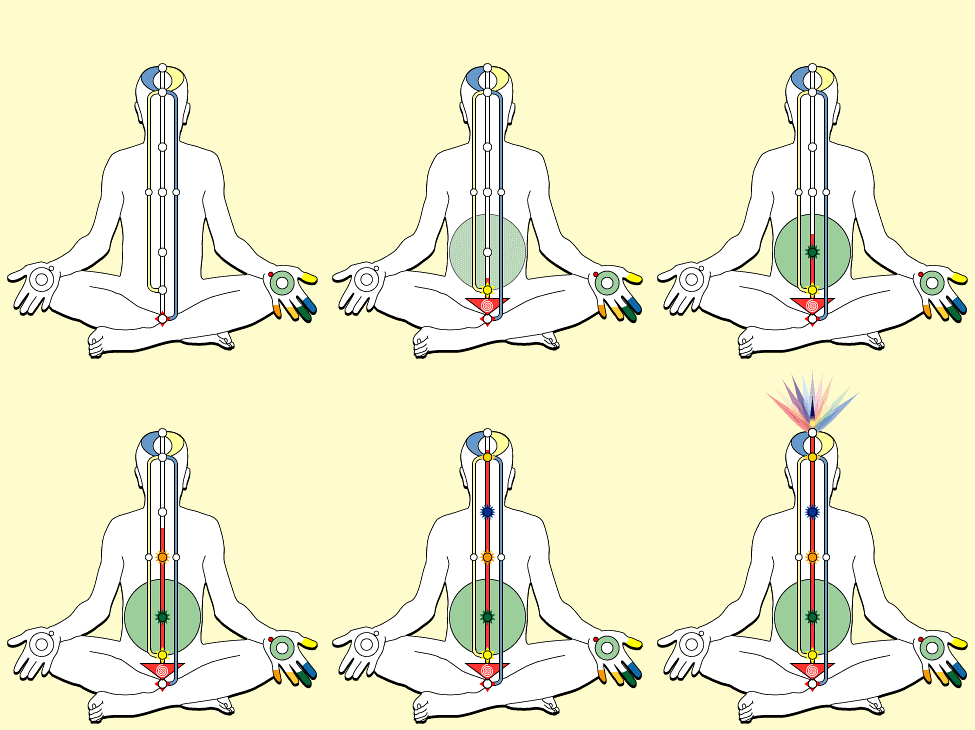
1) Place the left hand in front of your lower abdomen, palm facing the body.
2) Raise the left hand up vertically, until it reaches a position above your head. While the left hand is ascending, the right hand rotates around it clockwise, until both hands are above the head.
3) Use both hands to tie a knot. Repeat three times and the third time tie the knot three times.

4) Then hold the left hand out on your lap, palm upwards.
5) Place your right hand over your left hand and slowly raise your right hand over your head and down the right side of your body.
6) Then raise the right hand up the right side, back over your head and down the left side. Repeat seven times.

Now place both hands with palms open on lap/knee and meditate between 15-30 minutes.
Repeat the same procedure after finishing meditation.
Please do not be concerned or feel guilty that you are not following proper procedure or making 'mistakes' as all human rules, shortcomings, and conditioning become useless rituals as the thoughtless state attunes to the Cosmic Silence. Maintaining the Silence is the most important objective.
Daily meditation on His Ruh
Then regular meditation begins on a regular basis twice a day in the morning and evening, between 15-30 minutes each session. Just close your eyes, put your attention on His Ruh within, and remain thoughtless. All you need to take part in the Resurrection is to meditate on His Ruh (self-reproaching Spirit) in any way or position you feel comfortable. Only in meditation will you feel the Winds of Qiyamah.
After some time you will be able to meditate anywhere by putting your attention on His Ruh in your heart and mind, without even the need to follow above instructions of 1-6 i.e., just keep your palms open (upwards) for the Winds of Qiyamah to flow out, and meditate. Shri Mataji is only the initial catalyst for your Baptism of Allah to take place. After that we continue on our own.
within you is your self-reproaching Spirit (Ruh of Allah) that begins to nourish and cleanse you in mind, body and soul i.e., purify the Believers during Al-Qiyamah. Only your own Spirit will confirm whether you have truly received the Baptism of Allah by giving forth the Winds of Qiyamah (Divine Cool Breeze) especially from your hands and head.
So please help guard its utmost sanctity.
Other benefits of the Divine Wind of Qiyamah
And as you progress this Cool Breeze (Winds of Qiyamah) may be used to cure yourself of minor ailments. Just direct the Divine Wind towards the affected areas for a few minutes daily. However, more serious diseases and mental problems - high blood pressure, stress, anger, violence, insomnia, stuttering, cigarette addiction, alcoholism, substance abuse (to name just a few) - will take months of meditation, but eventually you will definitely heal yourself.
99% of those meditating on His Ruh are now free from alcohol, drug and cigarette addiction after sustained meditation. But don't take our word for it: Experience the Divine Power of your own Mother Kundalini (Ruh) destroying all self-abuse and other anti-spirit traits as it transforms base and ignorant humans into Believers who have surrendered to Allah's Call to commence the Resurrection - Muslims, Hindus, Jews, Christians, Buddhists, Sikhs, Jains and others. This is the Great Announcement to all who believe in God Almighty.
Some people do not feel the Winds of Qiyamah (Divine Cool Breeze) for some time, or it may be very faint. But once established by sustained meditation over weeks/months this Divine Wind from within becomes a 24/7 experience and convinces that you are indeed taking part in the Resurrection. God Almighty will give you this proof that you are indeed surrendered to His Call to commence Al-Qiyamah.

Divine Wind of Qiyamah flowing out of Believers who have surrendered to His Call to commence the Resurrection after receiving the Baptism of Allah.
This is the true Baptism of Allah by His Ruh (Imam Ma Adi) sent to collect, promulgate, announce and explain the Resurrection to all humankind. Those who are comfortable and wish to continue should learn how to meditate daily so that they can cleanse themselves in mind, body and soul. This Baptism of Allah empowers humans to daily cleanse themselves during the Night Of Power And Fate (Al Qadr). This lifelong internal jihad is absolutely necessary to enter Paradise in the Afterlife, prior to the wrath of the Day Of Noise and Clamour (Al Qariah). Allah (SWT) has never destroyed unless ample warning is given and that is why the Night Of Power And Fate (Al Qadr) precedes the Day Of Noise and Clamour (Al Qariah). The Call to commence the Resurrection is His Mercy and Warning as well.
“The Baptism of God, and who is better than God to baptize? Him do we worship"
(chap. ii). this is the translation from the Quran...
The spiritual baptism is the direct work of God Himself. As a fuller or a laundress washes the linen or any other object with water; as a dyer tints the wool or cotton with a tincture to give it a new hue; and as a baptist blots out the past sins of the true penitent believer, so does God Almighty baptize, not the body, but the spirit and the soul of him whom He mercifully directs and guides unto the Holy Religion of Islam. This is the "Sibghatu Allah," the Baptism of Allah, which makes a person fit and dignified to become a citizen of the Kingdom of Allah and a member of His religion.”
Encyclopaedia of Islam in 25 Volumes,
Mufti M. Mukarram Ahmed, 2005, page 214, Anmol Publications Pvt
ISBN: 8126123397
ISBN-13: 9788126123391, 978-8126123391
Dr. (Mufti) M. Mukarram Ahmed, M.A., Ph.D.,a reputed religious and literary schoalr, known all over the academic world for his intellect insight and origianl thinking, is an authority on Islam, entitled to issue verdicts. An Aalim and Mufti with doctorate in Arabic literature, he has widely travelled and ifnluenced people from all schools fo thought. His followers include people from all sections of society. Maulana Mukarram Ahmed is Shahi Imam of grand royal mosque at Fatehpuri, Delhi, India
WA-LAA UQSIM BI-AN-NAFSAL-LAWWAAMAH
I do call to witness the Resurrection Day;
And I do call to witness the self-reproaching Spirit.
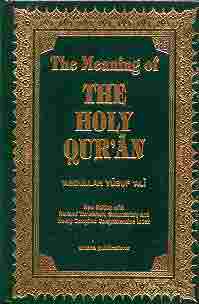
Concerning what are they disputing?
Concerning the Great News. [5889]
About which they cannot agree.
Verily, they shall soon (come to) know!
Verily, verily they shall soon (come to) know!
An-Naba (78:1–5): Concerning What Are They Disputing?
"5889. Great News: usually understood to mean the News or Message of the Resurrection.”
Abdullah Yusuf Ali, The Holy Qur'n, Amana Corporation, 1989.
 THE BAPTISM OF ALLAH (SIBGHATU I'LAH)