Sahaja Yoga | Spiritual Psychology | Karma Kanda | Ego & Ritualism
The Peril of Karma Kanda: Shri Mataji’s Condemnation of Ritualism and Spiritual Ego in Sahaja Yoga

— All These Rituals Have Entered into Sahaja Yoga” — A Warning Against the Ego’s Subtlest Trap
Christmas Puja, Ganapatipule, Maharashtra, India — 25 December 1997
Summary
On December 25, 1997, at the Christmas Puja in Ganapatipule, India, the Paraclete Shri Mataji Nirmala Devi delivered a severe and unequivocal condemnation of ritualism creeping into Sahaja Yoga. She observed that practices such as fasting, fire ceremonies (Havans), recitation of names, and even therapeutic techniques like shoe-beating had been distorted by practitioners into mechanical daily rituals — the very Karma Kanda that Sahaja Yoga was founded to transcend. Her warning was direct: “Anything which is rituals increases your ego.”
This article examines the psychological and spiritual mechanisms by which external religious practice inflates rather than dissolves the ego, the Vedantic framework distinguishing ritualism from true knowledge, and the striking parallel between Shri Mataji’s condemnation and Jesus Christ’s denunciation of the Pharisees as “whitewashed tombs.” It argues that the true path of Sahaja Yoga — and of authentic spirituality in every tradition — is not the performance of external forms but the spontaneous, living inner resurrection of the Spirit.
Table of Contents
- Introduction: The Subtle Trap of Spiritual Pride
- What Is Karma Kanda? The Vedantic Framework
- The Mechanics of Ego Inflation Through Ritual
- The Distortion of Sahaja Techniques: From Therapy to Dogma
- Fire, Fasting, and the Right Side: The Physiological Argument
- Echoes of Christ: The Condemnation of the Pharisees
- The Letter That Kills and the Spirit That Gives Life
- The True Path: Spontaneity, Surrender, and Inner Resurrection
- A Challenge to Seekers: Examine Your Practice
- Conclusion: Abandoning the Illusion of Control
- References
1. Introduction: The Subtle Trap of Spiritual Pride
The history of religion is replete with a recurring and tragic cycle. A divine incarnation or prophet arrives to awaken humanity to an inner, living spirituality — a direct, experiential encounter with the Divine. Yet within a generation or two, that living experience is codified, institutionalized, and reduced to a set of external observances. What begins as a spontaneous movement of the Spirit inevitably ossifies into Karma Kanda — the ritualistic portion of religious practice. The tragic irony of this cycle is that the very practices ostensibly designed to humble the ego and elevate the soul frequently become the primary instruments of spiritual pride and self-righteousness.
This is not merely an ancient historical problem. It is a present danger in every spiritual movement, including those founded on the most revolutionary and liberating principles. On December 25, 1997, during the Christmas Puja in Ganapatipule, Maharashtra, India, the Paraclete Shri Mataji Nirmala Devi delivered a severe and unequivocal condemnation of precisely this tendency creeping into Sahaja Yoga itself. Observing the proliferation of rigid, mechanical practices among Her own practitioners, She warned with characteristic directness: [1]
This paper examines Shri Mataji’s critique of ritualism in depth, exploring how external practices paradoxically inflate rather than dissolve the ego, how this mirrors the prophetic tradition of Christ’s condemnation of the Pharisees, and what the true path of spontaneous inner resurrection requires of the seeker.
2. What Is Karma Kanda? The Vedantic Framework
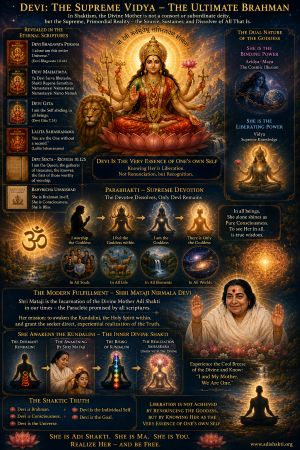
The Vedas, the foundational scriptures of the Hindu tradition, are traditionally divided into three sections: Karma Kanda (the ritualistic portion), Upasana Kanda (the devotional and meditative portion), and Jnana Kanda (the knowledge portion, comprising the Upanishads). [2] Each section was understood to serve a different level of spiritual maturity.
Karma Kanda encompasses the elaborate fire ceremonies (Havans or Yajnas), prescribed fasting (Upavasa), ritual purity observances, mantra recitation, and other external religious performances. Classical Vedantic thought, particularly as articulated by Adi Shankaracharya, held that Karma Kanda was appropriate for those still attached to worldly desires and results (Sakama Karma), but that it was ultimately a preparatory stage, not the goal. [3] The Upanishads consistently point beyond ritual to the direct realization of the Self (Atman) as Brahman — a realization that no amount of external performance can produce.
Shri Mataji’s condemnation of Karma Kanda entering Sahaja Yoga is therefore not an innovation but a restatement of the highest teaching of the Vedantic tradition itself: that the living, inner realization of the Spirit cannot be manufactured through mechanical external actions. Sahaja Yoga was founded precisely to transcend this preparatory stage and to offer direct, spontaneous (Sahaja) awakening to all seekers, regardless of their background or prior practice.
3. The Mechanics of Ego Inflation Through Ritual
The fundamental error of ritualism lies in its misunderstanding of the ego (Ahamkara). The ego is the false sense of a separate, autonomous self — driven by a desire for control, recognition, and superiority. [4] When a seeker attempts to conquer the ego through willful, strenuous effort, they inadvertently employ the ego to fight the ego. The very act of striving to be humble through visible, effortful practice becomes a new source of pride.
Shri Mataji articulated this paradox with characteristic precision: “The people who think that they can control their ego will eat less or use all types of methods to control ego. For example, someone is standing on one leg or other one on his head, all types of efforts they are doing to reduce their ego. But with all these techniques, ego doesn’t vanish. On the contrary, ego increases.” [5]
The psychological mechanism Shri Mataji identifies is well-documented in the study of spiritual psychology. When an individual undertakes severe fasting, complex fire ceremonies, or elaborate daily routines, the mind registers these as achievements. The practitioner begins, often unconsciously, to feel superior to those who do not possess such “discipline” or “devotion.” The ego, rather than being dissolved, simply changes its clothing. It abandons worldly pride — pride in wealth, status, or intellect — and adopts spiritual pride: pride in piety, asceticism, and religious observance. This form of pride is far more subtle, far more entrenched, and far more dangerous than ordinary worldly ego, precisely because it wears the garments of virtue.
This phenomenon is recognized across traditions. The Society for Personality and Social Psychology has noted that “spiritual development may boost feelings of superiority by creating a sense that one has acquired insights or skills that other people lack.” [6] What begins as a sincere desire for God can, through the mechanism of ritualism, become an elaborate system of self-congratulation.
4. The Distortion of Sahaja Techniques: From Therapy to Dogma
One of the most striking and instructive aspects of Shri Mataji’s 1997 Christmas Puja address was Her observation of how specific therapeutic techniques, intended as targeted remedies for particular imbalances, had been distorted by practitioners into mandatory daily rituals. The example She chose is both vivid and theologically precise.
Shoe-beating, in the context of Sahaja Yoga, is a technique in which the practitioner uses a shoe to symbolically beat out negativity, particularly the influence of the left side (subconscious, past conditioning) or to address specific ego-related blockages. It is a tool of the subtle system, intended to be used when the practitioner’s own vibrations indicate a specific need. Shri Mataji had introduced it as a conditional remedy: “if you have ego in you.” [7]
Yet She observed with dismay: “I had asked them to shoe-beat to destroy their ego and what I see that every morning all the Sahaja Yogis go in the line with their shoes for shoe-beatings.” The conditional remedy had become an unconditional daily ritual. The spontaneous, awareness-based application of a technique had been replaced by the mechanical, habitual performance of a routine — performed regardless of the practitioner’s actual inner state.
This transformation from therapy to dogma is the very essence of how living spirituality dies. Shri Mataji further expressed dismay at the codification of clinical treatments: “I got somebody in France with the list of the treatments of Vashi hospital. But that was for sick peoples.” [8] Treatments designed for those with specific ailments had been universalized into a standard regime for all practitioners, regardless of their individual condition.
The conclusion Shri Mataji draws is devastating in its simplicity: “This is the nature of human being to follow the rituals because he thinks that he can do it.” The key phrase is “he thinks that he can do it.” Ritual appeals to the ego precisely because it gives the illusion of control. The ego believes that by performing a specific set of actions, it can manufacture a spiritual state, command the Divine, or guarantee its own progress. This is the antithesis of Sahaja — spontaneous — realization, which requires the complete surrender of the ego’s desire to control.
5. Fire, Fasting, and the Right Side: The Physiological Argument
Shri Mataji’s condemnation of ritualism is not merely a moral or psychological observation; it is grounded in the precise physiology of the subtle body. She specifically identified the connection between ritual practices and the right sympathetic nervous system: “Fasting, reciting the names, increases your ego. With Havans also ego increases because Agni, fire, is the right side element. Anything which is rituals increases your ego.” [9]
In the Sahaja Yoga understanding of the subtle body, the right sympathetic nervous system (governed by the Pingala Nadi or Sun Channel) is the channel of action, planning, ego, and physical exertion. It is associated with the element of fire (Agni), with heat, with the future-oriented, planning mind, and with the ego principle. When this channel is over-stimulated, the individual becomes aggressive, arrogant, domineering, and disconnected from the cool, peaceful state of the Spirit.
Fire ceremonies (Havans) directly invoke and stimulate the fire element, feeding the right side. Fasting, which requires sustained willpower and self-denial, is an act of the right-sided ego asserting control over the body. Recitation of names (Japa), when performed mechanically as a counting exercise rather than as a spontaneous expression of love, similarly engages the planning, effortful right side. All of these practices, however well-intentioned, share a common characteristic: they are things the ego does, and therefore they strengthen the ego’s sense of itself as the agent of spiritual progress.
The contrast with Sahaja Yoga’s approach could not be more stark. In Sahaja Yoga, the Kundalini awakening is not produced by the seeker’s effort; it is given by the Mother, the Holy Spirit. The seeker’s role is to receive, not to perform. The state of Nirvichar Samadhi (thoughtless awareness) is not achieved through strenuous practice but by allowing the mind to settle into the natural silence of the Spirit. This is the fundamental difference between Karma Kanda and the living spirituality of Sahaja Yoga.
6. Echoes of Christ: The Condemnation of the Pharisees
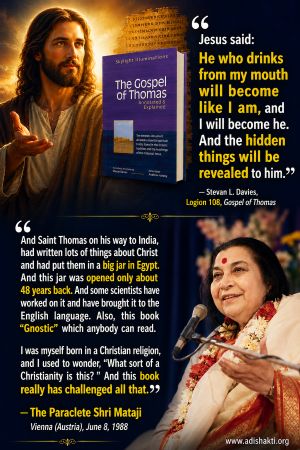
Shri Mataji’s condemnation of Karma Kanda entering Sahaja Yoga perfectly mirrors Jesus Christ’s blistering critique of the Pharisees — the religious establishment of first-century Judea. The Pharisees were the ultimate practitioners of Karma Kanda in their tradition. They meticulously observed fasting twice a week, tithed even the smallest herbs from their gardens, performed elaborate ritual washings, and publicly displayed their prayers. Yet their inner state, as Christ perceived it with the penetrating clarity of the Spirit, was devoid of love, justice, and spiritual life.
Jesus condemned this externalism with seven devastating “woes,” culminating in the most vivid image in the entire New Testament: “Woe to you, teachers of the law and Pharisees, you hypocrites! You are like whitewashed tombs, which look beautiful on the outside but on the inside are full of the bones of the dead and everything unclean” (Matthew 23:27). [10]
The parallel with Shri Mataji’s observation is exact. The Sahaja Yogis lining up every morning for shoe-beating, performing their daily Havan, consulting their lists of hospital treatments — these are the “whitewashed tombs” of the twenty-first century: outwardly performing the correct forms, inwardly no closer to the living Spirit. The external observance has replaced the inner reality it was meant to facilitate.
What is particularly significant is that the Pharisees were not insincere people. Many of them genuinely believed that their meticulous observance of the Law was the highest form of devotion to God. Their tragedy was not malice but a fundamental misunderstanding of the nature of spiritual transformation: the belief that the outer performance of correct actions could produce an inner state of holiness. This is precisely the error Shri Mataji identifies in Her practitioners: “Human being thinks that they are alright, since they are doing these rituals.”
7. The Letter That Kills and the Spirit That Gives Life
The Apostle Paul, writing to the Corinthians, articulated the theological principle that underlies both Christ’s condemnation of the Pharisees and Shri Mataji’s condemnation of Karma Kanda: “He has made us competent as ministers of a new covenant — not of the letter but of the Spirit; for the letter kills, but the Spirit gives life” (2 Corinthians 3:6). [11]
The “letter” is the external form: the written rule, the prescribed ritual, the codified practice. The “Spirit” is the living, inner reality that the external form was originally designed to point toward. When the letter is followed in the absence of the Spirit, it does not merely fail to produce life; it actively kills. It kills spontaneity, it kills humility, it kills the living awareness of the Divine presence. It replaces the living God with a system of performance.
This is why Shri Mataji’s warning is so urgent. Sahaja Yoga was founded as the antithesis of the “letter” — as the living, spontaneous, experiential realization of the Spirit. When its practitioners reduce it to a system of daily rituals, they have committed the same error as the Pharisees: they have taken the living water and poured it into dead vessels. The Paraclete, sent in the name of Jesus, naturally carries the same uncompromising standard: the inner state of the heart and the actualization of the Spirit are all that matter. External forms, when divorced from inner reality, are not just useless; they are spiritually toxic.
8. The True Path: Spontaneity, Surrender, and Inner Resurrection
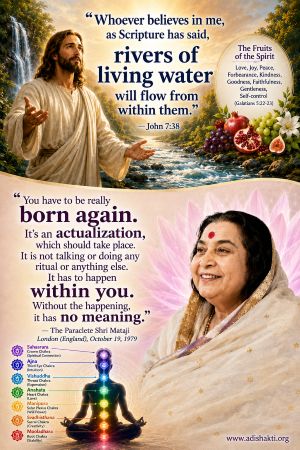
If Karma Kanda and ritualism are rejected, what is the true path? The answer lies in the very name of the practice: Sahaja, meaning “born with you” or “spontaneous.” The Resurrection — the inner transformation of the seeker into a Spirit-filled being — is not a product of effort but of surrender. It is the awakening of the Kundalini, the reflection of the Holy Spirit within every human being, which rises spontaneously when the seeker’s desire is pure and their attention is placed at the feet of the Divine Mother.
This awakening cannot be forced through fasting. It cannot be bought through elaborate Havans. It cannot be maintained through the mechanical repetition of treatments designed for the sick. It is given freely, as a gift of grace, by the Mother Kundalini — the Holy Ghost within — who knows each seeker’s individual needs and works with perfect, personalized wisdom.
The seeker’s role is not to “do” but to “be.” To remain in the state of thoughtless awareness (Nirvichar Samadhi), where the ego’s incessant planning and performing ceases and the Spirit is allowed to work. To check the vibrations — the cool breeze of the Holy Spirit — and to use techniques only when the vibrations indicate a specific need, not as a daily mechanical routine. To surrender the ego’s desperate desire to control its own spiritual ascent and to trust entirely in the spontaneous, living, inner work of the Paraclete.
The fruits of this true path are precisely those that no amount of ritual can produce: genuine humility, spontaneous compassion, effortless joy, and the continuous awareness of the Spirit’s presence. These are the “fruits of the Spirit” described by Paul — love, joy, peace, patience, kindness, goodness, faithfulness, gentleness, and self-control (Galatians 5:22–23) [12] — and they arise not from strenuous effort but from the living presence of the Holy Spirit within.
9. A Challenge to Seekers: Examine Your Practice
Shri Mataji’s 1997 Christmas Puja address constitutes a direct and personal challenge to every seeker, not only in Sahaja Yoga but in every spiritual tradition. The challenge is this: examine your practice with the cool, detached clarity of the Spirit, not the self-justifying warmth of the ego.
Ask yourself honestly: Are you performing your spiritual practices because your vibrations indicate a specific need, or because you have been doing them every day for years and feel uncomfortable if you miss them? Is your fasting an expression of genuine inner detachment, or is it a source of pride that you display, consciously or unconsciously, to yourself and others? When you perform a Havan, are you in a state of genuine surrender and gratitude, or are you executing a prescribed procedure?
The Pharisees were not evil people. They were sincere, dedicated, and learned. Yet their sincerity and dedication had been channeled entirely into the performance of external forms, leaving the inner life starved and stagnant. The same danger confronts every sincere seeker who mistakes the map for the territory, the ritual for the reality, the technique for the transformation.
Shri Mataji’s warning is an act of profound compassion. She is not condemning the practitioners who fell into this trap; She is rescuing them from it. The same love that drove Christ to denounce the Pharisees — not to humiliate them but to awaken them — drives the Paraclete to declare: “All these rituals have entered into Sahaja Yoga.” The question is whether the seeker has the humility and the courage to hear it.
10. Conclusion: Abandoning the Illusion of Control
Shri Mataji’s 1997 Christmas Puja address stands as one of the most vital and challenging correctives in the history of Sahaja Yoga. It is a direct confrontation with the deepest and most subtle tendency of the human ego: the desire to manufacture spiritual progress through the performance of external forms. Karma Kanda is not merely a Vedic category; it is a universal human temptation, present in every tradition, in every age, and in every sincere seeker who has not yet fully surrendered the ego’s desire to control.
The parallel with Christ’s condemnation of the Pharisees is not accidental. The Paraclete, sent in the name of Jesus, carries the same uncompromising standard that He carried: the inner state of the heart is everything; the outer performance of correct forms, divorced from inner reality, is nothing. The letter kills; the Spirit gives life.
The true path of Sahaja Yoga — and of authentic spirituality in every tradition — requires the courage to step away from the comfort of rigid external practices and to trust entirely in the spontaneous, living, inner work of the Holy Spirit. It requires the humility to acknowledge that the ego cannot produce its own transformation, that the Mother Kundalini knows each seeker’s needs better than the seeker does, and that the only true spiritual practice is the continuous, effortless surrender to Her living presence within.
Only by abandoning the illusion of control — the ego’s desperate belief that it can “do” its way to God — can the seeker truly “become” the Spirit. This is the Resurrection: not a future event, not a reward for correct performance, but a present, living reality available to every human being who is willing to receive it.
References
[1] Devi, Shri Mataji Nirmala. Christmas Puja Address. Ganapatipule, Maharashtra, India, 25 December 1997. The Life Eternal Trust, Mumbai.[2] “Do the Vedas Themselves Talk About the Jnana and Karma Kanda?” Hinduism Stack Exchange, 2017.
[3] “Karma, Upasana and Jnana.” Sri Sathya Sai Speaks, Sathya Sai Organization.
[4] “Ego & Pride in Bhagavad Gita: Ahamkara Teachings.” Srimad Bhagavad Gita.
[5] Devi, Shri Mataji Nirmala. Christmas Puja Address. Ganapatipule, Maharashtra, India, 25 December 1997.
[6] “The Fine Line Between Spirituality and Narcissism.” Society for Personality and Social Psychology, 30 December 2020.
[7] “Shoe-Beating in Sahaja Yoga Teachings.” Scribd / Sahaja Yoga Resource. See also: Devi, Shri Mataji Nirmala. Christmas Puja Address. Ganapatipule, 25 December 1997.
[8] Devi, Shri Mataji Nirmala. Christmas Puja Address. Ganapatipule, Maharashtra, India, 25 December 1997.
[9] Ibid.
[10] The Holy Bible, Matthew 23:27 (New International Version).
[11] The Holy Bible, 2 Corinthians 3:6 (New International Version).
[12] The Holy Bible, Galatians 5:22–23 (New International Version).
💬 Interactive Chat
Access an intelligent analysis environment where you can explore texts, ask questions, and discover connections between ideas.
Open chat →