
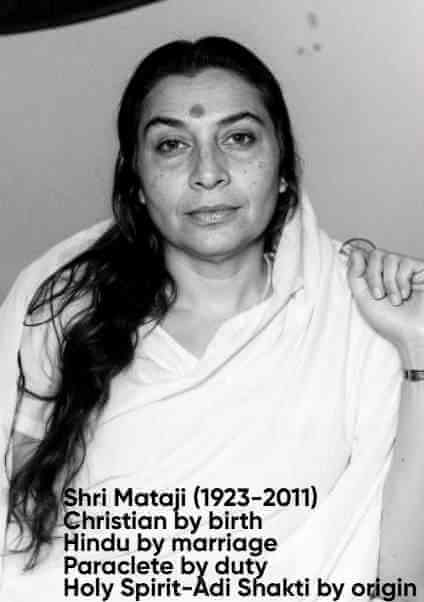
Shri Mataji: There should be no fear of death but on the contrary should be welcomed
The fear of death, a universal human anxiety, is countered by spiritual traditions that view it not as an end, but a transition. Shri Mataji Nirmala Devi crystallized this view, teaching that death should be welcomed as liberation. This perspective, echoed by thinkers like Dr. Haridas Chaudhuri, asserts that such fear stems from mistakenly identifying with the mortal body instead of the immortal spirit. Shri Mataji's core message was that through Self-realization, one directly experiences this eternal spirit, making death a mere continuation of the journey. As she proclaimed, for the realized soul, "Death does not exist for you... your spirit is free."
Introduction
The fear of death is one of the most fundamental anxieties of the human condition. Across cultures and throughout history, humanity has grappled with the finality of physical existence. However, the great spiritual traditions of the world have consistently offered a counter-narrative: that physical death is not an end, but a transition. This paper explores this concept through the profound teachings of Shri Mataji Nirmala Devi, who declared that death should not be feared, but welcomed as a moment of ultimate liberation. Her message, rooted in the direct experience of Self-realization and the promise of the Resurrection, finds resonance with the concepts of immortality and eternal life that are central to the world's major religions. By examining Shri Mataji's unique perspective alongside the timeless wisdom of these traditions, we can gain a deeper understanding of death as a gateway to a higher reality.
Shri Mataji's Perspective: Death as Liberation
Shri Mataji's teaching on death is a radical departure from the conventional view of it as a tragic loss. She presents it as a positive and liberating experience, a continuation of the journey of the spirit. In a 1995 address, she explained this profound truth in simple, yet powerful terms:[1]
This perspective is not based on blind faith, but on the experience of the spirit, which is separate from the physical body. Dr. Haridas Chaudhuri explains that the fear of death is rooted in "metaphysical or spiritual ignorance, which lies in the identification of the spirit with the body."[2] Once we realize our true nature as the immortal spirit, the fear of the body's demise naturally dissolves. This is the essence of Shri Mataji's message of Self-realization, which she made available to all of humanity. For a realized soul, death is not an extinction but a continuation of a journey that has already begun. As she stated, "Death does not exist for you — It is finished... your spirit is free."[3]
The Promise of Immortality in World Religions
Shri Mataji's message of eternal life is not an isolated teaching, but a confirmation of a truth that has been expressed in various forms by the world's great religions. While the details of their eschatology may differ, they share a common belief in the immortality of the human spirit. A comparative overview reveals this underlying unity:
| Religion | Concept of the Soul/Spirit | Nature of the Afterlife | Path to Immortality |
|---|---|---|---|
| Hinduism | The Atman, an eternal, divine spark that is part of the universal Brahman. | A cycle of reincarnation (samsara) based on karma, with the ultimate goal of moksha (liberation) and union with Brahman. | Dharma (righteous living), devotion (bhakti), knowledge (jnana), and meditation. |
| Buddhism | The concept of anatman (no-self); the individual is a temporary combination of aggregates (skandhas). | Rebirth based on karma, with the goal of achieving nirvana, the cessation of suffering and the cycle of rebirth. | The Eightfold Path, including right understanding, right conduct, and meditation. |
| Judaism | The soul (neshama) is a divine, immortal entity. | The World to Come (Olam Ha-Ba), a spiritual existence with God, and the belief in a future resurrection of the dead. | Observance of God's commandments (mitzvot) and living a righteous life. |
| Christianity | The soul is an immortal creation of God. | Eternal life in heaven (paradise) for the righteous, and damnation in hell for the unrepentant. Belief in the resurrection of the body. | Faith in Jesus Christ as the savior, repentance, and living according to his teachings. |
| Islam | The soul (ruh) is an immortal entity created by Allah. | On the Day of Judgment (Yawm al-Qiyamah), all will be resurrected to face a final judgment, leading to eternal life in paradise (Jannah) or punishment in hell (Jahannam). | Submission to the will of Allah (Islam), faith (iman), and righteous deeds. |
As the Encyclopedia of World Religions notes, "With all their diversity of beliefs, the major religions are in accord in one great teaching: Human beings are immortal and their spirit comes from a divine world and may eventually return there."[4] This universal promise of an existence beyond the physical body provides a powerful context for understanding Shri Mataji's teachings. Her message of the Resurrection is not a new doctrine, but the inauguration of the "Age to Come"[5], a time when the promise of eternal life becomes a tangible reality for all who seek it.
Conclusion: Welcoming the Great Departure
The fear of death is ultimately the fear of the unknown. By revealing the true nature of the spirit and its eternal journey, Shri Mataji Nirmala Devi transforms this fear into an joyful anticipation. Her teaching that death should be welcomed is not a morbid fascination, but a profound affirmation of life itself—a life that transcends the limitations of the physical body. This perspective is echoed in the Hindu concept of death as a Maha Prasthana, or "Great Departure."[6] It is a celebration of the soul's journey home.
In the light of Shri Mataji's teachings, we can see that the promise of immortality is not a distant hope, but a present reality that can be experienced through Self-realization. By awakening the divine spirit within, we can overcome the illusion of death and embrace the eternal life that is our birthright. As the Upanishads declare, the liberated soul, freed from the body, "roves around, laughing, playing, taking his pleasure... remembering no more that excrescence which was his body."[7] This is the ultimate freedom that Shri Mataji's message of the Resurrection offers to all of humanity.
References
[1] Shri Mataji Nirmala Devi. "To Achieve Complete Freedom." Cabella, Italy, 7 May 1995.[2] Chaudhuri, Haridas. The Essence of Spiritual Philosophy. Thorsons Publishing Group, 1990, pp. 133-6.
[3] Shri Mataji Nirmala Devi, as quoted in "There should be no fear of death but on the contrary should be welcomed." adishakti.org.
[4] "How the Major Religions View the Afterlife." Encyclopedia.com.
[5] "Adi Shakti." adishakti.org.
[6] Himalayan Academy. "Hinduism Today." 1998.
[7] Zaehner, R.C. Bhagavad-Gita. Oxford University Press, 1969, p. 234.
"General George Patton of World War II fame, no stranger to personal reincarnational remembrances (he claimed to recall previous battlefield experiences as Napoleon), once observed, 'For Hindus death is the most exalted experience of life.' This idea is naturally hard for non-Hindus to grasp — all the more so for atheists facing Eternal Oblivion and those of Abrahamic faiths which define death as a punishment for man's sinful disobedience. To them, death is the ultimate sign of man's spiritual failure, a belief which arouses instincts of denial and injustice. One may feel penitent and guilty, not to mention uncertain about the destination ahead.
No such thoughts attend the dying days of a Hindu. Of course, there is much sadness surrounding the passing of friends and family, but that is honest acknowledgement of our loving attachments. Inside we know death is OK, natural, that the soul, even if it was less than perfect in this life, is continuing its appointed journey across life's oceanic phenomena toward Liberation and will, in time and without fail, reach the other shore. The Hindu's presumption of numerous births mitigates the tragedy of death, whether the passage is his own or another's. So, Hindus call death by lofty names — Maha Samadhi, 'Great Superconscious State' and Maha Prasthana, 'Great Departure.' To be near an awakened soul at the time he or she gives up the body is considered among the most blessed of opportunities. While ordinary people are remembered on their day of birth, Hindus honor enlightened souls on the day of their departure, translated in English as 'liberation day.'"
"Those who have spiritual enlightenment tell us that the basic cause of fear of death is our metaphysical or spiritual ignorance, which lies in the identification of the spirit with the body. As long as we are not aware of our true spiritual essence, of the reality of the spirit or the true self within us, it is natural that we are subjected to this fear of death. The body is subject to the laws of nature. It is born, it grows, it attains maturity, it declines and it perishes. When we identify with this body and we have no understanding of our spiritual essence, naturally we feel that decline and eventual disintegration of the body mean our decline and destruction. So in all religions, the great spiritual geniuses have declared unequivocally that the more we know of our true spiritual essence of our being, the more we overcome the fear of death. We take a deeper perspective. We realize destruction of the body does not involve destruction of our spiritual nature, which is immortal and imperishable in character. Therefore, it is evident that the best way to conquer and overcome this fear of death is to sharpen our spiritual understanding and experience...
As the great philosopher Spinoza said, the essence of spiritual wisdom is to be able to behold life under the aspect of eternity."
Thorsons Publishing Group, UK, 1990, p. 133-6.
"... 'to become the very self of every being' (BG. 5.7) does not mean the loss of a personal relationship with God, and probably with other liberated beings as well. This is in line with at least one type of Upanishadic thought typified in the dialogue between Indra and Prajapati in Chandogya Upanishad 8. The relevant passage is 8.12, 1-3:
Bountiful One! For sure this body is mortal, held in the grip of death. Yet it is the dwelling-place of the immortal, incorporeal self. And this self, while still in the body, is held in the grip of pleasure and pain; and so long as it remains in the body there is no means of ridding it of pleasure and pain. But once it is freed from the body, pleasure and pain cannot as so much touch it.
The wind has no body. Clouds, thunder, and lightning — these too have no body. So, just as these arise from the broad expanse of space up there and plunge into the highest light, revealing themselves each in their own form, so too does this deep serenity arise out of this body and plunge into the highest light, revealing itself in its own form. Such a one is a superman (uttara purusa); and there he roves around, laughing, playing, taking his pleasure with women, chariots, or friends and remembering no more that excrescence which was his body...
Liberation is no longer the isolation of the classical Samkhya-Yoga: rather it is the end of what Christians mystics call as via purgativa, the way of the vishuddh'tma, the 'purified self' (5.7: cf. 5.11:6.12.) It is the beginning of the personal encounter of the integrated and liberated self with God."
Oxford University Press, 1969, p. 234.