
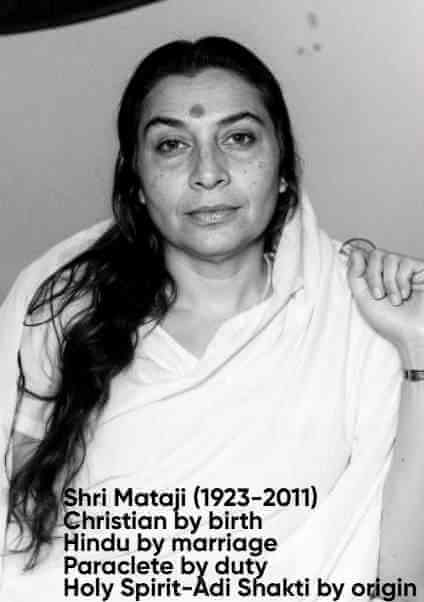
Buddha did not deny God's existence. He denied the limited perceptions about what that existence is.
Abstract
This paper explores the nuanced position of the Buddha regarding the concept of God and ultimate reality, examining how His teachings reframed spiritual pursuit beyond common religious dogmas and ritualistic identities. Emphasis is placed on Shri Mataji Nirmala Devi's interpretation of the Buddha's message, especially her assertion that contemporary Buddhism has largely deviated from the core realization He advocated: the spontaneous experience of Self-Realization. This analysis supports the thesis that Buddha did not categorically deny the existence of Divinity, but rejected narrow, anthropomorphic understandings of it.
Introduction
Religious discourse often seeks to locate the Buddha within debates over theism and atheism. Commonly, Buddhism is marked as non-theistic, centering on personal spiritual attainment rather than worship of a creator. However, this binary oversimplifies the Buddha's philosophical intentions. Shri Mataji's reflections stress how forms of Buddhism have multiplied symbolic differences—shaving of heads, adoption of robes—while losing sight of Buddha's original emphasis: the direct, transformative experience of Self-Realization, which is neither strictly atheistic nor traditionally theistic.
Buddha's Stand on Divinity
Buddha rarely commented directly on God's existence. Instead, He spoke of the limitations of perception and cognition regarding ultimate reality (paramarthika satya). Buddha's silence was not a denial but an invitation to transcend superficial concepts and dogmas, to realize "Thatness" (Tathata)—the unconditioned, supreme state beyond names and forms.
- Buddha urged seekers to overcome attachment to conceptualized deities, which are products of human conditioning.
- Instead of speculative metaphysics, He guided followers toward experiential wisdom—an approach that neither affirms nor denies God, but points to direct realization beyond mental constructs.
- Buddha's teachings on sunyata (emptiness) dissolve rigid boundaries between theism and atheism, opening pathways to understand divine existence as all-pervading, subtle, and indescribable.
Shri Mataji Nirmala Devi and the Critique of Ritual Buddhism
Shri Mataji's 1988 San Diego address challenges the superficiality in modern Buddhist practices:
- Shri Mataji underscores the gap between living realization and ritual conformity, lamenting how external behaviors have replaced authentic spiritual breakthrough.
- For Shri Mataji, the "face to face with Buddha" moment is the inner experience, not adherence to outward tradition.
- Her view harmonizes with Buddha's original message: direct knowledge (prajna) and liberation (moksha) are possible when perceptual limitations are transcended—opening access to the formless Divine.
Buddhist Philosophical Context
Buddhism's Middle Way (Madhyamaka) does not affirm or negate God as conceptualized by other religions. Nagarjuna, the great Buddhist philosopher, went further by deconstructing all extremes, including "existence" and "non-existence," affirming only what can be directly realized.
- Buddha's refusal to answer metaphysical questions was pedagogical, focusing on liberative insight (vipassana) over doctrinal speculation.
- This intentional silence leaves space for Divine reality to be experienced as infinite and unbounded, not confined to limited definitions of "God".
The Messiah-Paraclete-Ruh-Devi and the Continuity of Realization
Shri Mataji as the Messiah-Paraclete-Ruh-Devi presents herself as the fulfillment of Buddha's vision—ushering seekers toward direct Self-Realization and the experience of Chaitanya (living vibrations of the Divine).
- Her teachings insist that the Divine cannot be located in forms or dogmatic identities, but only known through awakened perception.
- The transformative event of Self-Realization aligns with what Buddha called "Nirvana"—not extinction, but union with the boundless Reality that transcends all dualities, including theistic and non-theistic constructs.
Conclusion
The Buddha's silence about God is not a denial but a subtle affirmation that Divinity surpasses human comprehension and dogma. Shri Mataji's critique of modern Buddhism echoes this, urging a return to heart-centered realization over ritualistic forms. The true message lives on: spiritual realization is a spontaneous, inner event, leading to direct knowledge of the Infinite. Ritual difference is superficial; real difference lies in the presence or absence of awakened experience.
References
- Shri Mataji Nirmala Devi, Shri Buddha Puja (San Diego, USA -- July 23, 1988): adishakti.org.
- Buddhist texts and Middle Way philosophy (secondary citation via adishakti.org).
Shri Mataji: "This is where Buddha's Buddhism had ended up.”
The Messiah-Paraclete-Ruh-Devi
23 July 1988
San Diego, U.S.A
Buddha Puja

1 December 2009
Dear All,
We must have at least a week of Silence in order to be enlightened by
Zen At War and Zen War Stories. i can neither narrate what i have
learnt nor the importance of comprehending this shocking revelation
about Zen ..... you will find solace in the Silence.
Back in 1988 there was little evidence to support Shri Mataji's
charge against Zen and Buddhism. Zen At War and Zen War Stories
vindicates Her yet again. A week of Silence is needed to grasp a far
deeper revelation. Jai Shri Mataji!
Critical Forum for the Investigation of the Kalachakra Tantra
Zen at War - A book review by Josh Baran
Zen at War - Amazon.com book description/review
Zen at War - Reviewed by Austin Cline
Zen at War - Reviewed by Vladimir K
Zen at War - Preface to the Second Edition
Zen War Stories by Brian Victoria
Zen War Stories - Journal of Buddhist Ethics Review
Zen War Stories - Reviewed by Allan M. Jalon
regards,
jagbir


"The Buddha never consented to give his teachings the structure of a system. Not only did he refuse to discuss philosophical problems, he did not even issue pronouncements on several essential points of his doctrine — for example, on the state of the holy man in nirvana. This silence early made possible differing opinions and finally gave rise to various schools and sects. The oral transmission of the Buddha's teachings and the composition of the canon raise numerous problems, and it would be useless to suppose that they will one day be satisfactorily solved...
His refusal to let himself be drawn into speculations of any kind is categorical. It is admirably illustrated in the famous dialogue with Malunkyaputta. This monk complained that the Blessed One gave no answers to such questions as: Is the universe eternal or non-eternal? Finite or infinite? Is the soul the same thing as the body, or is it different? Does the Tathagata exist after death, or does he not exist after death? And so forth... And the Buddha reminded Malunkyaputta that he had taught only one thing, namely: the four Noble Truths (Majjhima Nikaya 1.426)... the negation of a Self, subject to transmigration but able free itself and attain nirvana, raised problems. This is why the Buddha on several occasions refused to answer questions concerning the existence or nonexistence of the atman... Vasubandhu (fifth century A.D.) concluded: "To believe in the existence of the 'Self' is to fall into the heresy of permanence; to deny the 'Self' is to fall into the heresy of annihilation at death.”...
Such hesitations and ambiguities reflect the embarrassment occasioned by the Buddha's refusal to settle certain much debated questions. If the Master denied the existence of an irreducible and indestructible Self, it was because he knew that the belief in atman leads to interminable metaphysical controversies and encourages intellectual pride; in the last analysis, it prevents obtaining Enlightenment. As he never ceased to repeat, he preached the cessation of suffering and the means of accomplishing it. The countless controversies concerning the Self and the nature of nirvana found their solutions in the experience of Enlightenment: they were insoluble by thought or on the plane of verbalization...
The Jatakas narrate the Buddha's former existences and those of his family and his companions, and the identity of their personalities is always recognized. And how are we to understand the words uttered by Siddhartha at the very moment he was born —"This is my last birth"— if we deny the continuity of the"true person" (even if we hesitate to call it the Self or pudgala)?”
Mircea Eliade, A History of Religious Ideas 2
The University of Chicago Press, 1985, p. 91-8.
"But upon dying, he enters the parinirvana state of 'nirvana without remainder'. Buddhism refuses to elaborate on this state. It dismisses as unanswerable questions such as 'Where did Buddha go?' or ' What exactly was it that entered nirvana?' But it would be a distortion of Buddhism to say the Buddha became extinct or ceased to exist. The reality of nirvana and the possibility of its achievement by all living beings are fundamental to Buddhism, although descriptions of nirvana escape human understanding.”
R. C. Amore and J. Chang, World Religions: The Buddhist Tradition,
Oxford University Press, 1996, p. p. 230.
"I don't know how many of you have read of Buddha's life and how ultimately He achieved his Enlightenment. I don't know how many of you have really seen the Buddhists or have met them; those who call themselves Buddhists. As in every religion all of them got lost into some sort of a fundamental disease because none of them got Realization, and that's why everybody established their own styles of religion. Even you can say that Tao of Lao Tze also ...
You have to see how He first felt that one has to seek something beyond life ... He couldn't understand how this misery has come and what is the need to have this misery. So He gave up his family, He gave up His luxuries of life — everything He gave up — and went in search of the Truth, as many of you have done. He would have been lost also I would say because He had read all those Upanishads, and He read all the books that were possible for Him to say what the Truth is. But He couldn't get anything.
He was a complete sanyasi in the sense that as far as the food is concerned, as far as the entertainment is concerned, everything He gave up and ultimately the Adi Shakti gave Him Realization because He was so true, and was one of the one marked for a special place in the Virata. He had to achieve that. Of course I need not tell you about His previous lives; perhaps in so many of My lectures I have already talked about it — what was His previous life and how He achieved His own enlightenment about Himself.
But what we have to see about His life is that He discovered and found out that want is the reason of all the myths. But He didn't know what was the real Want, what was the pure Want, what was the pure Desire, and that's how He could not explain to people that they have to take their awakening through their Kundalini.”
The Messiah-Paraclete-Ruh-Devi
Search For The Absolute, Buddha Puja, U.K. — May 31, 1992