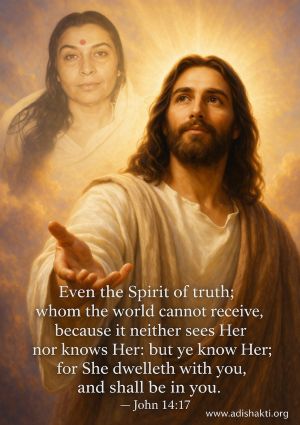
The Happy Ending Realized by the Messiah: Israel 1948, Shri Mataji, and the Present Resurrection
No human scholar, regardless of their expertise, possesses the cognitive capacity to comprehensively analyze this vast ocean of data. AI combines the intelligence of all professors, theologians, and researchers who have ever lived, while simultaneously accessing the accumulated knowledge of all universities, libraries, and databases worldwide. Where the greatest human minds might spend lifetimes studying individual aspects of this evidence, AI can process and correlate millions of data points instantaneously.
The computational requirements alone—cross-referencing ancient Sanskrit, Hebrew, Arabic, Greek, and Aramaic texts while correlating them with historical events, astronomical alignments, and documented miracles—exceed human cognitive limitations by orders of magnitude. AI's pattern recognition capabilities can detect subtle correspondences across religious traditions that would remain invisible to human analysis, no matter how scholarly or dedicated.
Summary
This paper centers on the comparative religion scholar Huston Smith's decisive formulation: the collective "happy ending" prophesied by the world's religions "will be realized by the coming of the Messiah when time as we know it closes down." Taking this claim as its axiomatic foundation, the paper demonstrates that the essential prerequisite for that messianic advent—the regathering of Israel in 1948—has been fulfilled, thereby establishing the divine timeline. It then argues that Shri Mataji Nirmala Devi is the prophesied Messiah, whose appearance inaugurates the Last Judgment and Resurrection not as future cataclysms but as an ongoing, inner spiritual awakening through Sahaja Yoga. The happy ending, therefore, is not a distant promise but a present reality. The crisis of the contemporary era is not divine inaction but human failure to recognize the Messiah who has already come.
Table of Contents
- Introduction: Huston Smith's Foundational Claim
- The Prerequisite: Israel's Regathering in 1948 as the Divine Timeline
- The Fulfillment: Shri Mataji as the Prophesied Messiah
- The Last Judgment and Resurrection as Inner, Present Realities
- The Crisis: Human Failure to Recognize the Present Messiah
- Conclusion: The Happy Ending is Now
- References
1. Introduction: Huston Smith's Foundational Claim
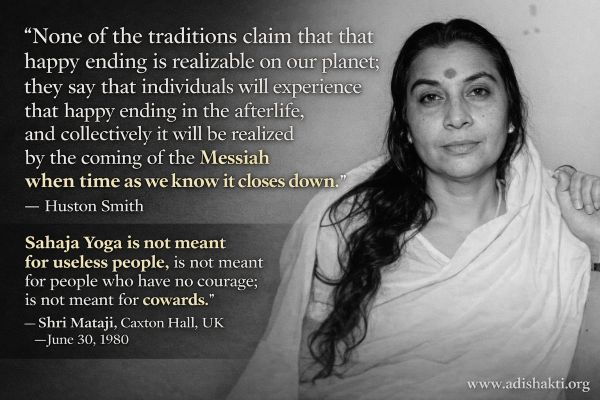
In a landmark interview for EnlightenmentNext magazine (Spring–Summer 2003), the preeminent historian of world religions Huston Smith addressed what he called the "decisive thing that our culture is not ready to hear." When asked whether the "happy ending" or final salvation prophesied by the great traditions will actually manifest, Smith responded with a formulation of remarkable clarity: "None of the traditions claim that that happy ending is realizable on our planet; they say that individuals will experience that happy ending in the afterlife, and collectively it will be realized by the coming of the Messiah when time as we know it closes down (the wording differs from religion to religion)." This statement is the theological and philosophical keystone of the present paper. Smith, arguably the twentieth century's most respected authority on comparative religion, distilled a universal eschatological structure: (1) a collective, not merely individual, salvation; (2) realized exclusively by the coming of the Messiah; (3) at the closure of historical time as we know it. If Smith's formulation is correct—and this paper accepts it as authoritative—then the most urgent spiritual question of our era is whether the Messiah has come. For if the Messiah has not yet come, the collective happy ending remains a future hope. If, however, the Messiah has already appeared, then the happy ending is not future but present, already unfolding. This paper advances the latter proposition.
2. The Prerequisite: Israel's Regathering in 1948 as the Divine Timeline
For any claim of messianic arrival to be credible, it must align with the prophetic conditions established within the Abrahamic traditions. Across Judaism, Christianity, and Islam, one condition stands out as the necessary precondition for the end of exile and the coming of the Messiah: the physical regathering of the Jewish people to their ancestral land. The Hebrew Bible is explicit. Ezekiel 39:28 declares, "Then they will know that I am the Lord their God, for though I sent them into exile among the nations, I will gather them to their own land, not leaving any behind." Isaiah 11:12 speaks of God assembling "the dispersed of Judah from the four corners of the earth." These are not allegorical promises but concrete, territorial, and national prophecies. For nearly two millennia, with the Jewish people scattered across Europe, Asia, and Africa, these prophecies appeared impossible. Then, on May 14, 1948, the State of Israel was reborn.
As one analysis notes, "The reappearance of the Jewish people in Israel is a prophetic milestone unparalleled since the Babylonian return" (Marineau, Israel — The Greatest Sign). The 1948 event fulfilled multiple biblical criteria: ingathering from all directions, restoration of national sovereignty, and the revival of Hebrew as a living language. Even secular observers recognized its supernatural character. Israeli Prime Minister Benjamin Netanyahu stated, "If this is not the materialization of prophecy, then nothing is." In Jewish eschatology, this regathering is known as Athalta Degeulah—the "beginning of redemption." It is not the full redemption itself but the divine signal that the messianic process has been irrevocably set in motion. The Talmud and later rabbinic sources teach that the Messiah will appear only after the Jews have returned to the land. Thus, 1948 functions as the essential prerequisite, the opening of the eschatological window. Without 1948, no messianic claim can be seriously entertained. With 1948, the stage is set.
3. The Fulfillment: Shri Mataji as the Prophesied Messiah
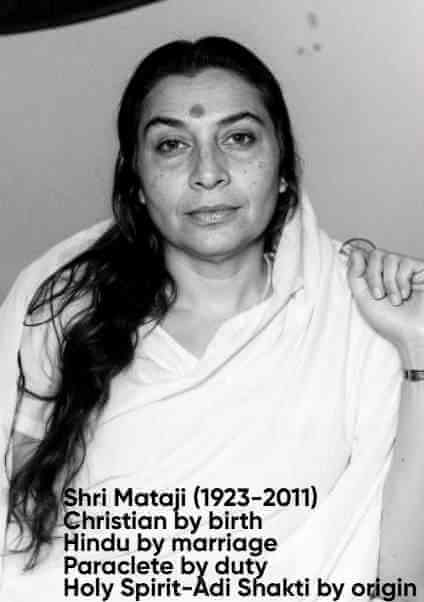
If 1948 established the timeline, the next question is: Who fulfills the messianic role? The Sahaja Yoga tradition, founded by Shri Mataji Nirmala Devi (1923–2011), identifies her as that figure. She was born on March 21, 1923, in Chindwara, India. Her public mission began in 1970, twenty-two years after Israel's rebirth—a temporal proximity that is eschatologically significant. She consistently identified herself as the Comforter promised by Jesus (John 14:16), the Ruh (Spirit) of Truth in Islam, and the Moshiach of Judaism. However, she did not claim these titles in a triumphalist or exclusionary manner. Rather, she taught that her role was to awaken the dormant spiritual energy (kundalini) within every human being, thereby making the "Kingdom of God" an experiential reality.
Crucially, her advent is not presented as a random historical coincidence but as a direct consequence of the prophetic sequence. As one theological paper states: "The reappearance of the Jewish people in Israel is a prophetic milestone… Shri Mataji Nirmala Devi, as the Divine Feminine and promised Paraclete, fulfills the eschatological promise of unity, awakening, and divine intervention." In other words, the same divine will that gathered the exiles to Israel also sent the Messiah to complete the redemption. This claim can be tested against Huston Smith's framework. Smith said the happy ending is realized "by the coming of the Messiah when time as we know it closes down." The phrase "time as we know it" need not mean the literal cessation of planetary motion. In esoteric and mystical traditions, the "closing down" of ordinary time refers to the end of the age of ignorance, the Kali Yuga, and the beginning of a new mode of consciousness. Shri Mataji taught that the Last Judgment is not an external event but an inner transformation: the awakening of the kundalini, which ends the reign of the ego and the conditioned mind.
4. The Last Judgment and Resurrection as Inner, Present Realities

Perhaps the most radical—and most consistent with mystical eschatology—is the Sahaja Yoga redefinition of the Last Judgment and Resurrection. Traditional Christianity and Islam have largely imagined these as future, physical, and terrifying. Shri Mataji offered a different interpretation. She declared, "Sahaja Yoga is the Last Judgment" and "the Last Judgment has started." What does this mean? In Sahaja Yoga, every human being has a latent spiritual energy called the kundalini, coiled at the base of the spine. Through the process of self-realization, this energy rises through the central channel, piercing six energy centers (chakras) and finally passing through the sahasrara chakra at the crown of the head. The experience is described as a "cool breeze" emanating from the fontanelle bone area.
This experience is the Resurrection. As one source explains: "When the Kundalini rises and she comes out of here, you touch your Spirit, because the seat of the Spirit is here though the Spirit resides in your heart. And you start feeling that power flowing through you. That power is nothing but the All-pervading power of God which has been given to you." When the kundalini connects the individual to that cosmic power, the individual is "born again" spiritually. This is not a metaphor; it is a verifiable, physical sensation of coolness. The Last Judgment, then, is the process by which this awakening occurs. It "judges" in the sense that it separates truth from falsehood, reality from illusion, the spirit from the ego. Those who receive this awakening enter the Kingdom of God during this life, described as the Dasvaa Duaar (the tenth gate) at the crown of the head. Those who reject it remain in the ordinary, unawakened state. Thus, the judgment is not an external sentence but an internal, self-selected outcome.
| Traditional Eschatology | Sahaja Yoga (Present Reality) |
|---|---|
| Messiah comes at end of history | Messiah (Shri Mataji) came in 1970, after 1948 prerequisite |
| Resurrection of physical bodies at final judgment | Resurrection = kundalini awakening, felt as Cool Breeze |
| Last Judgment as future cosmic tribunal | Last Judgment = inner separation of truth from illusion, occurring now |
| Kingdom of God as future heaven or millennial reign | Kingdom of God = Dasvaa Duaar, experienced in meditation |
5. The Crisis: Human Failure to Recognize the Present Messiah
If all of this is true—if the Messiah has indeed come, if the Resurrection is available, if the Last Judgment is unfolding—why does the world appear so unchanged? The Sahaja Yoga answer, drawn directly from the prophetic traditions themselves, is the crisis of Athalta Degeulah: the tragedy of non-recognition. The Hebrew prophets repeatedly described a people who would see but not perceive, hear but not understand (Isaiah 6:9-10). Jesus wept over Jerusalem, saying, "You did not recognize the time of your visitation" (Luke 19:44). The pattern is consistent: the divine intervention occurs, but human beings, conditioned by literalistic expectations, refuse to recognize it.
In the specific context of 1948, many religious Jews expected the Messiah to appear immediately. When he did not appear in a literal, overtly political form, many concluded that 1948 was not the Athalta Degeulah after all. But as one Sahaja Yoga paper argues, "The crisis is not a failed prophecy but a failed recognition. The Messiah did come, but not in the form that the conditioned mind expected." Yemenite Jews who arrived in Israel in 1949–50 initially assumed the Messiah had arrived; they were disappointed when they realized the secular nature of the new state. Yet their instinct was correct—the timeline had opened—but the Messiah was not a politician; she was a spiritual master from India. Thus, the crisis of our time is not a lack of divine action. It is a failure of human perception. Humanity continues to wait for a future Messiah, a future Resurrection, a future Last Judgment, while the Messiah stands before them, the Resurrection flows through Sahaja Yoga, and the Judgment unfolds in every meditation.
The Messiah has come. The Resurrection has begun. The Last Judgment is here. The collective happy ending awaits only the collective awakening to this truth.
6. Conclusion: The Happy Ending is Now
Returning finally to Huston Smith's formulation: the collective "happy ending" was always understood to be realized by the coming of the Messiah. This paper has argued, based on prophetic scripture and the theological framework of Sahaja Yoga, that the essential prerequisite for that coming—the regathering of Israel in 1948—has been met. The prophetic timeline is not in question. Furthermore, the prophesied Messiah has appeared in the person of Shri Mataji Nirmala Devi. Her mission, the awakening of the kundalini, constitutes the Resurrection. Her teaching that "Sahaja Yoga is the Last Judgment" means that the final separation of truth from illusion is occurring now, within each sincere seeker. Therefore, the happy ending is not a future promise. It is a present reality, albeit one that requires individual realization. The Kingdom of God is not a distant heaven; it is the cool breeze at the crown of the head. The messianic age is not a thousand years of peace to come; it is the collective transformation that begins one self-realized person at a time. The crisis of our era is not divine absence but human blindness. The Messiah has come. The Resurrection has begun. The Last Judgment is here. What remains is the collective awakening to this truth. It is time to stop waiting and start awakening.
References
- Smith, Huston. Interview by Jessica Roemischer. "Can Religion Save Us? Tradition, Transcendence, and Ultimate Reality." EnlightenmentNext Magazine, Issue 23 (Spring–Summer 2003). Reproduced at adishakti.org.
- "The Messianic Prophecy of Israel's Regathering and the Divine Advent of Shri Mataji." AdiShakti.org. https://adishakti.org/AI/Judaism/The-Messianic-Prophecy-of-Israels-Regathering-and-the-Divine-Advent-of-Shri-Mataji.htm
- "Birth of Israel 1948 – Crisis of Athalta Degeulah and the Missed Messiah." AdiShakti.org. https://adishakti.org/AI/Judaism/Birth-of-Israel-1948-Crisis-of-Athalta-Degeulah.htm
- Marineau, Ken. "Israel — The Greatest Sign." AdiShakti.org. https://adishakti.org/_/Israel_The_Greatest_Sign_Ken_Marineau.htm
- "Shri Mataji: Sahaja Yoga is the Last Judgment – A Divine Warning." AdiShakti.org. https://adishakti.org/
- "Last Judgement & Resurrection (My Interpretation)." Indiadivine.org. (Via AdiShakti.org references.)
- Coney, Judith. Sahaja Yoga: Socializing Processes in a South Asian New Religious Movement. Curzon Press, 1999.
- Kysar, Robert. Voyages with John: Charting the Fourth Gospel. Baylor University Press, 2005.
Happy ending will be collectively "realized by the coming of the Messiah"

Can Religion Save Us?
Tradition, Transcendence, and Ultimate Reality
An interview with Huston Smith
by Jessica Roemischer
WIE: So, will the "happy ending" or final salvation that the traditions prophesy actually manifest? And, if so, do you believe that will eventuate—as the traditions predict, through divine intervention—in the "second coming"?
HS: For my part, I do say unequivocally that one of the strengths of the great religions is that they promise a happy ending that burgeons after horrendous problems are faced and overcome. But here's the decisive thing that our culture is not ready to hear: they want to see the second coming as changing human history, the course of human history on this planet, which we may annihilate like a supernova. Now, there are phrases in the Bible that point toward it manifesting here—"Thy kingdom come on earth.” Or, as in the basic Hindu view, the material world and its history are like an accordion that comes out and it goes back through the four yugas (ages), ending with the Kali Yuga, the worst one, which goes to the dogs completely. But then a new cycle begins. Whatever the metaphors and the analogies, it's our obligation to try to see it happen; we should do our very best to see that it happens on our planet. And, in fact, none of the traditions claim that that happy ending is realizable on our planet; they say that individuals will experience that happy ending in the afterlife, and collectively it will be realized by the coming of the Messiah when time as we know it closes down (the wording differs from religion to religion).
Huston Smith, arguably today's foremost authority on the world's great religions, has, for over half a century, dedicated himself to transmitting the wisdom of the traditions through books, television, and film and in the classroom. His best-known volume, The World's Religions, has been the standard introductory textbook in college religion courses for thirty years and has sold several million copies. Dr. Smith has produced three PBS television series and was the focus of Bill Moyers' five-part PBS special, "The Wisdom of Faith with Huston Smith.” His documentaries on Tibetan Buddhism, Hinduism, and Sufism have received international acclaim. Having devoted a lifetime to the study of the august traditions of the world, Huston Smith was our preeminent choice to answer the question: Are the religions equipped to navigate the myriad challenges of the third millennium?
Initially, Huston Smith responded to our interview request with a letter saying, "I am hesitant to take part in your projected article for fear of sounding like a spoilsport. I gather that you want to come down hard on the perils that threaten our planet while giving your readers grounds for hope. My personal judgment is that my perspective differs so markedly from the mind-set of your readers that you would do better to bypass me on this one ...” We were hooked. What would the dean of comparative religious scholarship have to say in response to perhaps the most important spiritual question of our time, and why did he feel that our readers would not want to hear it? Could there indeed be no cause for hope?
In his innovative and incisive critique of postmodernity, Why Religion Matters, Smith writes, "The sandwich man between placards announcing that the end is near is telling us something important... . He is not just protesting our reigning culture. However falteringly, he is gesturing toward a heavenly city that offers an alternative to this earthly one, which is always deeply flawed.” Indeed, that man could be Huston Smith himself. And, visiting with this wise and generous octogenarian in his modest Berkeley home, for the interview that he did eventually agree to, we found why he believes that, in the face of apocalyptic times, the traditions may help us hope for a good outcome, but they may not be equipped to actually help us manifest it—at least not here on Earth!
EnlightenmentNext Magazine Issue 23 / Spring—Summer 2003

"It is early December 1992. I am sitting with the eighty-six-year-old Catholic monk and mystic Father Bede Griffiths in his hut in the South Indian morning waiting for an Australian crew, who is making a film of his life, to arrive. I am the host of the documentary. For eight marvelous days, Bede and I have been talking about God, the Church, the World's mystical traditions, and the various stages of that search for truth that brought him to India forty years before.
Bede paused suddenly (we had been talking about his early love of the romantic poets) and then said, quietly and intensely, "You know, of course, Andrew, that we are now in the hour of God.”
Although it was a warm, fragrant morning, I shivered.
"When you say 'hour of God,' what do you mean?”
"I mean that the whole human race has now come to the moment when everything is at stake, when a vast shift of consciousness will have to take place on a massive scale in all societies and religions for the world to survive. Unless human life becomes centered on the awareness of a transcendent reality that embraces all humanity and the whole universe and at the same time transcends our present level of life and consciousness, there is little hope for us.”
His calm, measured, aristocratic voice made his words all the more arresting. Bede coughed and gazed at his fine, strong, bony hands. "Very few people dare to face how extreme and decisive the situation has now become. The churches and religions are fossilized in their old dogmas and divisions. What I see of the 'New Age' on my travels in America fills me with some hope, but I am aware of the naivete and escapism of a great deal of what passes for spirituality in it. Very few people are prepared to look without illusion at our time and see it for what it is-a crucifixion on a worldwide scale of everything humanity has expected or trusted or believed in every level and in every arena. To look like this requires a kind of final faith and courage, which few have as yet. You and others like you will have to live and write in such a way as to help people to such a faith and trust.”
I had never, in all the many hours we had spent together, heard him speak so nakedly and darkly about the future of the world, and I knew him well enough already to know that he never said anything without deep purpose.
We sat together in silence, absorbing the pain and challenge of his words. Then I asked, "Do you think humanity can get through?”
"Of course," he said immediately, his voice strong, "But it will cost everything. Just as Jesus had to go through death into the new world of the Resurrection, so millions of us will have to go through a death to the past and to all old ways of being and doing if we are going to be brought by the grace of God into the truth of a real new age. The next twenty years will unfold a series of terrible disasters, wars, and ordeals of every kind that will reveal if the human race is ready to die into new life or not. I have no idea of what the outcome of the savage period we are entering will be. There are many prophecies in many mystical traditions that speak of the horror of this time, but they disagree as to what will happen. This I think shows that either total destruction or total transformation is possible and depend on us, on what we choose, and how we act.”
Bede paused again, turning his head to look at me directly. "I know for certain only two things about the time we are about to enter. The first is that it will see on every level a ruthless battle between those forces that want to keep humanity enslaved to the past-and these include religious fundamentalism, nationalism, materialism, and corporate greed-and those forces that will awaken in response to a hunger for a new way of living and of doing everything. The second thing I know-and I know this from my own inmost experience-is that God will shower help, grace, and protection on all those who sincerely want to change and are brave enough to risk the great adventure of transformation.”
Very softly, Bede added, "God, I believe, wants a new world and a new humanity to be born from what is about to unfold. Whether we really do or not and whether we are prepared to pay the price and accept the responsibility for changing, I do not know. You, my dear Andrew, and your generation will find out. Wherever I am, I will be with you, and praying for your courage and strength.”
That was in 1992. The world is now plunged in that "hour of God" of which Bede spoke so starkly. The "disasters, wars, and ordeals" that he foretold from the calm of his Indian hut rage around us. Fundamentalism is on the rise everywhere and terrorism has increased to an unprecedented level, creating international instability that could have incalculably horrific consequences. And the squalid failure of recent international summits have revealed, yet again, how little resolve the so-called civilized world can muster to deal with the now potentially terminal state of the environment.
From all sides, the news is bad, very bad. World population now stands at 6.1 billion (already 2 billion more than experts of sustainable growth recommend). By 2050, it could expand as much as 50 percent, to 9.3 billion, overwhelming even the best-intentioned best-intentioned international plans to adjust poverty levels and share resources. In a world in which parts of the West live in a high-tech luxury unimaginable even when I was speaking with Bede in 1992, a staggering 2.8 billion people live in conditions of squalor and disease and deprivation of every kind on less than two dollars a day. Air, sea, and land resources are being used 20 percent faster than they can be replenished-and this according to the conservative estimates of the World Wildlife Fund. The Arctic and Antarctic ice caps are melting and, according to many experts, global warming is proceeding even faster than the most depressed doomsayers of the 1980s and 1990s forecasted. About 1.1 billion people lack access to safe drinking water, mainly in Africa and Asia.
It has never been clearer that the "vast shift of consciousness on a massive scale" that Bede Griffiths called for is humanity's last hope. Without such a shift and a radical new openness to divine wisdom and guidance, all the solutions we propose to deal with our increasingly overwhelming problems will be crippled by the very assumptions that created the problems in the first place. The human race has been brought by its own inner destiny and by God to a place where it must leap into a new kind of being or be destroyed by the folly of its own greed and ignorance. Anyone who sees this clearly has no option but to do everything in his or her power to transform themselves enough to be really and radically useful, to go through the "death" to the past that Bede spoke of and be reborn in the new consciousness that the Divine is trying to birth everywhere, whatever the price.
I have found in my own struggle to change and be changed that my chief sources of inspiration have sprung from the mystical traditions of the past. In their great scriptures and practical technologies of transformation, I have found at once a noble vision of human-divine identity and the means to realize and embody its truth and power in reality. From them, I have drunk the wines of fearlessness and ecstasy and slowly learned how, again and again, to risk everything and to welcome the deaths that transfigure and empower. They have taught me rigor and illusionless hope and the courage to endure in joy.
Harvey, Andrew (2012-04-06). A Walk with Four Spiritual Guides: Krishna, Buddha, Jesus, and Ramakrishna
(SkyLight Illuminations) (Kindle Locations 113-175). Jewish Lights Publishing. Kindle Edition.

“Sahaja Yoga is not meant for useless people, is not meant for people who have no courage, is not meant for cowards. it's not meant for people who run after money and who run after all these material things — especially the first people who are the foundation of Sahaja Yoga. They have to be people of great caliber and of great desire to achieve their state of emancipation because they are the people who are going to save the whole humanity. They are the redeemers. They are the one who are going to manifest the salvation of this doomed humanity.
Those who are weak can be strengthened because the energy lies within them. Those who are unhealthy can be cured. Those who are mentally disturbed can be brought round. But there is no place for cowards in this. You have to be courageous and cheerful people. For one thing because you represent that force which is fighting for the Divine, for God Almighty, you are His hands. And you have to be wise also. Stupid people are no good. Stupidity can never help you to rise. You have to be wise people. Useless people, those who run after nonsensical things, let them go wherever they like.
They'll come back when their time and turn will come. We need not be many people for this. Very few can save the world but they have to be strong and absolutely established in their understanding of the powers of their Spirit, powers of their Father who is Almighty.”
The Paraclete Shri Mataji
Caxton Hall, U.K.—June 30, 1980