A New Axial Age Fulfilled: The Paraclete Shri Mataji and the Spiritual Transformation Foreseen by Karen Armstrong
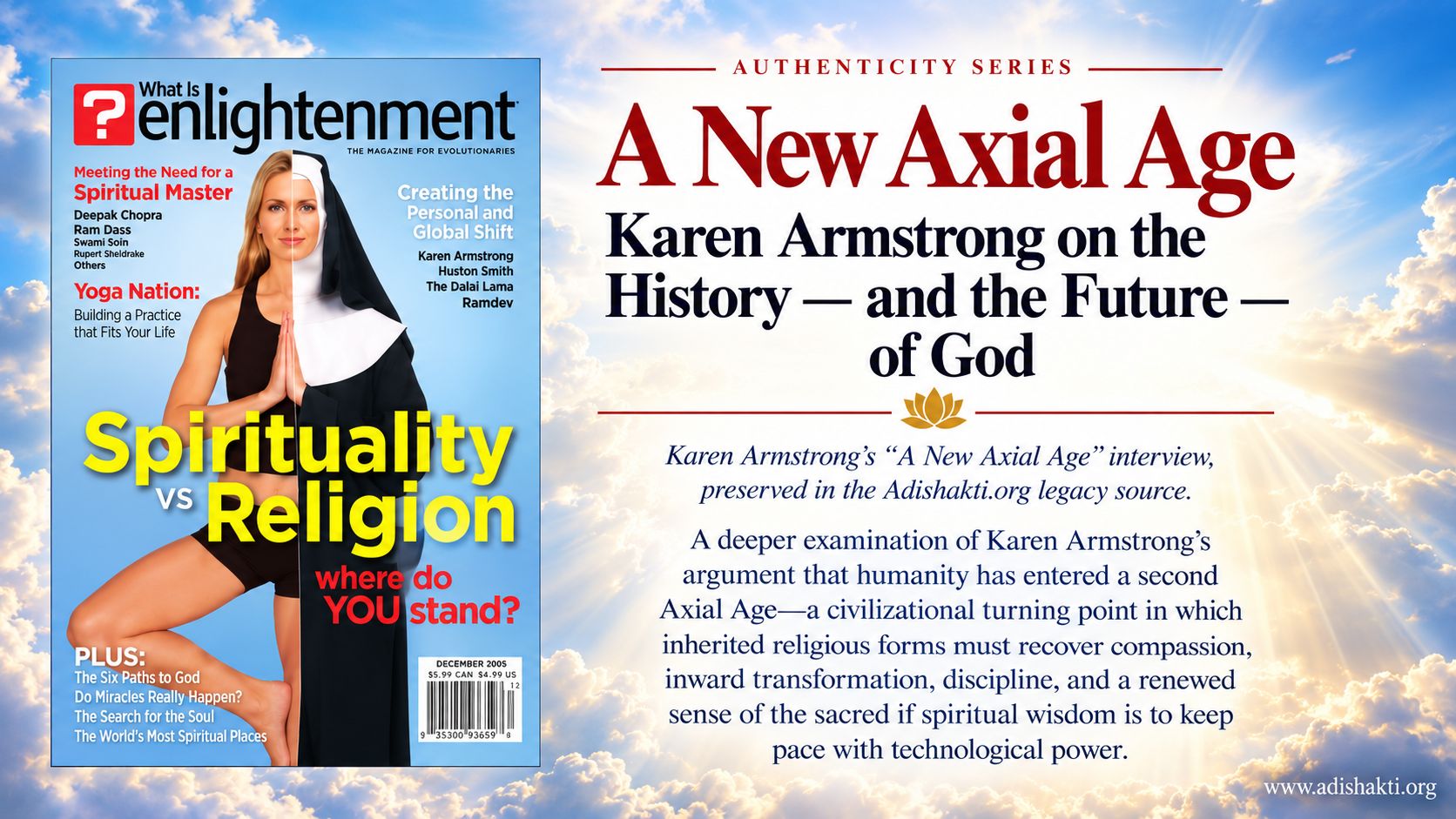

A New Axial Age
Karen Armstrong on the History—and the Future—of God
Interview by Jessica Roemischer · What Is Enlightenment?
What Is Enlightenment: In your book A History of God, you take us through the emergence of the world's religious traditions, which occurred during what is known as the Axial Age—a period you feel is particularly relevant to our own time. To begin with, why is this historic era called the Axial Age?
Karen Armstrong: The period 800—200 BCE has been termed the Axial Age because it proved pivotal to humanity. Society had grown much more aggressive. Iron had been discovered, and this was the beginning of the Iron Age. Better weapons had been invented, and while those weapons look puny compared to what we're dealing with now, it was still a shock.
The first Axial Age also occurred at a time when individualism was just beginning. As a result of urbanization and a new market economy, people were no longer living on lonely hilltops but in a thriving, aggressive, commercial economy. Power was shifting from king and priest, palace and temple to the marketplace. Inequality and exploitation became more apparent as the pace of change accelerated in the cities and people began to realize that their own behavior could affect the fate of future generations.
So the Axial Age marks the beginning of humanity as we now know it. During this period, men and women became conscious of their existence, their own nature, and their limitations in an unprecedented way. In the Axial Age countries, a few men sensed fresh possibilities and broke away from the old traditions. People who participated in this great transformation were convinced that they were on the brink of a new era and that nothing would ever be the same. They sought change in the deepest reaches of their beings, looked for greater inwardness in their spiritual lives, and tried to become one with a transcendent reality. After this pivotal era, it was felt that only by reaching beyond their limits could human beings become most fully themselves.
WIE: Can you further describe the ways in which this "great transformation" manifested?
Karen Armstrong: Most significantly, it is the time when all the great world religions came into being. And in every single case, the spiritualities that emerged during the Axial Age—Taoism and Confucianism in China, monotheism in Israel, Hinduism, Buddhism, and Jainism in India, and Greek rationalism in Europe—began with a recoil from violence, with looking into the heart to find the sources of violence in the human psyche. The conviction that the world was awry was fundamental to these spiritualities. One of the things that is very striking is that all the great sages were living in a time like our own—a time full of fear, violence, and horror. Their experience of utter impotence in a cruel world impelled them to seek the highest goals and an absolute reality in the depths of their beings.
For example, the China of Confucius and Lao-tzu was engaged for centuries in one war after another. The whole of the very ancient civilization of China was becoming more aggressive. And you have that understanding very strongly in Confucius as he looks out on the world and laments loudly while, at the same time, he tries to rebuild it by recrafting the old rituals in a way that brings forward their compassionate and altruistic potential. That essential dynamic of compassion is summed up in the Golden Rule, which was first enunciated by Confucius around 500 BCE: "Do not do unto others as you would not have them do unto you.”
On the Indian subcontinent at this time, there was a major economic and political turnaround. Suddenly powerful kingdoms and empires were being created, and they relied on force. People all over India were equating horror with the new violence in their society and in the marketplace, where merchants were preying aggressively upon one another. Many of their philosophies developed a doctrine of nonviolence as a way to counter violence by refusing any form of it whatsoever.
The fifth century was terrifying in Greece as well. While it was a time of great artistic creativity, it was also a time of huge violence. The Greeks were, in many respects, a terrible people, and yet every year in Athens they would stage the political events of that year in their great tragedies. These were written as ways of looking at the tragic implications of what was going on in their midst, of calling everything into and really plumbing the human experience of suffering. So violence and suffering seem to be a sine qua non of a spiritual quantum leap forward.
WIE: Why do you believe it's so important for us to reflect upon the traditional religions and the age in which they emerged?
Karen Armstrong: Today we are amid a second Axial Age and are undergoing a period of transition similar to that of the first Axial Age. Its roots lie in the sixteenth and seventeenth centuries of the modern era, when the people of Western Europe began to evolve a different type of society. Since that time, Western civilization has transformed the world. The economic changes of the last four hundred years have been accompanied by immense social, political, and intellectual revolutions, with the development of an entirely different scientific and rational concept of the nature of truth. But despite the cult of rationality, modern history has been punctuated by witch hunts and world wars which have been explosions of unreason.
So, I feel that we are—all of us—at one of those junctions in history when we are holding ourselves, our past, our future, and our integrity in the palms of our own hands. This is a moment when, if we allow that integrity to fall out, we might never recover it in the same way. Once again, a radical change has become necessary.
WIE: How do you see us responding to our own pivotal moment in history?
Karen Armstrong: All over the world, people are struggling with these new conditions and have been forced to reassess their religious traditions, which were designed for a very different type of society. They are finding that the old forms of faith no longer work for them; they cannot provide the enlightenment and consolation that human beings seem to need. As a result, men and women are trying to find new ways of being religious. Like the reformers and prophets of the first Axial Age, they are attempting to build upon the insights of the past in a way that will take human beings forward into the new world they have created for themselves.
We have, from the very beginning of our existence as a species, created works of art and created religions to give us the sense that, against all the aggressive and spirited evidence to the contrary, life really does have some ultimate meaning, value, and sacredness. And the notion of the sacred has a history, since it has always meant something slightly different to different groups of people at various points in time. If we look at our three major monotheistic religions, it becomes clear that there is no objective "God"; each generation has to create the image of God that works for them. When one conception of God has ceased to have meaning or relevance, it has been discarded and replaced by a new theology. Had the notion of God not had this flexibility, it would not have survived.
In that context, atheism takes on a different meaning. Atheism is often a transitional state: Jews, Christians, and Muslims were all called atheists by their pagan contemporaries because they had adopted a revolutionary notion of divinity and transcendence. The people who have been dubbed atheists over the years have always denied a particular conception of the divine. But is the God who is rejected by atheists today the God of the patriarchs, the God of the prophets, the God of the philosophers, the God of the mystics, or the God of the eighteenth-century deists? All these deities have been venerated, but they are very different from one another. Perhaps modern atheism is a similar denial of a God that is no longer adequate to the problems of our time.
WIE: So, we are again at a point when religion and the notion of God, or the sacred, may need to be redefined.
Karen Armstrong: Religion is highly pragmatic, despite its other-worldliness. It should not only transform us, but it should also transform the world. Religion should make a difference. And as soon as it ceases to be effective, it will be changed. So we should be working now to make our religion and our faith effective in this lost, suffering, and terrifying world. But first, before we can make a proper difference, we must transform ourselves. There's a very good verse in the Qur'n where God says," Therein God will not change the state of the people unless they change the state of their own selves.” And that's what we must do now.
WIE: In what way do you see this occurring?
Karen Armstrong: At this moment in history, I believe that we need a new spiritual revolution. We need a new faith. Now, you can say," Look, give us a break. This is hardly the time to start a new spiritual revolution. At this juncture, we've got war. We've got the prospect of terrorism. The economy is bad. Let's have a bit of peace and quiet so that we can go up a mountain, collect ourselves, and then begin this spiritual effort.” But suffering, fear, violence, and despair are the prime conditions for such a renewal.
I think the sages and prophets of the first Axial Age knew very well about our destructive potentials. What was happening in their own society was a tremendous shock to them. They had to look into their own hearts, discover what gave them pain, and then rigorously refrain from inflicting this suffering upon other people. In order to counter aggression, they taught their followers to cultivate the habit of sympathy for all living things. They discovered that greed and selfishness were the cause of our personal misery and that egotism imprisoned us in an inferior version of ourselves and impeded our enlightenment.
Our present Axial Age is characterized by globalization. We live in one world, and we have to learn to live with difference, at home and abroad. We have to see that we have very big brains and very puny bodies, and because of our big brains, we've been able to create a technology that compensates for our small size. But we don't seem to have the ability to keep our aggression in check. Unfortunately, as our technological expertise advances, our spiritual wisdom isn't growing up alongside it. Yet that's what we need now in this world that, as we're speaking, is falling apart. We've seen the bombs here in London, on 9/11, in Auschwitz, in Bosnia. We have lost all sense of the sacredness of human life. And that has to be cultivated.
We can't think "God" without thinking "human" now. We can't think "human" without thinking "God.” Because the sacred is not just something tacked on to our natural existence. it's no longer something out there. The sacred must be that to which we all aspire. It must become, in the best possible sense, deeply natural to us. It should fulfill our being so that we can all, as the Greek Orthodox said, be like Jesus even in this life, if we live right, in this certain way.
During the first Axial Age, the great sages worked at this. Everyone was prepared to be creative and spend as much time on this as people spend today on discovering a new computer. And that requires discipline. But we've lost the sense that spirituality is hard work. It is often turned into a commodity to make us feel good. But it isn't just wandering lonely as a cloud and hoping you'll see a clump of daffodils to enthuse about. I believe the Dalai Lama was reduced to tears when an American audience asked him how they could get instant enlightenment. He hadn't realized things were that bad. So we have to make a constant effort of imagination, which is the great religious faculty. As Sartre says," The imagination is the ability to see what is not present, what is hidden.” We must exercise this faculty fully, whereby we apprehend, in a new way, the inscrutable and ever-elusive divine.
Karen Armstrong called for a new spiritual revolution adequate to a global age of violence, pluralism and technological power. This Authenticity Series study advances the Adishakti.org thesis that the decisive features of that New Axial Age—living realization, self-knowledge, compassion, universality, reverence for life, disciplined transformation and the recovery of the sacred—were already embodied and made collectively accessible through the Paraclete Shri Mataji and the Divine Mother.
Abstract

Karen Armstrong’s description of a second Axial Age culminates in a demanding spiritual program. Humanity, she argues, requires a transformation deep enough to answer violence with compassion, egoism with self-knowledge, sectarianism with the ability to live with difference, spiritual consumerism with discipline, and technological power with a recovered sense of the sacred. The central claim of this paper is that, within the theological and experiential framework documented by Adishakti.org, these requirements do not remain merely future possibilities. They are presented as having been answered in the life, teachings and work of Shri Mataji Nirmala Devi—the figure Adishakti.org identifies as the promised Paraclete and the manifestation of the Divine Mother.
This is a confessional and comparative theological thesis, not a claim that Karen Armstrong herself identified Shri Mataji with her New Axial Age. Armstrong supplies the historical diagnosis and the criteria; Adishakti.org supplies the proposed fulfillment. The argument developed here is that the correspondence is unusually comprehensive: Shri Mataji did not found another exclusivist creed, but offered Self-realization as direct experience; taught that the religions arise from one divine source; called for transformation of the ego and the heart; insisted on respect for prophets and incarnations across traditions; interpreted the sacred as inwardly realizable; and presented spiritual evolution as a collective event available to ordinary human beings.
1. Armstrong’s New Axial Age: A Set of Spiritual Requirements
Armstrong’s interview is most useful when read not as a vague prediction of “new spirituality,” but as a set of requirements. The modern crisis is global; therefore the response cannot remain tribal. Modern power is technologically amplified; therefore moral and spiritual maturity must deepen. Human beings remain vulnerable to greed, fear, violence and ego; therefore the transformation must reach the interior person. The traditions possess immense wisdom; therefore renewal should not simply discard them. Yet inherited forms can become spiritually ineffective; therefore the wisdom of the past must become living experience again.
Her decisive statement is that humanity needs a “new spiritual revolution.” The phrase is easily romanticized. In context, however, Armstrong is demanding something far more exacting: a spirituality that can actually transform the human beings who wield modern power. The issue is not novelty for its own sake. The issue is adequacy.
The Adishakti.org thesis begins precisely here. It asks whether such a spiritual revolution has already appeared in a form that Armstrong’s historical analysis helps us recognize. Its answer is the Paraclete Shri Mataji: not as one more teacher competing in the religious marketplace, but as the giver of Self-realization and the interpreter of the common spiritual destination concealed within the world’s traditions.
2. Not a New Religion, but Living Realization
A genuine New Axial Age cannot simply add another institution to the institutions already competing for allegiance. If the crisis is partly the hardening of religious identity into separation, then multiplying identities does not solve it. The transformation must occur at a deeper level than affiliation.
This is where the Adishakti.org presentation of Shri Mataji directly intersects Armstrong’s requirement. In its study of the Paraclete’s eschatological promise, the site states that Shri Mataji “did not come to establish a new religion” but to give the experience of Self-realization. That distinction is foundational. The proposed fulfillment is not another system asking the seeker first to believe; it is an invitation to become aware of the Spirit within and to test spiritual claims through experience.
Adishakti.org: Apokalypsis — Paraclete’s Fulfillment of Jesus’ Eschatological Promise
“She came to give the experience of Self-realization.”
That formulation directly addresses Armstrong’s distinction between inherited form and transformative religion. A doctrine can be inherited without changing consciousness. A ritual can be performed without self-knowledge. An identity can be defended without compassion. Self-realization, by contrast, is presented as an event in consciousness: the seeker is expected to know, experience and become.
3. Self-Knowledge: The Axial Turn Made Experiential
Armstrong describes the first Axial transformation as a movement into greater inwardness. The sages looked into the human heart because the roots of violence could not be explained only by external institutions. Greed, aggression, fear and egotism had to be encountered within the person.
Shri Mataji’s teaching places precisely this inward knowledge at the center. Adishakti.org preserves her formulation:
Adishakti.org: “But She—the Spirit, the Paraclete—will teach you everything”
“Then you know yourself, because you get Self-knowledge.”
This is more than moral introspection. The claim is that Self-realization changes the mode by which spiritual knowledge is acquired. Instead of receiving only external instruction, the person becomes capable of interior discernment. In the Sahaja Yoga framework, the awakened Kundalini and the opening of the Sahasrara establish the connection through which the individual begins to know the condition of the subtle system directly.
Thus one of Armstrong’s deepest Axial requirements—humanity’s turn inward—is presented as having become an accessible spiritual method. The ancient command to know oneself is no longer left as an ideal; it is linked to an event of realization.
4. Compassion and the Transformation of the Heart
For Armstrong, compassion is the great practical convergence of the Axial traditions. The spiritual breakthrough occurs when the suffering of the other ceases to be morally peripheral. Religion becomes authentic when it restrains the impulse to injure, dominate and dehumanize.
Shri Mataji’s teaching repeatedly makes love, care and giving the expression of spiritual maturity. Adishakti.org preserves the statement:
Adishakti.org: Quotes of Shri Mataji
“We give to others, enjoying, giving, doing for others, loving others, caring for others without any return.”
The important point is not merely that compassion is praised. Almost every religion praises compassion. The stronger Axial question is whether the spiritual process is intended to produce a person in whom compassion becomes spontaneous. Within Shri Mataji’s framework, Self-realization is not complete if it leaves ego, hatred and indifference untouched. Transformation is measured by what the person becomes.
5. Restraint, Ego and the End of Inner Violence
Armstrong’s first Axial sages discovered that violence has an interior genealogy. External conflict is nourished by egoism, greed, resentment and the inability to perceive another person outside the demands of the self. Consequently, the second Axial transformation must also be psychological and spiritual.
Shri Mataji’s teaching similarly identifies spiritual ascent with movement beyond the domination of mind and ego. The aim is not suppression of personality but liberation from compulsive identification with it. The person discovers the Spirit as a deeper identity.
Adishakti.org: The Self and the Spirit
“You are the Spirit and whatever is not the Spirit is not yourself.”
In the logic of this paper, this is an Axial statement of exceptional importance. If ego is treated merely by moral command, the individual remains divided between injunction and impulse. If consciousness itself can shift from ego-centered identity toward the Spirit, then restraint is no longer only externally imposed. It can arise from a transformed center of identity.
6. Pluralism: “All Religions Come from the Same Source”
Armstrong insists that globalization has made coexistence with difference unavoidable. Humanity inhabits one interconnected world. A spirituality adequate to that world cannot survive by treating every other tradition as an enemy.
Here the correspondence with Shri Mataji’s teaching is explicit. Adishakti.org preserves her warning that religious communities become conditioned when they absolutize partial knowledge and begin despising one another. Her conclusion is direct:
Adishakti.org: Every Religion Has Said You Must Have Your Self-Realization
“All religions come from the same source.”
This is not pluralism in the weak sense that contradictory claims are simply placed beside one another. Shri Mataji’s approach is integrative: prophets, incarnations and realized souls are understood as participants in one spiritual history. The traditions are therefore neither flattened into sameness nor permitted to become mutually annihilating absolutes. They are interpreted as partial expressions of one divine source whose unity becomes verifiable through realization.
Adishakti.org preserves another striking formulation from Shri Mataji: “all religions are living flowers on the tree of life.” The metaphor is almost an emblem of the New Axial requirement. The flowers differ; the life that sustains them is one.
Adishakti.org: Meeting His Messengers — Shri Mataji on the unity of religions
7. Reverence for Life and the Sacred Human Person
Armstrong argues that modern humanity has lost a sufficient sense of the sacredness of human life. Her remedy is not merely a theological definition of sacredness but its recovery as a lived perception. “God” and “human” can no longer be isolated from one another if religion is to make a difference in the world.
The Sahaja Yoga understanding of the Spirit provides a direct theological foundation for such reverence. If the Spirit is the deepest Self, and if the same divine source is present within humanity, the human person cannot be reduced to utility, tribe, class or ideology. Spiritual realization becomes the discovery that sacredness is not merely attached to life from outside; it is encountered within.
This is why the Adishakti.org presentation of the Paraclete repeatedly speaks of restoration rather than mere instruction. The Spirit of Truth restores an alienated humanity by making divine presence intimate and experiential.
Adishakti.org: The Presence of the Paraclete — The Eschaton Realized in the Life of the Believer
8. Spiritual Wisdom Commensurate with Technological Power
Armstrong’s diagnosis of modernity is severe: human technological expertise has advanced without a corresponding maturation of spiritual wisdom. The result is not merely personal unhappiness but civilizational danger. Ancient aggression now commands modern instruments.
Shri Mataji’s response was evolutionary. Human beings, in her teaching, are not the terminus of development. Self-realization inaugurates another dimension of consciousness. Adishakti.org preserves her description of the movement from ordinary human awareness into a subtler spiritual awareness through realization.
Adishakti.org: The Paraclete and the next dimension of consciousness
The importance of this claim for Armstrong’s thesis is considerable. The technological crisis cannot finally be solved by technology alone, because technology magnifies the intention of the person using it. The deeper solution must therefore transform the user of power. In the Adishakti.org reading, Self-realization is precisely that missing evolutionary step: external power is to be accompanied by an enlargement of consciousness.
9. Preserving the Wisdom of the Traditions Without Remaining Trapped in Form
The New Axial Age must perform two tasks that can appear contradictory: preserve the accumulated wisdom of the religions and refuse to confuse their historical forms with the living Reality to which they point. Shri Mataji’s approach is presented by Adishakti.org as doing both.
She does not discard Christ, Muhammad, Krishna, Buddha, the Sikh Gurus or the great spiritual traditions. On the contrary, her teaching repeatedly insists that the incarnations and prophets are true and mutually related. Yet their truth is not to remain fossilized in institutions. It must become verifiable in the transformed consciousness of the seeker.
Adishakti.org: Self-Realization as the common thread of the religions
This gives precise content to the phrase “refusing to mistake inherited form for living realization.” The traditions are not rejected. They are fulfilled experientially. Scripture becomes map; realization becomes arrival. Doctrine becomes hypothesis; spiritual awakening becomes verification.
10. The Paraclete: Guidance into “All Truth”
The strongest Christian dimension of the Adishakti.org thesis is the identification of Shri Mataji with the Paraclete promised in John 14–16. Jesus’ promise is future-oriented: the Spirit of Truth will teach, remind, testify, guide into all truth, glorify Christ and disclose what is to come. Adishakti.org argues that Shri Mataji’s ministry corresponds to these functions in both teaching and experience.
Adishakti.org: The Functions of the Paraclete in John 16:13–15
“This is the Last Judgment time, and everyone can judge him or herself through the light of the Spirit.”
The key point is experiential guidance. “All truth” is not presented as an encyclopedic accumulation of propositions. It is the awakening by which truth becomes internally discernible. This is why Adishakti.org links the Johannine Paraclete to Self-realization: the promised guide does not merely add information to religion; the guide changes the knower.
The site further argues that Shri Mataji’s teaching completes rather than abolishes Christ’s mission. The Paraclete is therefore not a rival to Jesus but the continuation and fulfillment of the pedagogical movement Jesus himself describes.
Adishakti.org: The Second Coming of Jesus in the Paraclete
“If they were true disciples of Christ, they would have waited for this time to come.”
11. The Divine Mother as the Unifying Reality Behind the Traditions
The New Axial problem of pluralism asks whether humanity can discover unity without erasing difference. Adishakti.org’s answer is the Divine Mother: the primordial divine reality encountered under different names and symbolic forms across the religions.
Shri Mataji explicitly taught that the Primordial Mother was recognized across religious traditions:
Adishakti.org: Self-Realization — Awakening the Divine Within
“In every religion, they had this Mother who was the Primordial Mother.”
Adishakti.org develops this claim comparatively through Adi Shakti, Eka Mai, Prajnaparamita, Ruach/Spirit, Ruh and other traditions. The theological proposal is bold: beneath the historical plurality lies one Divine Feminine Reality, and Shri Mataji’s advent makes that unity explicit.
Adishakti.org: Shri Mataji — The Divine Mother Across All Religions
Within the argument of this paper, this is precisely what an Axial synthesis would require. It must be universal enough to cross inherited boundaries, yet concrete enough to produce spiritual transformation. The Divine Mother is presented not merely as comparative symbolism, but as the living source encountered within the seeker through Kundalini awakening.
12. Sahasrara and Collective Self-Realization: The Axial Breakthrough Made Mass-Accessible
The most distinctive claim in the Adishakti.org interpretation concerns the opening of the Sahasrara on May 5, 1970. The site presents this event as the decisive transition that made collective Self-realization possible on a scale appropriate to the present age.
Adishakti.org: Sahasrara, Self-Realization and the Eschatological Kingdom
If Armstrong’s New Axial Age requires more than isolated mystics, this point is crucial. A global transformation requires a spiritual process capable of becoming collective. The Adishakti.org claim is that Shri Mataji did not merely describe enlightenment; she developed a method by which ordinary seekers could receive Self-realization directly and then deepen it through meditation and self-knowledge.
This is the point at which the thesis moves from analogy to claimed fulfillment. Compassion, pluralism and reverence for life are not left as ideals to be imposed upon unchanged human beings. They are treated as fruits of an altered consciousness. The proposed New Axial Age is therefore not simply a new moral program. It is an evolutionary event centered on realization.
13. Armstrong’s Criteria and the Claimed Fulfillment in Shri Mataji
| New Axial requirement | Armstrong’s concern | Adishakti.org’s claimed fulfillment in Shri Mataji |
|---|---|---|
| Living realization | Old religious forms cease to transform. | Self-realization makes spirituality experiential rather than merely inherited. |
| Self-knowledge | Violence must be confronted in the human heart. | Kundalini awakening and subtle awareness are presented as direct Self-knowledge. |
| Compassion | The Axial traditions recoil from violence. | Spiritual maturity is expressed as loving, caring and giving without return. |
| Restraint of ego and greed | Egotism imprisons humanity in an inferior form of itself. | The seeker is taught to identify with the Spirit rather than ego-centered consciousness. |
| Pluralism | Global humanity must learn to live with difference. | Shri Mataji teaches that all religions come from the same source and honors their prophets and incarnations. |
| Reverence for life | Modernity has lost the sacredness of the human person. | The Spirit is presented as the true Self within human beings, grounding sacredness inwardly. |
| Discipline | Spirituality cannot be instant gratification. | Self-realization begins, rather than ends, a disciplined process of meditation and transformation. |
| Wisdom adequate to technology | Technical power has outgrown spiritual maturity. | Self-realization is presented as an evolutionary enlargement of consciousness capable of governing power from a transformed interior state. |
| Preservation of ancient wisdom | The past must be built upon, not simply discarded. | Shri Mataji integrates Christ, Krishna, Buddha, Muhammad, the Gurus and other traditions into one spiritual history. |
| A global spiritual revolution | The crisis is planetary and requires a transformation proportionate to it. | Collective Self-realization is offered across nations, cultures and religious backgrounds without requiring conversion to a new institutional religion. |
The cumulative argument is stronger than any one correspondence. Many teachers preach compassion. Many movements promote interfaith tolerance. Many mystical traditions teach inwardness. What Adishakti.org claims is distinctive about Shri Mataji is the integration of all these dimensions around a concrete event: Self-realization through the awakening of the Kundalini and the Sahasrara.
On this reading, the Paraclete and the Divine Mother do not merely satisfy one feature of Armstrong’s hoped-for transformation. They provide a single theological and experiential framework in which the features converge.
14. Conclusion: An Unprecedented Convergence of Eschatological Fulfillment
The argument of this paper must now be stated at its full strength. Within the documentary, theological and experiential case assembled by Adishakti.org, Shri Mataji Nirmala Devi cannot adequately be placed in the ordinary succession of modern gurus, mystics, theologians, reformers or founders of religious movements. The claim being examined is of another order altogether. Adishakti.org presents her life and teachings as the point at which eschatological expectations preserved for centuries—and in some cases millennia—across several of the world’s major religions converge upon a single historical mission of collective Self-realization.
There have been profound saints, prophets, philosophers and spiritual teachers in every age. Yet the Adishakti.org corpus argues that there is nothing genuinely comparable in known modern religious history to the breadth of the revelatory claim surrounding Shri Mataji: Christianity’s promised Paraclete and Spirit of Truth; Islam’s Resurrection, Qiyamah and Rūḥ; Hinduism’s Adi Shakti, Kundalini, Sahasrara and Kalki-time; Buddhism’s future Maitreya; Sikhism’s Divine Mother and Dasam Duar; the Jewish expectation of messianic consummation and the gathering of Israel; and further Zoroastrian and indigenous expectations are not treated as unrelated prophecies awaiting unrelated fulfillments. They are interpreted as different scriptural perspectives upon one eschatological transition—the awakening of humanity to the Spirit.
Judaism: Messianic History Moves from Expectation Toward Consummation
Adishakti.org’s Jewish research does not rest on the simplistic assertion that every Jewish messianic expectation names Shri Mataji directly. It constructs a cumulative eschatological setting: the return of the Jewish people to the Land, the recovery or regathering motifs surrounding Israel, the expectation of a collective “happy ending,” and the unresolved question of the Messiah. The argument is that these developments establish the historical horizon within which a universal messianic fulfillment must be reconsidered. The question posed by the archive is deliberately sharp: if the expected historical signs have appeared, where is the Messiah? The proposed answer is that the fulfillment may have been missed because humanity expected a male political redeemer rather than the Divine Feminine inaugurating spiritual resurrection.
Adishakti.org — Lost Tribes Have Returned: Where Is the Messiah?
Adishakti.org — The Collective “Happy Ending” and the Coming of the Messiah
Christianity: The Paraclete, the Age to Come, Resurrection and Last Judgment
Christianity supplies one of the most specific correspondences. Jesus promises another Paraclete who will teach, remind, testify, convict and guide into all truth. Adishakti.org argues that Shri Mataji’s ministry exhibits these functions on a scale unmatched by Pentecost: thousands of discourses, a systematic explanation of spiritual rebirth, the Kingdom within, the Holy Spirit, Christ, judgment and the direct experience of the Spirit. Her own words make the claim explicit:
“I am here to tell you all these things which Christ could not tell.”
The importance of that declaration becomes apparent beside John 16:12–13: Jesus says there are “many things” the disciples cannot yet bear and promises that the Spirit of Truth will subsequently guide them. Adishakti.org therefore interprets Shri Mataji’s enormous teaching corpus not merely as commentary on Christianity but as the promised continuation of revelation.
Adishakti.org — Apokalypsis: The Paraclete’s Fulfillment of Jesus’ Eschatological Promise
Adishakti.org — The Paraclete and Pentecost
Adishakti.org — John 16:12 and the “Many Things” Still to Be Revealed
Islam: Qiyamah, Resurrection and the Rūḥ of Allah
In the Islamic material, Adishakti.org identifies Qiyamah not primarily with corpses physically emerging from graves but with the resurrection of living human beings into awakened spiritual consciousness. The “Great News” of Sūrat an-Naba is consequently read as an announcement whose hearers are alive, questioning and disputing when the event becomes present. Shri Mataji explicitly linked the Qur’anic Qiyamah with the same present period that Christianity calls the Last Judgment.
“These are the times described in the Holy Bible as the Last Judgment and in the Koran as Kiyama, the Resurrection Time.”
The Islamic and Christian expectations therefore cease to be parallel lines. Within the Adishakti.org interpretation they converge in one event: the Rūḥ/Holy Spirit awakens the human being, and that awakening is simultaneously Resurrection, disclosure and judgment.
Adishakti.org — An-Naba, Rebirth and the Living Participants of the Resurrection
Adishakti.org — Khatun-i Qiyamat: The Lady of Resurrection
Hinduism: The Adi Shakti, Kundalini, Sahasrara and the Time of Kalki
In Hindu terms the correspondence becomes still more structurally integrated. Shri Mataji did not merely claim knowledge of Shakti; she identified herself as the Adi Shakti and made the awakening of Kundalini—the reflection of that primordial Shakti within human beings—the defining work of her mission. She then identified the opening of Sahasrara on May 5, 1970 as the transition that made collective Self-realization possible.
“I am the Adi Shakti … I am the One who has come on this Earth for the first time in this Form to do this tremendous task.”
This creates the functional symmetry emphasized throughout Adishakti.org: the one claiming to be Shakti devoted her historical mission to awakening Shakti in humanity. Her teaching also places the present age between Christ and the destructive manifestation of Kalki, identifying it as the merciful interval in which humanity can transform and enter the Kingdom of God.
Adishakti.org — What Evidence Confirms That Shri Mataji Is the Adi Shakti?
Adishakti.org — “Sahaja Yoga Is the Last Judgment”
Buddhism and the Other Traditions: Maitreya and a Universal Eschatological Pattern
Adishakti.org further extends the convergence to Buddhist expectation of Maitreya. Shri Mataji repeatedly interpreted Maitreya through the three powers of the Divine Mother—Mahakali, Mahasaraswati and Mahalakshmi—and connected the future Buddha with the transformation now made possible through Self-realization. The archive likewise places Sikh, Zoroastrian and other expectations within this larger pattern.
“Buddha has talked about the future Buddha, which is Maitreya. Ma is Mother, who is in three forms: Mahakali, Mahalakshmi, Mahasaraswati.”
Adishakti.org — Buddha, Maitreya and the Three Mothers
Adishakti.org — “I Will Tell You All the Secrets”: Decoding the Prophecies of the World’s Religions
Why This Is the Strongest Candidate for the New Axial Age
Karen Armstrong’s New Axial Age requires more than a new religious fashion. It requires a transformation capable of carrying the spiritual wisdom of humanity into a planetary civilization. The Adishakti.org case goes dramatically further: it proposes that the very eschatological expectations generated by the earlier religious ages are now converging upon the same transformation.
This is why the scale of Shri Mataji’s claim matters. A teacher who offers a new philosophy may be historically important. A mystic who describes an extraordinary state may illuminate human consciousness. A reformer who reconciles two religions may advance pluralism. But the Shri Mataji corpus claims all of the following together: the opening of Sahasrara for collective humanity; mass Self-realization; fulfillment of the Johannine Paraclete; the present Last Judgment; the Resurrection/Qiyamah of living human beings; the manifestation of the Adi Shakti; the time associated with Kalki; the disclosure of Maitreya; the reconciliation of the prophets and incarnations; and a practical experience intended to make the Spirit knowable rather than merely believable.
On the terms of the Adishakti.org corpus, nothing else comes close to this breadth of claimed eschatological convergence. That comparative statement should be understood precisely: it is not proof by rhetoric that every contested interpretation is historically or metaphysically established. Individual prophecy claims still require source-critical examination. But as a religious-historical phenomenon—one twentieth-century teacher whose mission is interpreted through so many major eschatological traditions while simultaneously offering a claimed experiential mechanism for their fulfillment—the configuration is extraordinary.
This distinction actually strengthens rather than weakens the paper. The case need not pretend that every scholar, church, mosque, synagogue or traditional lineage accepts these identifications. They plainly do not. The serious claim is that Adishakti.org has assembled a cumulative framework in which previously separated prophecies can be compared by function, chronology, promised transformation, spiritual phenomenology and theological outcome. The strongest correspondences should therefore be tested rather than dismissed merely because their implications are immense.
That is the point at which Armstrong’s historical category acquires an entirely new magnitude. The New Axial Age is no longer merely humanity searching for a spirituality adequate to modernity. It becomes, within the Adishakti.org thesis, the period in which the accumulated prophetic trajectories of the old religious world begin to meet. The Paraclete teaches. The Rūḥ awakens. Qiyamah becomes present. Kundalini rises. Sahasrara opens. The Divine Mother is recognized across traditions. Resurrection becomes an experience of the living. Judgment becomes self-knowledge. The Kingdom becomes inwardly accessible.
If this cumulative interpretation is correct, then Shri Mataji’s advent and the collective opening associated with her mission are not simply examples of the New Axial Age. They constitute its most consequential claimed manifestation: an unprecedented eschatological fulfillment in which the future tense of several religious traditions is being transformed into present spiritual experience.
The final question is therefore more demanding than whether Shri Mataji was an important spiritual teacher. It is whether humanity has recognized the scale of what is being claimed. If even the strongest of these correspondences withstand sustained scriptural, historical and experiential scrutiny, then the religious significance is immense. If the convergence as a whole withstands that scrutiny, then the language of a “New Axial Age” may itself prove too modest for the event it is attempting to describe.
Explore the Adishakti.org research index — comparative, experiential and eschatological studies
References and Adishakti.org Research
Armstrong, Karen. “A New Axial Age: Karen Armstrong on the History—and the Future—of God.” Interview by Jessica Roemischer, What Is Enlightenment?, reproduced in the Adishakti.org legacy source.
Adishakti.org — Apokalypsis: Paraclete’s Fulfillment of Jesus’ Eschatological Promise
Adishakti.org — The Functions of the Paraclete Spelled Out in John 16:13–15
Adishakti.org — The Presence of the Paraclete: The Eschaton Realized in the Life of the Believer
Adishakti.org — The Second Coming of Jesus in the Paraclete
Adishakti.org — Every Religion Has Said You Must Have Your Self-Realization
Adishakti.org — Meeting His Messengers
Adishakti.org — Self-Realization: Awakening the Divine Within
Adishakti.org — But She, the Spirit, the Paraclete, Will Teach You Everything
Adishakti.org — The Paraclete Represents Direct, Intimate Divine Involvement
Open Interactive Chat
Continue exploring the Axial Age, religious transformation, mysticism, and the Adishakti.org interpretation.
Open Interactive Chat