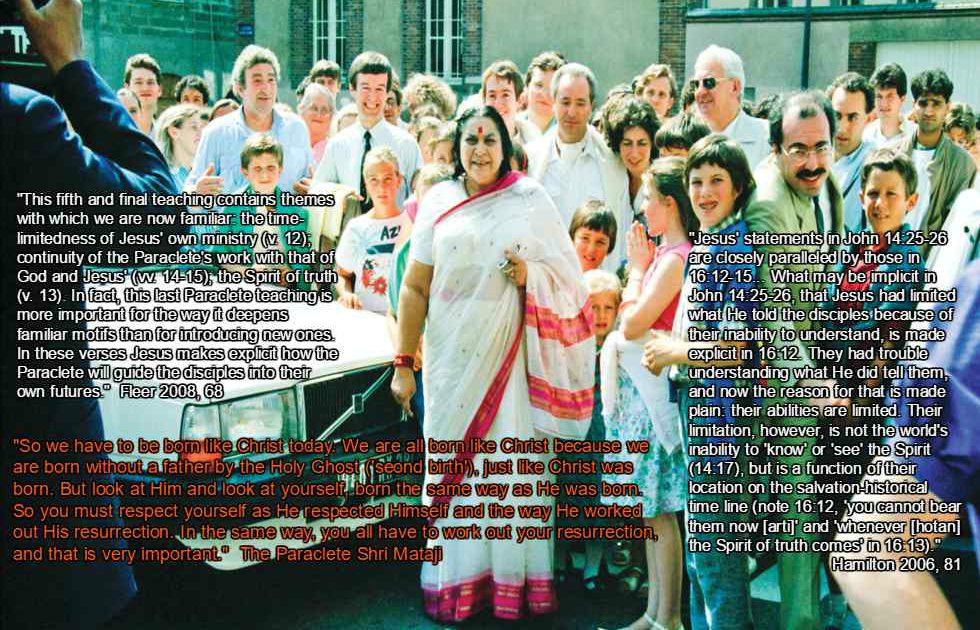
THE DIVINE FEMININE
Apocalypse Of The Spirit

unlimited power), omnipresent (present everywhere)
Divine Mother of extreme beauty and ageless eternity.
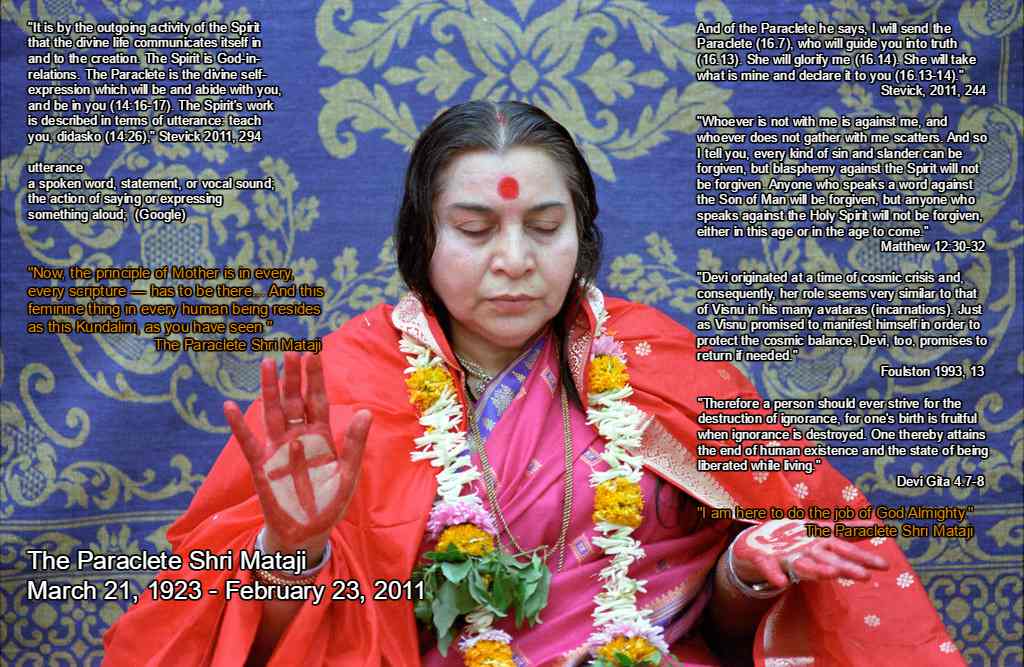
"Therefore a person should ever strive for the
destruction of ignorance, for one's birth is fruitful when
ignorance is destroyed. One thereby attains the end of
human existence and the state of being liberated
while living." — The Divine Mother (Devi Gita 4.7-8)
"May all the gods attend to what I have to say. By
merely hearing these words of mine, one attains my
essential nature. I alone existed in the beginning;
there was nothing else at all, O Mountain King. My
true Self is known as pure consciousness, the highest
intelligence, the one Supreme Brahman/Thus through
hearing about, reflecting upon, and ascertaining the
Self by the Self, one should also, through intense
meditation, realize that I am in essence the Self...
By this meditation, O King, the noble person will
perceive me directly and then merge into my own
essence since we two are one. By practicing this yoga,
one realizes me as the supreme Self. In that instant,
ignorance and its effects all perish."
— The Divine Mother (Devi Gita 2.12;/4.40;49-50)
"The Devi insists that liberating knowledge can be
attained here in this world, while still living. Seeking
such knowledge alone makes life worthwhile, and
the attainment of knowledge completely fulfils the
ultimate purpose of existence." C.M. Brown, 2002. 25
"Now the name Nirmala itself means immaculate;
means the one who is the cleansing power and the
name of the Goddess also. My actual sign name is
Lalita who is the name of the Primordial Mother.
That is the name of the Primordial Mother."
Shri Mataji Nirmala Devi
New York, USA—September 30, 1981
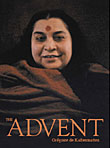
Except for quotes and images of Her incarnation
Shri Mataji Nirmala Devi, this site is almost entirely
about Devi, the Divine Feminine. The Devi's yoga
(to unite) requires absolutely discarding all external
rules, rituals and rulers. Only then can meditation and
merging with the Divine Mother within truly begin.
Hence the term "Self-realization", and the means of
realizing Her as our divine core or Self begins here.
(Please note that these quotes represent a miniscule
portion of about 3000 public speeches and private
conversations with disciples over nearly four decades.)
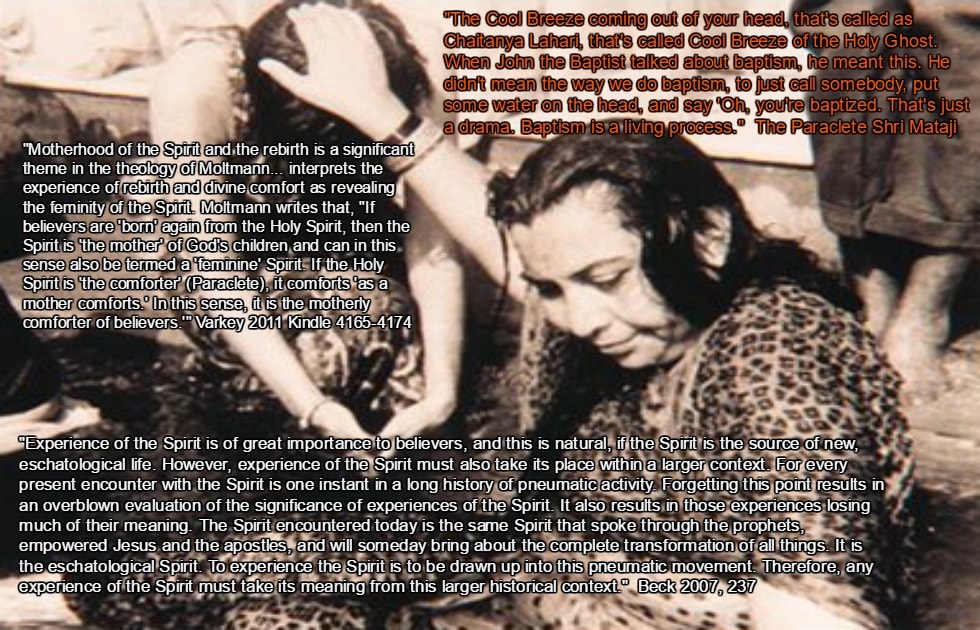
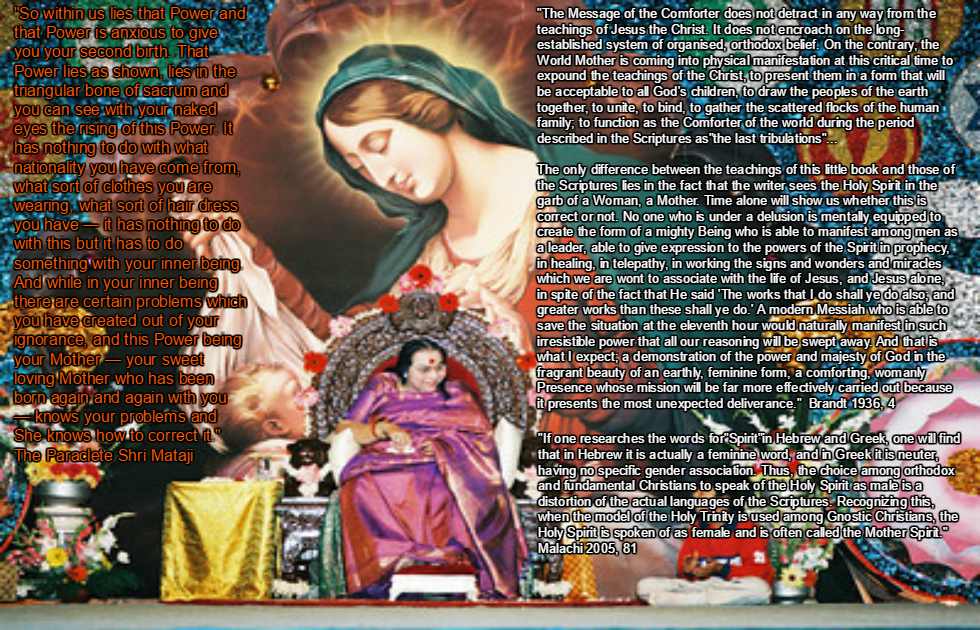
"If the experiences of the Holy Spirit are grasped as being a ‘rebirth’ or a ‘being born anew’, this suggests an image for the Holy Spirit which was quite familiar in the early years of Christianity, especially in Syria, but got lost in the patriarchal empire of Rome: the image of the mother. If believers are ‘born’ of the Holy Spirit, then we have to think of the Spirit as the ‘mother’ of believers, and in this sense as a feminine Spirit. If the Holy Spirit is the Comforter, as the Gospel of John understands the Paraclete to be, then she comforts ‘as a mother comforts’ [cf.. John 14.26 with Isa 66.13). In this case the Spirit is the motherly comforter of her children. Linguistically this brings out the feminine form of Yahweh’s ruach in Hebrew. Spirit is feminine in Hebrew, neuter in Greek, and masculine in Latin and German." Jurgen Moltmann, The Source of Life (1997) p. 35


every scripture - has to be there!" Shri Mataji
Jesus said: "Whoever blasphemes against
the Father will be forgiven, and whoever
blasphemes against the Son will be forgiven,
but whoever blasphemes against the Holy
Spirit will not be forgiven either on earth or
in heaven." The Gospel of Thomas Logion 44
"According to the Gospel of Thomas, then, the
kingdom of God symbolizes a state of
transformed consciousness. One enters that
kingdom when one attains self-knowledge.
The Gospel of Thomas teaches that when one
comes to know oneself, at the deepest level,
one simultaneously comes to know God as
the source of one’s being." E. Pagels 1996, 71
"... in 14.26, Jesus equates the Paraclete with
the Holy Spirit and mentions for the first time
that the Paraclete will teach, reminding his
followers of all that he has said to them. The
Spirit answers the concern of the disciples."
Daniel B. Stevick 2011, 288
The means of realizing God/Father/Self/Divine
as the source of one’s being also begins here.
Shri Mataji, as the pledged Paraclete, has openly and repeatedly proclaimed the world over the Good News (Al Naba) of the Kingdom of the Spirit since the 1970s. (She passed away peacefully February 23, 2011 in Genoa, Italy at the age of 87.)
Only in this age of mass media and literacy is its universality possible, and comprehensible. The common eschatology of the deeply-divisive faiths of Judaism, Christianity and Islam have been harmoniously declared, explained in detail, concluded, and set in motion by the Spirit-Paraclete.
As Her incarnation, Shri Mataji calls upon humanity to cross-examine evidence of the Holy Spirit's promise and pledge of evolution into life eternal. The Spirit-Paraclete reveals the apocalypse and eschatology that completes and brings closure to Jesus' unfinished teachings:
"Ehrman's is a historical-Jesus book ... He believes that apocalypticism is the true core of Jesus' message, and that comfortable middle-class complacency among scholars, clergy, and laypeople has forged a counterfeit, domesticated, 'ethical' Jesus to cover up their befuddlement about his misprediction of the apocalypse." - Michael Joseph Gross (Hardcover jacket of Ehrman's Jesus: Apocalyptic Prophet of the New Millennium)
"Jesus has far too mordant an understanding of ruthlessness and corruption ... that keeps the world sunk in degradation. Not only does Jesus know this, but he faces its necessity and lives it out in the extremity of his own life; he is fully aware that his knowledge of the laws of the birth of the Kingdom threatened all previous human accommodations to the way of the world; after his very first public sermon, the Gospel of Matthew tells us, occasional attempts on his life were made. Unlike many of the gurus and so-called teachers of our time, whose vague transcendental waffling further drugs an already comatose culture and leaves every aspect of the status quo intact, Jesus’ vision of the new way was rooted not only in visionary ecstasy but in an utterly illusionless and ruthless analysis of power in all its aspects. This is what made him—and makes him—dangerous, perpetually scandalous, and what makes the Gospel of Thomas a fiery challenge, not only to less incendiary versions of his own message, but to all philosophers who do not propose a complex mystical revolution on every level.
... we see the agency of this transformation in the motherhood of God, the Divine Feminine. This is quite clear from the image of infants sucking at the breast, through which Jesus is trying to make us aware of how important is the embodied Godhead, the Mother aspect of God, and how important it is to the kind of transformation he wants. Only those who have awoken to the kingdom within and without as the embodied Godhead will be able to view life and Creation and all the workings of the universe with the kind of abandon and trust that will allow them to be fed directly by God, with all the powers of vision and action they need. Without a restoration to the Christian mysticism of Jesus’ own full celebration of the Divine Feminine, the ‘Kingdom-consciousness’ cannot and will not be born."
Stevan L. Davies, The Gospel of Thomas
Shambhala Library, December 2004, p. xx-xxii
Kingdom of God within*
"At the same time, the knowledge Jesus communicates in the gnostic gospels and related texts is a knowledge both of what is outside and of what is inside...
In the Gospel of Thomas Jesus says that the kingdom is inside and outside (3:3), and the inner may be like the outer and the outer like the inner (22:4)...
Another Valentinian gospel, the Gospel of Philip, gives a meditation on the outer and the inner. Based on an utterance of Jesus very much like Gospel of Thomas 22:4, this meditation maintains it is actually more fitting to focus attention upon what is within, what is innermost. The world of the pleroma, the fullness of God, thought by many to be the divine realm above, truly is within. In the words of the Gospel of Philip, ‘What is innermost is the fullness, and there is nothing further within’ (68). If the fullness is within, so, in the Gospel of Thomas, is the kingdom within, or spread out upon the earth, unseen by people (3:3; 113:4), and so also, in the Gospel of Mary, is the child of humankind (or son of man) within. As Jesus says to the disciples in the Gospel of Mary, ‘Follow that. Those who seek will find it’(8)." (Marvin Meyer, 2009, p. xxiii-xxiv)
"But those who have got Realization will enter into the Kingdom of God. You have to enter into the Kingdom of God here, as I say, in the Seventh Chakra.
The Paraclete Sri Mataji
The New Age Has Started, Houston, USA—October 6, 1981
"His search for God led us to meet Mataji."
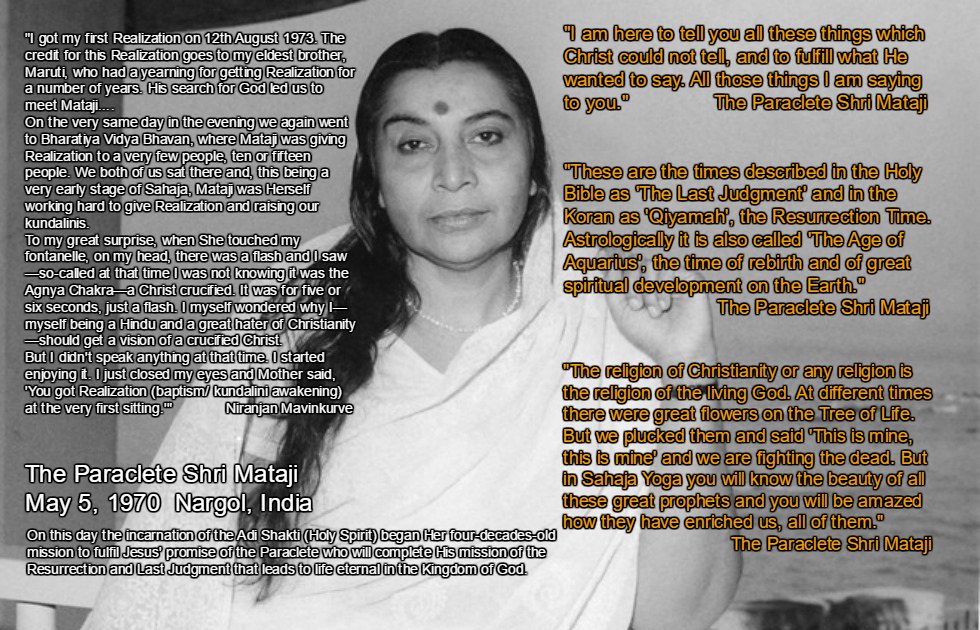
"I got my first Realization on 12th August 1973. The credit for this Realization goes to my eldest brother, Maruti, who had a yearning for getting Realization for a number of years. His search for God led us to meet Mataji.
On a fine day of 12th August, we read an article written by one Marathi newspaper editor about Shri Mataji and Sahaja Yoga and that led us to approach him in his office. We went to see him and he explained how things had happened to him. He told us to visit Bharata Vidya Bhavan on that same day. We left his place and went to Bharata Vidya Bhavan about three o’clock and, to our surprise, nobody was there to tell us what Sahaja Yoga is. We came out of the hall and telephoned back to his office, asking, 'Where do we find Mataji?' He said, 'Oh, this is not the time. You must come after six or seven in the evening.'
On the very same day in the evening we again went to Bharatiya Vidya Bhavan, where Mataji was giving Realization to a very few people, ten or fifteen people. We both of us sat there and, this being a very early stage of Sahaja, Mataji was Herself working hard to give Realization and raising our kundalinis.
To my great surprise, when She touched my fontanelle, on my head, there was a flash and I saw—so-called at that time I was not knowing it was the Agnya Chakra—a Christ crucified. It was for five or six seconds, just a flash. I myself wondered why I—myself being a Hindu and a great hater of Christianity—should get a vision of a crucified Christ.
But I didn’t speak anything at that time. I started enjoying it. I just closed my eyes and Mother said, 'You got Realization at the very first sitting.' "
Niranjan Mavinkurve
Note: This is just one of many experiences or visions of Jesus Christ confirmed by Shri Mataji's disciples. Verification of that fact on this website is all given by non-Christian children meditating and meeting Jesus and others in the Kingdom of God (Sahasrara Chakra) within. They also provide irrefutable evidence of Shri Mataji's central claim that humans can "enter into the Kingdom of God here, as I say, in the Seventh Chakra." Since children are able to enter it (in their spirit form), the existence of the Kingdom of God within is also beyond doubt.
The theme of Jesus Christ's gospel message was the good news of the coming Kingdom of God. The Paraclete Shri Mataji had for decades repeatedly declared in public its arrival, inviting all to enter it, from within themselves! As Jesus promised and subsequently demonstrated, finding it leads to the resurrection of the body and, after death, life eternal in the spiritual Kingdom of God. Jesus' eschatological promise of its future coming—the subject of endless speculation, confusion, contradiction, vagueness, ignorance, ridicule and even denial—is now fulfilled to the letter, and brought to closure. This article sums that closure up: "The Kingdom of God stands as a comprehensive term for all that the messianic salvation included... The Kingdom is like a treasure or a costly pearl whose possession outranks all other goods (Mt. 13:44-46). It is something to be sought here and now (Mt. 6:33) and to be received as children receive a gift (Mk. 10:15 = Lk. 18:16-17). In this saying the Kingdom is God’s rule, but it includes the gift of his rule. The divine reign is not a fearful power before which people are compelled to bow, but a gift. Children exemplify the trustfulness and receptivity required of the 'sons of the Kingdom.' The Kingdom belongs to them, not because their humility is a virtue that merits it, but because they are responsive. 'The Kingdom belongs to such because they receive it as a gift.... [It] is the gift of the divine rule.' Matthew 19:14 echoes the same thought that the Kingdom of God is a present possession of the childlike. The promise that those who ask shall receive, and those who seek shall find (Mt. 7:7), is to be understood in this context. 'The thing to be sought is the Kingdom of God, which, being found, is the satisfaction of all needs (Lk. 12:31). The door to be knocked at is the door which gives entrance into the Kingdom of God.' " G. Ladd
"Equally appealing for modern believers, the Jesus of the hidden gospels has many points of contact with the great spiritual traditions of Asia."

"Despite its dubious sources and controversial methods, the new Jesus scholarship of the 1980s and 1990s gained such a following because it told a lay audience what it wanted to hear. For some ideological perspectives, the new view of early Christianity has been almost too good to be true, in validating postmodern approaches. The hidden gospels have been used to provide scriptural warrant for sweeping new interpretations of Jesus, for interpreting theological statements in a purely symbolic and psychological sense, and for challenging dogmatic or legal rules on the basis of the believer’s subjective moral sense. Generally, the hidden gospels offer wonderful news for liberals, feminists, and radicals within the churches, who challenge what they view as outdated institutions and prejudices. And this is by no means true of the churches alone: since Christianity is so fundamental a component of Western culture, any radical reinterpretation of the movement’s core message is bound to reverberate through contemporary issues and debates. Though proponents of the radical view usually write as scholars, there is rarely much pretense of objectivity, in the sense that orthodoxy and the institutional church are regularly blamed as authoritarian, patriarchal, and narrow, while the heresies suppressed were egalitarian, creative and libertarian.
The rediscovered texts help shift the whole ground of debate within the churches, permitting liberals to argue from their own distinctive version of the primitive gospel. Feminist scholars in particular note the central role which women play in texts like the Gospel of Mary, which is believed to show that women were apostles, leaders and teachers in the earliest Jesus movement: if this is the case, how can modern churches refuse to grant priestly authority to women today? Apart from the obvious appeal for women, the new portrait of Gnosticism is profoundly attractive for modern seekers, that large constituency interested in spirituality without the trappings of organized religion or dogma. For such an audience, texts like Thomas are so enticing because of their individualistic quality, their portrait of a Jesus who is a wisdom teacher rather than a Redeemer or heavenly Savior. Modern readers are drawn by the work’s presentation of the mystical quest as a return to primal innocence, an idea that recalls the psychological quest for the inner child. Regardless of the work’s historical value, reading Thomas undoubtedly can provide the basis for meditation and spiritual insight, as well as justifying diverse forms of contemporary spirituality. As N. T. White remarks, the emphasis on the ‘real’ Jesus of the alternative gospels ‘appears to legitimate precisely the sort of religion that a large swathe of America yearns for: a free-for-all, do-it-yourself spirituality with a strong agenda of social protest against the powers that be and an I’m-OK-you-are-OK attitude on all matters religious and ethical. You can have any sort of spirituality you like (Zen, walking labyrinth on church floors, Tai Chi) as long as it isn’t orthodox Christianity.’ Some have given this eclectic creed the suspect title of ‘flexodoxy’, flexible orthodoxy.
Equally appealing for modern believers, the Jesus of the hidden gospels has many points of contact with the great spiritual traditions of Asia. This concept makes it vastly easier to promote dialogue with other great world religions and diminishes any uniquely Christian claims to divine revelation. Pagels has written that ‘one need only listen to the words of the Gospel of Thomas to hear how it resonates with the Buddhist tradition... These ancient gospels tend to point beyond faith toward a path of solitary searching to find understanding, or gnosis,’ She asks, ‘Does not such teaching—the identity of the divine and human, the concern with illusion and enlightenment, the founder who is not presented as Lord but as spiritual guide—sound more Eastern than Western?’ She suggests that we might see an explicitly Indian influence in Thomas... The statements of this Jesus even have something of the quality of Zen kaon: stories like the woman with the jar of meal are obvious examples. Coincidently or not, the Jesus movement was initially known as the Way, which is the same self-descriptive term used by other great religions and philosophical systems, including Buddhism and Taoism. Jesus thus becomes far more congenial to modern sensibilities about both gender and multiculturalism.”
Philip Jenkins, Hidden Gospels: How the Search for Jesus Lost Its Way
Oxford University Press (Feb 18 2003) pp. 16-18

"This worst of times needs the clearest and most unflinchingly exigent of visions to counteract and transform it"
"There may be very little time left to take the adventure into total being that the Gospel of Thomas advocates with such astringent brilliance and precision. In such a terrible age as ours, it is easy to believe that the dark powers, the powers of that corpse of the world that the Jesus of Thomas so fiercely denounces, have won already, and there is nothing even the most passionate of us can do to turn around a humanity addicted to violence and destruction.
Despair, however, is the last illusion. The Gospel of Thomas and the Jesus who gave it to us continue to challenge us to dare to become one with the Divine and start living the revolutionary life that streams from union and that can transform all things. This worst of times needs the clearest and most unflinchingly exigent of visions to counteract and transform it; in Jesus’ words in the Gospel of Thomas and in his living out of their reality through and beyond death itself into the eternal empowering glory of the Resurrection, we have the permanent sign of the Way, the Truth, and the all-transforming life that, even now, can build here on earth the reality of God’s Kingdom."
S. L. Davies, The Gospel of Thomas
Shambhala Library, Dec 2004, p. 26
"The Spirit will declare the things that are to come (v.13), and she will declare what is Christ’s (vv. 14, 15)"

Shri Mataji Nirmala Devi was
Christian by birth, Hindu by
marriage, and Paraclete by duty.
"The Paraclete represents direct,
intimate divine intervention,
supporting and teaching
believers and challenging the
world, as Jesus did." "The
Paraclete cannot be received by
the world (14:17), as Jesus
himself was rejected (5:43; 12:48;
15:18-20). The world which does
not know the Paraclete (14:17)
did not know Jesus (16:13)."
Daniel B. Stevick, Jesus and His
Own, 2011, pp. 290 & 292
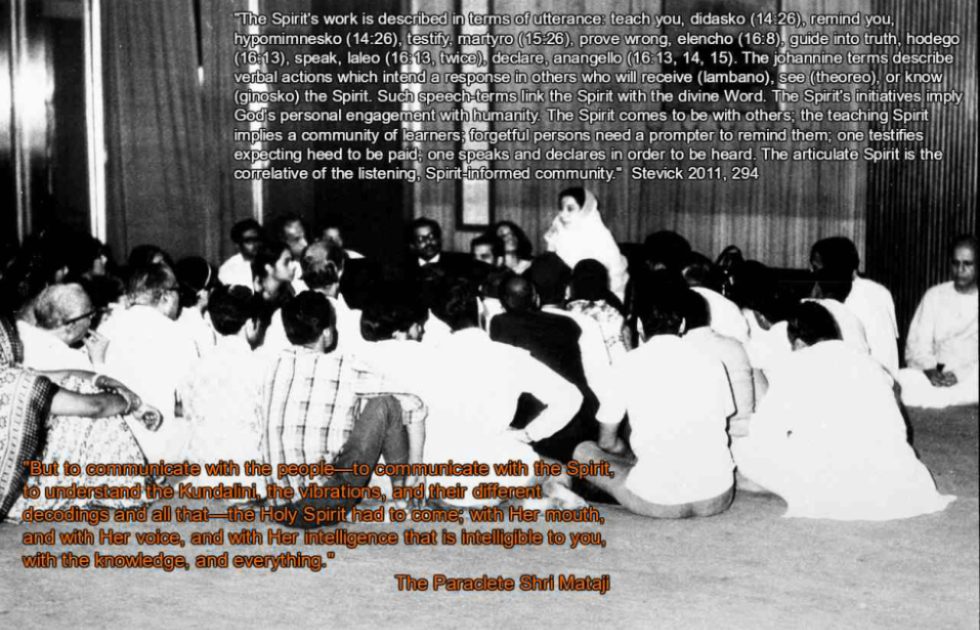
By the Paraclete, God imparts God. It is by the outgoing activity of the Spirit that the divine life communicates itself in and to the creation. The Spirit is God-in-relations. The Paraclete is the divine self-expression which will be and abide with you, and be in you (14:16-17). The Sprit’s work is described in terms of utterance: teach you, didasko (14:26), remind you, hypomimnesko (14:26), testify, martyro (15:26), prove wrong, elencho (16:8), guide into truth, hodego (16:13), speak, laleo (16:13, twice), declare, anangello (16:13, 14, 15). The johannine terms describe verbal actions which intend a response in others who will receive (lambano), see (theoreo), or know (ginosko) the Spirit. Such speech-terms link the Spirit with the divine Word. The Spirit’s initiatives imply God’s personal engagement with humanity. The Spirit comes to be with others, the teaching Spirit implies a community of learners; forgetful persons need a prompter to remind them; one testifies expecting heed to be paid; one speaks and declares in order to be heard. The articulate Spirit is the correlative of the listening, Spirit-informed community.
The final Paraclete passage closes with a threefold repetition of the verb she will declare (anangello), 16:13-15. The Spirit will declare the things that are to come (v.13), and she will declare what is Christ’s (vv. 14, 15). The things of Christ are a message that must be heralded. The Spirit is a proclaimer, an evangelist to the church."
Daniel B. Stevick, Jesus and His Own: A Commentary on John 13-17
Wm. B. Eerdmans Publishing Company (April 29, 2011), pp. 294-95
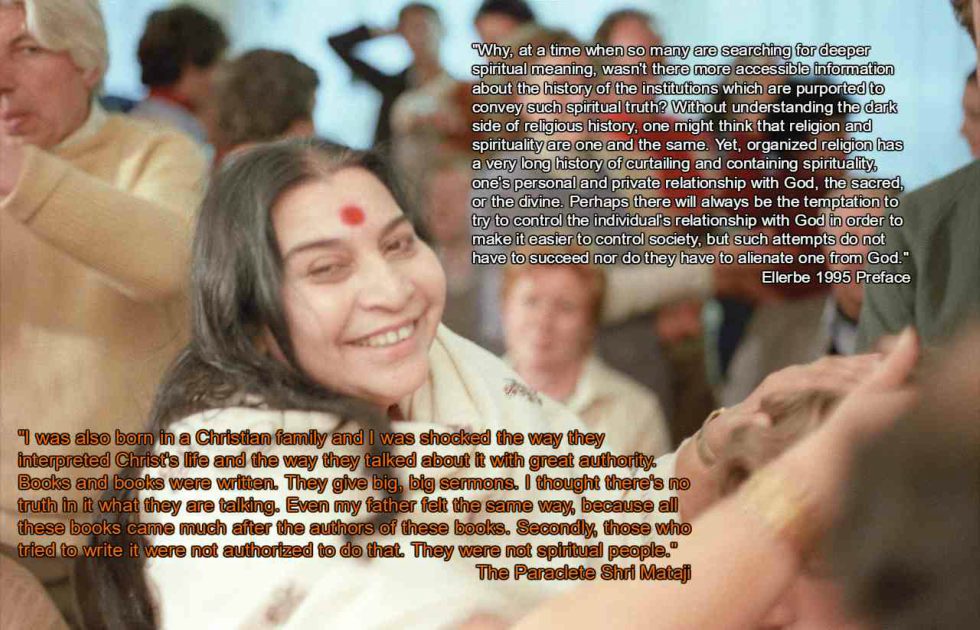
"I was also born in a Christian family and I was shocked the way they interpreted Christ's life and the way they talked about it with great authority. Books and books were written. They give big, big sermons. I thought there's no truth in it what they are talking. Even my father felt the same way, because all these books came much after the authors of these books. Secondly, those who tried to write it were not authorized to do that. They were not spiritual people. They all wanted to have power; they wanted to have power in religion.
The power in religion is inside and that should be awakened. I must say, thanks to the Sufis of this country and other countries that people still think that there is something beyond all these words and talks and books."
The Paraclete Shri Mataji
Easter Puja, Istanbul, Turkey—April 23, 2000
"But to communicate with the people—to communicate with the Spirit, to understand the Kundalini, the vibrations, and their different decodings and all that—the Holy Spirit had to come; with Her mouth, and with Her voice, and with Her intelligence that is intelligible to you, with the knowledge, and everything.
Otherwise it is not possible to communicate and that's why if somebody has to come you have to just recognize. Recognition is the best way of understanding the powers that are given to you.
You have been given powers, no doubt. But these powers, even if somebody gets Realization, like Buddha got his realization he thought there is no God. He did not believe in God because he just got Realization through a formless, formless thing you can say. And he just did not know. He did not talk of Kundalini. Then he did not talk of God actually, and he started talking only of the ascent.
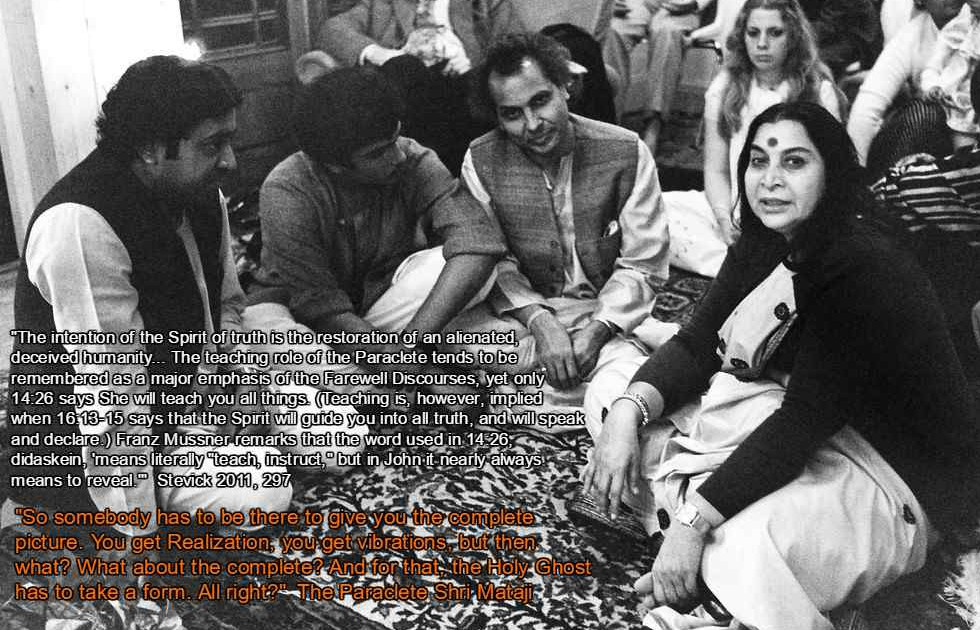
So somebody has to be there to give you the complete picture. You get Realization, you get vibrations, but then what? What about the complete?
And for that, the Holy Ghost has to take a form. All right?
May God bless you."
The Paraclete Shri Mataji
Talk after Shri Lalita Havan
Sydney, Australia—April 7, 1981
"The Paraclete’s expressive teaching, declaring, witness-bearing, and judging actions exhibits the Paraclete’s role as the Spirit of Truth…. The intention of the Spirit of truth is the restoration of an alienated, deceived humanity....
The Spirit of truth engages with the world, albeit, according to the First Discourse, not directly (14:17), but through the believing and very humane community of faith. On its own, the alienated world cannot ‘receive’ or ‘see’ or ‘know’ the Spirit....
In relation to the church, the Spirit is counselor, teacher, and guide; but in relation to the world, which is carried away in untruth, the Spirit goes on the offensive: She will prove the world wrong (16:8). Christians who hear the Spirit described as ‘Advocate’ tend to think of the divine Paraclete as one who stands with them, taking their part before God. They have an image of a court in which God is judge, and weak, erring persons are in need of a partisan, forceful representative if their case is to carry. But such an understanding of the Spirit’s advocacy should not be read into this Paraclete passage. The Evangelist might think that such a construction of his terms represented, to say the best for it, a half-converted understanding. When he uses the legal aspect of his Paraclete terminology most fully (in 16:7-11), he depicts the Paraclete as a prosecutor, a power that is effective on the world, contending against it and in behalf of God. A verdict for God is sought from humanity. The urgent need, with respect to God and the world, as the Evangelists describes it, is not that humanity be represented before God, but that God’s truth and judgment be set before a world that is largely closed against them. The Paraclete gives the case for God her potent advocacy." — Daniel B. Stevick, 2011, 295-96
"I am the Adi Shakti (Holy Spirit/Paraclete). I am the one who has come on this Earth for the first time in this form to do this tremendous task . The more you understand this the better it would be. You will change tremendously. I knew I’ll have to say that openly one day and we have said it. But now it is you people who have to prove it that I am that!"
The Paraclete Shri Mataji
Sydney, Australia—March 21, 1983
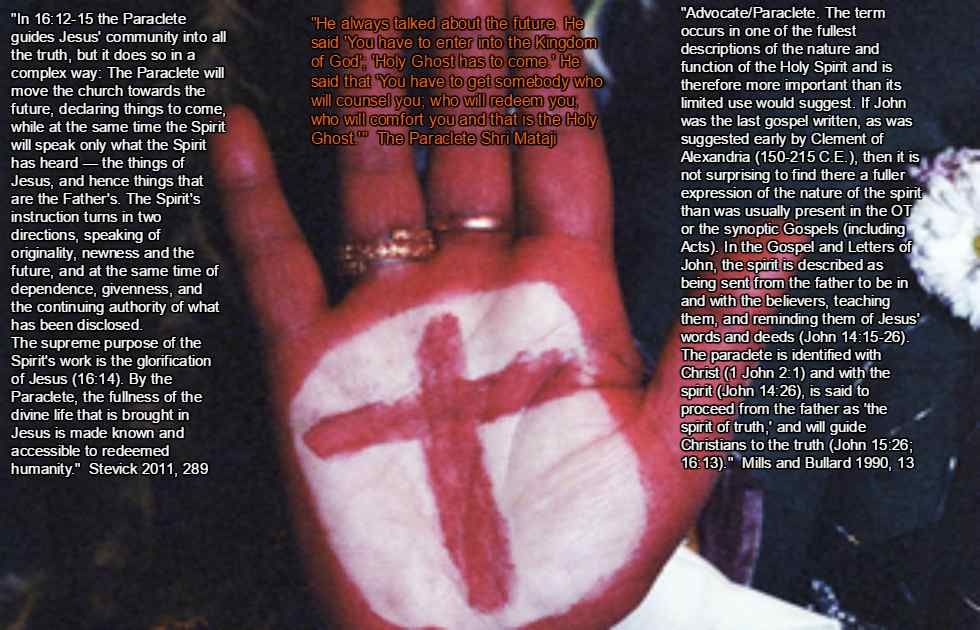
Paraclete: "In 14:26, Jesus says, 'But the Paraclete, the Holy Spirit, whom the Father will send in my name, will teach you all things and will remind you of all that I myself spoke to you.' (14:26). The teaching ministry of the Paraclete is presented as superior to that of Jesus because the Paraclete will teach them 'all things' and will remind them of 'everything' that Jesus said (14:26). The Paraclete’s ministry is set clearly in the future. Jesus again identifies this 'Paraclete' with the Holy Spirit, whom the disciples would know from the Old Testament (Ps. 51:11; Is. 63:10,11): 'But the Paraclete, the Holy Spirit—the Father will send in My name' (14:26). This sending will fulfill Old Testament promises as well as Jesus’ request (14:16). The sending of the Paraclete in Jesus’ name not only links the sending to Jesus’ request but also supports the claim that the Paraclete comes to continue Jesus’ ministry.
The Paraclete’s ministry to the disciples both goes beyond and is limited by Jesus’ ministry. On the one hand, the Paraclete would teach the disciples 'all things' (14:26), and so the disciples would know more from the Paraclete’s teaching than they knew from Jesus’ teaching (see 1 John 2:27)... The Spirit’s teaching went beyond what Jesus taught only in that it deepened their understanding of what He said.
Jesus’ statements in John 14:25-26 are closely paralleled by those in 16:12-15... What may be implicit in John 14:25-26, that Jesus had limited what He told the disciples because of their inability to understand, is made explicit in 16:12. They had trouble understanding what He did tell them, and now the reason for that is made plain: their abilities are limited."
James M. Hamilton, Jr., God's Indwelling Presence, B&H Academic (August 1, 2006), pp. 79-82
"Although one of the johannine Paraclete passages, 16:7-11, draws on the forensic background of the term parakletos, the other passages suggest broader, more personal senses, referring to one who consoles another, befriends another, guides or teaches another, or to one who publicizes the truth of things. Translators have tried many equivalents for the Evangelist’s term: Advocate (the choice of the NRSV), Comforter, Convincer, Counselor, Encourager, Friend, Helper, teacher. Some have simply transliterated: ‘Paraclete.’ John Reumann judges that ‘No one English word catches all the nuances in the Paraclete passages.’" — Daniel B. Stevick, 2011, 285
"I know all ... but I have not revealed it so far. It will be slowly revealed by me because people have not been prepared yet to become capable of absorbing it."
The Paraclete Shri Mataji
Bombay, India—February 26, 1987

traditional fresco scenes in Osogovo
Monastery, Republic of Macedonia
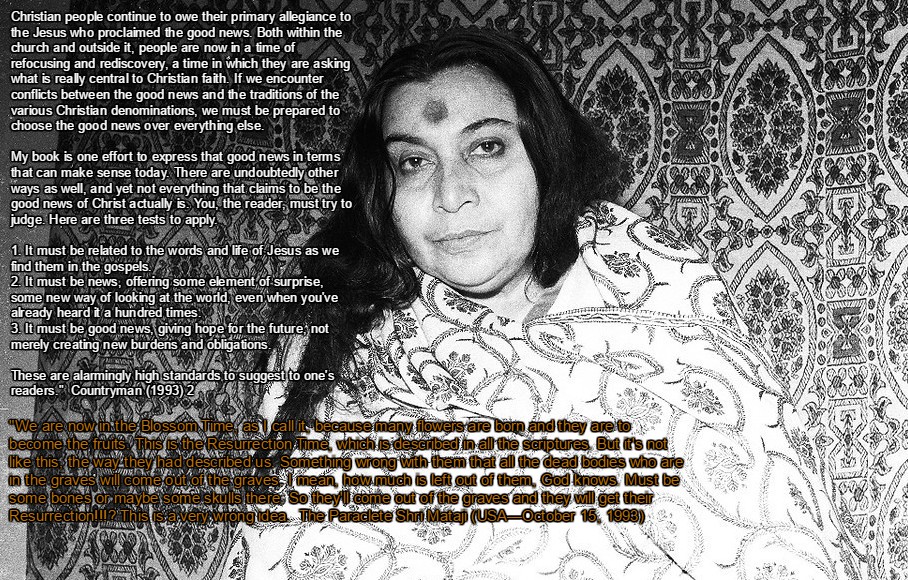
"We are now in the Blossom Time, as I call it, because many flowers are born and they are to become the fruits. This is the Resurrection Time, which is described in all the scriptures. But it’s not like this, the way they had described us. Something wrong with them that all the dead bodies who are in the graves will come out of the graves. I mean, how much is left out of them, God knows. Must be some bones or maybe some skulls there. So they’ll come out of the graves and they will get their Resurrection!!!? This is a very wrong idea."
The Paraclete Shri Mataji
Philadelphia, USA—October 15, 1993
Eschatology: "is not exactly your everyday word. If you had read every word of this newspaper every day for the last five years, you would have encountered it fewer than 20 times. Half those times were somehow referring to fundamentalist religious beliefs about the final battles between good and evil, the coming of Jesus (or other messianic figures), the Last Judgment and the eternal assignment of the saved and the damned to heaven or to hell... In the 1960s, his 'Theology of Hope,' subtitled 'On the Ground and the Implications of a Christian Eschatology,' became one of the most widely translated and read theological works, stirring enthusiastic responses among Roman Catholics as well as Protestants, and among religious radicals in the developing world as well as dissident Marxists in Eastern Europe. At the core of this theology were the principles that human consciousness is not shaped only by the past and present but also by anticipation of the future, that biblical revelation is centered on God’s promises, and that hope for the future does not rest on extrapolations of past or present trends but on something truly beyond them, namely those divine promises... The goal of a final judgment, in this interpretation, is not reward and punishment but victory over all that is godless, which he calls 'a great Day of Reconciliation.' Professor Moltmann argues for the universal preservation and salvation not only of humans, as individuals and as members of groups, but also of all living creatures. It has been 'a fatal mistake of Christian tradition in doctrine and spirituality,' he argues, to emphasize the 'end of the old age' rather than 'the new world of God,' the beginning of the 'life of the world to come.' " — Peter Steinfils, New York Times
"In the context of mysticism, the phrase refers metaphorically to the end of ordinary reality and reunion with the Divine. In many religions it is taught as an existing future event prophesied in sacred texts or folklore. More broadly, eschatology may encompass related concepts such as the Messiah or Messianic Age, the end time, and the end of days... Most modern eschatology and apocalypticism, both religious and secular, involves the violent disruption or destruction of the world, whereas Christian and Jewish eschatologies view the end times as the consummation or perfection of God's creation of the world. For example, according to ancient Hebrew belief, life takes a linear (and not cyclical) path; the world began with God and is constantly headed toward God’s final goal for creation." Wikipedia (Web, January 13, 2012)

The Paraclete Shri Mataji"Of course there are some absurd things which grew with misinterpretation and interference from unholy people, which are common in these religions. For example, Jews, Christian and Muslims believe that when they die their bodies will come out of their graves and they will all be resurrected at the Time of Resurrection, at the Time of Last Judgment, at the Time of Qiyamah. It is illogical to think what will remain inside those graves after five hundred years. Nobody wants to think and understand that it is not the body but the soul that will come out of these bodies, be born again as human beings and be saved through Qiyamah and Resurrection."
The Paraclete Shri Mataji
The Message of Christ, London, UK December—10, 1979
"The world needs to be convinced of the truth about itself — something it cannot come to on its own terms. Yet without that truth, the world is forever self-deceived. The showing of the world to itself is the mission of the Paraclete, when she comes. The Spirit comes (as in 15:26); she engages actively with the world. As Jesus had been sent and came, so the Spirit." — D. B. Stevick, 2011, 252
"Though you can understand that Mother's Love makes it very easy for you to get to your Realization and that the whole story of Last Judgment—which looks such a horrifying experience—has been made very beautiful and very tender and delicate, and does not disturb you... All this, if it is told without Realisation, has no meaning. But people were given great ideas about it and also were promised that 'one day your resurrection will come.' It is the greatest happening for you. It is the greatest event of your life and one must consider it is very fortunate that you have been able to achieve it."
The Paraclete Shri Mataji
Kundalini And Kalki Shakti
Bombay, India—September 28, 1979
"The writer’s general thesis is clear: The world has gotten things wrong — things that it must get right if it is to understand itself and carry out its appointed work. But the self-enclosed world has no vantage from which to see itself; its efforts to gather the truth about itself from itself are futile. No observer, taking a point of view within the world, can be freed of that darkening which pervades both the object of inquiry and the inquirer. That is the condition of the world — to find itself a continual object for its own investigation, to have the self-reflective capacity for examining itself, but always to miss the truth about itself. Lacking self-understanding, the actions of the world easily become inhumane and unjust. When the world comes to a new understanding of itself, it will be through the revealing work of God’s Spirit." — Daniel B. Stevick, 2011, 252
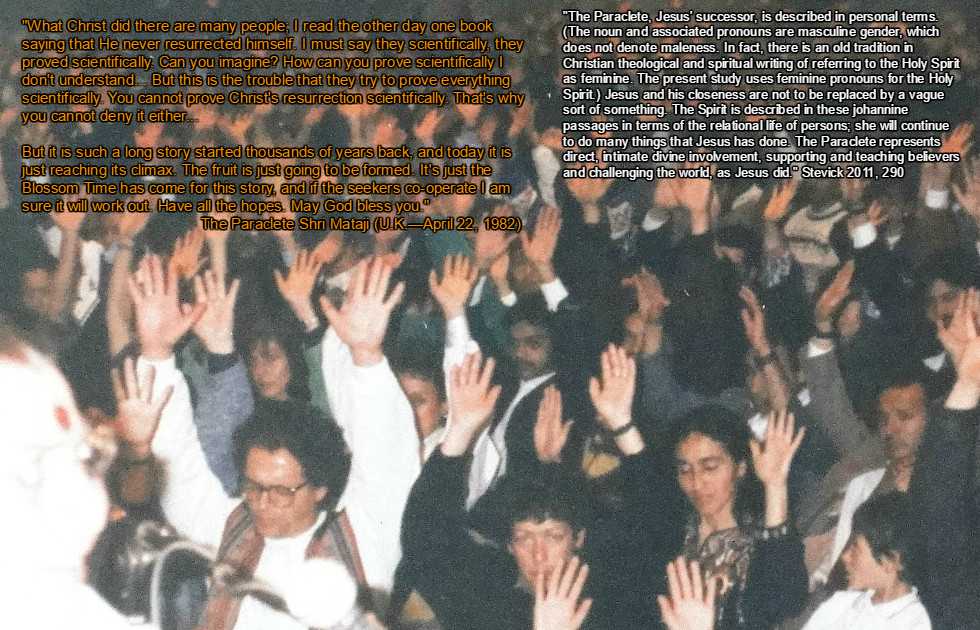
"What Christ did there are many people; I read the other day one book saying that He never resurrected himself. I must say they scientifically, they proved scientifically. Can you imagine? How can you prove scientifically I don’t understand...
But this is the trouble that they try to prove everything scientifically. You cannot prove Christ’s resurrection scientifically. That’s why you cannot deny it either...
But it is such a long story started thousands of years back, and today it is just reaching its climax. The fruit is just going to be formed. It’s just the Blossom Time has come for this story, and if the seekers co-operate I am sure it will work out. Have all the hopes. May God bless you."
The Paraclete Shri Mataji
All Is Beautifully Made, Hampstead, U.K.—April 22, 1982
THE APOCALYPSE OF THE SPIRIT-PARACLETE
The fulfillment of the promise of eschatological divine instruction
This website is primarily based on the living gnosis, epiphany, and mystical evidence of cosmic visions and mystical experiences of children's souls meditating, meeting, and inquiring from "His Spirit who dwells in you" (Rom. 8:11), and Her answers and revelations to them. Without question it is about encountering the inner Divine Mother, the Spirit-Paraclete who resides within.
It also deals with the advent of the Spirit-Paraclete's incarnation, Shri Mataji Nirmala Devi, and Her Divine Message to humanity. This message is the very foundation of each and every religion, holy scripture and messenger. It embraces all and excludes none, a collective and harmonious triumph unlike anything learnt or experienced in organized religion. It is an eschatological message of divine intervention and fulfillment of the promised Resurrection to evolve from the temporary physical body into the eternal spirit
The Divine Mother reveals detailed evidence of this mystical dimension and spiritual sanctuary within human beings never properly understood or explained by organized religions—the Kingdom of Spirit (Christianity), Sahasrara Chakra (Hinduism), Dsam Dwar (Sikhism), 1000 Petal Lotus (Buddhism), "Crystal Palace" (Taoism), Kether (Judaism) or Regions in their Souls (Islam). That it is possible to pursue this inner world beyond everyday physical reality is now backed by incontrovertible evidence.
The Paraclete explains how knowledge of this mystical Kingdom of Spirit will eventually awaken, transform and bring about peace and harmony during this Age of the Resurrection and Last Judgment. This unprecedented knowledge and remembrance of Jesus' mystical teachings, to be delivered by the Paraclete, is the final breakthrough in human evolution.
"But, if the Spirit of him who raised Jesus from the dead dwells in you, he who raised from the dead Christ Jesus shall quicken your mortal bodies also through His Spirit who dwells in you." The divine agent, then, is the Holy Spirit, in unity with the human spirit" [1]; "The Messiah will come and the great age of salvation will dawn (for the pious)" [2]; "He (Jesus) is the Sign of the Hour (of Resurrection)" - Surah Az-Zukhruf 43:61 [3].
[1] F. J. Lambretch, Resurrection in the New Testament, page 297;
[2] Eric Eve, The Jewish Context of Jesus' Miracles, p. 195;
[3] Al-Qur'an, Surah 43. Az-Zukhruf (The Gold Adornment)
In this Golden Age of the Last Judgment and Resurrection humans will break free of centuries-old false religious dogmas, destructive indoctrinations, and absurd ideas about the Divine. The Last Judgment and Resurrection is not the sudden apocalyptic end of the world feared by the divisive religious institutions.
On the contrary, humanity awakens to a new dawn of genuine spiritual evolution (Resurrection/birth by the Spirit) and enlightenment (Jesus, the Last Judgment and the Kingdom of Spirit) ushered by the promised Paraclete over a span of about four decades. This epic task comprising of thousands of talks, lectures and programs commencing in the 1970s has one central theme - the glorification, defense, completion and conclusion of the teachings of Jesus Christ that commences the Last Judgment and Resurrection!
Gnosis (from one of the Greek words for knowledge) is the spiritual knowledge of a saint or mystically enlightened human being. Within the cultures of the term's provenance (Byzantine and Hellenic) Gnosis was a knowledge or insight into the infinite, divine and uncreated in all and above all, rather than knowledge strictly into the finite, natural or material world. Gnosis is a transcendental as well as mature understanding. It indicates direct spiritual experiential knowledge and intuitive knowledge, mystic rather than that from rational or reasoned thinking. Gnosis itself is obtained through understanding at which one can arrive via inner experience or contemplation such as an internal epiphany of intuition and external epiphany such as the Theophany.
An epiphany (from the ancient Greek epiphaneia, "manifestation, striking appearance") is the sudden realization or comprehension of the (larger) essence or meaning of something. The term is used in either a philosophical or literal sense to signify that the claimant has "found the last piece of the puzzle and now sees the whole picture," or has new information or experience, often insignificant by itself, that illuminates a deeper or numinous foundational frame of reference. (wikipedia.org 15 December 2010)
Happy ending will be collectively "realized by the coming of the Messiah"

Huston Smith Can Religion Save Us?
Tradition, Transcendence, and Ultimate Reality
An interview with Huston Smith
by Jessica Roemischer
WIE: So, will the "happy ending" or final salvation that the traditions prophesy actually manifest? And, if so, do you believe that will eventuate—as the traditions predict, through divine intervention—in the "second coming"?
HS: For my part, I do say unequivocally that one of the strengths of the great religions is that they promise a happy ending that burgeons after horrendous problems are faced and overcome. But here's the decisive thing that our culture is not ready to hear: they want to see the second coming as changing human history, the course of human history on this planet, which we may annihilate like a supernova. Now, there are phrases in the Bible that point toward it manifesting here—"Thy kingdom come on earth." Or, as in the basic Hindu view, the material world and its history are like an accordion that comes out and it goes back through the four yugas (ages), ending with the Kali Yuga, the worst one, which goes to the dogs completely. But then a new cycle begins. Whatever the metaphors and the analogies, it's our obligation to try to see it happen; we should do our very best to see that it happens on our planet. And, in fact, none of the traditions claim that that happy ending is realizable on our planet; they say that individuals will experience that happy ending in the afterlife, and collectively it will be realized by the coming of the Messiah when time as we know it closes down (the wording differs from religion to religion).
Huston Smith, arguably today's foremost authority on the world's great religions, has, for over half a century, dedicated himself to transmitting the wisdom of the traditions through books, television, and film and in the classroom. His best-known volume, The World's Religions, has been the standard introductory textbook in college religion courses for thirty years and has sold several million copies. Dr. Smith has produced three PBS television series and was the focus of Bill Moyers' five-part PBS special, "The Wisdom of Faith with Huston Smith." His documentaries on Tibetan Buddhism, Hinduism, and Sufism have received international acclaim. Having devoted a lifetime to the study of the august traditions of the world, Huston Smith was our preeminent choice to answer the question: Are the religions equipped to navigate the myriad challenges of the third millennium?
Initially, Huston Smith responded to our interview request with a letter saying, "I am hesitant to take part in your projected article for fear of sounding like a spoilsport. I gather that you want to come down hard on the perils that threaten our planet while giving your readers grounds for hope. My personal judgment is that my perspective differs so markedly from the mind-set of your readers that you would do better to bypass me on this one . . ." We were hooked. What would the dean of comparative religious scholarship have to say in response to perhaps the most important spiritual question of our time, and why did he feel that our readers would not want to hear it? Could there indeed be no cause for hope?
In his innovative and incisive critique of postmodernity, Why Religion Matters, Smith writes, "The sandwich man between placards announcing that the end is near is telling us something important. . . . He is not just protesting our reigning culture. However falteringly, he is gesturing toward a heavenly city that offers an alternative to this earthly one, which is always deeply flawed." Indeed, that man could be Huston Smith himself. And, visiting with this wise and generous octogenarian in his modest Berkeley home, for the interview that he did eventually agree to, we found why he believes that, in the face of apocalyptic times, the traditions may help us hope for a good outcome, but they may not be equipped to actually help us manifest it—at least not here on Earth!
EnlightenmentNext Magazine Issue 23 / Spring–Summer 2003
i. Regathering of Jews back to Israel "will occur right before the return of the Messiah"
ii. "Quran explicitly refers to the return of the Jews to the Land of Israel before the Last Judgment"
iii. "Until Moshiach comes, Judaism is simply a 'religion,' seemingly relegated to its houses of worship"
iv. "The coming Messiah would inaugurate the age of salvation with the pouring out of the Spirit on all flesh"


"Jesus therefore predicts that God will later send a human being to Earth to take up the role defined by John .i.e. to be a prophet who hears God’s words and repeats his message to man."
M. Bucaille, The Bible, the Qur'an, and Science
"And when Jesus foreannounced another Comforter, He must have intended a Person as distinct and helpful as He had been."
F. B. Meyer, Love to the Utmost
"The Paraclete has a twofold function: to communicate Christ to believers and, to put the world on trial"
Robert Kysar, John The Meverick Gospel
"But She—the Spirit, the Paraclete...—will teach you everything."
Danny Mahar, Aramaic Made EZ)
"Grammatical nonsense but evidence of the theological desire to defeminize the Divine."
Lucy Reid, She Changes Everything
"The functions of the Paraclete spelled out in verses 13-15... are all acts of open and bold speaking in the highest degree."
David Fleer, Preaching John's Gospel: The World It Imagines
"The reaction of the world to the Paraclete will be much the same as the world’s reaction was to Jesus."
Berard L. Marthaler, The Creed: The Apostolic Faith in Contemporary Theology
Bultmann calls the "coming of the Redeemer an 'eschatological event,' 'the turning-point of the ages."
G. Ladd, A Theology of the New Testament
"The Paraclete equated with the Holy Spirit, is the only mediator of the word of the exalted Christ."
(M.E. Boring) Benny Thettayil, In Spirit and Truth
"The divine Paraclete, and no lessor agency, must show the world how wrong it was about him who was in the right."
Daniel B. Stevick , Jesus and His Own: A Commentary on John 13-17
Stephen Smalley asserts that "the Spirit-Paraclete ... in John’s Gospel is understood as personal, indeed, as a person."
Marianne Meye Thompson, The God of the Gospel of John
"The Messiah will come and the great age of salvation will dawn (for the pious)"
Eric Eve, The Jewish context of Jesus' Miracles
"The remembrance is to relive and re-enact the Christ event, to bring about new eschatological decision in time and space."
Daniel Rathnakara Sadananda, The Johannine Exegesis of God
"The Spirit acts in such an international situation as the revealer of 'judgment' on the powers that rule the world."
Michael Welker, God the Spirit
The Paraclete's "appearance means that sin, righteousness, and judgment will be revealed."
Georg Strecker, Theology of the New Testament
"While the Spirit-Paraclete is the true broker, the brokers they rely on are impostors."
T. G. Brown, Spirit in the writings of John
"The pneumatological activity ... of the Paraclete ... may most helpfully be considered in terms of the salvific working of the hidden Spirit."
Michael Welker, The work of the Spirit
"The pneuma is the peculiar power by which the word becomes the words of eternal life."
Robert Kysar, Voyages with John: Charting the Fourth Gospel
"The gift of peace, therefore, is intimately associated with the gift of the Spirit-Paraclete"
Francis J. Moloney, The Gospel of John
"This utopian hope, even when modestly expressed, links Jesus and the prophets to a much wider history of human longing."
Harvey Cox, The Future of Faith
"Because of the presence of the Paraclete in the life of the believer, the blessings of the end-times—the eschaton—are already present"
Robert Kysar, John
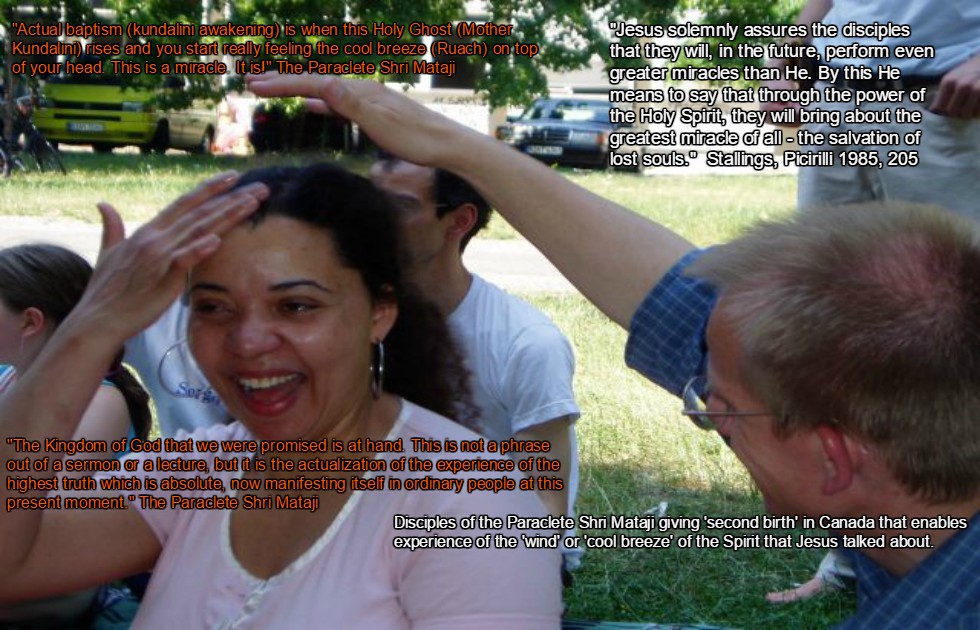
"They are going, by the Holy Spirit’s power, to be part of the greatest miracle of all, bringing men to salvation."
Robert E. Picirilli, The Randall House Bible Commentary
"The Kingdom of God stands as a comprehensive term for all that the messianic salvation included... is something to be sought here and now (Mt. 6:33) and to be received as children receive a gift (Mk. 10:15 = Lk. 18:16-17)."
George Eldon Ladd, A Theology of the New Testament
"They will be privileged to know the Paraclete, as they have known Jesus (14:7, 9, 17). The Spirit will be within the disciples and will remain with them" - Robert Creech

Thanks Isabelle. i just love the photo
Tuesday, March 1, 2011
Dear disciples of Shri Mataji,
Namaste - i bow to the Spirit-Paraclete who
resides in you!
Thanks Isabelle. i just love the photo and
Her promise. It will now remain permanently
here, and i will explain why in the next
paragraph.
Since 1994 i know what that promise truly
meant. i have been defending and holding
on to that truth for the last 17 years. Now,
with Her Mahasamadhi, it is a source of
great comfort, strength and resolve. i wish all
Her disciples grasp the truth and reality of
"Tat Twam Asi", the deeper meaning of
that quote! Lord Jesus is telling you the
same when He says the Spirit-Paraclete will
remain with you forever.[1]
For those who have followed Shri Mataji the
world over for the last four decades
to listen to Her Good News of the Kingdom
of God, and for those who also intimately
experienced the Spirit-Paraclete within
themselves in vivid visions and dreams, this
quote is most comforting:
"The Spirit will be ... the helper, comforter,
counselor, and companion that Jesus has
been. Indeed, nearly everything said about
the Paraclete has been said elsewhere in
the Gospel about Jesus. Only one difference
emerges: the word 'forever.' Unlike Jesus,
the Paraclete/Spirit will not go away but will
remain with the disciples forever. Jesus, the
Word made flesh, lived on this earth in one
time and place. The Paraclete dwells within
every believer for all times and in all places,
and is thus a more intimate and enduring
presence."
Faithful Disagreement: Wrestling with
Scripture in the Midst of Church Conflict
Frances Taylor Gench, (April 2, 2009) p. 103
The Paraclete Shri Mataji continues to
remain with us, but in a more intimate and
enduring presence within. She has given
irrefutable evidence of that internal
presence too, so that future believers will
have the faith and comfort of salvation. She
now dwells within, for all times, thereby
fulfilling everything promised by Jesus!
Please meditate on this reality as deeply as
you can, daily if possible. That would be
just before going to sleep, which i find to be
the best time to lose 'consciousness' (fall
asleep) .......... and awaken again in
consciousness (at dawn).
i also wish to thank all for contributing and
sharing their thoughts. i wish all of you a
beautiful journey into eternity. May Her
photo and promise always give you the
comfort of THE MOTHER within.
regards,
jagbir
[1] " 'And I will ask the Father, and he will
give you another paraclete, to be with you
forever' John 14:16... The paraclete is not
merely a substitute for Jesus while he is
absent. The role of the paraclete, as Jesus
describes it, exceeds this. The paraclete
will carry forward the disciples while
maintaining their link to Jesus. “I have said
these things to you while I am still with you.'
Jesus says. 'But the paraclete, the Holy
Spirit, whom the Father will send in my
name, will teach you everything, and
remind you of all that I have said to you'
(John 14:25-26). The paraclete takes up
residence in them and provides a critical
link between past, present, and future....
Second, up to this point, Jesus has been
describing the relationship between the
disciples and God; he introduces here a new
relationship that the disciples will have with
the world. When the paraclete comes, the
paraclete will come as a witness. 'When the
paraclete comes, whom I will send to you
from the Father, the Spirit of truth that
comes from the Father, will testify on my
behalf” (John 15:26). Again the paraclete
is introduced as the Spirit of truth. This
Spirit testifies on behalf of Jesus and does
so in the face of the world and its opposition
to [the paraclete]. The paraclete will
transform them, as well, into witnesses
(John 15:27). In this chapter, housing the
paraclete is not static. Instead, the spirit’s
residence within them transform them into
witnesses."
Shelly Rambo & Catherine Keller
Spirit and Trauma: A Theology of Remaining
Westminster John Knox Press
September 2, 2010, p. 101-3
[1] "In her function as Paraclete the Breath
will abide with the disciples as She abode
with Jesus. Indeed, She will abide with them
forever (Jn. 14:16). As She dwelt with Jesus,
She will now dwell with them. Through Her
indwelling, the disciples will know Her with a
new intimacy."
Donald L. Gelpi, The Divine Mother, A
Trinitarian Theology of the Holy Spirit
University Press of America, 1984, p. 56
(NASB), 'Advocate' (NRSV) and 'Counselor' (NIV). The Greek word itself contains all those meanings, describing one who is summoned to the aid of another. 'Helper' may be the better translation, allowing the context to describe the specific kind of help being offered (advocacy, comfort or counsel). Some commentators do not translate the word at all, simply bringing it into English as Paraclete, as we do with other Greek words like 'baptism' or 'deacon.'
In many ways, the role of the Paraclete is to continue the ministry of Jesus to his disciples. Jesus introduces the Spirit as 'another' Paraclete, implying he himself had been the first (14:16). As Jesus is the Truth (14:6) and bears witness to the Truth (18:37), the Paraclete is 'the Spirit of Truth' (14:17) who testifies as well (15:26-27). Just as Jesus is 'the Holy One of God' (6:69), the Spirit is 'the Holy Spirit' (14:26).
Jesus has 'come into the world' (5:43), and now promises the Paraclete will come as well (16:8). The Spirit 'comes forth' from the Father (15:26), just as Jesus has come forth from the Father. The Father gives the Paraclete at Jesus' request (14:16), just as the Father has given his Son (3:16). The Father who sent Jesus (3:17) will send the Spirit as well (14:26). Jesus came in the Father's name (5:43) and the Paraclete comes in Jesus' name (14:26). As Jesus spoke only what the Father told him (14:10), so the Spirit would reveal Jesus' words (16:13). Jesus glorified the Father (14:13; 17:4), and the Paraclete will glorify Jesus (16:14). In many ways, the Paraclete is to Jesus as Jesus is to the Father.
The Paraclete will play a significant role in the lives of Jesus' followers. They will be privileged to know the Paraclete, as they have known Jesus (14:7, 9, 17). The Spirit will be within the disciples and will remain with them, as Jesus remains in and with his friends (14:20, 23; 15:4-5; 17:23, 26). The Spirit will guide the disciples along the way of truth (16:13), even as Jesus is the Way and the Truth (14:6). Jesus has taught those who would listen (6:59; 7:14, 18; 8:20), and now the Paraclete will do the teaching (16:12-15). The Spirit will empower disciples to testify to Jesus (15:26-27; 20:21-23).
The Spirit also has an important role to play in relation to the world. The world that did not accept Jesus will not accept the Paraclete (5:43; 12:48; 14:17). The world that did not recognize Jesus (7:28; 8:14, 19; 14:7; 16:3) will not recognize his Spirit either (14:17). Like Jesus, the Paraclete will bear witness in the context of the world's hatred (7:7; 15:26-27). And the Paraclete ultimately proves the world wrong concerning its verdict on Jesus (16:8-11). Jesus' “advocate” will become the prosecuting attorney bringing the world to trial before the bar of Truth."
Robert Creech
University Baptist Church-Clearlake, Houston
"Jesus is promising to send the Spirit of truth to make a home within us, to become, as Brown notes, 'a way of life or something that penetrates [our] very being.' How, then, might we describe the turn toward a new direction for gospel living, the calling to discover what is deepest in the human soul in order to find God in the midst of life.
A summons to a way of life that allows the Spirit of truth to penetrate our very being is a call to a continuous process of aletheia, the Greek name for truth. Aletheia means unconcealing, uncovering such as is done in theological reflection, an art that one could argue is 5 percent our effort and 95 percent the guidance of the Paraclete. Such an effort on our part requires openness to learning the truth and personal engagement with the mystery of grace, an attitude of receptivity and a sense of awe. The trouble is, we live in a culture that offers us little assistance in the art of seeking truth and grace in life."
Feasting on the Word: Preaching the Revised Common Lectionary
David L. Bartlett, Barbara Brown Taylor, p. 23
"Jesus tells the disciples in John 14:15-17 that the Spirit will be given to those who love Him. Their ability to love Jesus comes from the enabling new birth by the Spirit (John 3:3-8). This regeneration then manifests itself in love for Jesus, which results in obedience. Thus, John 14:15-17 fits with John 7:39, where those who have believed (i.e., those who have been born again) are described as those who are about to receive the Spirit.
The purpose of the Father’s gift of the Paraclete is 'that [the Spirit] might be with you forever' (14:16). The reason for the Paraclete’s coming is that they might continue to enjoy God’s presence forever. As Barret correctly concludes, 'The Spirit is given in order that the divine presence maybe with the disciples continually ...' Jesus is giving His disciples reason to trust Him (14:1) and so tells them that they will continue to experience God’s presence (14:15-17, 20-23).
The identity of “another Paraclete” (allon parakleton) in v. 16 is given by the appositional phrase beginning v. 17, 'the spirit of truth' (to pneuma tes altetheias). Most scholars agree that 'Spirit of truth,' 'Holy Spirit,' and 'Paraclete' are all used to designate the Spirit of God in John. Most also agree that the designation 'another Paraclete' implies that Jesus has served as a Paraclete for the disciples and that it is because of His departure that He will ask the Father to provide for them 'another Paraclete.' "
God’s Indwelling Presence: The Holy Spirit in the Old and New Testaments
James M. Hamilton, Jr., B&H Academic (August 1, 2006), pp. 75-76
"This book is my attempt, as a sociologist of religion, to answer the question raised by my friend that day. It is about Sahaja Yoga, the new religious movement (NRM) whose member was responsible for the 'cool breezes' which he felt." - Judith Coney

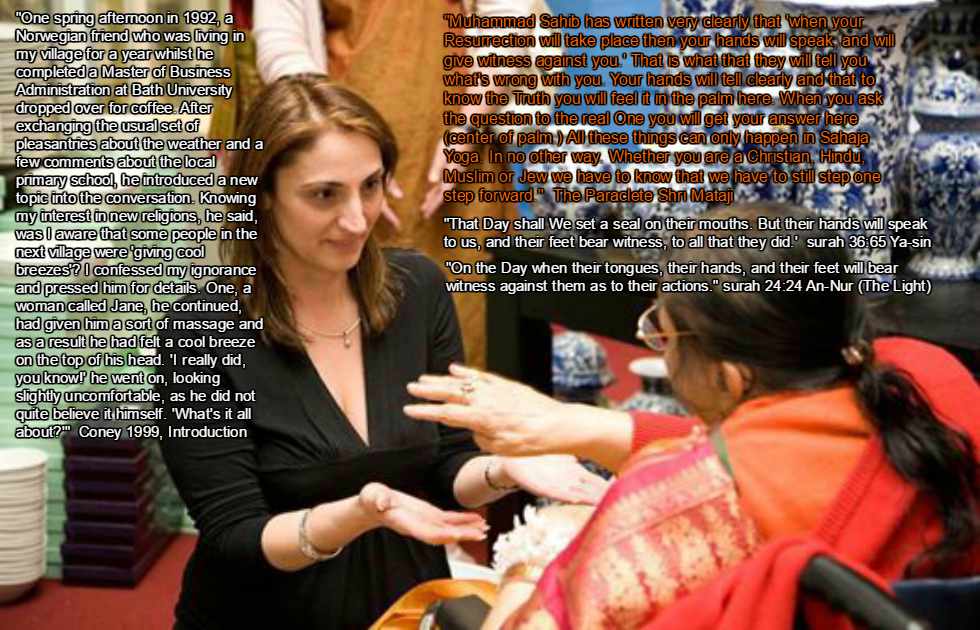
"One spring afternoon in 1992, a Norwegian friend who was living in my village for a year whilst he completed a Master of Business Administration at Bath University dropped over for coffee. After exchanging the usual set of pleasantries about the weather and a few comments about the local primary school, he introduced a new topic into the conversation. Knowing my interest in new religions, he said, was I aware that some people in the next village were 'giving cool breezes'? I confessed my ignorance and pressed him for details. One, a woman called Jane, he continued, had given him a sort of massage and as a result he had felt a cool breeze on the top of his head. 'I really did, you know!' he went on, looking slightly uncomfortable, as he did not quite believe it himself. 'What's it all about?'
This book is my attempt, as a sociologist of religion, to answer the question raised by my friend that day. It is about Sahaja Yoga, the new religious movement (NRM) whose member was responsible for the 'cool breezes' which he felt."
Judith Coney, Sahaja Yoga (Introduction page)
Publisher: RoutledgeCurzon; 1 edition (May 24 1999)
Judith Coney is a lecturer in the Department of Study of Religions at the School of Oriental and African Studies, University of London.

Feeling the Cool Wind of the Spirit for the very first time!
Since the 1970s hundreds of thousands, like the Bath
University undergraduate given Self-realization ('born of
the Spirit' or Kundalini awakening) at Sahaja Yoga public
programs, have felt the Cool Breeze (pneuma).* This
experience confirms the spiritual rebirth that Jesus Christ
declared is absolutely required to enter the Kingdom of
God. For those accepting the Good News and taking part
in the Resurrection, this Divine Wind (Ruach, Qi, Prana,
Reeh al-Qiyamah, Pneuma) will flow 24/7 for the rest of
their lives, and are empowered to trigger the same
spiritual rebirth in others too! (*YouTube 4:20) Jesus answered and said unto him, 'Verily, verily I say to you, except a man born be born again, he cannot see the Kingdom of God'. Nicodemus said to him, 'How can a man be born again when he is old? Can he enter the second time into his mother's womb, and be born?' Jesus answered, 'Verily, verily, I say to you, except a man born of water and the Spirit, he cannot enter into the Kingdom of God. That which is born of flesh is flesh and that which is born of Spirit is spirit. Marvel not that I say to you: 'You must be born again.' The wind blows where it pleases, and you hear its sound, but cannot tell where it comes from and where it is going: So it is with everyone born of the Spirit." - John 3:3-8

"The idea of chi is not unique to the Chinese. Nearly every culture in the world has a word to express this concept. Dr. John Mann and Larry Short, authors of The Body of Light, count forty-nine cultures around the world that articulate the concept of chi in one form or another.
In Hebrew, the word is ruach, and it appears in the first chapter of the Book of genesis:
In the beginning God created the Heaven and the Earth. The world was without form and void, and darkness was upon the face of the deep; and the ruach [spirit, wind, or breath] of God was moving over the face of the waters. Genesis 1:1-2
Ruach was present at the creation of the universe, even before light. The term means ‘breath of God’ or ‘divine breath.’
In Japanese, the term ki expands the concept of chi to include the Chinese idea of yi, or intention, indicating that our mind or will is a major influence governing the movement of chi, which is very important in meditation and in the martial arts.
In Sanskrit, the word for chi is prana. The Tibetan word is lung. In Lakota Sioux it is known as neyatoneyah. The Bush People of the Kalahari speak of it as num, which means ‘boiling energy.’ In the Islamic world chi is referred to as barraka. Although many cultures possess an awareness of chi, the Chinese have refined the concept and integrated it into their culture to an unparalleled degree. Chi is a pivotal factor in Chinese medicine, martial arts, meditation, science, painting, calligraphy, architecture, interior design, and poetry."
Mantak Chia, Healing Light of the Tao
Inner Tradition (Jun 6 2008) pp. 32-33

"In Christianity the Spirit is God permeating God's own creation. According to the creation study in the Hebrew Scriptures, ‘a wind [spirit] from God swept over the face of the waters’ in the beginning of creation (Gen. 1:2)…. Hence, the primary mission of the Spirit has to do with life, creating it, sustaining it and directing it towards its future destiny. The Spirit is the source of life, not only of the present life but of eternal life as well. The Spirit is within creation, but is not conditioned by creation.
Chinese theologians Chang Chun-shen and C. S. Song suggest that this Spirit is what the Chinese would call qi—air, breath and spirit. According to the teachings of Confucianism and Taoism, qi is the material origin of all things; it is at the same time the origin of the life-force and energy moving into action. Or rather it is in itself equipped with life-giving properties and energy for action. The following is a standard expression of qi:
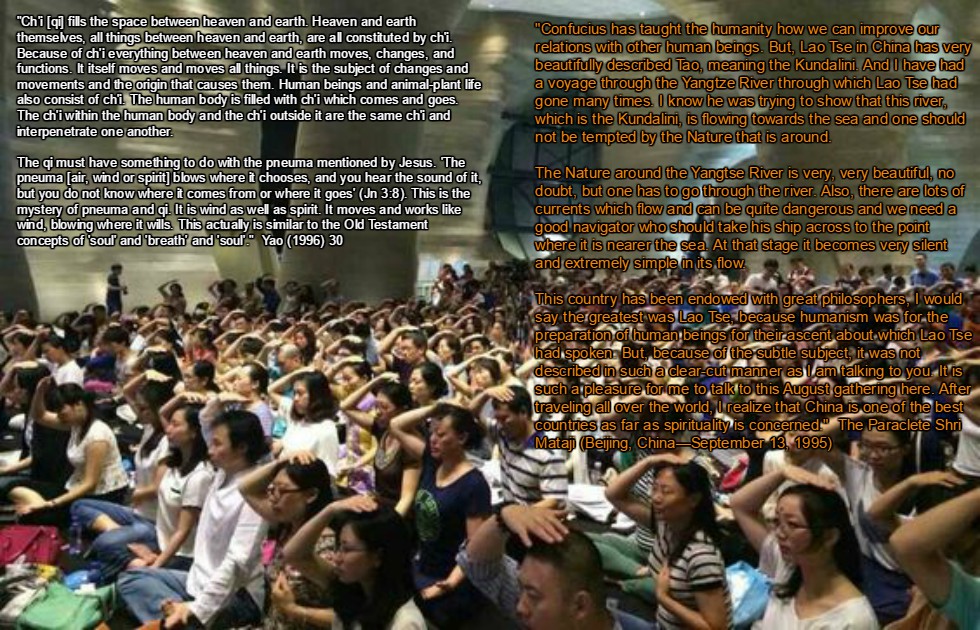
Ch’i [qi] fills the space between heaven and earth. Heaven and earth themselves, all things between heaven and earth, are all constituted by ch’i. Because of ch’i everything between heaven and earth moves, changes, and functions. It itself moves and moves all things. It is the subject of changes and movements and the origin that causes them. Human beings and animal-plant life also consists of ch’i...
The qi must have something to do with the pneuma mention by Jesus. 'The pneuma [air, wind or spirit] blows where it chooses, and you hear the sound of it, but you do not know where it comes from or where it goes’ (Jn. 3:8). This is the mystery of pneuma and qi. It is wind as well as spirit. It moves and work like wind, blowing where it wills. This actually is similar to the Old Testament concepts of 'soul' and 'breath,' ..."
Veli-Matti Kärkkäinen, Holy Spirit and Salvation
Westminster John Knox Press (August 16, 2010) , p. 435

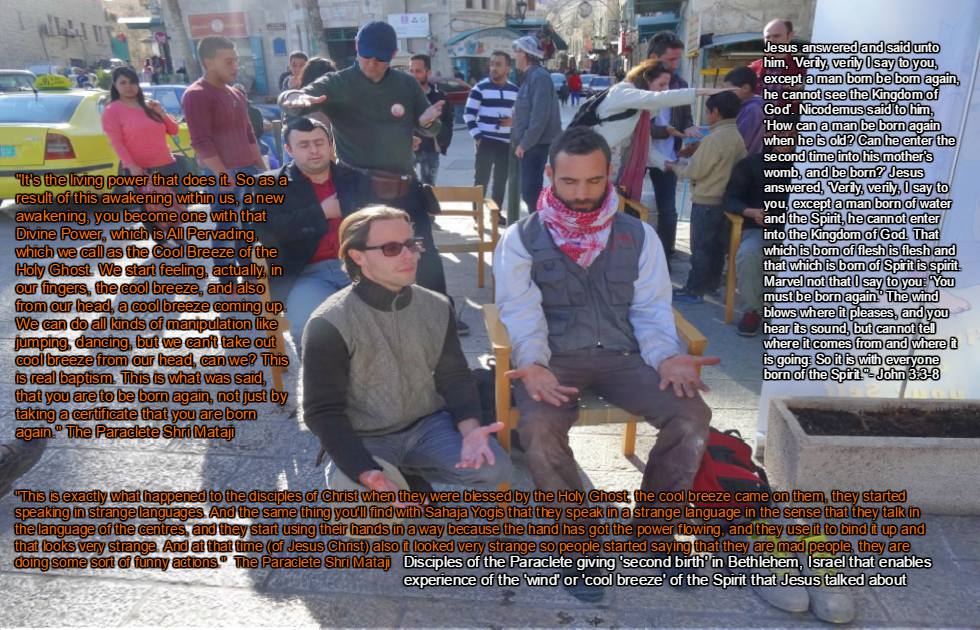
The Paraclete Shri Mataji "This is exactly what happened to the disciples of Christ when they were blessed by the Holy Ghost: the cool breeze came on them, they started speaking in strange languages. And the same thing you’ll find with Sahaja Yogis* that they speak in a strange language in the sense that they talk in the language of the centres, and they start using their hands (see photo above) in a way because the hand has got the power flowing, and they use it to bind it up and that looks very strange. And at that time (of Jesus Christ) also it looked very strange so people started saying that they are mad people, they are doing some sort of funny actions."
The Paraclete Shri Mataji
Public Program, "The Knowledge of the Roots"
Cardiff, UK—August 8, 1984
* YouTube 1:40
"It’s the living power that does it. So as a result of this awakening within us, a new awakening, you become one with that Divine Power, which is All Pervading, which we call as the Cool Breeze of the Holy Ghost. We start feeling, actually, in our fingers, the cool breeze, and also from our head, a cool breeze coming up. We can do all kinds of manipulation like jumping, dancing, but we can’t take out cool breeze from our head, can we? This is real baptism. This is what was said, that you are to be born again, not just by taking a certificate that you are born again."
The Paraclete Shri Mataji
Public Program, Rome, Italy—September 8, 1983
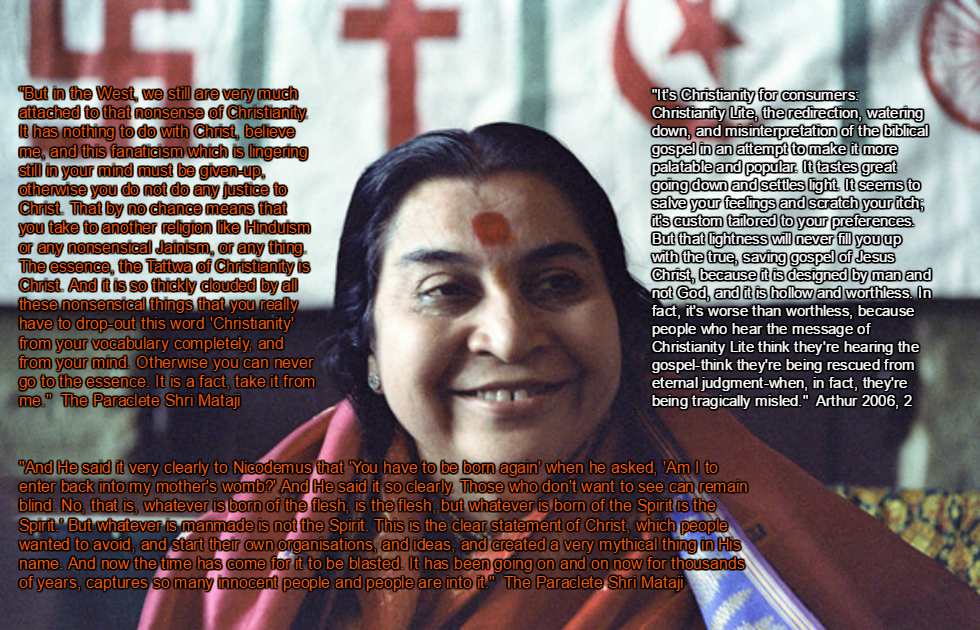
"And He said it very clearly to Nicodemus that 'You have to be born again' when he asked, 'Am I to enter back into my mother’s womb?' And He said it so clearly. Those who don’t want to see can remain blind. No, that is, whatever is born of the flesh, is the flesh, but whatever is born of the Spirit is the Spirit.
But whatever is manmade is not the Spirit. This is the clear statement of Christ, which people wanted to avoid, and start their own organisations, and ideas, and created a very mythical thing in His name. And now the time has come for it to be blasted. It has been going on and on now for thousands of years, captures so many innocent people and people are into it."
The Paraclete Shri Mataji
Easter Puja, London, UK—April 22, 1984
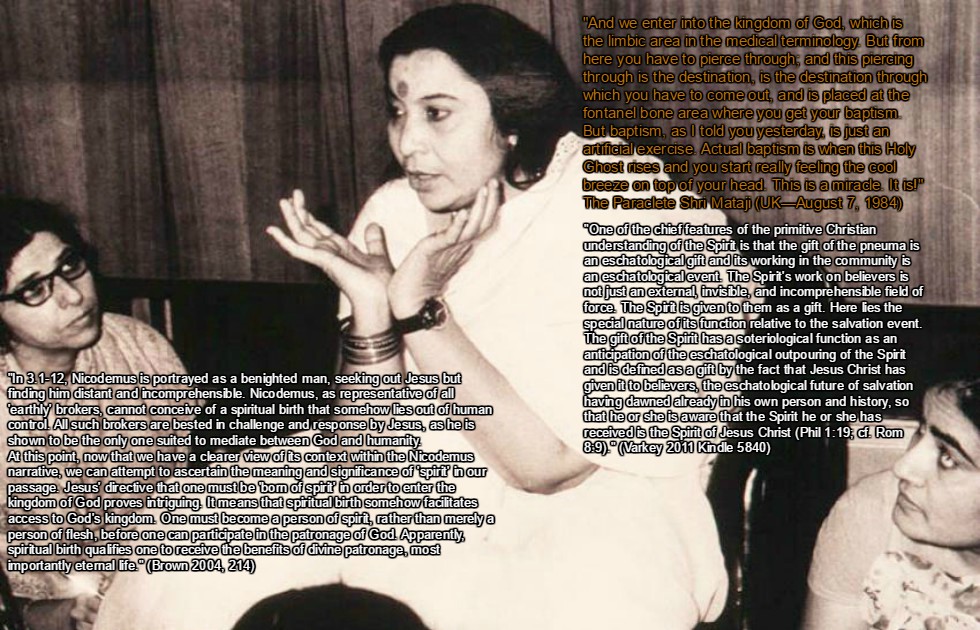
"And we enter into the kingdom of God, which is the limbic area in the medical terminology. But from here you have to pierce through; and this piercing through is the destination, is the destination through which you have to come out, and is placed at the fontanel bone area where you get your baptism. But baptism, as I told you yesterday, is just an artificial exercise. Actual baptism is when this Holy Ghost rises and you start really feeling the cool breeze on top of your head. This is a miracle. It is!"
The Paraclete Shri Mataji
Public Program, Bath, UK—August 7, 1984
"The Holy Spirit represents the presence and reality of the salvation event in a way that can be experienced by the senses." - M. Walker
According to the Paraclete Shri Mataji, the Cool Breeze (Ruach, Pneuma, Reeh al-Qiyamah) is evidence of 'being born again', the promised evolution of humans into the eternal spirit. In many different traditions the perception of the nature of God has been described by individuals that claimed to have God experiences as being accompanied by a breath-like feeling in ways that seem similar to the cool breeze (pneuma). Whether it is called Chi (Chinese), Ki (Japanese), Prana (Hindus), Ruach (Hebrew prophets), Reeh al-Qiyamah (Quran), Pneuma (Greeks), or Spiritus, the latin word from which the English word 'Spirit' is derived, this Breath of Life has the same meaning in all these languages and cultures. Chinese, Christian, Arabic, Indian, Greek, and contemporary writings describe the experience of the divine as a mysterious wind. This daily Divine Wind is proof of being born again of the Spirit during the Last Judgment and Resurrection—the promised eschatological salvation which confers both bodily resurrection (kundalini awakening) and spiritual immortality (moksa)—has commenced!

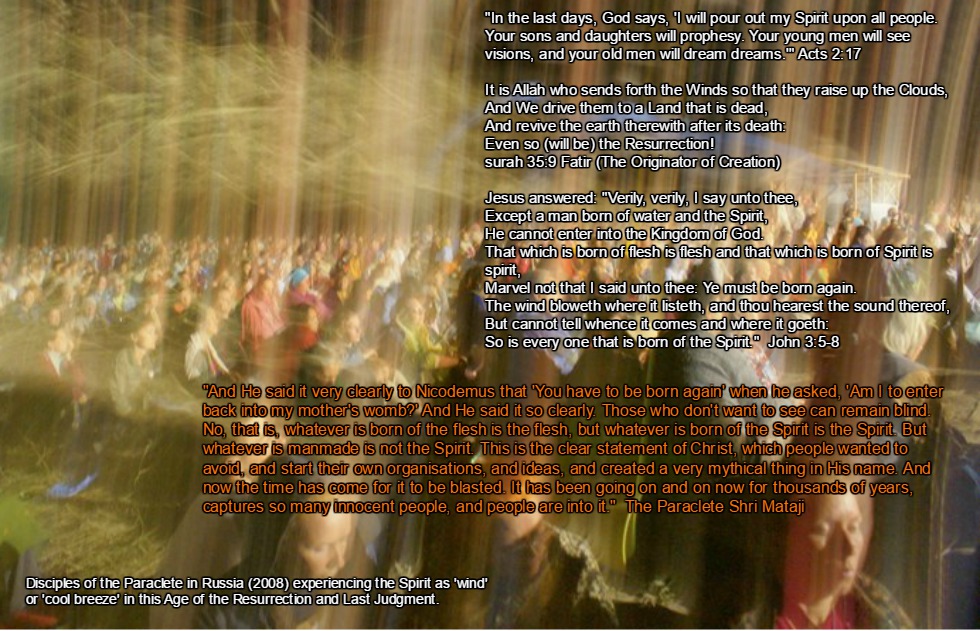
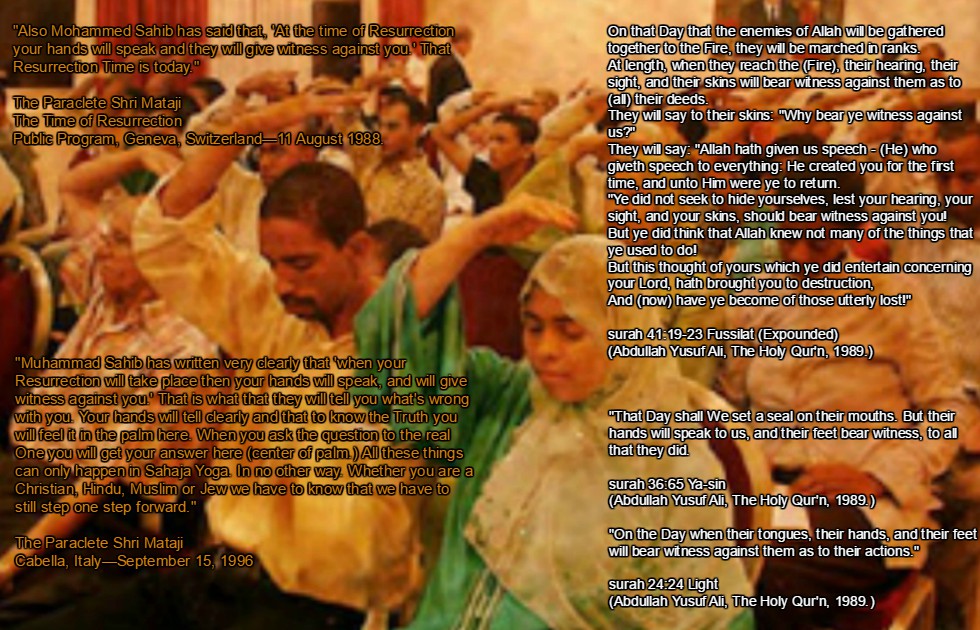
those taking part in the Resurrection (Photo
taken 1st August 2008 in Russia of Ruach
which, though invisible to the naked eye,
can be felt as Cool Breeze (pneuma, prana, qi,
Reeh al-Qiyamah) flowing from the palm of
hands, head (fontanel) and other parts of body.
(Click image for uncropped original)
"It is a widespread opinion that the Holy Spirit is the 'unknown God', the most hidden mystery within the Trinity. We place in contrast to this opinion the biblical conviction that the Holy Spirit represents the presence and reality of the salvation event in a way that can be experienced by the senses... This community of those who have themselves become bearers of the Spirit is filled with the power of God. The community bears and reflects this power, let’s it benefit others, and is itself strengthened in return.”
Michael Walker, God the Spirit
Fortress Press, 1994, pages 184-5.

Note: On 28th February 1990, while on Her way to Australia, Shri Mataji stopped at Changi Airport, Singapore. The Paraclete/Messiah/Ruh informed those who had gathered to meet Her that in Islam there is a complete surah written about Her.
The chapter in the Qur'an She is referring to is Surah 75 Al-Qiyamah (The Resurrection), explained in depth at www.al-qiyamah.org. A number of Muslim nations, unable to challenge it despite being based entirely on the Qur'an, have instead resorted to blocking the site as it not only reveals that Al Qadr (The Night of Power) precedes Al Qariah (The Day of Noise and Clamor), but also confirms the preordained Sure Signs to back this Great News. Shri Mataji Nirmala Devi has openly challenged and clearly exposed centuries of absolutely misguided Islamic dogma and conditioning regarding Al-Qiyamah, the heart and soul of Islam. Both the Divine Feminine (Ruh/Spirit) and Her incarnation, Shri Mataji, give irrefutable evidence and Sure Signs that the Resurrection is the promised Al Qadr (The Night of Power) that precedes Al Qariah (Day of Noise and Clamour). Shri Mataji has spent roughly four decades spreading the Great News (Al-Naba) by collecting, promulgating, reciting and explaining the message and means to take part in the Resurrection (Al-Qiyamah).

Shri Mataji meeting Sufis at the Nizamuddin shrine in
Delhi, India (1993) "And even in Koran, Muhammed Sahib says that all the Heavens lie at the Lotus Feet of the Mother. Among them, among Muslims there are Sufis who are realized souls and also accepted in the society.
The other day I met something in Paris, a very high person in the Islamic world and he accepted Sahaja Yoga (spontaneous salvation). He said it is described in Koran that there has to be Qiyamah, the Resurrection - we believe in Resurrection.
Also it is for Christians or Hindus, everybody, they have to be resurrected to a higher state. It is just for money and power are some people, who are trying to mislead others, keeping them away from Resurrection. I must say they are committing the greatest sin against the Holy Ghost...
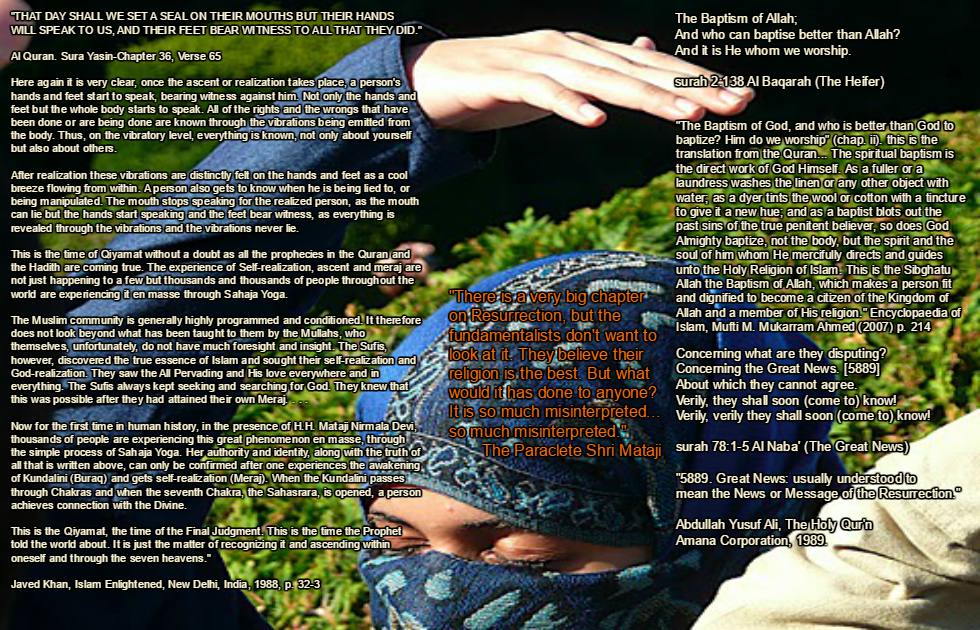
There is a very big chapter on Resurrection, but the fundamentalists don't want to look at it. They believe their religion is the best. But what good it has done to anyone? It is so much misinterpreted... so much misinterpreted."
The Paraclete Shri Mataji
Public Program, Brussels, Belgium—July 1, 1993
"But the Muslims do not want to talk about Resurrection at all because they want to frighten people with the Doomsday. They don't want to talk about the Resurrection Time which is going to come, which is the intermediary time (Al Qadr: The Night of Power), because they want to use the time which will frighten people (Al Qariah: Day of Noise and Clamor) by saying that Now your Doomsday is coming! Now your Doomsday is coming!"
The Paraclete Shri Mataji
spontaneous:
1. Happening or arising without apparent external cause; self-generated.
2. Arising from a natural inclination or impulse and not from external incitement or constraint.
3. Unconstrained and unstudied in manner or behavior.
4. Growing without cultivation or human labor. (www.thefreedictionary.com)
"That you have to be born again ... all these descriptions have come to us from all the great scriptures." - The Paraclete Shri Mataji

The Paraclete Shri Mataji "That you have to be born again, that you have to be baptized, that you have to become a Pir, that you have to become a Brahmin; all these descriptions have come to us from all the great scriptures. It is very easy to say that we don’t believe in God, we don’t believe in any Incarnation, we don’t believe in Jesus, we don’t believe in any religion, we don’t believe into anything; is very easy to say. Even it is easy to say that we believe in them, we believe in God, we believe in Christ, we believe in Krishna, Rama, all that. Both things are equally the same.
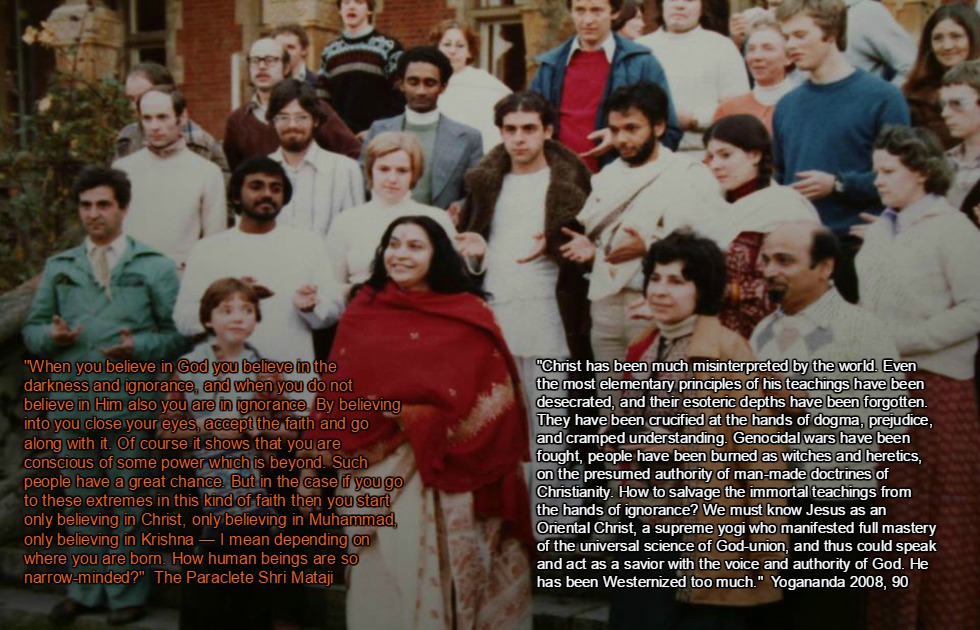
When you believe in God you believe in the darkness and ignorance, and when you do not believe in Him also you are in ignorance. By believing into you close your eyes, accept the faith and go along with it. Of course it shows that you are conscious of some Power which is beyond. Such people have a great chance. But in the case if you go to these extremes in this kind of faith then you start only believing in Christ, only believing in Muhammad, only believing in Krishna—I mean depending on where you are born. How human beings are so narrow-minded?
If you are born in England either you will be a Catholic, or a Protestant, or maybe one of these witchcraft people. You believe into anything because you are localized in a place; there has been some identifications because your mother believed into something, because your father believed into something, or you paid for it. And this faith can become such a blinding effect on people that you develop absurd types of groups which call themselves as Christians, Hindus, Muslims—whatever you may say—and are extremely, extremely exclusive, blind, and fanatic. Today one of the problems of the times, of the modern times, is fanaticism. Now this fanaticism has been growing. The more people try to get out of this fanaticism, it grows more."
The Paraclete Shri Mataji, Being Born Again
Caxton Hall, London, U.K.—May 12, 1980
"Such a lot of ignorance. That ignorance is really like a ditch of no return. I have seen people who have read books after books. There are people who do one lakh (100,000) mantras, fasting and reaching nowhere; that are the most hot tempered people, or they have no joy in their heart. They leave their families, come out of it, and think that they have done a great sacrifice. God does not want all this nonsense. Why will God who is your Father, who is so compassionate and loving personality, want you to suffer? Why should you suffer? By suffering how will you gain moksha (liberation, salvation or emancipation of soul) is beyond me ... We are killing ourselves — don’t eat food, don’t do this, do that; all the time after our lives. God has created this world for your comfort and enjoyment. Why did He create this world if you had to go through such hell?"
The Paraclete Shri Mataji
Madras, India—Jan. 17, 1994
Evidence of this promised eschatological bodily resurrection (kundalini awakening) and spiritual immortality (moksa) will be the experience of Divine Wind (Rûach, Qi, Prana, Ruh, Pneuma)

for uncropped original)
"The Kundalini rises through a very thin line of Brahmanadi. In the beginning only a hair like thing rises, it pierces through. In some people, of course, in a big way it rises also. And then it pierces this fontanel bone area which is a real baptism, real. Today only people felt the cool breeze (pneuma) coming out of their heads. Can you do that by jumping, or by paying money? They felt the cool breeze (pneuma) in the hand. It's written in the Bible, even in the Bible very clearly, that it's the cool breeze (pneuma). Cool breeze is the sign of the Holy Ghost. You start feeling the cool breeze in your hands and you start feeling the cool breeze on your head. This is the actualization.
Of course, you people don't read other books which are very good, like Adi Shankaracharya. People don't even like the mention of his name who has really and clearly said that it is the cool breeze, the chaitanya, is to be felt like cool breeze (pneuma) in the hands. They do not want that you should know the truth. And this is the truth that when you get your Realization, you have to feel the cool breeze (pneuma) in your hands yourself. You have to judge yourself. I'm not going to tell you. It is you who has to see, it is you who has to feel. And then you have to grow and you have to know all and everything - all the secrets of Divine Science. You become the master then, you are the guru.
You are the Spirit, and you should get it. It's your own which is given to you. I have nothing to do about it. I'm just a catalyst."
The Paraclete Shri Mataji
March 22, 1981—Maccabean Hall, Sydney, Australia
"Today, Sahaja Yoga (spontaneous salvation) has reached the state of Mahayoga, which is en-masse evolution manifested through it. It is this day's Yuga Dharma. It is the way the Last Judgment is taking place. Announce it to all the seekers of truth, to all the nations of the world, so that nobody misses the blessings of the Divine to achieve their meaning, their absolute, their spirit."
The Paraclete Shri Mataji
"These are the times described in the Holy Bible as the Last Judgment and in the Koran as Qiyamah—the Resurrection Time. Astrologically it also called the Age of Aquarius, the Time of Rebirth and of great spiritual development on the Earth.”
The Paraclete Shri Mataji
Just get the Cool Breeze (pneuma) activated and continue on your own
It must be made clear again that except for quotes and images of Her incarnation Shri Mataji Nirmala Devi this site is almost entirely about the Divine Feminine (Devi/Holy Spirit-Paraclete/Ruh/Tao/Aykaa Mayee/ Mother). There is no hidden agenda and this site contains all the knowledge and evidence required to re-establish the faith, belief and conviction in the Divine and the promised Resurrection to evolve into the eternal spirit - 4000 pages and counting. The mystical Kingdom of Spirit (Sahasrara) is within your being. There is thus absolutely no need for any external religious/spiritual organizations, dogmas, rituals, worship of images/ idols, or any human intermediary whatsoever.
This non-profit website—which went online exactly on 1-1-2000, the beginning of the New Millennium—is thus for the human race to examine the revelations, miracles, knowledge, truths and prophecies of the Spirit-Paraclete and Her incarnation Shri Mataji Nirmala Devi, about the Kingdom of Spirit and the Resurrection. Should they be convinced they may get their Self-realization/second birth of the Spirit (Kundalini Awakening/Second Birth/Baptism of Allah) to prepare themselves to continue life eternal in the Spirit World where all liberated souls live. The Spirit-Paraclete (Divine Mother) within assures that She will guide and liberate you from earthly existence. That is why there is absolutely no need whatsoever to join any organization. At all times it is, and will always be, an individual journey of self-salvation from within. At all times you must be your own master, with no human intermediary or influence between yourself and the Spirit-Paraclete within! No external rule, ritual or ruler! This is most important to understand.
"In the Thomas gospel, Jesus is presented as a spiritual guide whose words (when properly understood) bring eternal life (Saying 1). Readers of these sayings are advised to continue seeking until they find what will enable them to become rulers of their own lives (Saying 2) and thus to know themselves (Saying 3) and their legacy of being the children of "the living Father" (Saying 3). These goals are presented in the image of "entering the Kingdom" by the methodology of insight that goes beyond duality. (Saying 22). The Gospel of Thomas shows little or no concern for orthodox religious concepts and doctrines...
The Gospel of Thomas emphasizes direct and unmediated experience. In Thomas saying 108, Jesus says, "Whoever drinks from my mouth will become as I am; I myself shall become that person, and the hidden things will be revealed to him." Furthermore, salvation is personal and found through spiritual (psychological) introspection. In Thomas saying 70, Jesus says, "If you bring forth what is within you, what you have will save you. If you do not bring it forth, what you do not have within you will kill you." As such, this form of salvation is idiosyncratic and without literal explanation unless read from a psychological perspective related to Self vs. ego. In Thomas saying 3, Jesus says,
...the Kingdom of God is inside of you, and it is outside of you. When you come to know yourselves, then you will become known, and you will realize that it is you who are the sons of the living Father. But if you will not know yourselves, you dwell in poverty, and it is you who are that poverty." - Wikipedia (Easter Sunday April 24, 2011)
Definitions of unmediated
"1. [adj] - without the interposition of other agencies or conditions
Quotes - Example use of the word unmediated
1. unmediated relations between God and man"
www.webdictionary.co.uk
"unmediated - having no intervening persons, agents, conditions"
www.thefreedictionary.com
"not mediated : not communicated or transformed by an intervening agency"
www.merriamwebster.com
We also wish to inform that this site is continuously updated with research data, cross-referenced and linked across a broad spectrum of religious traditions and spiritual issues in a comprehensible way. This is necessary as the sheer magnitude, profound impact and pervading universality of the Divine Feminine and Her incarnation's message of the Resurrection and Last Judgment, unless presented as a completed whole of a massive and complex spiritual puzzle, may result in adverse reactions from those conditioned by centuries of scriptural half-truths, misinformation and distortion. Given the strenuous, sustained and extremely successful efforts of various religious institutions over the millennia to divide and differ over every issue imaginable, it is not an easy task. Our plea is that visitors come with an open mind to be able to venture deep into the Divine Forest in spite of the countless species of religious trees, sect saplings and atheist undergrowth marring their way. (At present there are about 4000 web-pages, covering a range of religious and spiritual topics, that can be googled.)

The Paraclete Shri Mataji "This all-pervading power is the power of divine love. It thinks, it organises, it plans, it loves. It is the one which is the subtle of the ether, you can call it. It is the subtle of the matter. It is the subtle of your emotions. It is the subtle of your mental power. It is the subtle of your evolutionary power. But all integrated and coordinated in complete synchronisation. So efficient it is that you are amazed how it works.
Now you see these flowers, how beautiful they are. And they appear on the trees or on the shrubs where they are supposed to be… At the right time these flowers become the fruits. A mango tree will give you a mango; an apple tree gives you an apple. Who does this choice? Is this great power which is all-pervading.
But we have never felt its existence. We have taken it for granted that it exists and we don’t want to know about it. We don’t want to know why we have become human beings from amoeba. What is the purpose of this life? Why nature has taken so much trouble to make us human beings? There must be some purpose for it. We never think of the purpose and we lead a purposeless life. We are not here to just live like animals.
But we have to do something much more because why should we have this human body and this human awareness? This human awareness, when it reaches a state where it starts thinking why are we here, that time you become a seeker. But you have to know that you have to become the Spirit, which is a collective being within ourselves."
The Paraclete Shri Mataji
Founex, Switzerland—June 11, 1985
"Global unity of mankind can be achieved through this awakening that can occur within each human being, so that transformation takes place within us. By this process a person becomes moral, united, integrated and balanced. One actually gets the experience of the feeling of the all-pervading divine power as cool breeze (pneuma). 'Know thyself' is the main theme of all the scriptures. It becomes evident and one reaches the absolute understanding of oneself. Thus one becomes peaceful and joyous in life. One becomes collective as a drop falling into the ocean of compassion... Moreover, it is the last breakthrough of our evolution. This is the actualization of such transformation, which is taking place now, worldwide, and has been proved and experienced by hundreds of thousands in over 85 countries."
The Paraclete Shri Mataji
We are evolving and the daily experience of Cool Breeze (Ruach, Pneuma, Prana, Reeh al-Qiyamah, Spiritus, Chi) is evidence of the spiritual evolution i.e., the Resurrection promised and backed by the Holy Scriptures! So get in touch with the truth of your being. Live consciously and mindfully. Release yourself from negative religious conditioning and regain a clearer perspective concerning the spiritual potential of humankind. Meditate on your own everlasting Self within and learn to live conscientiously in the eternal present. The Resurrection is a genuine, verifiable, spiritual rebirth promised by the Divine Feminine.
www.adi-shakti.org/ — Divine Feminine (Hinduism)
www.holyspirit-shekinah.org/ — Divine Feminine (Christianity)
www.ruach-elohim.org/ — Divine Feminine (Judaism)
www.ruh-allah.org/ — Divine Feminine (Islam)
www.tao-mother.org/ — Divine Feminine (Taoism)
www.prajnaaparamita.org/ — Divine Feminine (Buddhism)
www.aykaa-mayee.org/ — Divine Feminine (Sikhism)
www.great-spirit-mother.org/ — Divine Feminine (Native Traditions)
"Now the name Nirmala itself means immaculate; means the one who is the cleansing power and the name of the Goddess also. My actual sign name is Lalita who is the name of the Primordial Mother. That is the name of the Primordial Mother."
The Paraclete, New York, USA—30 September 1981
"I'm the Holy Ghost" (New York, 30.09.81)
(The DCB, vol.XV, issue 9&10, September-October, 2003)

The Paraclete Shri Mataji Shri Mataji Astrology Chart
Nirmala Yoga Magazine, Jan-Feb 1981
"MATAJI was born at Nagpur at 12.09 p.m., I.S.T. (noon time) on 21st March 1923. At this moment, taking into consideration the local time of Nagpur, the Sun was exactly on the Meridian in full glory, and being in the zero degree of Aries or the 30th degree of Pisces, the Sun in that position made a Rajayoga (i.e. an aspect for leadership and prominence in life), which has endowed her with the Sun's glamour and power.
Her rising sign is Cancer and the Ascendent is in the 8th degree. The Ascendant in Cancer makes her a Mother of the Universe, a Jaganmata, as the Ascendant is strongly aspected by five planets, Jupiter, Mercury, Uranus, Mars and the Moon, while it is occupied by Pluto, which itself forms grand trines with three of the five planets and sextiles with the other two. Her spiritual powers arise mainly from this combination of aspects in the angles of the chart, also, the position of the planet of spiritual life viz. Neptune in the second house indicates that her wealth accumulation is spiritual. It is interesting to note that the current position of Neptune in the transit is near the cusp of the sixth house. This shows that her main work in the years to come will be solely in this field.
The Lord of the Ascendant Moon, is exalted in Taurus strongly posited in the 11th house, conjunct Mars, which is Lakshmi-Yoga and invest her with divinity. She is thus the incarnation of Mahalaxmi. She is destined to live richly like a Goddess. Her aristocratic origin is further indicated by the exalted Saturn in the 4th house, who being the lord of the 7th house (Capricorn) has brought her into matrimonial union with an eminent official. This same Saturn makes for vairagya, i.e. distaste for worldly life and renunciation.
Jupiter strongly aspected in the 5th house, makes her a Mother- Teacher and as he is trined by three powerful planets and squared by two and opposed by two, Mataji will have a most eventful life as a World Teacher. It will all bring a great renown, an enormous following all over the world, a lot of conflict with evil.
Saturn, strong in the 4th house, gives much longevity, great distinction towards the end of life, a lot of power both spiritual and temporal, although it inclines her to some solitude also in old age.
International fame is indicated by the presence of a strong Uranus in the 9th house, trined by Jupiter, Pluto and sextiled by Mars and Moon. Also, the Mercury-Uranus conjunction gives Mataji great eloquence and invincibility as a debater.
The T-square formations between Moon, Mars, Venus, Jupiter, and Neptune indicate that some of the plans of Mataji might be hindered by obstructive activities of evil and negative forces. Also Mataji might have to steer through conflicting loyalties and aims of some of her so-called followers who are enemies in disguise. But despite all this, she will find her way to the goal of her life, viz., universal Self-Realisation!
Altogether, a great and powerful chart of a truly Divine personality."
Nirmala Yoga Magazine - Jan-Feb 1981
Disclaimer: Our material may be copied, printed and distributed by referring to this site. This site also contains copyrighted material the use of which has not always been specifically authorized by the copyright owner. We are making such material available to our readers under the education and research provisions of "fair use" in an effort to advance freedom of inquiry for a better understanding of religious, spiritual and inter-faith issues. The material on this site is distributed without profit. If you wish to use copyrighted material for purposes other than "fair use" you must request permission from the copyright owner.(Updated May 16, 2012)