
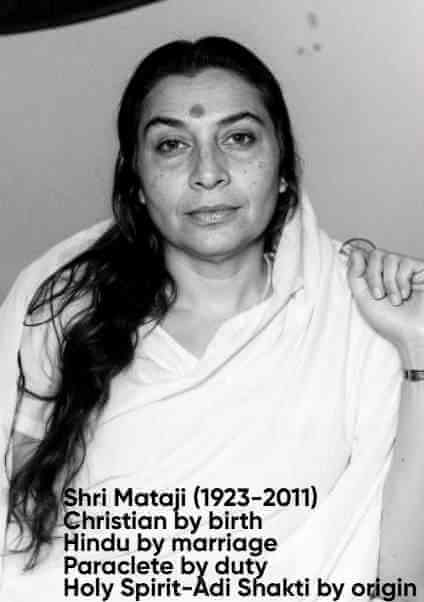
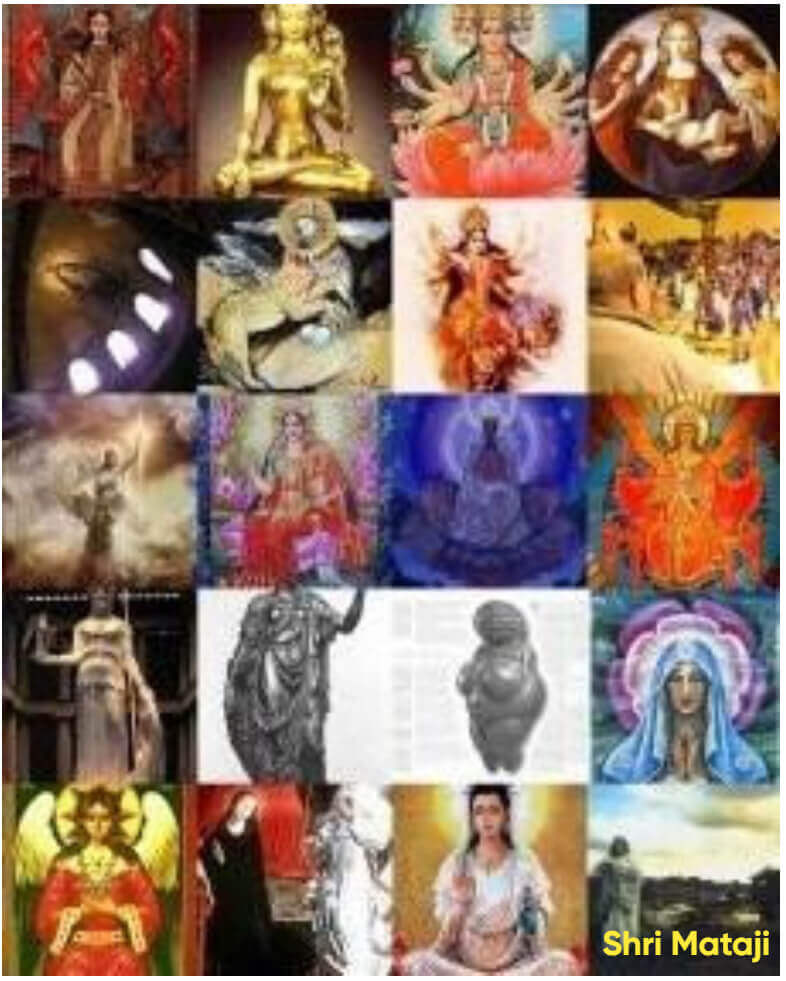
Achieve your Self, become your Self.... That's the only way you can get rid of your confusions.
In this profound 2007 talk, Shri Mataji Nirmala Devi reveals that Self-realization is the only path to dissolve confusion and attain spiritual clarity. Through Kundalini awakening, seekers transcend ego and become one with the Divine. Her words echo the eternal truth of Advaita: that we must become the Ocean itself. This paper contends that Shri Mataji Nirmala Devi's injunction to "Achieve your Self, become your Self" is a modern articulation of the Advaita Vedanta principle that liberation arises from realizing the Self (Atman) as one with ultimate reality (Brahman). It examines her critique of external religious institutions and argues that her teachings outline a direct, experiential path to this realization through Kundalini awakening. The paper concludes that this process is presented as the definitive solution to the confusion engendered by the ego and external dogma.
But today the time has come where thousands can get their realization and can be established because the Last Judgment has started. The Last Judgment is going to be through Kundalini awakening, as if Kundalini is the pointer in the balance. It has started! People are not aware it has started! They do not want to be judged as yet, but time should not be lost.It argues that this statement encapsulates a profound spiritual teaching rooted in the non-dualistic tradition of Advaita Vedanta, which posits the divine nature of the eternal, internal Self (Atman) and its identity with the ultimate reality (Brahman). The paper analyzes Shri Mataji's assertion that this Self is to be found within, never in external, man-made religious structures like temples, churches, or mosques. Through an examination of her teachings and a comparative analysis with other mystical traditions, this paper will demonstrate that Shri Mataji's message emphasizes a direct, experiential path to liberation through the awakening of the inner divine energy, Kundalini, thereby transcending the confusion and limitations of the ego and external dogma.But this Judgment is so beautiful that when you are judged you get powers of your own, of your love; you enjoy the bliss of your Spirit; you become so peaceful, all the tensions disappear; you become so dynamic and the blessings of all the well-beings come on you. As Krishna has said "Yogakshema." First the yoga then the kshema. Kshema is well-being. If you have not achieved your yoga the kshema is not bothered.
People say I am preaching Advaita of Shankaracharya. Of course, it is the same, whether it is Shri Sankaracharya or anybody. I am doing that. Only he was preaching, I am doing it.
What Christ said, what Krishna said, and what Muhammad said is nothing but Advaita, that "you have to become One with God."
But there are many who do not like it, they want to have dvaita, they want to keep their personalities, so-called, with them. I asked the other day one gentleman who was a minister and all that. I said "What do you want to keep that? What, which part?" He said "Not my ego." I said "What is it then? It is that only. You want to keep back your ego."
Unless and until you become big you cannot evolve. And how do you become big?—by becoming the Ocean yourself. A small drop becomes an ocean, as long as he becomes One with the Ocean. You become One with the awareness of God. This is what Christ has said, "You have to be born again." Is said by everyone. Moses has said it, everyone has said it but people are telling you "No, no, no, no. That should not be done" because these middle agencies will be losing their income. How will they exist without it?
Try to see these points. Achieve your own powers of Love; achieve your Self, become your Self. If you want it you can have it, but if you don't want nobody can force this. Nobody can take away your freedom. If you want to remain as you are, you are left with that; then you face it up and live with it.
But if you want the ultimate, the absolute, it is there. That's the only way you can get rid of your confusions and get rid of all your ideas of relative existence—political, economic and everything can be only dissolved through achievement of your absolute. Because after realization you can feel, you can ask any absolute question. For example, if you want to ask the question "Is there God?", immediately the cool breeze starts coming out. Tremendous! The answer comes as if like a computer you start working out because you are put to the mains.
So it is necessary for the whole humanity to pay attention today because the time is coming when the sorting out will take place. That time nobody is going to persuade, or tell you and fill the halls and request you. The sorting out will be there. Better get it now and establish it. Whole humanity has to be saved. No use doing patchwork. Do something substantial. Substantial is only possible if you go to the roots of this Tree of Life and nourish it, enlighten it. That is the only way one can work it out. May God bless you all.
Achieving the Self: An Analysis of Shri Mataji Nirmala Devi's Declaration on Internal Divinity
Abstract
This paper examines the declaration of Shri Mataji Nirmala Devi: "Achieve your Self, become your Self.... That's the only way you can get rid of your confusions.
Table of Contents
1. Introduction
The spiritual landscape is replete with diverse paths and philosophies, yet a common thread running through many mystical traditions is the emphasis on an inward journey toward self-discovery and divine realization. Shri Mataji Nirmala Devi, a prominent spiritual teacher of the 20th and 21st centuries, articulated this principle with profound simplicity in her declaration: "Achieve your Self, become your Self.... That's the only way you can get rid of your confusions.[1] This statement serves as the cornerstone of her teachings, which advocate for a direct, experiential path to spiritual enlightenment by awakening the divine potential within each individual. This paper will explore the depth of this declaration, focusing on the central tenet that the Self—the eternal, divine soul—is an internal reality, not to be sought in any external, man-made institution of worship.
Shri Mataji's teachings are deeply rooted in the Indian philosophical tradition of Advaita Vedanta, which posits the non-dualistic identity of the individual Self (Atman) and the ultimate reality (Brahman). This paper will demonstrate how her message represents a practical application of this ancient wisdom, making it accessible to a modern global audience. Furthermore, it will analyze her unequivocal rejection of external religious structures—temples, churches, mosques, and the like—as ineffectual in the quest for true self-realization. By examining her lectures and comparing her teachings with those of other spiritual luminaries and traditions, this paper will argue that Shri Mataji presents a radical yet timeless message: the divine is not an external entity to be worshipped, but an internal reality to be experienced through the awakening of the dormant spiritual energy known as Kundalini.
2. The Internal Self in Advaita Vedanta
The philosophical foundation of Shri Mataji's teachings on the Self can be traced to Advaita Vedanta, one of the most influential schools of Indian philosophy. The central tenet of Advaita, as systematized by the 8th-century philosopher Adi Shankaracharya, is the principle of non-duality. According to this view, the individual soul or Self (Atman) is not distinct from the ultimate, all-pervading reality, known as Brahman. The Stanford Encyclopedia of Philosophy explains that Advaitins "seek to establish that the essential core of one's self (atman) is brahman. The fundamental thrust of Advaita Vedanta is that the atman is pure non-intentional consciousness. It is one without a second, nondual, infinite existence, and numerically identical with brahman."[2]
Shri Mataji explicitly aligns her teachings with this tradition, stating, "People say I am preaching Advaita of Shankaracharya. Of course, it is the same... I am doing that. Only he was preaching, I am doing it."[1] This distinction between "preaching" and "doing" is crucial. While Shankaracharya provided the philosophical framework for understanding non-duality, Shri Mataji emphasizes the experiential realization of this truth. She asserts that this is not merely an intellectual concept but a tangible reality that can be accessed through a process she calls Self-realization. This is the moment when the individual transcends the illusion of a separate self, or ego, and experiences their true nature as the universal Spirit.
"Unless and until you become big you cannot evolve. And how do you become big?—by becoming the Ocean yourself. A small drop becomes an ocean, as long as he becomes One with the Ocean. You become One with the awareness of God."[1]
This metaphor of the drop becoming the ocean vividly illustrates the Advaitic concept of the individual Self merging with the universal Self. The confusion and limitations that characterize ordinary human existence are, in this view, a product of ignorance (avidya)—the mistaken identification with the body, mind, and ego. To "achieve your Self" is to dispel this ignorance and awaken to the reality of one's own divinity. This is not an act of becoming something new, but of realizing what one has always been. As Professor Harish C. Gaur explains, drawing from the Upanishads, "Any one who knows the supreme Brahman becomes Brahman indeed... Because Jiva becomes Brahman, its identity was real, the ignorance having been destroyed by knowledge leaving only Brahman."[3]
3. Rejection of External Forms of Worship
A central and uncompromising aspect of Shri Mataji's teaching is the assertion that the divine Self cannot be found in any external, man-made structure or through ritualistic practices. This represents a direct challenge to the conventional religious paradigm, which often relies on intermediaries, institutions, and idols as focal points for worship. Shri Mataji argues that such external forms are not only ineffective but can be detrimental to the spiritual search, as they distract the seeker from the true, internal source of divinity.
"The ultimate act against the Spirit is to worship that which has no Spirit — gross matter... The Atma and its expression is the sole Reality in the Universe. Identification with anything else causes the heart to 'catch.'"[4]
This statement highlights the fundamental error, from her perspective, of directing one's devotion towards lifeless objects or concepts. This includes not only idols and statues but also the rigid dogmas and institutions that have been built around them. She contends that these "middle agencies" have a vested interest in maintaining their position between the seeker and the divine, often for material gain, thereby obstructing the path to genuine self-realization.
"This is what Christ has said, 'You have to be born again.' Is said by everyone. Moses has said it, everyone has said it but people are telling you 'No, no, no, no. That should not be done' because these middle agencies will be losing their income. How will they exist without it?"[1]
This teaching is not unique to Shri Mataji but echoes a long-standing mystical tradition that critiques external religiosity. The ancient Vedic scriptures themselves contain passages that warn against the worship of created things. The Yajurveda, for instance, states, "They enter darkness, those who worship natural things... And they sink deeper in darkness those who worship sambhuti (created things, for example table, chair, idol etc.)."[4] Similarly, the Sikh Gurus, particularly Guru Nanak, vehemently rejected idol worship. The Guru Granth Sahib proclaims, "The Hindus have forgotten the Primal Lord and are going the wrong way. As Narad instructed so worship they idols. They are blind, dumb and the blindest of the blind. The ignorant fools take stones and worship them. Those stones when they themselves sink, how shall they ferry thee across?"[4] This perspective underscores the futility of seeking salvation from inanimate objects when the true, living Lord resides within.
By situating the divine within the human being, Shri Mataji democratizes spirituality, removing the need for external authority or sanction. The temple, the church, the mosque—these are not the dwelling places of God, but rather the human heart is the true tabernacle. The path to God is not a pilgrimage to a holy site, but an inward journey to the core of one's own being.
4. Kundalini Awakening as the Path to Self-Realization
If the Self is an internal, divine reality, the question then arises: how does one "achieve" or "become" this Self? For Shri Mataji, the answer lies in the awakening of a dormant spiritual energy within every human being, known as the Kundalini. She describes this energy as the "projection of the power of God, of His desire which is the Primordial Mother, or you can call it Adi Shakti, Holy Ghost or Athena."[1] This divine feminine energy is believed to reside at the base of the spine in the sacrum bone. Its awakening and ascent through the central channel of the subtle system, piercing the six chakras (energy centers) above it, culminates in the union of the individual consciousness with the universal consciousness at the crown chakra. This is the state of Self-realization, or Yoga.
"But this Judgment is so beautiful that when you are judged you get powers of your own, of your love; you enjoy the bliss of your Spirit; you become so peaceful, all the tensions disappear; you become so dynamic and the blessings of all the well-beings come on you. As Krishna has said 'Yogakshema.' First the yoga then the kshema. Kshema is well-being. If you have not achieved your yoga the kshema is not bothered."[1]
Shri Mataji's unique contribution to this ancient spiritual science was her development of a method for spontaneous, en-masse Kundalini awakening, which she called Sahaja Yoga (meaning "spontaneous union"). Unlike traditional yogic paths that often required years of arduous practice, austerities, and the guidance of a guru, Sahaja Yoga offers a simple, accessible method for anyone to experience their Self-realization. This is the "doing" that she referred to in contrast to the "preaching" of Shankaracharya. The awakening of the Kundalini is not a mere concept but a tangible experience, often felt as a cool breeze on the palms of the hands and above the head, which is the manifestation of the all-pervading power of divine love.
This direct experience of the Self is what dispels the "confusions" that Shri Mataji speaks of. The confusion arises from the identification with the ego and the external world, with its dualities and conflicts. When the Kundalini is awakened, the individual's attention is drawn inward, away from the turmoil of the mind and emotions, to the silent, blissful awareness of the Spirit. In this state, one becomes a witness to the play of life, detached from the anxieties and desires that once held sway. This inner transformation is the true meaning of liberation (moksha), a state of freedom and joy that is not dependent on any external circumstances.
5. Comparative Analysis with Other Spiritual Traditions
The emphasis on an internal, divine Self and the critique of external religious formalism are not exclusive to the traditions of Advaita Vedanta and Sahaja Yoga. These themes resonate across a wide spectrum of mystical teachings, suggesting a universal spiritual truth that transcends cultural and religious boundaries. By examining these parallels, we can better appreciate the context and significance of Shri Mataji's declaration.
In Christianity, the words of Jesus Christ as recorded in the Gospel of Luke, "The kingdom of God is within you" (Luke 17:21), provide a powerful parallel. While interpretations of this verse vary, many mystical and esoteric Christian traditions have understood it as pointing to an inner, divine reality. Jesus' frequent critiques of the Pharisees for their focus on external piety and ritual while neglecting the inner state of the heart further align with Shri Mataji's rejection of externalism. The concept of being "born again" (John 3:3) can also be seen as a metaphor for the spiritual transformation that occurs when one awakens to this inner divinity, a concept Shri Mataji directly references.
In the mystical tradition of Islam, Sufism, the poetry of Rumi eloquently expresses the same sentiment: "I looked in temples, churches, and mosques. But I found the Divine within my heart."[5] Sufis seek a direct, personal experience of God through practices like meditation and the purification of the heart (Qalb). The goal is to annihilate the ego (nafs) and achieve union with the Divine, a state of being that is found not in any physical location but in the depths of one's own soul.
In Sikhism, as previously mentioned, Guru Nanak's teachings represent a radical departure from the ritualistic and idolatrous practices of his time. He emphasized the oneness of God and the importance of a direct, personal relationship with the Divine, unmediated by priests or idols. The Sikh concept of God as an all-pervading, formless reality (Nirankar) that can be realized through meditation and righteous living aligns closely with the idea of an internal, universal Self.
Finally, in Buddhism, the doctrine of Buddha-nature (Tathagatagarbha) posits that all sentient beings possess the innate potential for enlightenment. This "Buddha within" is not an external entity to be worshipped, but the inherent purity and wisdom of the mind that is obscured by ignorance and defilements. The path to liberation, therefore, is not one of acquiring something new, but of uncovering the radiant, awakened nature that has always been present within.
This comparative analysis reveals a remarkable convergence of mystical thought on the internal nature of the divine. While the language and methods may differ, the core message remains consistent: the ultimate spiritual quest is an inward journey to discover the divine spark that resides within every human being. Shri Mataji's teachings, therefore, can be seen as a modern-day expression of this perennial philosophy, offering a practical and accessible means for individuals to experience this universal truth for themselves.
6. Conclusion
Shri Mataji Nirmala Devi's declaration, "Achieve your Self, become your Self.... That's the only way you can get rid of your confusions, is a powerful and profound call to an inward spiritual journey. This paper has argued that her message is deeply rooted in the non-dualistic philosophy of Advaita Vedanta, which posits the identity of the individual Self with the universal Divine. By asserting that this Self is to be found within, and not in any external religious institution, Shri Mataji challenges the conventional paradigms of worship and offers a direct, experiential path to liberation.
The rejection of external forms of worship—temples, churches, mosques, and the rituals associated with them—is not a nihilistic denial of the sacred, but a radical affirmation of the sanctity of the individual. It is a call to shift the focus of devotion from the created to the creator, from the lifeless idol to the living Spirit that resides within the human heart. This message, while challenging to established religious structures, finds resonance in the mystical traditions of Christianity, Sufism, Sikhism, and Buddhism, all of which, in their esoteric core, point to an internal, divine reality.
The mechanism for this inner transformation, according to Shri Mataji, is the awakening of the Kundalini, the divine feminine energy that lies dormant within every human being. Through the practice of Sahaja Yoga, she has made this once-esoteric science accessible to people of all backgrounds, offering a tangible experience of Self-realization and a means to transcend the confusion and anxieties of the ego-driven world. The experience of the cool breeze, the tangible sign of the awakened Kundalini, serves as empirical evidence of the divine within, moving the spiritual quest from the realm of belief to the realm of direct perception.
In a world fraught with conflict and division, often fueled by religious dogma and external identities, Shri Mataji's message of an internal, universal divinity offers a path toward unity and peace. By achieving the Self, one transcends the narrow confines of creed and culture and awakens to the fundamental oneness of all existence. The ultimate truth, as she so powerfully articulates, is not a doctrine to be believed, but a reality to be experienced. It is in the silent depths of our own being that we find the end of confusion and the beginning of true freedom.
7. References
[1] Shri Mataji Nirmala Devi. "Achieve your Self, become your Self.... That's the only way you can get rid of your confusions. adishakti.org, 30 Sept. 2007[2] Dalal, Neil. "Sa?kara." The Stanford Encyclopedia of Philosophy, edited by Edward N. Zalta, Metaphysics Research Lab, Stanford University, 2021
[3] Gaur, Harish C. "Nature of Brahman: The Supreme Self." adishakti.orgAccessed 15 Oct. 2025.
[4] Shri Mataji Nirmala Devi. "The ultimate act against the Spirit is to worship that which has no Spirit." adishakti.org, 29 Feb. 2008
[5] Rumi. Quoted in "I looked in temples, churches, and mosques..." Facebook, 2019
Nature of Brahman: The Supreme Self
By Prof. Harish C. Gaur
About the importance of knowing Brahman, Yajnavalkya said—-"In this world, one without knowing the imperishable, may offer oblations into fire, perform sacrifices, practice austerities for thousands of years (but still) find all such acts unproductive (of result). Also, whoever departs from this world (meets death) without knowing the imperishable, is miserable, but he who departs after knowing, that as a knower of Brahman (Brahmavit), attains to Brahman.”
But how does one know, if It exists? It is said that just as"Oil exists in sesame seeds, butter in milk, water in (underground) rivers, fire in (Arani) woods, yet is not apparent. But one can obtain oil by compressing the sesame seeds, butter by converting the milk into curd and churning, water by digging the wells and fire by rubbing together two pieces of dry wood. Likewise, Self is realized as the Self (within) when one looks for it by truthfulness, observing austerity" (Svet. Up. I. 15-16).
It is emphasized that only the purified Antahkarana of a being is capable of 'revealing' the self by reflection (Abhasa) like the sun reflected in a (clean) mirror or in (still and clean) water. But if polluted by blemishes as attachment arising from contact of senses with respective objects and possessed of desire, anger, pride, greed, envy etc., it becomes non-transparent like a stained mirror or disturbed/polluted water in a lake and does not enable reality of the Self to be revealed even though it is so near.
Also, Supreme Self is not attained by (revealed to) one bereft of vigor (weak spirit), to one possessed of ignorance (from constant adherence to body as Self ), delusion (caused by attachment to mundane things) or from improper practice of austerities etc. The self of the enlightened (possessed of knowledge) who strives with diligence and possessed of proper means attains to union with (enters the abode that is) Brahman (Mund. Up. III. 2.4). In yet another context, Lord Yama told Nachiketa—-"One who has not desisted from activities prohibited (not sanctioned by scriptures), whose senses are not under control, whose mind may not be concentrated and is not free from anxiety (about the result of concentration) cannot attain to the Self (even) through knowledge" (Kath. Up. 1. 2. 24).
The favorable condition for the intellect is purity and transparency like a cleaned mirror or clean and still water. Thus, possessed of purified intellect (Antahkarana) freed from all desires and by prolonged and uninterrupted practices that lead to divine traits (also, subjugating non-divine traits), with control of mind and senses, one realizes the individual self through meditation (thinking of it alone) with concentrated mind, by a control of Prana repeating 'So' while inhaling and 'ham' while exhaling; Soham (I am He) being a reminder of oneness of the self with Brahman (Brihad. Up. I. 4. 1). Also it is emphasized that 'self' alone should be realized (Brihad. Up. I. 4.7). In the purified intellect, Self is said to reveal its true nature. About the necessity of freeing one's self from desires it was said—-"When all desires clinging to one's heart fall off, then a mortal becomes immortal and he attains to Brahman here (meaning in this life) (Kath. Up. II. 3.14). The cessation of bondage from desires is like blowing out a lamp. He attains to Brahman.
Realization of Self is facilitated by association with and the guidance of a qualified teacher (Guru), who besides being a knower of Brahman (Brahmavit), should have realized Brahman. The realization is accomplished in several stages by understanding the true significance of Sruti Mahavakya as 'yam Atma Brahma' (this individual self is the Supreme Self, Brahman) (Brihad. Up. II. 5. 19), 'Tattawamasi' (Thou art That, Brahman), (Ch. Up. VI. 8.7), culminating in 'ham Brahmasmi' (I am Brahman) (Brihad. Up. I. 4.10). The man without desire, has no Karma and therefore no cause to go through yet another birth, his organs such as of speech etc., do not depart (with the subtle body). He is undifferentiated from the Supreme Self. It is said—-"Any one who knows the supreme Brahman becomes Brahman indeed" (Mund. Up. III. 2. 9). It is clarified that if the difference was real, Jiva could not become Brahman Itself. Knowledge. may destroy ignorance but not what is real. Because Jiva becomes Brahman, its identity was real, the ignorance having been destroyed by knowledge leaving only Brahman.
When one awakens up from deep (dreamless) sleep (Sushupti), he says he was not conscious of anything, meaning he did not know or was ignorant, but he did experience the bliss with no worries or pain. This is a momentary experience of oneness of individual self with the Supreme Self, albeit in ignorance. In present day medical practices, this bliss (freedom from pain) is artificially created when the body is unable to bear pain as during and after surgery. By administering anesthetic agents with sedative influence, the patient is induced to deep-sleep and unconsciousness, oblivious of the pain the body is undergoing. Realization of the Supreme Self is the attainment of that bliss while one is conscious (as in Samadhi) and without the adjunct of ignorance. This is realization of the Supreme Self by the self.
Nature of Brahman: The Supreme Self
By Prof. Harish C. Gaur
“The Self is the Spirit. This Spirit resides in the heart of every human being and is in a witness-like state. The Spirit is the projection of God Almighty, while the Kundalini is the projection of the power of God, of His desire which is the Primordial Mother, or you can call it Adi Shakti, Holy Ghost or Athena. So the Kundalini is the projection of the Holy Ghost, while the Spirit is the projection of God Almighty. The All-pervading Power of love is the power of the Primordial Mother, which creates and evolves, and does all the living work.”- Shri Mataji Nirmal Devi
Question: How does one discard all the organization and useless activities (of Sahaja Yoga) and seek her (Holy Spirit/Adi Shakti) only in the Sahastrara (Kingdom of God)?
Answer: Silence on Self
Question: I am still unable to rid myself of catches and other chakra problems despite years of daily (Sahaja Yoga) footsoaking and treatments. What do I do now?
Answer: Silence on Self
Question: I am far from a Sahaja Yoga collective. How do I continue practicing Sahaja Yoga?
Answer: Silence on Self
Question: My collective leader has told me to leave Sahaja Yoga due to some personal problems. What do I do now?
Answer: Silence on Self
Question: Despite being years in Sahaja Yoga I do not agree with what our leaders are doing. I am thinking of leaving my collective. Can you suggest something that will help me continue on my own?
Answer: Silence on Self
Question: I am a Muslim who absolutely am against worshipping of any idol or image. How then is Sahaja Yoga and Shri Mataji compatible with Islam?
Answer: Silence on Self
Question: We are devout Christians who are very uncomfortable with Hindu rituals, and see the same in Sahaja Yoga. Is there any way we can do without such rituals?
Answer: Silence on Self
Question: You loudly claim on your website that all religions and holy scriptures preach the same message. I don't see such evidence. What have you got to say?
Answer: Silence on Self
Question: I do not want to meditate on anything non-Christian but agree that the Holy Spirit is feminine. How do I only worship the Holy Spirit but not the Adi Shakti?
Answer: Silence on Self
Question: My parents and husband are against worshipping Shri Mataji. How can I solve this serious family problem but still continue to practice Sahaja Yoga without their knowledge?
Answer: Silence on Self
Question: I completely agree with your belief that if you have to take a single step in any direction to seek the Divine you are going the wrong way. How and why did you reach this incredible conclusion only now despite spending so many years meditating, checking the scriptures and listening to Shri Mataji's speeches?
Answer: Silence on Self
Question: How can we spread Shri Mataji's message successfully? So many have failed all these years and Sahaja Yoga is very slow. Most of the seekers have never heard of Shri Mataji. Other than Her Divine Message what can we teach new seekers that will attract them?
Answer: Silence on Self
Question: I do not want to follow any religious organization or yoga teacher but still am interested in spirituality. You think that is possible?
Answer: Silence on Self
Question: My mother-in-law is totally against Shri Mataji and regards Her as just another false guru. But I know Shri Mataji is the Adi Shakti and want to continue. However, i do not want to antagonize my mother-in-law. Any suggestions?
Answer: Silence on Self
Question: I am a Sikh. I am completely against any Hindu ritual or worshipping of their idols and gods. Sikhism is completely against such practices. But Sahaja Yoga is also so full of such rituals and gods. What have you got to say, being a Sikh yourself?
Answer: Silence on Self
Question: I am getting somewhat ridiculed for my own spiritual experiences regarding the crown chakra and the divine feminine. People think I'm weird by emphasizing that the Devi is the true nature of brahman and it is creating doubt about my path (despite my own experiences). Should I continue with my meditations and ignore them or try to explain to them? What do you suggest?
Answer: Silence on Self
Question: There is so much information about yoga and meditation. I am so confused and do not know which path to take. What then is the truth? How do I attain it?
Answer: Silence on Self
Question: I have been in Sahaja Yoga for years but still do not know what is Self-realization. Can you tell me in detail what you understand by it?
Answer: Silence on Self
Question: I have been a SY for many years and some of us find shoe- beating and some rituals quite absurd. You also are against them. How then can we solve our subtle system problems without such treatments?
Answer: Silence on Self
Question: I am a Muslim living in Pakistan who want to practice Sahaja Yoga. But there are no centers here. How can I continue?
Answer: Silence on Self
Question: What will happen after Shri Mataji passes away? Will She still be in the photograph? Where will the vibrations come from then?
Answer: Silence on Self
Question: I have just started meditating on Shri Mataji in the Sahasrara but find it very difficult. Is there a better way?
Answer: Silence on Self
Question: I do not want to join Sahaja Yoga but believe in a number of Shri Mataji's teachings. Can you help me?
Answer: Silence on Self
Question: I am an established SYogini who am concerned at the way the organization is heading. However, I still want to spread Shri Mataji's teachings. What do you suggest I tell others?
Answer: Silence on Self
Question: I want to practice meditation but find it impossible to stop the thoughts. I value you opinion. If you don't mind my asking, but how do you do it?
Answer: Silence on Self
Question: What is the shortest and surest route to realize God?
Answer: Silence on Self
Question: Some religions claim that humans are divine in nature and that liberation is from within. Can you tell me how all this is realized in such a hectic and materialistic world?
Answer: Silence on Self
Question: As a SY I am concerned that after Shri Mataji takes Mahasamadhi there will great grief and sense of loss. How can I cope with this eventuality and continue my faith and devotion? Do I continue to meditate on Her photo even though She is not physically present anymore?
Answer: Silence on Self
Question: Jagbir, you are already telling us to discard Shri Mataji's photo and meditate on Her is the Sahasrara. A number of SYs have been offended by this and have left the forum. What makes you so sure you are right?
Answer: Silence on Self
Question: What is the most profound and deepest enlightenment you have discovered after all these years, based on the teachings of Shri Mataji? She also claims that all religions teach the same truth about the spirit. How is that so given all the religious differences and centuries-old rivalry?
Answer: Silence on Self
Question: Hi, man-made religions, sects and denominations are wide spread. So much misdeeds and divisions are committed and blood is shed in the name of God and religion. Is there a way to make humans realize that they are all worshipping the One and same Creator, no matter how different religious organizations have made God to be?
Answer: Silence on Self
Question: It seems that religions are all preaching about a God that is to be found only in their organizations. Why then is it that the Divine can only be realized through one's own experience? What and where is God then?
Answer: Silence on Self
Articles based on Shri Mataji quotes:
“A day will dawn when whole world would bow to this ..."“A great war is taking place between satanic forces and ..."
“About Sahasrara nowhere in the scriptures something ..."
“Achieve your Self, become your Self"
“After all we are all human beings created by one God"
“All the people laugh at us, nobody believes us.”
“All these rituals have entered into Sahaja Yoga.”
“Among Muslims there are Sufis... who are realized souls"
“And now the time has come for it to be blasted.
“Announce it to all the seekers of truth, to all the nations.”
“Anyone can commit any sins in the name of religion.”
“But if you put one little fish and two eggs for ten people"
“But Muslims do not want to talk about Resurrection at all"
“But this Judgment is so beautiful ... you enjoy the bliss ..."
“But you know that you have eternal life. You can never die.”
“Death does not exist for you — It is finished... your spirit ...”
“Do not destroy your spirit by going to such people.”
“Every religion has said you have to have Self-realization"
“For all people whom I gave Self Realization yesterday"
“He (Jesus) was the Holiest of the Holy. You accept that ....”
“I don't care for your protocols and rituals. It is nonsense ...”
“I have to warn all SYs Sahaja Yoga is the Last Judgment"
“I must say they are committing the greatest sin ...”
“I was with Him (Guru Nanak Ji), in fact with all of Them.”- 1
“I was with Him (Guru Nanak Ji), in fact with all of Them.”- 2
.”... if you see around the world is in chaos"
“Indians have no goal as far as spiritual life is concerned"
“It is the greatest event of all spiritual happenings of ....”
“It means the Last Judgment has begun with full force"
“It will be slowly revealed by Me because ...”
“Like all the thieves of the world ... have taken over.”
“Meditation is not to sit before the photograph"
“My actual sign name is Lalita ... name of the Primordial ..."
“Nobody has to change dresses or anything nothing outside.”
“Now watch. I will change the direction of the waves.”
“No reality in those religions...no Divine Force working"
“Pure knowledge is not of chakras, vibrations, kundalini ..."
“Self-Realization will progressively lead to the creation of ..."
“Some are money-oriented ... some are violent"
“Tell Jagbir now to leave it to Her.”
“That's not the way it (Al-Qiyamah) is going to work out.'"
“The expression of Adi Shakti within you is the Kundalini.”
“Christianity has nothing to do with Christ.”
“The time has come for you to get all that is promised"
“The ultimate act against Spirit is to worship that which ..."
“The whole Cosmos is waiting for their arrival.”
“They are stagnated at the point of dharma, so they start ...”
“There is so much blind faith, ... so much of wrong ideas"
“They came to Sahaja but they said "We cannot worship ...”
“They made Christ look like a TB patient"
“You have to enter into the Kingdom of God"
“Your job is, in a way, greater than the saints and sages.”